In-House IT vs. Co-Managed IT for Electronics Manufacturers
In-house IT gives electronics manufacturers direct control and institutional knowledge of production systems. Co-managed IT keeps that internal expertise while adding 24/7 monitoring, cybersecurity depth, compliance support, and after-hours coverage that a 1-3 person internal team can't sustain alone. For most electronics manufacturers with 50-1,000+ employees, the right answer isn't one or the other. It's figuring out which responsibilities belong in-house and which ones scale better with an external partner.
Table of Contents
The Question You're Actually Asking
Nobody wakes up thinking "I need to evaluate IT delivery models." What actually happens is one of these.
Your IT manager just gave notice and you're looking at a 3-month hiring timeline in a market where California systems administrators average $129k and cybersecurity engineers start at $140k. And those are base numbers before benefits, tools, training, and the 20% recruiter fee.
Or your internal IT team is solid on production systems but can't keep up with the cybersecurity requirements your defense customer just flowed down in their latest contract.
Or you're running 24/7 production across 2 shifts and your IT coverage ends at 5 PM because that's when your one IT person goes home.
The question isn't really "in-house vs. co-managed." It's "what do we need that we don't have, and what's the most practical way to get it without losing what already works?"
What Each Model Actually Looks Like in Electronics Manufacturing
In-house IT means employees on your payroll own every IT function. Help desk, server management, network administration, cybersecurity, compliance documentation, vendor management, production system support. For a 150-person electronics manufacturer, that typically means 2-4 IT staff depending on complexity.
The strength is direct. Your IT team knows the MES, understands the production equipment, has relationships with the equipment vendors, and can walk to the clean room when something breaks. That institutional knowledge is real and hard to replace.
The gap is also direct. A 3-person IT team can't run a 24/7 SOC. They can't maintain deep expertise across cybersecurity, compliance, cloud architecture, and production floor networking simultaneously. When someone takes vacation, coverage drops. When someone leaves, you're exposed. ISC2's workforce data shows 4.8 million unfilled cybersecurity positions globally in 2026. Replacing an IT employee in California takes 60-90 days on average, and the replacement costs $95k-$165k fully loaded before they've learned your environment.
Co-managed IT splits responsibilities between your internal team and an external partner. Your team keeps what they're best at, typically production system support, equipment vendor relationships, and day-to-day user support. The external partner handles what scales better externally, typically 24/7 monitoring, cybersecurity operations, compliance documentation, after-hours help desk, and strategic IT planning.
The model works because it addresses the gaps without replacing the strengths. Your internal IT person isn't redundant. They're freed up to focus on the work that requires physical presence and institutional knowledge, while an external team handles the work that requires depth, coverage, and specialized expertise.
The Cost Math That Doesn't Show Up in Proposals
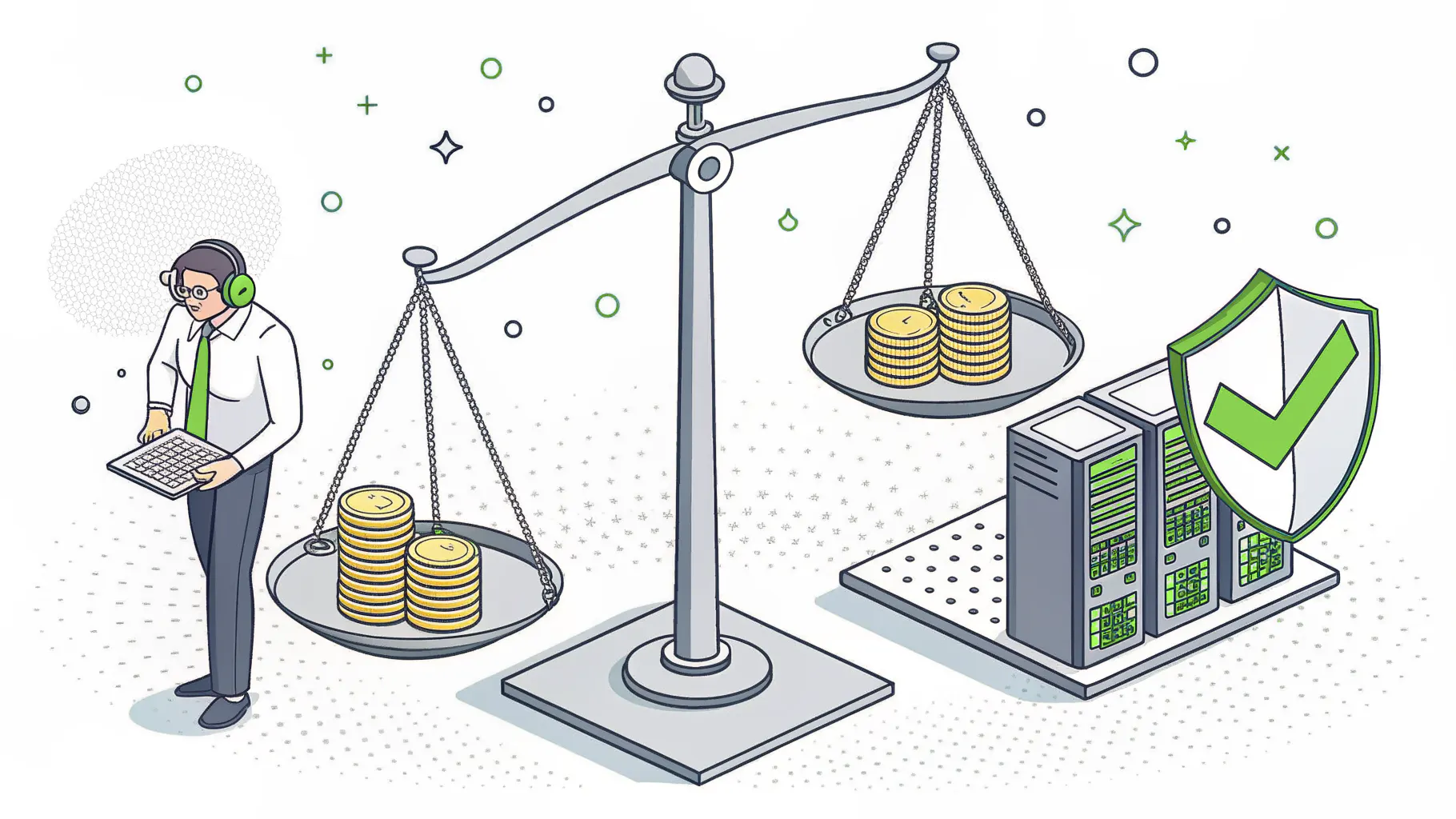
Every comparison article gives you salary vs. monthly fee. That's half the picture. Here's the other half.
The fully loaded cost of one in-house IT employee in California. Base salary for a systems administrator averages $129k (Glassdoor, August 2026). Add 25-35% for benefits, payroll taxes, equipment, training, and software licenses. You're at $160k-$174k for one person. A cybersecurity engineer in California averages $131k-$185k base (ZipRecruiter/KORE1, 2026), which puts fully loaded cost at $165k-$250k.
For an electronics manufacturer that needs IT infrastructure management AND cybersecurity AND compliance, that's 2-3 full-time hires minimum. Call it $350k-$500k+ annually in California, not counting recruiting costs, coverage gaps during turnover, or the risk of losing someone mid-compliance project.
The cost of co-managed IT. Managed IT services run $100-$250 per user per month nationally in 2026, with California pricing at the upper end. For a 100-person electronics manufacturer, that's roughly $180k-$300k annually for comprehensive coverage, including 24/7 monitoring, help desk, cybersecurity operations, and compliance support.
That's less than the fully loaded cost of 2 in-house hires, but with the coverage of a full team. 24/7 SOC. Multiple engineers. Security specialists. Compliance expertise. Backup when someone is sick or on vacation.
The catch, and it's worth naming honestly. Co-managed IT means giving up some control. Your partner handles things their way, using their tools and processes. If they're good, that's better than what you had. If they're not, it's friction. The provider selection decision is the most important variable in whether co-managed IT works. We covered that in detail in the MSP evaluation guide.
Where Each Model Wins for Electronics Manufacturers
This isn't a close call in every scenario. Some situations clearly favor one model.
In-house wins when:
- You have 250+ employees and can staff a full IT department (not just one generalist) with dedicated roles for infrastructure, cybersecurity, compliance, and production systems.
- Your production environment is highly specialized, with equipment that requires IT staff with years of institutional knowledge to support effectively.
- You handle classified information that requires cleared personnel with physical access restrictions that external providers can't meet.
- You operate in an environment where the volume of production-specific IT work (equipment configuration, line changeover support, test system programming) fills multiple full-time roles.
Co-managed wins when:
- You have 50-250 employees with 1-3 IT staff who are capable but stretched across too many functions.
- Your IT team is strong on production systems but lacks depth in cybersecurity, compliance, or cloud infrastructure.
- You're entering the defense supply chain and need CMMC compliance, ITAR access controls, or NIST 800-171 support that your internal team hasn't built before.
- Your production runs 24/7 but your IT coverage doesn't.
- You've lost an IT employee recently and need to maintain operations while you evaluate whether to rehire or restructure.
- Your cybersecurity insurance premiums are climbing and the insurer is asking for controls your internal team can't implement or document alone.
How to Split Responsibilities in a Co-Managed Model
The biggest risk in co-managed IT isn't the model itself. It's unclear ownership. If nobody explicitly owns the boundary between what your internal team handles and what the external partner handles, things fall through the gap. Especially in electronics manufacturing, where that gap sits between corporate IT and the production floor OT environment.
Here's a responsibility split that works for most electronics manufacturers in the 50-250 employee range.
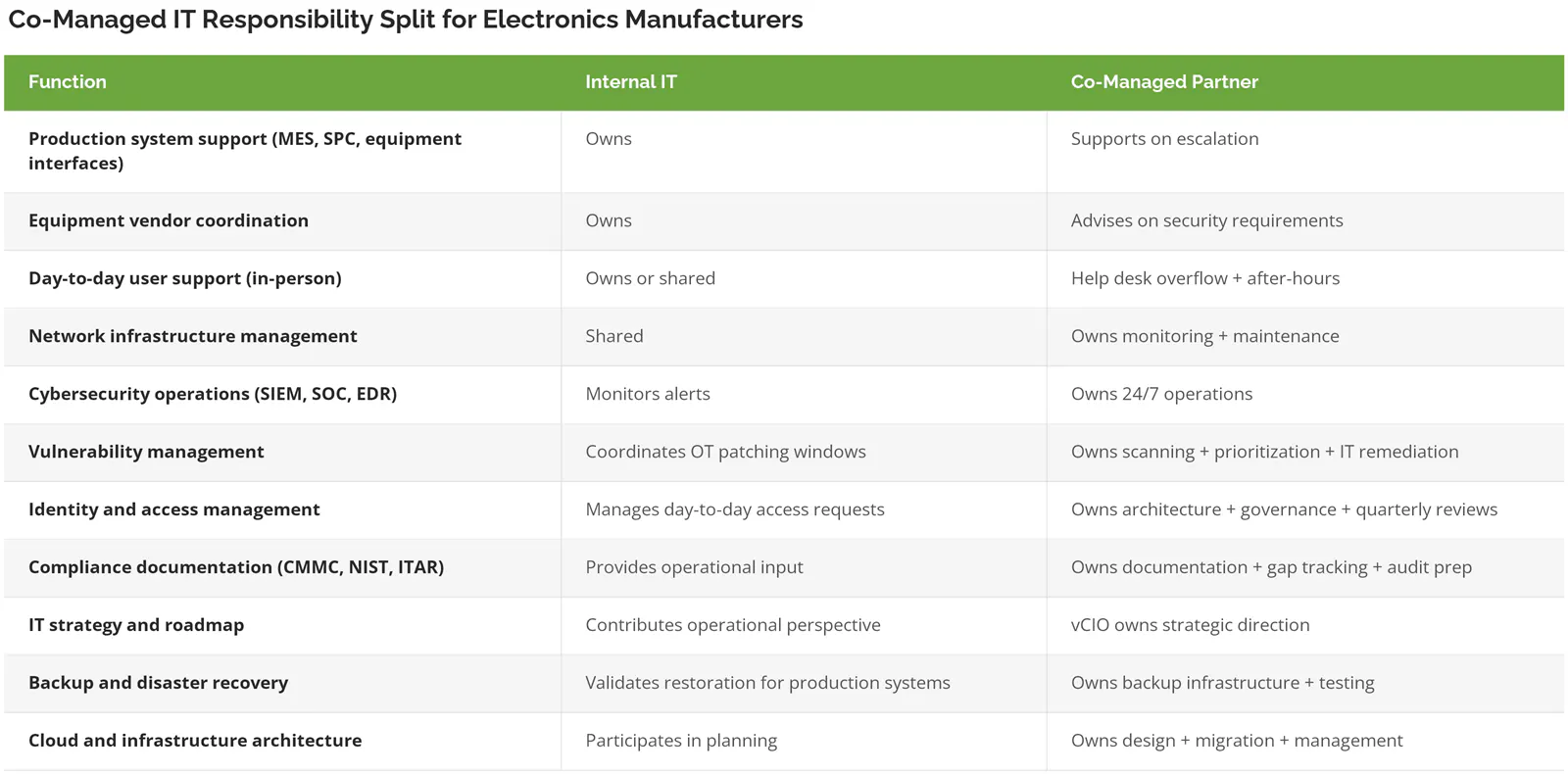
That split keeps your internal team focused on the work that requires physical presence and production knowledge. It puts the work that requires depth, 24/7 coverage, and specialized expertise with the partner who has the team to deliver it.
The critical requirement is a named contact on both sides who owns the boundary. Not a ticketing system. A person. Someone who knows when to escalate from internal to external, and someone on the external side who understands your production environment well enough to respond appropriately.
The Manufacturing-Specific Considerations
Generic in-house vs. outsourced comparisons miss what makes electronics manufacturing different.
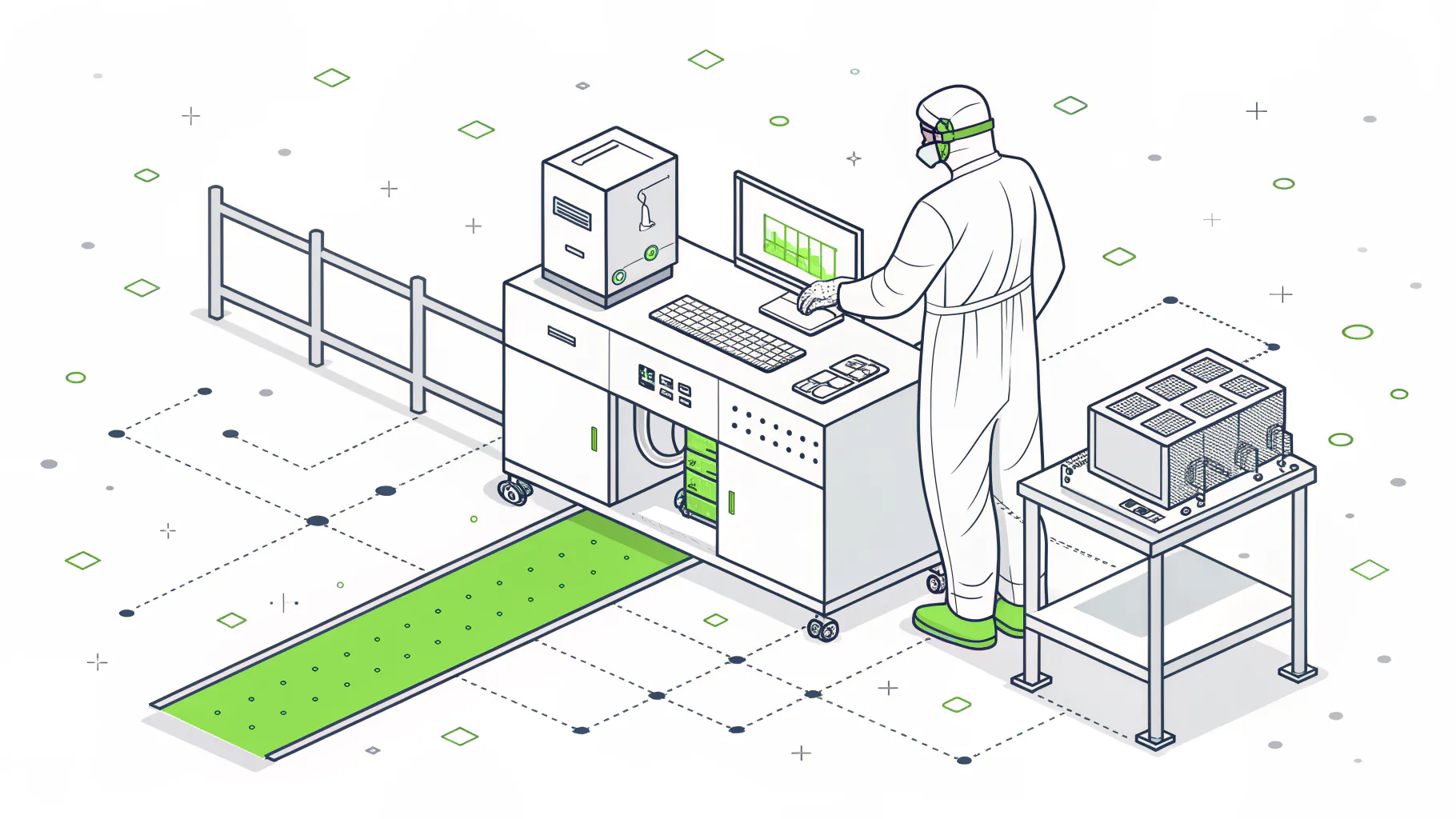
Clean room access. If your production environment includes clean rooms, any IT support touching those areas needs gowning-trained personnel. That's easier to maintain with dedicated internal staff than with a rotating cast of external technicians. The co-managed model accounts for this by keeping production floor support internal while handling remote-capable functions externally.
OT/IT boundary ownership. Someone has to own the security boundary between corporate IT and production OT. In a co-managed model, this ownership needs to be explicitly defined. Does the external partner manage the firewall between IT and OT zones? Does the internal team own production network monitoring? Undefined boundaries create security gaps that attackers exploit.
Compliance framework complexity. An electronics manufacturer entering the defense supply chain might need CMMC, NIST 800-171, ITAR access controls, IEC 62443 for OT security, and ISO 27001 for customer requirements, all simultaneously. Building that compliance expertise internally means hiring a dedicated security and compliance professional at $140k-$200k+ in California. Co-managed IT can provide that expertise as part of the engagement, shared across multiple clients, at a fraction of the dedicated hire cost.
Equipment vendor management. Your internal IT team has relationships with equipment vendors. They know who to call when the AOI software crashes or the pick-and-place programming station drops off the network. That institutional knowledge is genuinely valuable and shouldn't be outsourced. What should be outsourced is ensuring those vendor connections are secure, logged, time-limited, and compliant.
The Decision Framework
In-house IT works when you can staff the full team and your production environment demands daily physical IT presence that external providers can't replicate.
Co-managed IT works when your internal capabilities are strong but incomplete, your coverage needs exceed your headcount, and the compliance and cybersecurity requirements you face outpace what a small internal team can maintain.
For electronics manufacturers between 50 and 250 employees, co-managed IT is the model that delivers the coverage of a full department at a fraction of the cost, without sacrificing the institutional knowledge your internal team provides.
Above 250 employees, the math starts shifting. Some functions that were outsourced begin making sense to bring in-house. But even large manufacturers often keep cybersecurity operations and compliance externally because the specialization required makes dedicated internal hires expensive and hard to retain.