ITAR Cybersecurity Requirements for Electronics Manufacturers
ITAR governs how defense-related technical data is handled, stored, and transmitted. For electronics manufacturers making PCBs, components, or sub-assemblies for defense programs, ITAR applies to your IT environment, not just your shipping dock. Access must be restricted to U.S. persons. Data must be encrypted. Systems must log who accessed what and when. Civil penalties sit at $1.27M per violation as of 2025. This guide covers the specific IT controls ITAR requires, where electronics manufacturers typically fail, and how to get compliant before it becomes a crisis.
Table of Contents
ITAR conversations in electronics manufacturing usually start the same way. A prime contractor or OEM customer asks whether your company is ITAR-registered. Your sales team says yes. Then the customer asks for documentation of your IT controls around controlled technical data. That's when things get quiet.
Registration with DDTC (the Directorate of Defense Trade Controls) is step one. It's the part everyone knows about. What catches electronics manufacturers off guard is everything that comes after: the cybersecurity requirements that govern how your IT environment handles, stores, and protects ITAR-controlled information.
ITAR doesn't prescribe specific technology solutions. It requires a risk-based approach to protecting the confidentiality, integrity, and availability of controlled technical data. That sounds flexible. In practice, it means your IT environment needs specific controls, and the Department of State expects you to demonstrate them.
What ITAR Controls From an IT Perspective
ITAR itself is an export control framework. It governs defense articles, defense services, and technical data listed on the United States Munitions List (USML). For an electronics manufacturer, the ITAR-controlled data is typically design files, schematics, BOM data for defense programs, manufacturing specifications, test procedures, and any technical data related to USML items.
The cybersecurity dimension of ITAR centers on preventing unauthorized access to this data. "Unauthorized" includes non-U.S. persons (foreign nationals, foreign entities), unauthorized employees within your own company, and external threat actors.
Here's what that means for your IT environment.
The IT Controls ITAR Requires
U.S. person access restriction. Every individual with access to ITAR-controlled technical data must be a U.S. person (U.S. citizen, permanent resident, or protected person under 8 U.S.C. 1324b). This isn't a guideline. It's a legal requirement. Your IT environment must enforce this through access controls that restrict who can reach ITAR data, and you need to be able to demonstrate that restriction on demand.
For a PCB manufacturer, this means your design file server, your ERP records for defense programs, your engineering workstations with Gerber files, and your email system (if defense-related technical data passes through it) all need access controls that limit access to verified U.S. persons.
If you have any foreign national employees, contractors, or vendors with access to systems that contain ITAR data, you have a violation. Full stop.
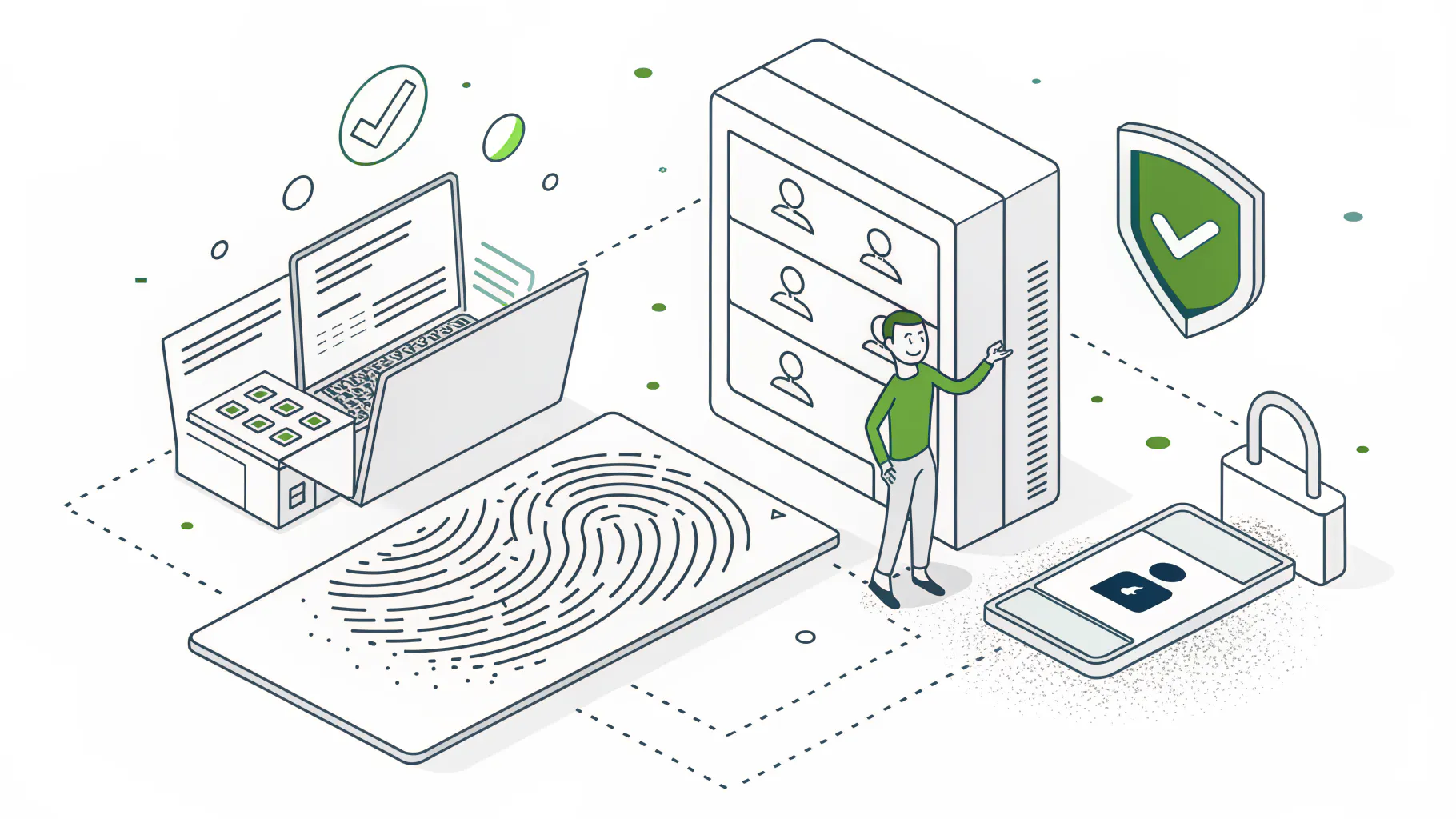
Encryption at rest and in transit. ITAR-controlled data must be encrypted when stored and when transmitted. NIST SP 800-171 provides the technical framework (and is required under DFARS 252.204-7012 if you're also handling CUI). AES-256 for data at rest. TLS 1.2+ for data in transit. Encrypted email or secure file transfer for any transmission of controlled technical data.
If your engineers are emailing Gerber files to a defense customer over unencrypted channels, that's an exposure.
Audit logging and accountability. Systems that store or process ITAR data must maintain audit logs that capture who accessed what, when, and what they did. Access logs. Modification logs. Transfer logs. These logs need to be retained and reviewable. If a DDTC investigation asks who accessed a particular design file on a particular date, you need to be able to answer.
Physical and logical access controls. Server rooms, network closets, and any physical infrastructure housing ITAR data need controlled access. Logical access controls (role-based access, multi-factor authentication, least-privilege) need to be implemented across all systems that touch controlled data.
Network segmentation. ITAR data should reside on network segments that are logically separated from general corporate IT traffic. If your ITAR design files sit on the same file server as your marketing materials, accessible to everyone with a network login, your segmentation is insufficient.
Incident response capability. If ITAR-controlled data is compromised, your company has reporting obligations. You need a documented incident response plan that covers detection, containment, eradication, recovery, and notification. Without one, a breach becomes both a security event and a compliance event simultaneously.
Vendor and supply chain controls. Prime contractors must ensure that their suppliers handling controlled PCBs and technical data are also ITAR-compliant (Altium, 2026). If you use cloud services, managed IT providers, or any third party that could access ITAR data, their compliance posture matters too.
What's Changing in 2026
Three developments are worth tracking.
USML Category XI revision. DDTC has signaled a planned revision consolidating semiconductor and circuit board controls under Category XI (PreVeil, May 2026). If you manufacture PCBs or semiconductor components for defense applications, this revision could change which of your products fall under ITAR's scope. No final rule yet, but companies in these sectors should monitor the Federal Register.
Cloud and AI risks. Multi-tenant cloud environments create data residency risks. Shared infrastructure means your ITAR data could theoretically reside on servers accessible to non-U.S. persons. And AI tools (including generative AI platforms) that process or are trained on ITAR-controlled data can trigger unauthorized export violations. If your engineers are using AI tools to assist with defense-related design work, that's a compliance exposure most companies haven't thought about yet.
Enforcement isn't slowing down. Raytheon (now RTX) agreed to pay $950M in October 2024 to resolve investigations involving ITAR and AECA violations among other charges. GlobalFoundries, a semiconductor manufacturer, paid $500K to BIS in November 2024 for Entity List violations. Civil penalties for ITAR violations now sit at $1,271,078 per violation as of 2025 (Export Compliance Training Institute, 2025). Criminal violations can result in imprisonment.
Where Electronics Manufacturers Typically Fail ITAR IT Requirements
Access controls that haven't been reviewed. The most common failure. Access was set up when the system was deployed. People have been added. People have left. Nobody's reviewed who has access to the ITAR file share in 18 months. Former employees, contractors, and vendor accounts with stale credentials create both security and compliance risk.
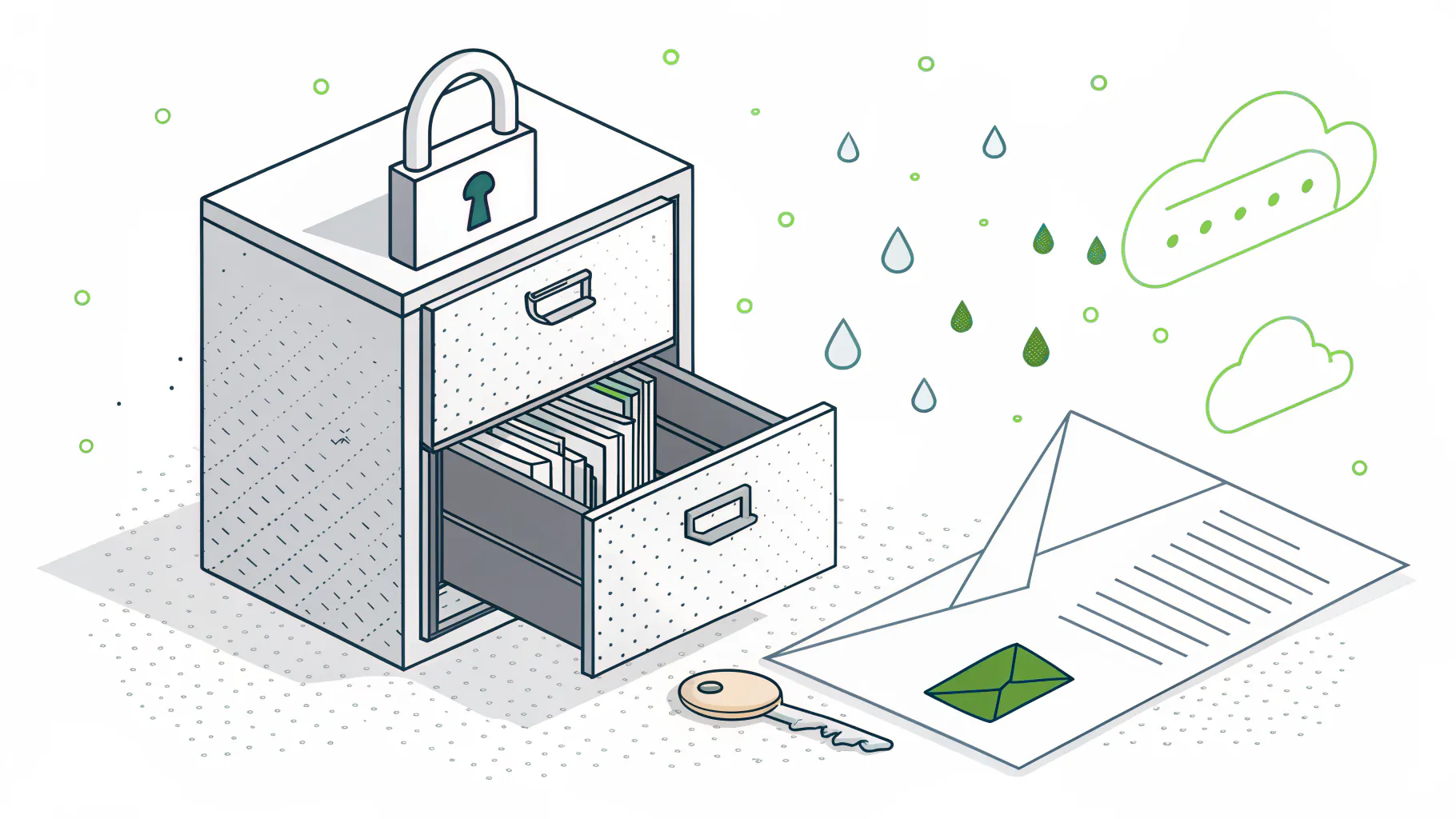
No separation between ITAR and non-ITAR data. Design files for defense programs sit on the same server as commercial project files, accessible to anyone with a network login. Without data classification and segmentation, you can't enforce U.S.-person access restrictions cleanly.
Email-based technical data transfers without encryption. Engineers email Gerber files. It happens. If those files contain ITAR-controlled data and they're sent over unencrypted email, that's a violation. Secure file transfer (SFTP, encrypted portals) should replace email for any controlled data transmission.
No documented policies. The controls might functionally exist. But without written policies for data handling, access management, incident response, and vendor oversight, you can't demonstrate compliance. DDTC expects documentation. "We do it but didn't write it down" isn't a defense.
Vendor access without oversight. IT vendors, cloud providers, and managed service providers who access systems containing ITAR data need to be vetted. If your MSP's help desk includes non-U.S. persons who could access ITAR-controlled systems during support sessions, that's a problem.
AI tool exposure. This is the newest failure point. Engineers using cloud-based AI tools to process design specifications, generate code for firmware, or analyze manufacturing data may be inadvertently exporting controlled technical data to servers outside U.S. jurisdiction. Most companies haven't addressed this yet.
How ITAR and CMMC Overlap (and Where They Don't)
ITAR and CMMC are administered by different agencies (State Department and DoD) and address different concerns (export control vs. CUI protection). But for electronics manufacturers in the defense supply chain, the IT controls overlap significantly.
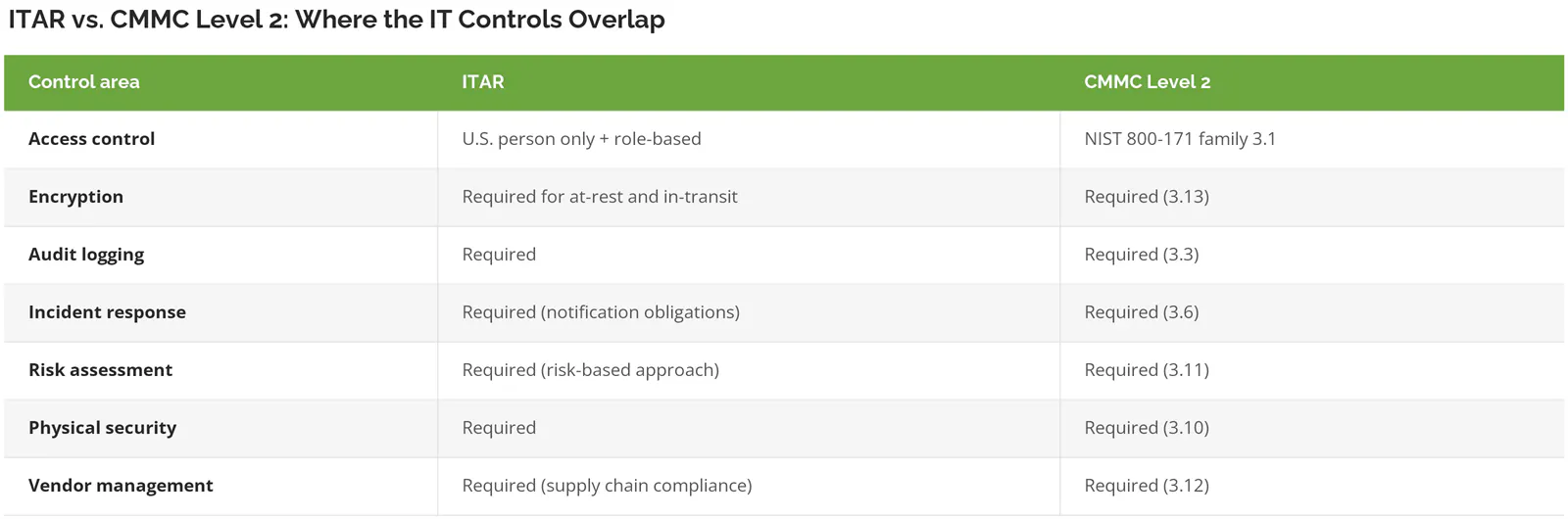
The major difference: ITAR adds export control dimensions that CMMC doesn't cover. U.S. person restrictions, DDTC registration, and export licensing are ITAR-specific. CMMC adds third-party assessment verification that ITAR doesn't require (yet).
If you're implementing NIST SP 800-171 controls for CMMC, you're covering most of ITAR's cybersecurity requirements simultaneously. But ITAR's access restrictions (U.S. person only) and export control obligations require additional controls beyond what CMMC mandates.
Consilien builds unified compliance programs that address both ITAR and CMMC simultaneously.
How to Get Your IT Environment ITAR-Ready
1. Classify your data. Identify which files, systems, and databases contain ITAR-controlled technical data. You can't protect what you haven't identified.
2. Audit access. Review every account with access to ITAR data. Verify U.S. person status. Remove access for anyone who shouldn't have it. Implement quarterly access reviews going forward.
3. Implement encryption. AES-256 on storage. TLS 1.2+ on transmission. Encrypted email or secure file transfer for all controlled data exchanges.
4. Segment your network. ITAR data on isolated network segments. Access controlled through firewalls and role-based policies.
5. Deploy audit logging. Every access event on ITAR systems logged. Logs retained and reviewable.
6. Write the policies. Access control policy. Data handling policy. Incident response plan. Vendor management procedures. Get them reviewed and signed by leadership.
7. Train your team. Everyone who handles ITAR data needs to understand the requirements. Not a generic cybersecurity video. ITAR-specific training covering data handling, access rules, and reporting obligations.
8. Get strategic oversight. A vCISO can own the ITAR IT compliance program, coordinate with your prime contractor's requirements, and ensure the controls stay current as regulations evolve.
The Penalty Math
Civil: $1,271,078 per violation as of 2025, or twice the transaction value, whichever is greater.
Criminal: Up to $1M per violation and up to 20 years imprisonment for willful violations.
Administrative: Debarment from government contracts. For a defense electronics manufacturer, debarment is functionally a death sentence for that revenue stream.
A single misconfigured access permission can constitute a violation. An email sent to a non-U.S. person containing controlled technical data is a violation. A cloud backup of ITAR data on a server accessible to foreign nationals is a violation.
The cost of ITAR IT compliance is a fraction of the cost of a single violation.
For a broader view of all compliance requirements facing electronics manufacturers, read our compliance readiness guide.