Managed IT vs In-House IT for Manufacturing Companies: Real Cost Comparison
For manufacturing companies, deciding between managed IT and in-house IT is not merely a matter of price, but also of risk, downtime, and operational continuity. While an in- house IT solution may seem less expensive at first, it has many hidden costs (downtime, security gaps, turnover). Managed IT provides stable expenses, improved cybersecurity, and round-the-clock support. Usually, in the manufacturing industry, the risk of downtime and cyber threats is a more critical factor than the savings on salaries.
Table of Contents
Often, the best solution is a hybrid IT model, where internal teams are backed up, not bought out, by external professionals.
What is the difference between managed IT and in- house IT?
Managed IT refers to an outsourcing model where IT operations, security, and support are handled by a third-party provider. On the other hand, in- house IT depends on internal staff for systems, infrastructure, and troubleshooting management.
Why This Decision Is Different for Manufacturing
Manufacturing IT isn't like office IT. It directly affects production.
Key differences:
- IT failure can stop production lines
- Systems include OT (Operational Technology), like PLCs and SCADA
- Many environments rely on legacy systems that are hard to secure
- Multi-site plants increase complexity
According to the Cybersecurity and Infrastructure Security Agency, manufacturing is a frequent target due to its operational impact and supply chain dependencies.
Real Cost Comparison: In-House vs Managed IT
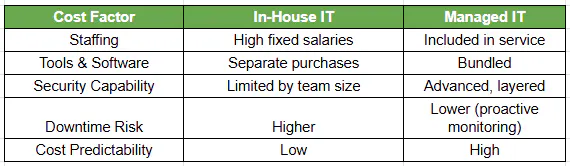
True Cost of In-House IT
Most companies underestimate internal IT costs.
- Salaries + benefits (often 20-30% above base salary)
- Tools (RMM, security, backup, monitoring)
- Training and certifications
- After-hours coverage gaps
- Downtime risk
- Security limitations
- Hiring delays and turnover
Data from the U.S. Bureau of Labor Statistics shows IT salaries are only part of total employment cost benefits, and overhead significantly increases total spend.
Managed IT Cost Structure
- Fixed monthly subscription
- Tools and platforms included
- 24/7 monitoring and response
- Access to specialized expertise (security, compliance)
- Scalable support as operations grow
Cost Comparison Table
The Hidden Cost of Downtime in Manufacturing
Downtime is the cost most companies ignore and it's often the largest.
When IT fails:
- Production stops
- Orders are delayed
- Revenue is lost
- Supply chains are disrupted
There is no universal downtime cost; figures vary widely by plant, but industry research from the International Society of Automation and Siemens consistently shows downtime as a major operational risk.
Cybersecurity Risk: The Cost Most Companies Ignore
Manufacturing is now one of the most targeted sectors.
- Verizon DBIR reports consistently rank manufacturing among the top attack targets
- IBM Security (2024) states that the cost of a breach can range in the millions of dollars worldwide
- Ransomware can stop production completely
Frameworks like the National Institute of Standards and Technology (NIST) require a focus on layers of security and monitoring/response efforts that are difficult to achieve internally.
Reality: Choosing an IT model = choosing your risk exposure level
When In-House IT Makes Sense
- Single-site operations
- Limited regulatory or compliance pressure
- Low cybersecurity exposure
- Strong internal expertise already in place
When Managed IT Makes Sense
- Multi-site manufacturing operations
- The internal IT team is overloaded
- Increasing cybersecurity threats
- Compliance requirements (NIST, CMMC readiness)
- Need for predictable IT costs
The Reality: Co-Managed IT (Best of Both)
Most manufacturing companies don't fully outsource and shouldn't.
How it works:
Internal IT:
- Handles plant-specific systems
- Manages vendors and operations
Managed IT provider:
- Delivers cybersecurity
- Monitors systems 24/7
- Supports compliance readiness
- Provides escalation and expertise
This is where Consilien operates, augmenting internal teams, not replacing them.
Decision Framework: What Should You Choose?
Choose In-House IT if:
- Your environment is simple
- Downtime risk is low
- You have strong internal expertise
Choose Managed IT if:
- You need 24/7 coverage
- Security risk is increasing
- IT complexity is growing
Choose Co-Managed IT if:
- Your internal team is stretched
- You need better security and compliance
- You want to keep control but reduce risk