NIST CSF 2.0 for Electronics and Semiconductor Manufacturers
NIST CSF 2.0 is a voluntary cybersecurity framework built around 6 core functions: Govern, Identify, Protect, Detect, Respond, and Recover. For electronics and semiconductor manufacturers, NIST and the SEMI Manufacturing Cybersecurity Consortium developed a Semiconductor Manufacturing Community Profile (NIST IR 8546) that maps CSF 2.0 directly to fab and production environment risks. This guide covers how the framework applies to electronics manufacturing, what the semiconductor profile adds, and how to use CSF 2.0 as the organizing layer across CMMC, IEC 62443, and SEMI E187.
Table of Contents
The Framework That Connects Everything Else
If you're an electronics manufacturer dealing with multiple cybersecurity requirements, you've probably noticed the overlap. NIST SP 800-171 for CUI protection. CMMC for defense supply chain certification. IEC 62443 for OT security. SEMI E187 for fab equipment. ISO 27001 for information security management.
Each one covers a different angle. None of them covers everything. And running 5 separate compliance programs isn't realistic for a company with 80 employees and an IT team of 3.
NIST CSF 2.0 isn't another compliance requirement stacked on top. It's the organizing layer that connects the others. CSF maps cleanly to NIST SP 800-171, ISO 27001, and SOC 2. The semiconductor manufacturing profile aligns it with IEC 62443 and SEMI E187. You manage one framework and report against several.
That's why it matters, even though it's voluntary.
What Changed in CSF 2.0
NIST published CSF 2.0 in February 2024, replacing the original 1.0 framework from 2014 and the 1.1 update from 2018. Three changes matter for electronics manufacturers.
The Govern function. CSF 1.1 had 5 functions. CSF 2.0 has 6. The new Govern function sits at the center and covers cybersecurity strategy, risk management policies, roles and responsibilities, and supply chain risk oversight. It's not new thinking. It's an elevation of governance from a background activity to a core function. For electronics manufacturers, this means cybersecurity governance is now explicitly part of the framework, not something you hope the IT manager is doing on the side.
Expanded scope. CSF 1.1 was framed for critical infrastructure. CSF 2.0 applies to any organization of any size in any sector. NIST rewrote the small-business guidance from scratch. A 75-person electronics manufacturer can use the same framework structure as a Fortune 500 semiconductor company, scaled to their risk profile and resources.
Supply chain risk as a first-class concern. CSF 2.0 treats third-party and vendor cyber risk as a top-level priority running through Govern, Identify, and Protect. For electronics manufacturers with extended supply chains, contract manufacturers, component distributors, and equipment vendors, this isn't optional reading. Supply chain compromise is the fastest-growing attack vector in manufacturing, and your framework needs to address it structurally.
The 6 Functions Applied to Electronics Manufacturing
CSF 2.0 organizes cybersecurity into 6 functions, 22 categories, and 106 subcategories. Here's what each function means in practice for an electronics manufacturer.

Govern (GV). Establish who owns cybersecurity decisions, how risk is communicated to leadership, what policies exist, and how supply chain risk is managed. For electronics manufacturers, this is where a vCISO or designated security leader fits. Governance without a named owner is governance on paper only. This function also covers regulatory awareness, meaning someone is responsible for tracking which compliance frameworks apply and when requirements change.
Identify (ID). Know what you have. Asset inventories across IT and OT. Data classification for IP, CUI, and ITAR-controlled data. Risk assessment that accounts for both corporate network threats and production floor threats. Supply chain dependency mapping. You can't protect what you haven't inventoried, and in electronics manufacturing, the OT asset inventory is usually where the gaps are. Equipment with network connections that nobody documented. Vendor access paths that were set up during installation and never reviewed.
Protect (PR). Implement controls that prevent or limit the impact of a cybersecurity event. Identity and access management. MFA. Data encryption. Security awareness training. Network segmentation between IT and OT. Endpoint protection. Configuration management. Backup and disaster recovery. For electronics manufacturers handling ITAR data, Protect also covers the technical enforcement of citizenship-based access restrictions and CUI boundary controls.
Detect (DE). Monitor for anomalies and events that indicate a cybersecurity incident. SIEM and SOC operations. Log collection and analysis across IT and OT. Intrusion detection. Anomaly detection on production network traffic. The Detect function is where most mid-market electronics manufacturers have the biggest gap. They have protective controls in place but limited visibility into whether those controls are actually working or whether something has already gotten through.
Respond (RS). When an incident occurs, contain the damage, investigate the cause, and communicate with stakeholders. Incident response planning. Forensic analysis. Stakeholder notification. The electronics manufacturing angle here is that incident response on the production floor requires different playbooks than IT incident response. Shutting down a compromised email server is different from deciding whether to stop a production line mid-run.
Recover (RC). Restore operations after an incident. Backup restoration. Business continuity. Communications. Lessons learned. For electronics manufacturers, recovery means getting production back online, not just restoring data. The recovery plan needs to account for OT systems, production schedules, customer delivery commitments, and the time-to-recovery for specialized equipment.
The Semiconductor Manufacturing Community Profile
In February 2025, NIST and the SEMI Semiconductor Manufacturing Cybersecurity Consortium (SMCC) released the draft of NIST IR 8546, the Cybersecurity Framework 2.0 Semiconductor Manufacturing Community Profile. The public comment period extended through July 2025.

This isn't a separate framework. It's a tailored application of CSF 2.0 to semiconductor manufacturing. What it adds is specific.
Mission objectives for semiconductor manufacturing. The profile organizes CSF subcategories around semiconductor-specific goals: protecting fab uptime, securing IP, managing supply chain integrity, maintaining yield, and meeting regulatory requirements across jurisdictions.
Criticality tables. Not every system in a fab matters equally. The profile introduces criticality-based prioritization aligned with SEMI E187 risk scoring. A tool controller running a lithography system gets a different criticality rating than a lobby kiosk. The controls you apply and the speed at which you respond scale with criticality.
Alignment with existing semiconductor standards. The profile maps CSF 2.0 functions to IEC 62443 zone-and-conduit architecture, SEMI E187/E188 equipment cybersecurity requirements, and NIST SP 800-82 for industrial control system security. Japan's Ministry of Economy, Trade and Industry published complementary OT security guidelines in 2025 that segment semiconductor factories using the IEC 62443 Purdue Model and map to both the CSF 2.0 semiconductor profile and SEMI E187.
Legacy OT guidance. Semiconductor fabs and electronics manufacturing facilities run equipment that's 10-20 years old. The profile acknowledges this reality and provides guidance for managing cybersecurity in environments where patching isn't possible, where equipment can't run modern endpoint protection, and where compensating controls are the only option.
The profile is voluntary and supplementary. It doesn't replace your existing compliance programs. It strengthens them by providing semiconductor-specific context that the generic CSF 2.0 doesn't have.
Implementation Tiers: Where You Are vs. Where You Need to Be
CSF 2.0 defines 4 implementation tiers that describe how mature your cybersecurity risk management practices are.

Tier 1 (Partial). Ad hoc and reactive. No formal cybersecurity strategy. Risk management is inconsistent. This is where most electronics manufacturers start when they first engage with a structured framework. It doesn't mean you have no security. It means what you have isn't formalized, documented, or consistently applied.
Tier 2 (Risk-Informed). Cybersecurity practices are defined but not consistently executed across the organization. Some risk awareness exists. Policies may be written but aren't uniformly followed. This is the typical state for a company that has an IT team managing security but no formal governance structure, no regular risk assessments, and no OT-specific security program.
Tier 3 (Repeatable). Practices are documented, applied consistently, and regularly reviewed. Risk management is formalized. Roles are defined. Controls are tested. This is the target for most mid-market electronics manufacturers. Tier 3 is where cybersecurity stops being dependent on individual heroics and becomes institutional.
Tier 4 (Adaptive). Risk management is data-driven, continuously improving, and integrated with business strategy. This is a multi-year goal appropriate for large semiconductor companies or defense electronics manufacturers with significant threat exposure. Few organizations achieve Tier 4 across all functions.
A realistic trajectory for a mid-sized electronics manufacturer. Reach Tier 2 within 90 days of starting a structured program. Reach Tier 3 within 12-18 months. Tier 4 is a continuous improvement target, not a near-term milestone.
How CSF 2.0 Maps to Your Other Compliance Requirements
This is where CSF 2.0 earns its value. Instead of running parallel compliance programs, you use CSF as the organizing layer and map the others into it.
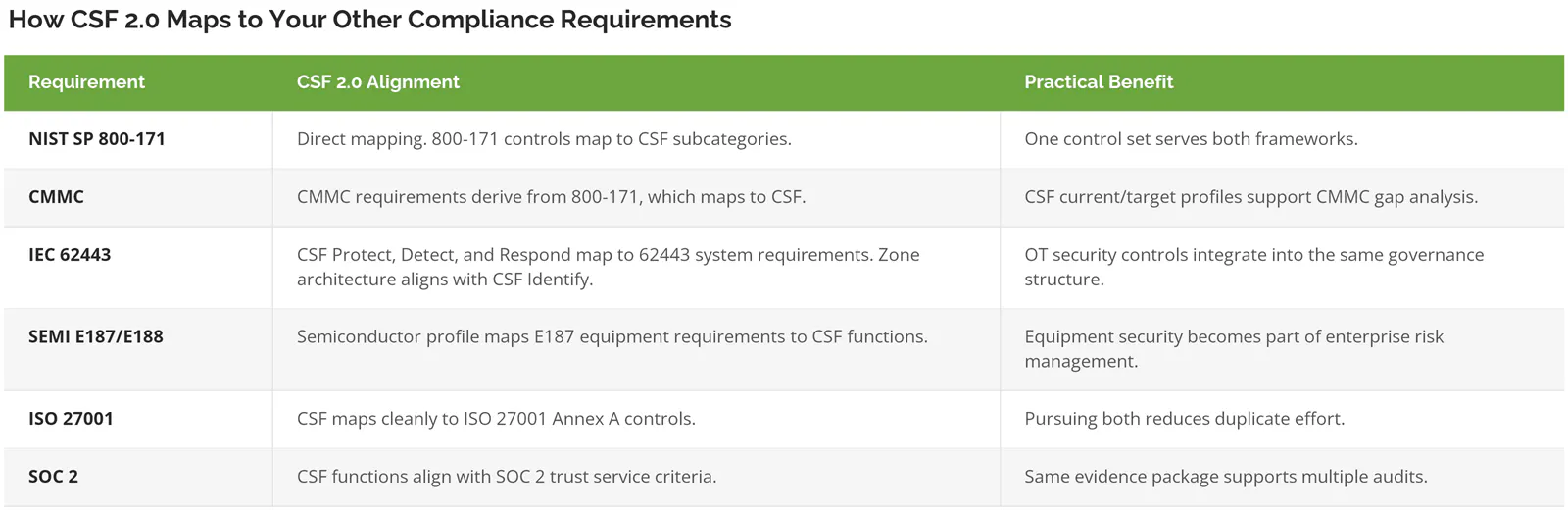
For electronics manufacturers facing CMMC compliance, CSF 2.0 provides the framework for building and maintaining the controls that CMMC assesses. The current profile shows where you are. The target profile shows where you need to be. The gap between them becomes your remediation plan, which maps directly to the Plan of Actions and Milestones (POA&M) that CMMC expects.
What a Practical Starting Point Looks Like
You don't implement CSF 2.0 by reading the document and checking boxes. You implement it by making decisions.

Week 1-2: Assign ownership. Someone has to own this. A vCISO, an internal security lead, a designated IT manager. The Govern function requires a named person accountable for cybersecurity risk management.
Week 2-4: Build your current profile. Assess where you stand against each CSF function. Not every subcategory requires the same depth. Focus on the categories most relevant to your threat profile. For an electronics manufacturer, that means heavy emphasis on Identify (especially asset management across OT), Protect (access controls, encryption, network segmentation), and Detect (monitoring gaps).
Month 2: Define your target profile. Where do you need to be? This decision is driven by your threat exposure, your compliance requirements, your customer expectations, and your risk tolerance. A defense electronics manufacturer targeting CMMC Level 2 has a different target profile than a commercial EMS company.
Month 2-3: Gap analysis and prioritization. The gap between current and target profiles becomes your work plan. Prioritize by risk, not by framework sequence. A missing network segmentation between IT and OT is a higher-priority gap than a missing governance policy document, even though Govern comes before Protect in the framework.
Month 3+: Execute, measure, repeat. Implement controls. Test them. Document the results. Review quarterly. Update the current profile as controls mature. Adjust the target profile as threats and requirements evolve.
The mistake most companies make is treating the assessment as a one-time event. CSF 2.0 is an operating rhythm, not a project. The current profile, the risk register, and the target profile are living documents that should be revisited each quarter.
We sell the services that support this implementation. But the framework itself is free, published by NIST, and available at csrc.nist.gov. A company with strong internal IT leadership can self-implement. Where external support typically adds value is in the OT-specific assessment, the compliance cross-mapping, and the ongoing governance structure that makes it sustainable.
The Framework Is Free. The Execution Is What Costs.
NIST CSF 2.0 and the semiconductor manufacturing profile are publicly available at no cost. The documents, the implementation examples, the quick-start guides, all published by NIST. You don't need to buy anything to start.
What costs money is doing something with it. The risk assessment. The gap analysis. The controls implementation. The monitoring. The ongoing governance. Whether you build that internally or bring in external support, the investment is in execution, not in access to the framework.