ISO 27001 for Electronics Manufacturers: What You Actually Need
ISO 27001 is the international standard for information security management. The 2022 edition has 93 Annex A controls across 4 categories. All 2013 certificates expired, so every 2026 audit is against the current version. For electronics manufacturers, ISO 27001 is increasingly a procurement requirement from OEM customers, particularly European and multinational buyers. This guide covers what the standard actually requires, why it matters for PCB fabricators and electronics companies, and how to get certification-ready without building a compliance department from scratch.
Table of Contents
Here's what typically happens. A commercial OEM customer sends your sales team a vendor security questionnaire. One of the first questions asks whether you hold ISO 27001 certification. Your team checks. You don't. The next question asks when you plan to achieve it.
That's usually when electronics manufacturers start paying attention to ISO 27001.
The standard itself isn't new. ISO/IEC 27001 has been around since 2005. But the 2022 revision restructured the controls, all 2013 certificates have expired, and OEM customers are treating certification as a procurement gate, not a nice-to-have. Amphenol Invotec, one of the largest advanced PCB manufacturers, publicly announced their ISO 27001 certification specifically because their customers demanded evidence of information security management.
For mid-market electronics manufacturers, the question isn't whether ISO 27001 matters. It's whether you can achieve it without your 2-person IT team burning out in the process.
What ISO 27001 Actually Is
ISO 27001 is a framework for building and maintaining an Information Security Management System (ISMS). That sounds abstract. Here's what it means in practice.
An ISMS is a documented set of policies, processes, and controls that govern how your company protects information. Not just digital information. All information. Customer data, employee records, financial data, and the IP that makes your company valuable: Gerber files, schematics, BOM data, test procedures, firmware.

The standard requires you to do 5 things.
Define the scope of your ISMS. What systems, locations, people, and data does it cover? For an electronics manufacturer, this typically includes engineering workstations, design file servers, ERP systems, production-adjacent IT, and any system that touches customer data or proprietary designs.
Conduct a formal risk assessment. Identify the information security risks specific to your environment, evaluate their likelihood and impact, and decide how to treat them. This isn't a generic checklist. It's your risk register, reflecting your actual environment.
Implement controls from Annex A. The 2022 edition has 93 controls organized into 4 categories: organizational (37 controls), people (8 controls), physical (14 controls), and technological (34 controls). You don't implement all 93 blindly. You implement the ones that address your identified risks and document why you excluded any that don't apply. That document is called the Statement of Applicability.
Run internal audits. At least annually. Check whether your controls are working as documented. Identify nonconformities. Fix them.
Conduct management reviews. Leadership reviews the ISMS performance, audit findings, and risk landscape. This is how ISO 27001 makes information security a leadership responsibility, not just an IT task.
Why Electronics Manufacturers Need ISO 27001 Now
Three things changed.
OEM procurement requirements tightened. European and multinational OEM customers are making ISO 27001 a condition of doing business. If you manufacture PCBs, electronic sub-assemblies, or components for customers who sell into regulated markets (automotive, medical, aerospace, industrial), they need assurance that your information security is managed. ISO 27001 certification provides that assurance in a format they recognize globally.
IP theft became the primary attack motive. IBM's 2026 X-Force report found that 40% of manufacturing cyberattacks targeted intellectual property (IBM X-Force, 2026). For a PCB fabricator, that's design files. For a semiconductor supplier, that's IC designs and test data. ISO 27001's controls around access management, data classification, and information transfer directly address this.
Cyber insurance requirements converged with ISO. Underwriters are asking for the same controls ISO 27001 requires: documented policies, access controls, incident response plans, backup validation, and security awareness training. Holding certification simplifies the renewal conversation.
The 4 Control Categories and What They Mean for Electronics Manufacturers

Organizational controls (37). Policies, roles, responsibilities, asset management, supplier relationships, information classification. For an electronics manufacturer, this is where you formalize how design files are classified, who can access customer data, how vendors are vetted, and what happens when someone leaves. If your access controls haven't been reviewed since your last IT person set them up, this category is going to require work.
People controls (8). Screening, terms and conditions of employment, security awareness, disciplinary process, responsibilities after termination. Eight controls, but they matter. The former employee who still has VPN access to your design server? That's a people control failure.
Physical controls (14). Physical security perimeters, entry controls, securing offices and facilities, protection against physical threats, equipment security. For an electronics manufacturer with a production floor, these controls cover how you protect server rooms, restrict access to engineering areas, and manage equipment disposal (wiping drives before decommissioning, for example).
Technological controls (34). Access rights, authentication, malware protection, logging, network security, encryption, secure development, data masking. This is the largest category and the one most electronics manufacturers think of first. But implementing 34 technical controls without the organizational and people controls in place means you'll have tools without governance. The auditor will notice.
Where Most Electronics Manufacturers Get Stuck
Documentation. Always documentation. The controls might exist in practice. The network might be segmented. Backups might be running. But without written policies, procedures, and evidence, the auditor can't verify anything. ISO 27001 is fundamentally a documentation standard backed by technical controls, not the other way around.
Risk assessment. Most mid-market manufacturers have never conducted a formal information security risk assessment. They know their risks intuitively ("we probably need better access controls") but haven't gone through the structured process of identifying, evaluating, and treating each risk. The standard requires this, and the Statement of Applicability depends on it.
Internal audit capability. You need to audit your own ISMS at least annually. Most electronics manufacturers don't have anyone qualified to do that internally. This is where outside support makes the difference. A vCISO can own the audit program and drive remediation.
Management review. Leadership needs to be involved. Not just approving a budget and walking away. The standard requires documented management reviews of ISMS performance, incidents, audit findings, and the changing risk landscape. If your CEO or COO hasn't been part of a structured IT security review, this will be new.
How Long Certification Takes and What It Costs
Timelines vary by starting point.

A company with existing security controls but no formal ISMS: 6-9 months to certification readiness if they're working with an experienced partner. Longer if doing it alone.
A company starting from minimal security: 12-18 months is realistic. There's remediation work, documentation, and at least one internal audit cycle before the certification audit.
The certification audit itself has two stages. Stage 1 is a document review (the auditor checks your ISMS documentation). Stage 2 is the evidence audit (the auditor verifies that your controls are implemented and working). After certification, you have annual surveillance audits and a full recertification every 3 years.
Costs depend on company size and scope. For a 100-200 person electronics manufacturer, budget $15K-$40K for the certification body fees alone (Stage 1, Stage 2, and surveillance audits over the first 3 years). Add consulting and remediation costs on top of that. The investment pays for itself the first time an OEM customer requires certification as a condition of doing business.
ISO 27001 vs. the Other Frameworks You're Already Managing
If you're in the defense electronics supply chain, you're probably already working on NIST SP 800-171 or CMMC. Good news: there's significant overlap.
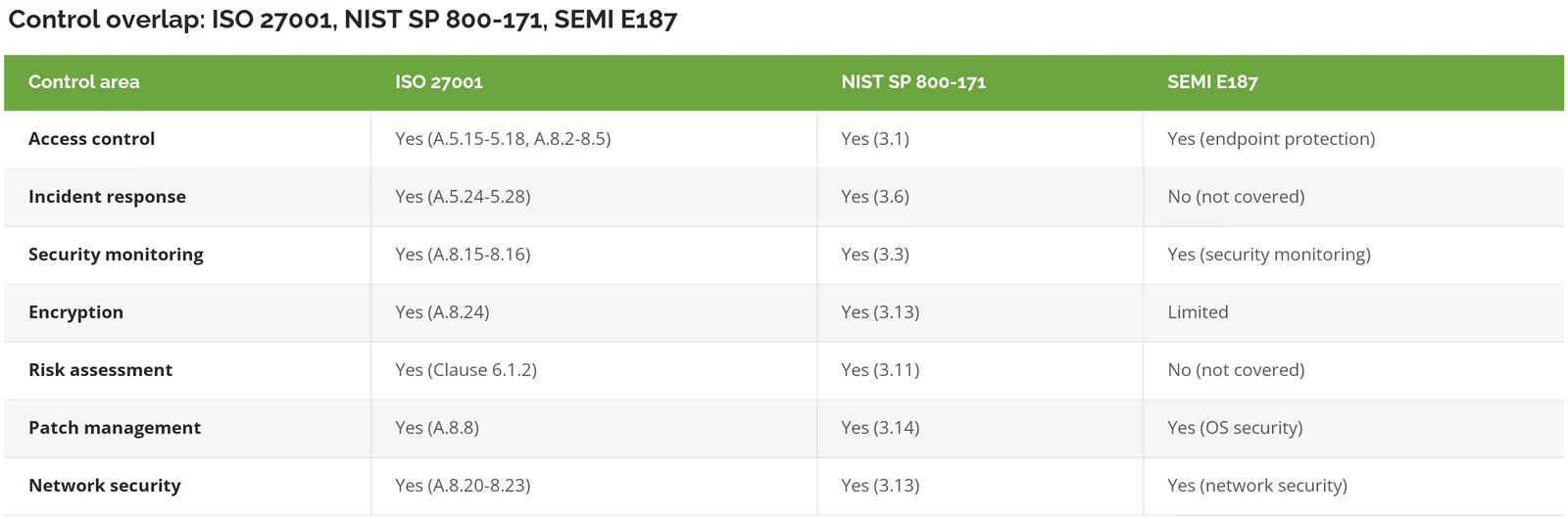
The overlap means you don't need separate compliance programs for each framework. A unified approach that maps controls across ISO 27001, NIST SP 800-171, and SEMI E187 simultaneously saves time, money, and documentation effort.
Consilien builds unified compliance programs for electronics manufacturers facing multiple overlapping frameworks. One set of controls. One documentation library. Multiple frameworks satisfied.
How to Get Started
Don't try to read the standard and figure it out alone. The ISO document itself is dense and procedural. What you need is someone who can translate it into specific actions for your environment.
Start with a gap assessment. 2-4 hours. We map your current state against ISO 27001:2022 requirements, identify what's in place, what's missing, and what needs documentation. The output is a prioritized remediation roadmap with realistic timelines.
From there, it's control implementation, policy documentation, internal audit, and management review. We do this alongside your IT team through the co-managed model. They keep running the business. We drive the compliance program.
25+ years managing IT for manufacturers. MSP 501 for 2025 and 2026. Highly rated on Clutch.
If ITAR and CMMC are your primary compliance drivers rather than ISO 27001, read our guide on compliance readiness for electronics manufacturers.