Co-Managed IT vs. Full Outsource: What Electronics Manufacturers Should Choose
Co-managed IT keeps your internal team and adds outside cybersecurity, compliance, and infrastructure support. Fully outsourced IT replaces your internal team entirely. For electronics manufacturers with 1-3 IT staff and production systems that require institutional knowledge, co-managed is almost always the better model. This guide breaks down both approaches with specifics for PCB fabricators, semiconductor suppliers, and EMS companies.
Table of Contents
We sell co-managed IT. But we've also walked away from co-managed deals and recommended full outsourcing instead when the client had no internal IT staff, no production floor complexity, and no institutional knowledge to preserve. The right model depends on your situation. Not our sales quota.
The problem with most "co-managed vs. outsourced" articles online is that they're written for generic office environments. A 200-person law firm and a 200-person PCB fabricator have completely different requirements. This guide is written for electronics manufacturers specifically.
What Co-Managed IT Actually Means
Co-managed IT is a partnership model. Your internal IT team stays in place. An external IT provider works alongside them, handling the functions your team doesn't have the bandwidth, expertise, or coverage to manage.
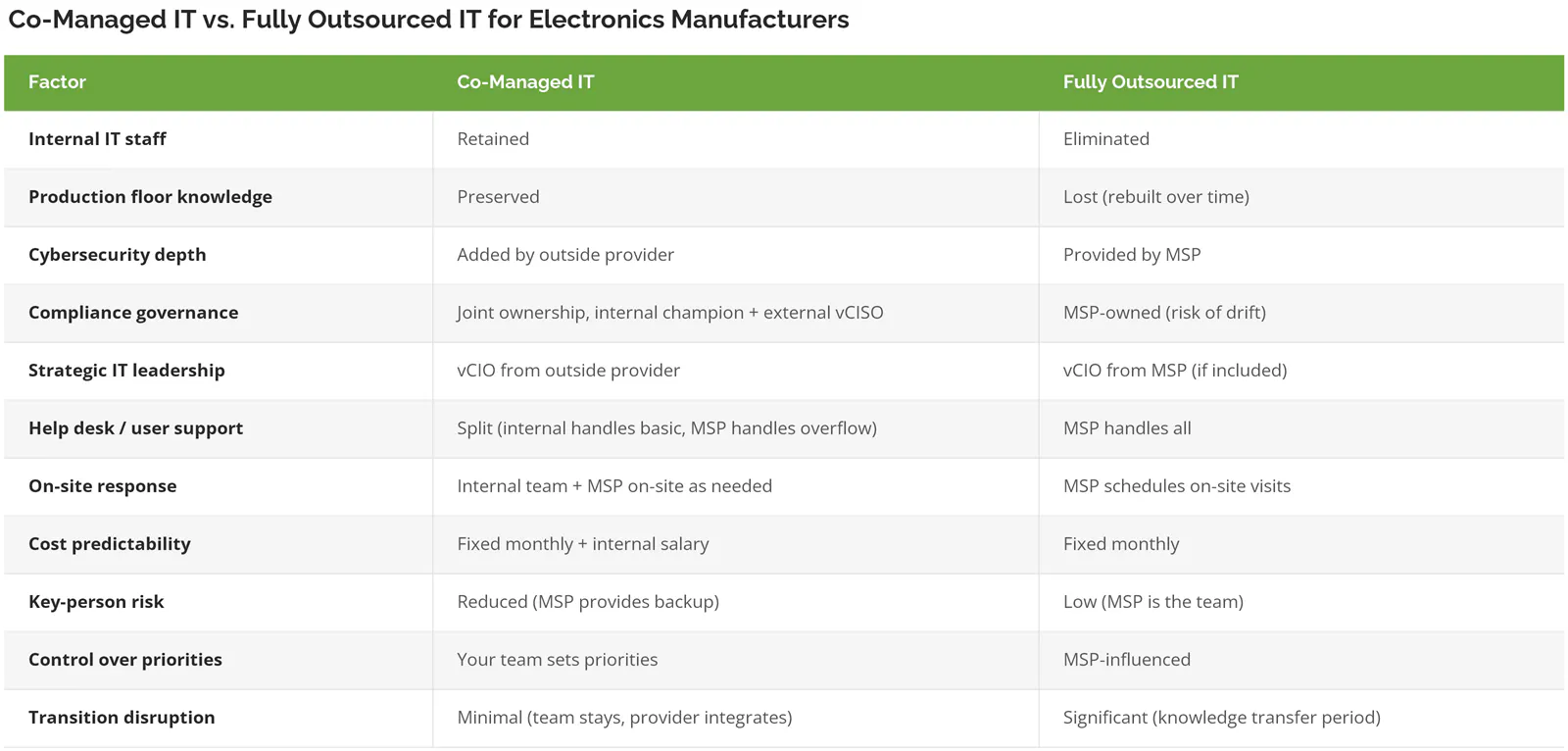
For an electronics manufacturer, that typically means the internal IT person (or 2-3 person team) keeps handling what they know: user support, ERP administration, production floor troubleshooting, and the institutional knowledge that only comes from working inside the business for years. The outside provider handles cybersecurity, compliance governance, infrastructure management, strategic planning (vCIO/vCISO), and project work the internal team can't get to.
The key distinction: your team retains control. They set priorities. They maintain relationships with users. They keep the contextual knowledge of your production environment. The outside team adds depth, not displacement.
What Fully Outsourced IT Means
Fully outsourced IT means the MSP becomes your IT department. They own everything: help desk, infrastructure, security, strategy, vendor management. Your company has no internal IT staff.
This model works for organizations that don't have IT people already and don't want to hire them. If you're starting from zero, full outsourcing gives you a complete IT operation without building one internally.
Why This Decision Is Different for Electronics Manufacturers
In a standard office environment, switching from internal to outsourced IT is mostly about cost and coverage. The MSP takes over desktops, email, and network management. The transition is straightforward because office environments are relatively standard.
Electronics manufacturing is different. Five factors change the calculation.
Production floor knowledge can't be outsourced easily. Your IT person knows which MES system crashes when you update the firmware on Line 3. They know the workaround for the legacy AOI software that hasn't been patched since 2019. They know which engineer stores critical test procedures on a local drive instead of the server. That knowledge takes months, sometimes years, to rebuild. Outsourcing means losing it.
OT/IT convergence requires on-site context. When production equipment shares network infrastructure with corporate IT, the person managing the network needs to understand both worlds. An off-site MSP team doing remote monitoring doesn't have the same visibility into production floor dynamics as someone who walks the floor.
Compliance requires internal champions. ITAR, CMMC, and SEMI E187 compliance programs need someone inside the organization who owns the controls day-to-day. A fully outsourced MSP can build the framework, but without internal ownership, compliance drift starts immediately.
Response time for production issues is different. When a critical production system goes down, the response needs to be minutes, not hours. An on-site IT person who can physically touch the system has an advantage over a remote help desk that needs to schedule an on-site visit.
Your IT person is often the only person who understands the full environment. In many electronics manufacturers, the IT admin is also the unofficial ERP admin, the network admin, the print server manager, and the person who troubleshoots the label printer on the production floor. Replacing that person with an outside team creates a transition gap that can disrupt operations for months.
Side-by-Side: What Each Model Looks Like for Electronics Manufacturers
When Co-Managed IT Is the Right Choice
Co-managed IT fits electronics manufacturers in these situations.
You have 1-3 IT staff who know your environment but are stretched too thin. They're good at what they do. They just can't do everything. Adding cybersecurity, compliance, and strategic IT leadership through an outside partner lets them focus on what they do best.
You have production systems that require institutional knowledge. If your ERP, MES, or legacy production equipment has quirks that only your internal person understands, replacing them creates unnecessary risk.
You have compliance obligations that require internal ownership. ITAR, CMMC, and ISO 27001 all benefit from having someone inside the organization who owns controls day-to-day. Co-managed gives you that structure.
You want to keep control. Your team sets the priorities. Your leadership makes the decisions. The outside provider executes within your framework, not theirs.
When Full Outsourcing Is the Right Choice
Full outsourcing fits in a narrower set of scenarios.
You have zero IT staff and no plans to hire. If you're starting from nothing, building a one-person IT department and immediately layering co-managed on top is often less efficient than going directly to fully outsourced.
Your environment is relatively standard. If you don't have production floor equipment, OT/IT convergence, or specialized systems that require institutional knowledge, the transition risk is lower.
You want complete simplicity. One provider, one contract, one accountability point. No internal IT management required.
How Consilien's Co-Managed Model Works for Electronics Manufacturers
We built our co-managed IT service specifically for manufacturers with lean IT teams.
Your IT team keeps running day-to-day operations. We add 24/7 cybersecurity monitoring, compliance governance, infrastructure management, vCIO strategy, help desk overflow, and project capacity. We integrate alongside your team through a structured onboarding process: discovery, assessment, roadmap, kickoff.
CIMS (Consilien IT Maturity Standard) gives your environment a defined maturity path. Your vCIO meets with leadership regularly to review the roadmap, adjust priorities, and make sure IT spend aligns with business goals.
Standard 3-year agreement with a 1-year opt-out and 60-day notice. If it doesn't work, you're not trapped.
Before You Decide
Ask yourself three questions.
Do you have internal IT staff with institutional knowledge worth preserving? If yes, co-managed.
Does your production environment require on-site, hands-on IT support? If yes, co-managed.
Do you have compliance obligations that require internal ownership? If yes, co-managed.
If the answer to all three is no, fully outsourced may be the better path. But for most electronics manufacturers with production floor complexity, 50-1,000+ employees, and compliance requirements, co-managed is the model that works.
Explore Consilien's full approach to IT services for semiconductor and electronics manufacturers.