IT Challenges for Clean Room and Precision Manufacturing Environments
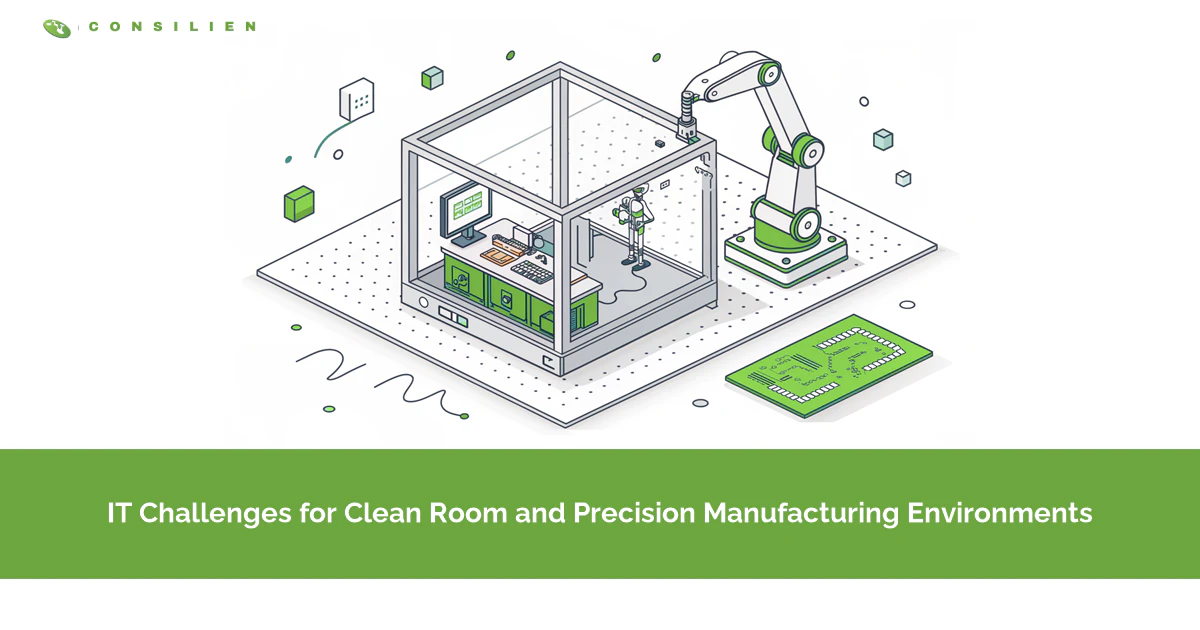
Clean room and precision manufacturing environments create IT constraints that standard office-centric IT support isn't built for. Restricted device access, ESD-safe hardware requirements, contamination protocols that prevent normal troubleshooting, legacy equipment on isolated networks, and authentication challenges on shared production terminals all demand IT approaches designed around the manufacturing floor, not adapted from an office playbook.
Table of Contents
Your IT Provider Probably Hasn't Gowned Up
Most IT support models are built for offices. Laptops on desks, phones in pockets, Wi-Fi everywhere, and a technician who can walk over and fix the printer.
That model falls apart in a clean room.
Try sending a help desk technician into an ISO Class 5 environment without gowning training. Try scanning a barcode on a moving conveyor with a consumer-grade Wi-Fi access point that drops signal behind every metal enclosure. Try pushing a firmware update to a semiconductor process tool that hasn't rebooted in 14 months because the production schedule doesn't have a maintenance window until Q4.
For electronics manufacturers running clean room or precision manufacturing operations, IT isn't a support function you bolt onto the production environment. It's infrastructure that has to be designed around constraints most IT providers have never encountered. And when it's done wrong, the consequences aren't a slow email server. They're contaminated product, ESD damage, production downtime, or a compliance failure that costs a contract.
The Constraints That Change Everything
Clean room and precision manufacturing environments operate under a set of restrictions that fundamentally change how IT infrastructure gets designed, deployed, and maintained.
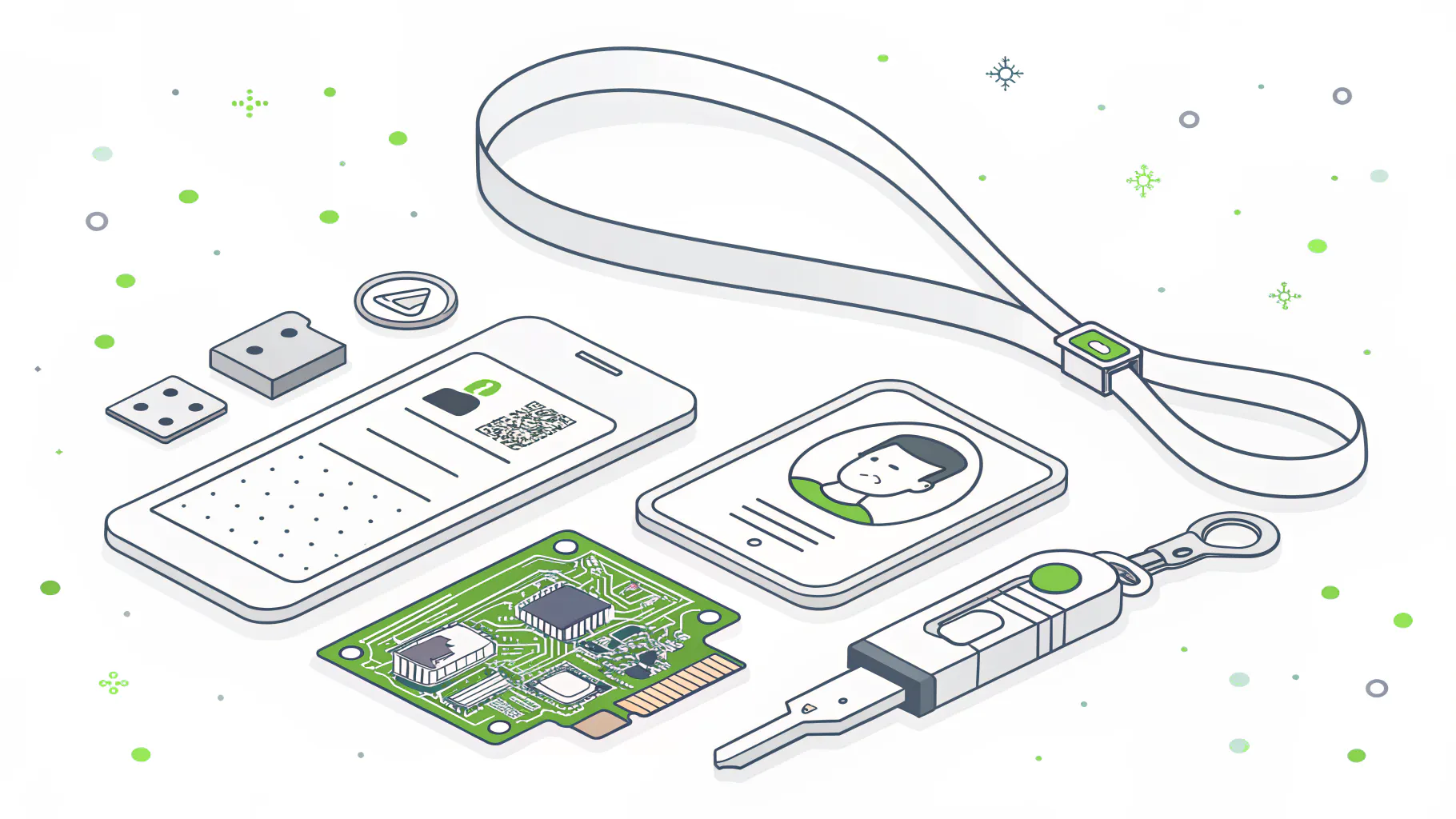
No personal devices on the production floor. Phones are restricted or banned in most clean rooms and many precision manufacturing areas. That eliminates phone-based MFA, mobile app authenticators, and SMS verification as authentication options. For companies implementing identity and access management across their environment, shared production terminals need authentication methods that don't rely on personal devices. Badge-based authentication, FIDO2 hardware tokens, or proximity cards. Not the authenticator app that works fine for the office upstairs.
Contamination protocols that restrict physical IT access. IT equipment entering a clean room requires specific handling procedures. Technicians need clean room gowning training and must follow documented entry and exit protocols. A standard break-fix dispatch where someone walks in with a toolkit and starts swapping components isn't just ineffective in a clean room, it can compromise the manufacturing environment itself. Every particle matters. An IT technician who doesn't understand that can cause more damage than the problem they came to fix.
ESD creates a different hardware standard. Electrostatic discharge as low as 10-20 volts can damage sensitive electronic components. Humans can't perceive ESD below about 3,000 volts. Standard IT hardware, keyboards, mice, monitors, networking equipment, isn't ESD-rated by default. Clean room and precision manufacturing IT infrastructure requires ESD-safe components, conductive or static-dissipative materials at workstations, proper grounding, and ionization systems. An IT provider specifying standard commercial equipment for a clean room workstation is creating a contamination and damage risk.
Environmental controls that affect hardware performance. Temperature and humidity in a semiconductor clean room are maintained within fractions of a degree. HVAC systems designed for particle filtration and temperature precision don't always play well with heat-generating IT equipment. Server rooms adjacent to clean rooms need their own environmental controls. Network switches and access points deployed inside clean rooms need to be rated for the environment and positioned to avoid disrupting airflow patterns designed to maintain laminar flow.
Legacy equipment on networks that can't change. Precision manufacturing equipment often runs for 15-20 years. The process tool that was installed in 2012 running Windows 7 embedded with a proprietary control application isn't getting replaced because your IT policy says Windows 7 is end of life. It's producing $2M in revenue per month. The IT challenge is building the security and network architecture around equipment that can't be modernized without a capital expenditure nobody has budgeted for. That means network segmentation, compensating controls, and monitoring, not replacement.
Wireless Networking on a Manufacturing Floor Is a Different Problem
Setting up Wi-Fi in a clean room or precision manufacturing facility has almost nothing in common with deploying an office network.
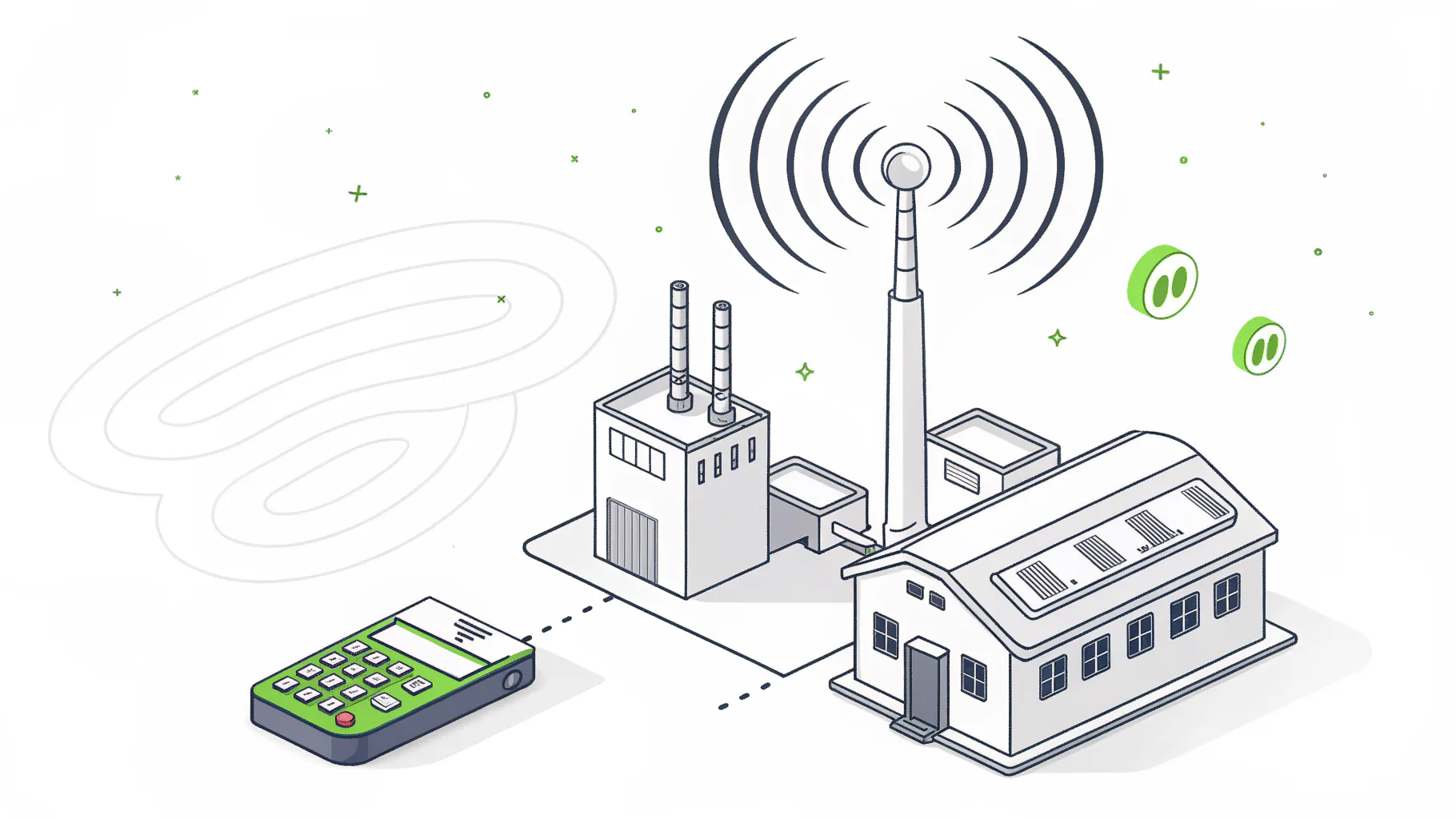
Metal enclosures, concrete walls, moving equipment, electromagnetic interference from production machinery, and high-density sensor networks all degrade wireless signal. Standard consumer-grade or even commercial-grade access points don't cut it. Industrial-rated wireless hardware, professional RF site surveys, and protocol-aware network design are requirements, not upgrades.
In electronics manufacturing specifically, the wireless challenges compound.
The production floor might have hundreds of IoT sensors feeding environmental monitoring data. Barcode and RFID scanners operating across the warehouse and staging areas. Engineering workstations that need reliable connectivity for CAD/CAM applications. MES terminals pulling production data in real time. Each of these puts different demands on the wireless network, and they're all competing for bandwidth in an environment designed to block exactly the kinds of signals wireless networks depend on.
RF interference from production equipment is the challenge nobody talks about until deployment day. Pick-and-place machines, reflow ovens, wave solder equipment, and test systems all generate electromagnetic noise. An RF site survey done with equipment powered down is useless. You need the survey done during production, under full load, to understand the actual signal environment.
IT Support That Understands Manufacturing Operations
The gap between standard IT support and what clean room and precision manufacturing environments actually need shows up in predictable places.
Maintenance windows that align with production schedules. You can't patch a production server at 2 AM if the line runs 24/7. You can't reboot a network switch during a wafer run. IT maintenance has to coordinate with production planning, not the other way around. Critical patches get tested in a staging environment and deployed during planned downtime, which might be once a quarter or less frequently.
On-site support that follows clean room protocols. When a workstation in the clean room fails, the response isn't dispatching the nearest available technician. It's sending someone who is gowning-trained, understands the entry and exit procedures, knows which tools can enter the environment, and can troubleshoot without introducing contamination. If your IT provider doesn't have technicians trained for clean room access, every hardware issue becomes either a production stop while someone gets trained or a contamination risk while someone wings it.
Vulnerability management that doesn't disrupt production. Active vulnerability scanning against OT equipment and sensitive production systems can crash legacy controllers. Passive monitoring, configuration audits during planned maintenance, and vendor-coordinated patching are the approach. Your IT provider needs to understand the difference between scanning a corporate laptop and scanning a wire bonder's control interface.
Backup and recovery that accounts for production data. A clean room manufacturer's recovery plan isn't just about restoring email and file servers. It's about restoring MES data, production recipes, equipment configurations, SPC databases, and quality records. The recovery time objective for a production MES isn't 24 hours. It's measured in the cost-per-hour of a production line sitting idle waiting for data.
The Compliance Intersection
Clean room and precision manufacturing environments don't exist in a compliance vacuum. The same facilities that run ISO Class 5 clean rooms often handle ITAR-controlled data, CUI subject to NIST SP 800-171, or production data governed by customer-specific security requirements.

The compliance challenges specific to these environments include authentication in restricted-device zones (we covered this on the IAM page), access logging on shared production terminals, data protection for process recipes and test procedures that constitute trade secrets, and audit trails that satisfy both quality systems (ISO 9001, AS9100) and cybersecurity frameworks (CMMC, NIST CSF).
What makes this complicated is the overlap. The same workstation that needs clean room protocol compliance for quality purposes also needs cybersecurity controls for CMMC. The same network that needs to be segmented for IEC 62443 zone architecture also needs to support the environmental monitoring systems that keep the clean room within specification.
An IT provider who treats cybersecurity and manufacturing operations as separate conversations is going to create separate, conflicting systems. The goal is one integrated infrastructure that satisfies both, designed by people who understand that a clean room isn't just an office with stricter HVAC.
What Clean Room and Precision Manufacturers Should Expect from IT
Not everything on this list is complicated. Some of it is just knowing to ask.
Does your IT provider have technicians trained for clean room access? If not, how do they handle hardware issues inside the clean room?
Do they understand ESD-safe hardware requirements for production floor workstations? Or are they specifying the same commercial equipment they'd put in a law firm?
Can they design wireless networks for industrial RF environments? Have they done RF site surveys during production?
Do they coordinate maintenance windows with your production schedule? Or do they push patches on their timeline?
Do they understand the difference between scanning a corporate endpoint and probing a precision manufacturing control system?
Can they build a network architecture that segments production OT from corporate IT while maintaining the data flows your MES, quality systems, and environmental monitoring depend on?
Can they support co-managed IT where your internal team handles production-specific systems while they manage the broader IT infrastructure and security stack?
If the answer to most of those is no, you don't have an IT problem. You have a fit problem. The provider built for professional services firms and general office environments isn't wrong. They're just not designed for your operating constraints.
The Floor Dictates the IT. Not the Other Way Around.
Clean room and precision manufacturing environments don't adapt to IT standards. IT adapts to them. The production floor's contamination protocols, ESD requirements, uptime demands, and environmental controls are fixed constraints. The IT infrastructure, the support model, the security architecture, and the maintenance cadence all need to be designed within those constraints.
If your current IT partner treats your production floor like an office with expensive equipment, the gap will show up eventually. Usually during a hardware failure, a compliance audit, or a security incident where the response team can't enter the room where the problem is.