IT Compliance Costs: What CMMC, SOC 2, and ISO 27001 Cost in 2026
A first SOC 2 or ISO 27001 effort usually costs $30,000 to $90,000 in year 1. CMMC Level 2 runs higher. Combine two government estimates and a small business starting from zero lands near $488,000 over 3 years. The audit fee is rarely the big line.
Table of Contents
IT compliance costs tend to get quoted as if CMMC, SOC 2, and ISO 27001 were 3 versions of the same purchase. They aren't. Each one is checked by a different kind of auditor, on a different schedule, and ends with a different piece of paper, so the invoices come out shaped differently even where the security work underneath overlaps.
That shape is worth understanding before you look at any single number. A SOC 2 report gets bought again every year. Every single year. An ISO 27001 certificate lasts 3 years, with smaller check-ins in between. CMMC also runs on a 3-year clock, but with Phase II on hold, a defense supplier right now is typically paying for the work and a self-assessment, not an outside assessor. Scoping a compliance program starts with figuring out which of those clocks a business is actually on.
How much do CMMC, SOC 2, and ISO 27001 cost?
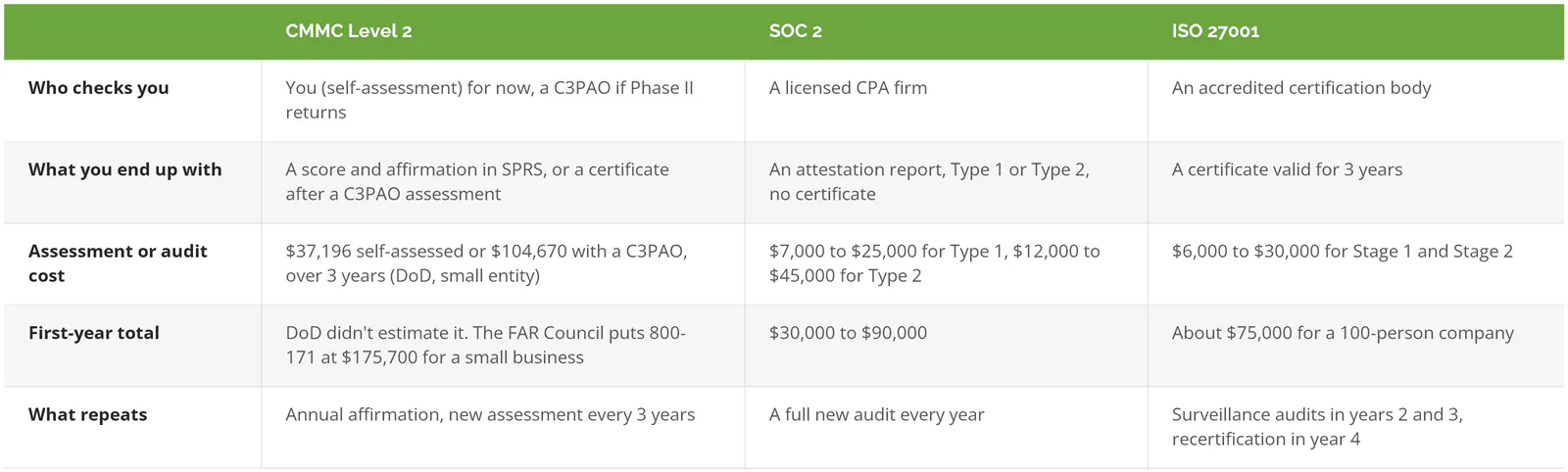
SOC 2 audits run about $7,000 to $45,000, and ISO 27001 certification audits about $6,000 to $30,000, but first-year totals land closer to $30,000 to $90,000. The DoD estimates a CMMC Level 2 third-party assessment at $104,670 over 3 years for a small business.
IT compliance costs are the total a business spends to meet a security framework and prove it to an outsider. That includes the gap assessment, the fixes, the software that collects evidence, the hours your own people put in, and the audit fee itself. The audit is the part with an invoice attached. So it gets the attention.
CUI, or controlled unclassified information, is the government's label for sensitive data that isn't classified, like the drawings and specs a defense prime contractor shares with its suppliers. A C3PAO is an outside firm authorized to assess CMMC. SPRS is the DoD database where your self-assessment score lives, and contracting officers check it before award.
If you're comparing outside help as well as audit fees, our roundup of IT compliance consulting firms lists published minimums for 8 of them.
What are you actually paying for?
Five things, and the audit is usually the smallest. Readiness work, fixing gaps, evidence software, and your own staff hours make up the rest, and the staff hours are the line nobody puts on a quote.
Roughly in the order the money goes out the door:
- Gap assessment. Someone compares what you do today against the framework's requirements and writes down the difference. For SOC 2, BD Emerson puts a standalone gap assessment at $5,000 to $15,000 and full readiness support at $15,000 to $40,000.
- Remediation, meaning fixing what the gap assessment found. No ceiling on this one. A company that already uses multi-factor authentication everywhere, keeps tested backups, and writes things down might spend a few thousand dollars here. A company whose file server still runs on a closet tower from 2016 can spend more on remediation than on everything else combined.
- Evidence and tracking software, often called a compliance automation platform. BD Emerson's range is $8,000 to $30,000 a year.
- Your people's time.
- The audit.
Staff time deserves real numbers, because it's where budgets quietly break. BD Emerson estimates 100 to 300 internal hours for a first SOC 2, and 300 to 600 hours for an ISO 27001 effort run without a consultant. Put a price on those hours using the Bureau of Labor Statistics median wage for information security analysts, $129,180 in May 2025, and the BLS finding that wages are 70% of total employee compensation, and an hour of that person costs about $88.70 loaded. So 100 to 300 hours is roughly $8,900 to $26,600. The ISO range is $26,600 to $53,200.
Nobody invoices you for that. It shows up somewhere else. The firewall replacement slips a quarter. The ERP upgrade, meaning the system that runs orders and inventory, waits.
Whether the software is worth buying depends on how many frameworks you're carrying and how disciplined your team already is about writing things down. We walked through that tradeoff in compliance automation, build vs. buy.
What does CMMC Level 2 cost while Phase II is paused?
During the pause, your CMMC compliance cost is whatever implementing NIST SP 800-171 costs you, plus a self-assessment the DoD estimates at $37,196 over 3 years for a small business. The $104,670 third-party assessment isn't required for award right now.
On July 13, 2026, the Department of War (the renamed Department of Defense) suspended CMMC Phase II. Phase II was the step that would have made a C3PAO assessment a condition of contract award starting November 10, 2026, and that requirement is now on hold. A reform task force delivered its report to the DoW CIO in September, and as of Covington's September 21 update it hadn't been made public.
The work didn't pause. Self-assessments against the 110 requirements in NIST SP 800-171 Rev. 2 still apply, offerors still need a current score and affirmation in SPRS to be eligible for award, and DFARS 252.204-7012, the defense contracting clause behind these controls, still requires incident reporting within 72 hours. Latham & Watkins notes that some contractors are choosing a C3PAO assessment or readiness review anyway, and that prime contractors still have to confirm their subcontractors meet the same requirements, even without one.
DoD priced each path in the final CMMC program rule published in the Federal Register on October 15, 2024.

The same rule says the DoD "did not consider the cost of implementing the security requirements themselves," because DFARS has required those controls since December 31, 2017. The DoD priced the inspection. It assumed the house was already built.
What if it isn't? A different government estimate fills the gap. When the FAR Council proposed applying the same 800-171 controls to non-defense contractors in January 2025, it estimated $175,700 in the first year and $103,800 a year after that for a small business. Take that first year, add 2 years of upkeep and the DoD's C3PAO figure, and you get $487,970, to the dollar. It matches the $487,970 figure some vendor pages attribute to the government. It's real. But it describes a company starting from nothing, which a defense supplier that has been following DFARS since 2017 shouldn't be.
One cost that surprises people is licensing. CUI generally has to live in an environment built for it, and for a lot of suppliers that means GCC High, Microsoft's government cloud version of Microsoft 365. Secureframe lists GCC High Business Premium at $35.80 per user per month against $22 for the commercial version. For 50 users, that's $8,280 a year more. Every year.
Does everyone need to move? Not usually. A smaller walled-off environment, called an enclave, can hold the CUI so only the 8 or 10 people who actually open drawings need the expensive licenses. That's a scoping decision. It's also where the CMMC budget really gets set, well before anyone picks an assessor, and it's the first thing a CMMC gap assessment should settle. The NIST 800-171 to CMMC crosswalk shows how the two map control by control. For the full engagement, see CMMC compliance services.
What does SOC 2 cost, and why do you pay for it every year?
A SOC 2 Type 1 audit runs about $7,000 to $25,000, and a Type 2 about $12,000 to $45,000 for startups and mid-market companies. SOC 2 is a report, an auditor's written opinion on your controls, not a certificate, so customers expect a fresh one every year.
Two types, two different questions. Type 1 says your controls were designed correctly on one day. Type 2 says they actually worked across an observation window, which Scrut puts at 3 to 12 months. Think of Type 1 as a photograph and Type 2 as the security camera footage. Larger buyers usually ask for the footage, and our breakdown of SOC 2 Type I vs. Type II covers when the photograph is enough.
Then there's the auditor spread, which is wider than people expect. BD Emerson describes one company quoted $15,000, $35,000, and $90,000 by a boutique CPA firm, a mid-tier firm, and a Big Four practice for materially the same report. Same controls. Same company.
Is the $90,000 report better? Sometimes. A specific enterprise customer might insist on a name they recognize. Usually it isn't, though, and asking your largest customer which auditors they accept before you sign anything is a free question that can save five figures.
Year 2 catches people off guard. BD Emerson puts ongoing SOC 2 compliance costs at $25,000 to $75,000 a year, because the audit starts over each cycle. It gets cheaper only when year 1 left behind controls that run without someone chasing them, and that's a big part of what SOC 2 compliance services should be setting up.
What does ISO 27001 certification cost over a 3-year cycle?
Stage 1 (a document review) and Stage 2 (testing that controls actually work) certification audits run about $6,000 to $30,000, surveillance audits $4,000 to $12,000 each in years 2 and 3, and recertification in year 4 costs close to the original audit.
ISO doesn't certify your firewall. It certifies your ISMS, short for information security management system. That's the written set of policies, risk reviews, internal audits, and management sign-offs that keeps security running as a process instead of a project. BD Emerson's worked example for a 100-person, single-site company comes to roughly $75,000 in year 1, about $30,000 in each of years 2 and 3, and roughly $135,000 for the first full cycle.
We've covered ISO in more depth in ISO 27001 certification cost and timeline, including where the 200 to 1,200 hours of staff time go. For help running it, see ISO 27001 certification services.
How do the three compare over 3 years?
Over a full cycle, ISO 27001 often costs less than SOC 2 because its middle years are lighter. CMMC can cost the most, but only if you're starting implementation from scratch.
One 100-person company, modeled from the published component costs above. Not a quote.
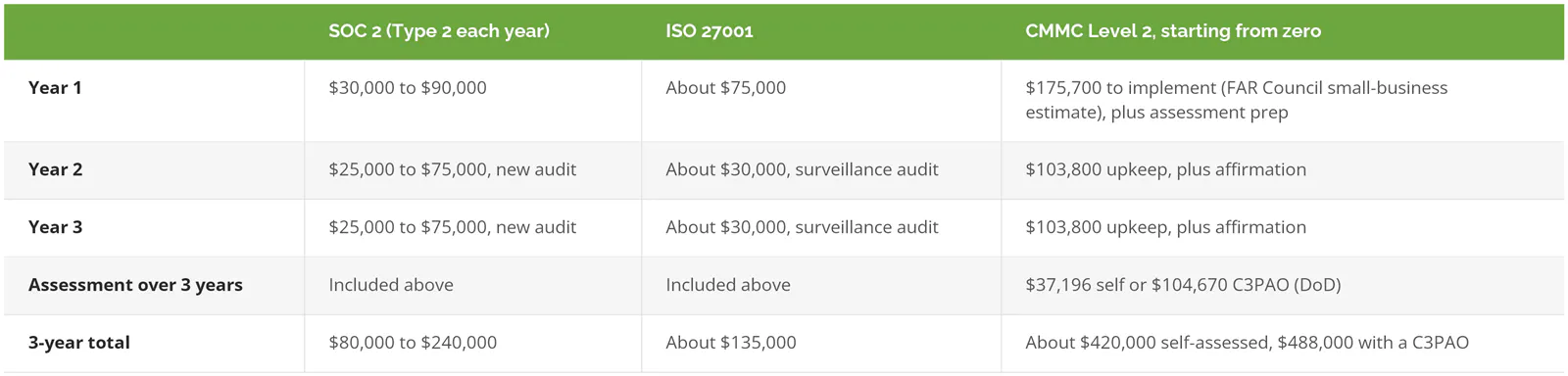
Two caveats. The CMMC column mixes two government estimates and uses the small-entity figures. A larger company runs higher. And SOC 2's year 2 drops toward the bottom of its range only if year 1 left you with controls that run on their own.
PCI DSS is a different animal, since your payment setup decides most of the cost, and we priced it separately in PCI DSS compliance cost for small businesses.
Does doing two frameworks at once save money?
Usually, yes, because the controls overlap. But the published overlap estimates range from 40% to 85%, so plan on reusing evidence, not skipping work.
That range comes from Drata's comparison of SOC 2 and ISO 27001, and the width tells you something. It depends on how you count. Some controls map cleanly. Access reviews, change management, incident response, and risk assessment line up almost one to one. Others don't. ISO's management system and its Statement of Applicability, the document listing which controls you use and why, have no real SOC 2 equivalent.
What actually saves money is building one set of controls and mapping it to each framework, instead of running two programs side by side with two owners and two evidence folders. Picture two people writing the same password policy for two auditors, a year apart. Wasteful. And surprisingly common.
Order matters too. If you handle CUI, start with CMMC, because NIST SP 800-171 is the most prescriptive of the three and its 110 controls cover a lot of what SOC 2 and ISO ask for. If you sell software to U.S. companies, SOC 2 first is common. International customers tend to ask for ISO. Our SOC 2 vs. ISO 27001 comparison goes further, and our list of compliance automation platforms covers the tools that handle the mapping.
When it makes sense to wait
If no customer has asked for a SOC 2 report, and you don't touch CUI or card data, you probably don't need to buy an audit this year.
Waiting isn't skipping. Compliance and security aren't the same thing. A framework proves that certain controls existed when someone checked. It doesn't promise you won't be breached the week after, and a business can pass an audit with a backup nobody has ever test-restored. The useful order is to make the environment sound first, then pay someone to verify it when a contract or customer requires proof.
Picture a 60-person engineering firm about to buy a SOC 2 Type 2 because a competitor has one, though none of its own customers have asked. Spending that year on multi-factor authentication, an offsite backup it actually tested, and written access reviews instead means that when a large client does ask, the readiness gap is small and the audit is the easy part. Cheaper, too.
Consilien is a managed IT and cybersecurity company headquartered in Torrance, California, working with businesses nationwide. Compliance readiness for CMMC, SOC 2, ISO 27001, NIST, and PCI DSS is its own service, separate from managed IT, built around gap assessments, remediation plans tied to specific controls, and ongoing governance alongside your external auditor.
If you're trying to work out which framework you're actually on the hook for, and what it would take to get there from where you are, speak to a compliance expert.