How NIST 800-171 Maps to CMMC: A Crosswalk for Defense Contractors
How NIST 800-171 Maps to CMMC: A Crosswalk for Defense Contractors
Here's what most contractors get wrong. NIST 800-171 and CMMC are not two separate obligations stacked on top of each other. CMMC Level 2 is NIST SP 800-171 Revision 2. Same 110 security requirements, same 14 control families, same 320 assessment objectives. What the Cybersecurity Maturity Model Certification adds isn't a new control set. It adds verification. Where you used to self-attest your score, a third party now checks it. If you have already built toward 800-171 and you are staring down a contract clause that names CMMC, the work you need is a CMMC compliance crosswalk, not a restart.
Table of Contents
That single shift, from "trust me" to "prove it," is the whole reason a crosswalk matters. A System Security Plan you wrote for your DFARS 252.204-7012 obligations is the same document an assessor wants to see for CMMC. This guide lays out the map: which CMMC level points to which NIST source, how the 14 families line up, how scoring ties the two frameworks together, and where the mapping quietly breaks during a real assessment.
NIST 800-171 vs. CMMC: same controls, different proof
NIST SP 800-171 is the standard. It defines 110 requirements for protecting Controlled Unclassified Information (CUI) on non-federal systems. It's been the substance of DFARS 252.204-7012 since 2017, and for years contractors graded their own homework, posting a self-assessment score to the Supplier Performance Risk System and moving on.
CMMC is the enforcement mechanism wrapped around that standard. The Department of Defense built it because self-attestation was not working. By the DoD's own analysis, the average contractor had implemented only a fraction of the required controls while reporting far higher. CMMC does not rewrite the controls. It decides who gets to confirm you actually meet them, and at Level 2 for most CUI work, that confirmation comes from an accredited C3PAO assessment, not your own word.
So the crosswalk starts with a clean mental model. NIST 800-171 answers "what do I have to do." CMMC answers "how do I have to prove I did it, and how often." Hold those two questions apart and the rest of the mapping falls into place.
The crosswalk at a glance
CMMC has three levels. Each one points to a specific NIST or FAR source. This is the core of the map.
- Level 1 (Foundational): maps to FAR 52.204-21. 17 requirements covering Federal Contract Information (FCI), verified by an annual self-assessment.
- Level 2 (Advanced): maps to NIST SP 800-171 Rev 2. 110 requirements covering Controlled Unclassified Information (CUI), verified by C3PAO certification on most contracts, or self-assessment in limited cases.
- Level 3 (Expert): maps to NIST SP 800-171 plus selected 800-172. 110 requirements plus 24 enhanced ones covering CUI under advanced persistent threat, verified by a government (DIBCAC) assessment.
Two details on this list do most of the work in practice. First, the jump from Level 1 to Level 2 is not a step up the same ladder. It is a change of source document, from a FAR clause to the full 800-171 standard, and a change of stakes, from FCI to CUI. Second, Level 3 doesn't replace 800-171. It sits on top of it and grafts on 24 enhanced requirements drawn from NIST SP 800-172. If you handle ordinary CUI, Level 2 is your world, and 800-171 is the whole conversation.
The 14 control families, mapped
NIST 800-171 sorts its 110 requirements into 14 families. CMMC Level 2 uses the same 14, calls them domains, and keeps the same counts. There is no translation loss here. A control in 800-171 is the same control in CMMC, down to the identifier.
- Access Control (AC), 22 requirements. Who can reach CUI and what they can do with it.
- Awareness and Training (AT), 3 requirements. Staff recognize and report security risks.
- Audit and Accountability (AU), 9 requirements. Logs are generated, retained, and reviewed.
- Configuration Management (CM), 9 requirements. Systems are hardened and changes are controlled.
- Identification and Authentication (IA), 11 requirements. Users are uniquely identified, including MFA.
- Incident Response (IR), 3 requirements. Incidents are detected, handled, and reported.
- Maintenance (MA), 6 requirements. System maintenance is performed safely.
- Media Protection (MP), 9 requirements. CUI on media is protected, encrypted, and sanitized.
- Personnel Security (PS), 2 requirements. People are screened before access.
- Physical Protection (PE), 6 requirements. Facilities and hardware are physically secured.
- Risk Assessment (RA), 3 requirements. Risks and vulnerabilities are identified.
- Security Assessment (CA), 4 requirements. Controls are assessed and tracked in an SSP and POA&M.
- System and Communications Protection (SC), 16 requirements. Network boundaries and data in transit are protected.
- System and Information Integrity (SI), 7 requirements. Flaws are fixed and threats are monitored.
Three families carry the most weight by sheer count: Access Control at 22, System and Communications Protection at 16, and Identification and Authentication at 11. They are also where most contractors lose the most ground, which we will get to. The official CMMC Model mapping from the DoD CIO publishes the full requirement-by-requirement crosswalk if you want the line items.
How scoring connects the two: SPRS, the 80% threshold, and POA&Ms
Here's where the crosswalk gets useful instead of academic. The same 110 requirements feed a single scoring system, and that score is your compliance currency in both the 800-171 and CMMC worlds.
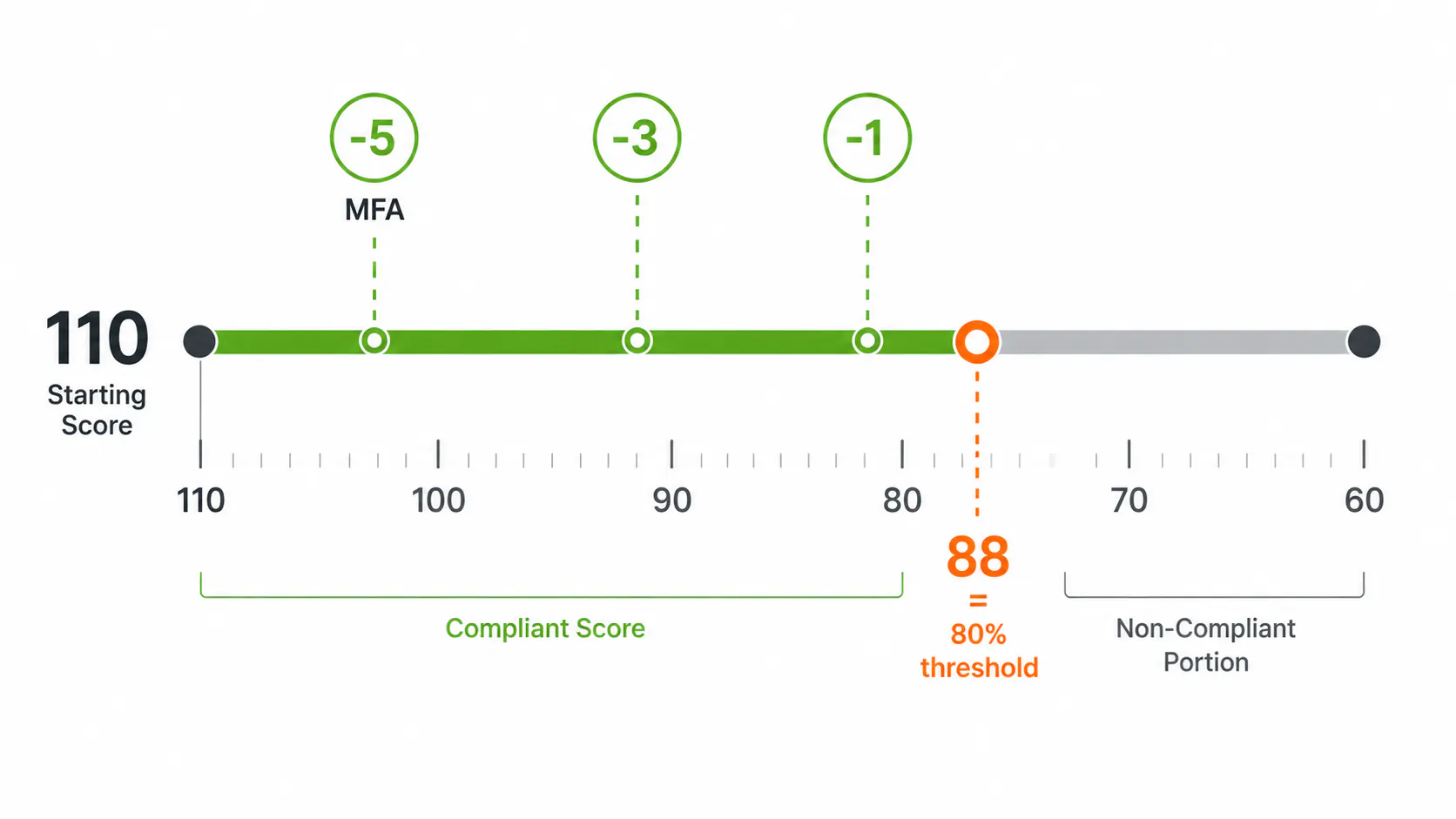
The math starts at 110 and works down. Every requirement you haven't fully implemented subtracts a weighted value: 5 points for the highest-impact controls, 3 for moderate, 1 for the rest. Miss multi-factor authentication and you lose 5 in one stroke. The resulting SPRS score can run as low as negative 203 and tops out at a clean 110.
Under each of those 110 requirements sits a set of assessment objectives, 320 in total across the standard, spelled out in NIST SP 800-171A. An assessor does not grade the requirement as a single pass-fail. They grade every objective beneath it. That granularity is why a control you believe is "done" can still fail. You implemented the technology but never documented the procedure, and the objective asking for the procedure is marked not met.
CMMC Level 2 layers a threshold on top of the score. To earn conditional certification, you need at least 80%, or 88 of 110 points, and a Plan of Action and Milestones covering the rest. Conditional status gives you 180 days to close every item on that POA&M and pass a closeout assessment. One catch is worth circling. Certain high-value requirements, including MFA, cannot be deferred to a POA&M at all. If they aren't done on assessment day, you don't certify, regardless of your total score.
Which revision applies in 2026: Rev 2, not Rev 3
This is the question that derails the most compliance budgets, so be clear on it. NIST published Revision 3 of 800-171 in 2024. CMMC does not use it. Through a DFARS class deviation issued in May 2024, the DoD locked CMMC to Revision 2, and Rev 2 remains the only enforceable baseline for certification today.
Revision 3 will arrive eventually, through its own rulemaking, and most analysts put that 12-18 months out at the earliest. But rebuilding your program around Rev 3 right now means mapping to a standard no assessor is allowed to grade you against. Benchmark to Rev 2, document to Rev 2, and watch DoD guidance for the transition. The crosswalk in this guide is a Rev 2 crosswalk for that reason.
Where the regulatory timeline stands
The framework reached full legal force in stages, and the dates matter because they decide when a CMMC clause can actually appear in your contracts.
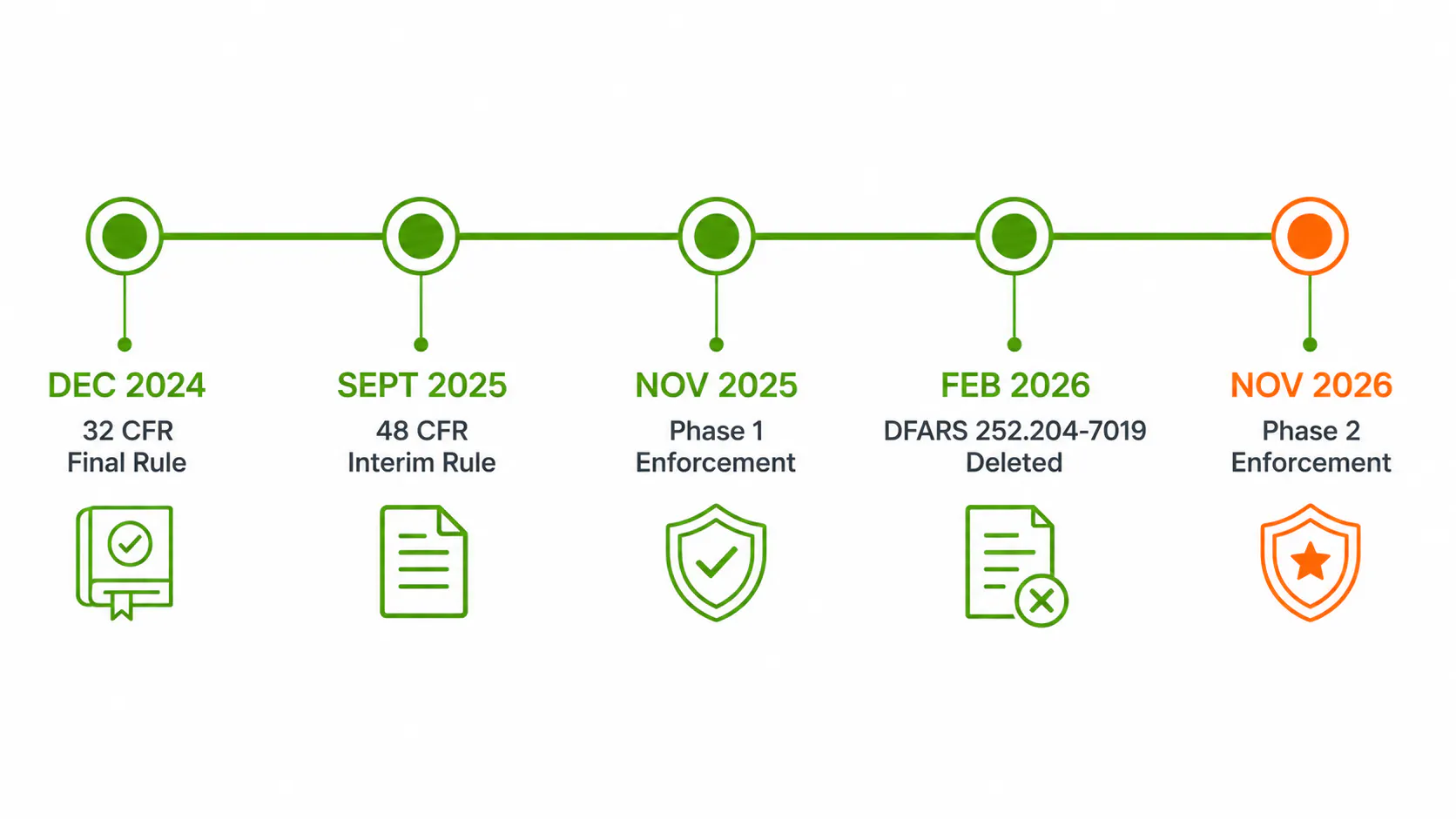
- December 16, 2024: the 32 CFR rule took effect, establishing the CMMC Program in regulation.
- September 10, 2025: the 48 CFR final rule published, adding the contract clause that puts CMMC into the DFARS.
- November 10, 2025: CMMC requirements began appearing in new DoD solicitations under Phase 1.
- February 1, 2026: DFARS 252.204-7019 was deleted, retiring the old self-assessment-and-upload path. Assessment obligations now run through DFARS 252.204-7021, the CMMC clause.
- Around November 2026: Phase 2 begins, when Level 2 C3PAO certification becomes a condition of award on applicable CUI contracts.
Which level you need still comes down to one question: what information touches your systems. Only FCI puts you at Level 1. The moment CUI enters, you are in Level 2 territory, and the requirement flows down. A prime contractor cannot pass CUI to a subcontractor who has not met the matching CMMC level, which is why the subcontractor flow-down has become the supply chain's bottleneck. Your certification is increasingly a precondition for someone else's contract.
The five mapping gaps that sink assessments
The crosswalk looks clean on paper. In a real assessment it frays at predictable seams. After enough engagements you see the same five failures, and four of them aren't technology problems. They are evidence problems.
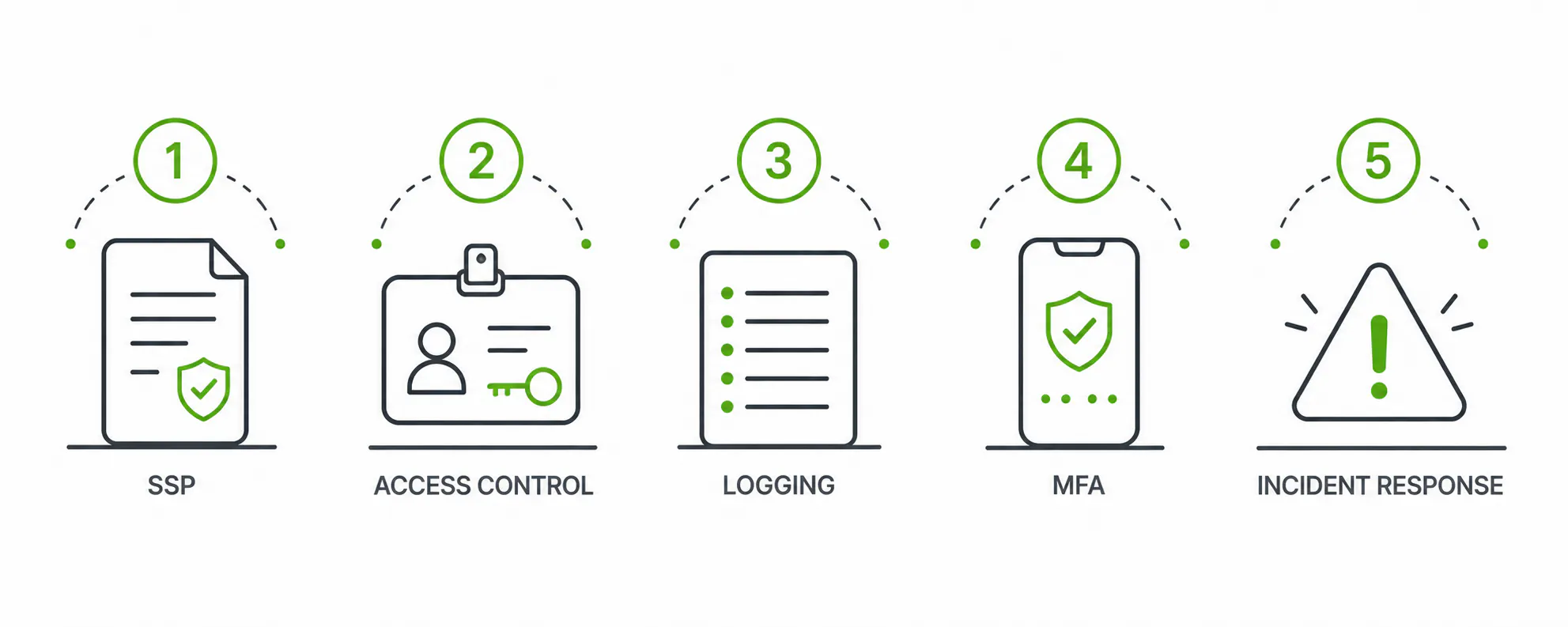
- The System Security Plan. A missing or stale SSP earns a "No Score," which means the assessment effectively cannot proceed. This is the single most common stop-the-clock failure, and it is a writing task, not an engineering one.
- Access control sprawl. Over-privileged accounts, shared logins, and no separation of duties. The controls exist on paper. The access list tells a different story.
- Audit logs nobody reads. Logging is usually on. What fails is the rest of the objective: central collection, defined retention, and documented evidence that a human actually reviews the logs.
- Multi-factor authentication gaps. A 5-point requirement that cannot be deferred to a POA&M. Partial MFA, an admin account left exposed, or an unmanaged legacy system is enough to fail the whole certification.
- Incident response on paper only. A plan exists but has never been tested, so there is no evidence the process works. Assessors grade evidence, not intentions.
The pattern underneath all five is simple. Contractors map their technology to the controls and forget to map their documentation. The crosswalk an assessor uses is built from artifacts. If the artifact doesn't exist, the control isn't met, no matter what your firewall is doing.
How to use the crosswalk to get certified
Turn the map into a route. Three steps move you from "we comply with 800-171" to "we are certified for CMMC."
Start with a gap assessment against the 320 objectives, not the 110 requirements. Grading at the requirement level hides the documentation holes that fail real audits. The objective-level view is the one an assessor will use, so use it first.
Then decide your assessment path honestly. Roughly 95% of contractors handling CUI will need a C3PAO certification rather than a self-assessment, and the cost gap is steep. Self-assessment work tends to land in the five-figure range. A Level 2 C3PAO certification for a small or mid-size contractor commonly runs in the high five to low six figures once remediation is counted, over a 12-18 month timeline. Knowing your path early decides your budget and your calendar.
Finally, close the documentation gaps before you touch the harder technical ones. The SSP, the POA&M, the audit-review records, the tested incident response plan: these are the cheapest points on the board and the ones that most often block certification. For the full regulatory picture behind this crosswalk, our complete guide to CMMC 2.0 compliance walks through the levels, deadlines, and SPRS scoring in depth.
The crosswalk is not the goal. Certification is. Treat NIST 800-171 as the work and CMMC as the proof, and the path from one to the other stops looking like two projects and starts looking like one.