How Much Does Managed IT Cost for Professional Services Firms?
A professional services firm should budget $150 to $275 per user per month for managed IT, against $100 to $250 for a typical business, with 24/7 threat response, licenses, and penetration testing often billed as separate lines.
Table of Contents
Law firms, accounting practices, consultancies, and design firms all sell the same thing. Hours. So the IT bill gets judged against billable time, and the question a managing partner asks is whether the per-user number covers what clients now demand before they'll send work (what that IT looks like is on our page about IT services for professional services firms).
Key Takeaways
- Managed IT for professional services firms runs $150 to $275 per user per month, against $100 to $250 for a typical business.
- The fee covers help desk, patching, monitoring, and backup.
- 24/7 detection and response ($9 to $50 per device on lower tiers), Microsoft 365 licenses ($22 per user), and penetration tests ($5,000 to $20,000) usually cost extra.
- A 30-person firm spends about $5,500 to $9,100 a month.
- SOC 2 and other compliance work is a separate engagement.

How much does managed IT cost for a professional services firm?
Plan on $150 to $275 per user per month, against the $100 to $250 a business without client security demands typically pays (our guide to outsourced IT support cost per user breaks that band down). Accounting practices that price by device sit at the low end, law firms in the middle to upper part of the band, and consulting and other service firms with 25 or more people often pay $200 to $275 for full coverage with projects included.
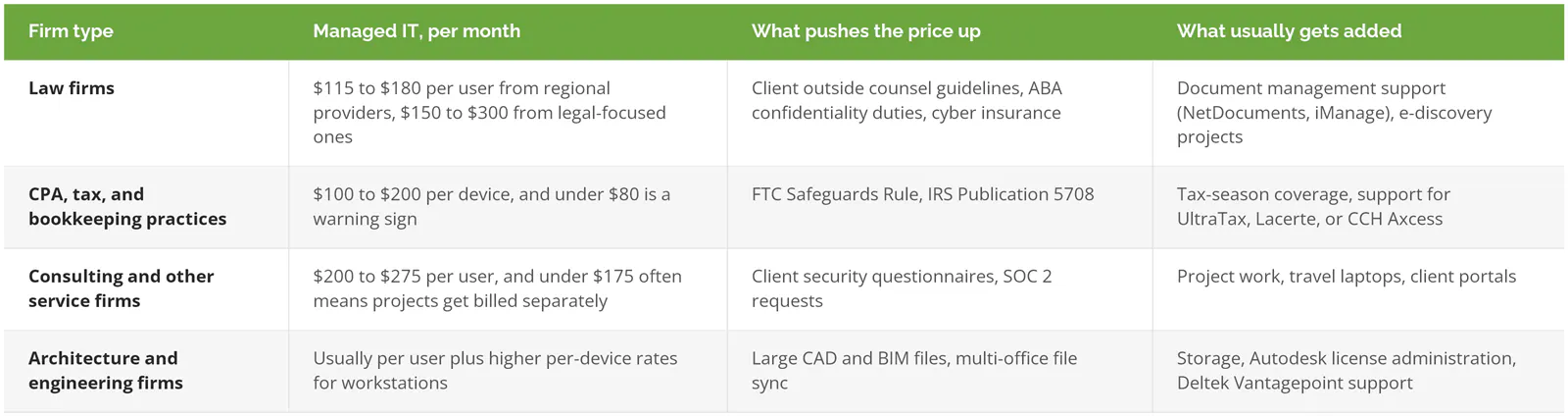
I compiled the law, accounting, and consulting ranges from MSP pricing pages published between March and November 2026 (a Las Vegas provider quoting law firms at $115 to $180, a legal-focused MSP at $150 to $300, an accounting specialist that calls anything under $80 a device a red flag, and a professional services MSP that puts firms of 25 to 80 people at $200 to $275), so treat them as what providers say in public rather than a market survey, and not as Consilien's prices. Architecture and engineering firms rarely see published per-user rates at all.
What's in the per-user fee, and what gets billed on top?
The per-user fee usually covers help desk support, monitoring, patching, endpoint protection, and backup. 24/7 managed detection and response (MDR) on lower tiers, Microsoft 365 licenses, penetration tests, onboarding, practice software, and compliance work are separate lines.
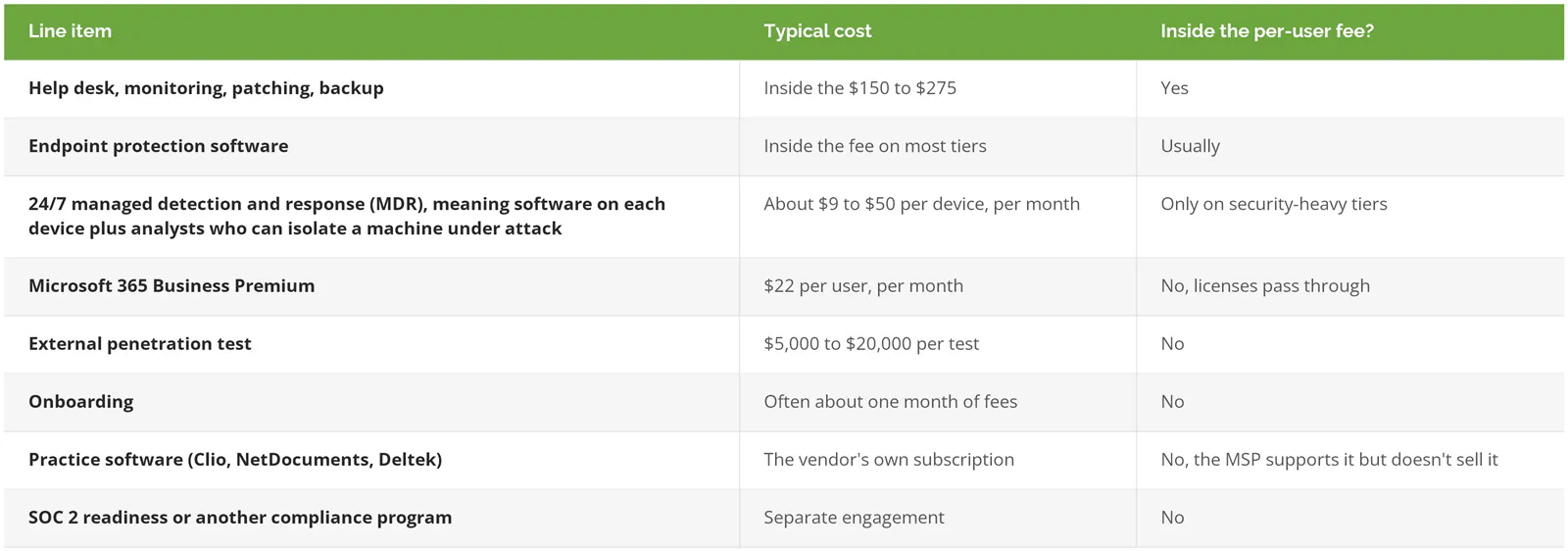
The MDR range comes from our guide to managed cybersecurity cost, the penetration test range from our IT assessment cost guide, and the license price from Microsoft's Business Premium page ($22 per user per month, annual plan, unchanged in the July 2026 price increase).
Penetration testing is the line firms most often forget. A penetration test is a hired specialist trying to break in. A vulnerability scan is software looking for known holes. Client questionnaires and insurance applications ask for the date of the last test. Have an answer ready. The FTC rule for tax preparers requires continuous monitoring or "annual penetration testing, as well as vulnerability assessments, including system-wide scans every six months."
What does a 30-person firm actually budget?
The example firm has 30 people, one office, Microsoft 365, a practice management system, 34 devices (including the conference room PC, the scanner workstation, and 2 partners with both a laptop and a desktop). It buys a standard managed IT tier and adds MDR because its cyber insurer asked for 24/7 monitoring.


Annual recurring cost is $66k to $109k. Per user that's $182 to $304, compared with $150 to $225 on the per-user line of the proposal. The add-ons make up the gap.
Now hold it against the billable hour. Assume 20 of the 30 people bill $250 an hour. A 4-hour outage costs 80 billable hours, or $20,000. That's 2 to 4 months of the managed IT bill. One morning.
Is SOC 2 or compliance work included in managed IT?
No, and at Consilien compliance is a separate service from managed IT. The managed provider runs the controls (MFA, patching, backups), while a compliance program writes the policies, runs the risk assessment, gathers the evidence, and sits through the audit.
A SOC 2 report is an independent auditor's opinion on your security controls, at a point in time (Type I) or over several months (Type II). Our SOC 2 Type I vs Type II guide explains the difference. Consultancies usually get asked for one in an enterprise client's vendor questionnaire. Tax practices face the FTC rule, which says a covered firm must "designate a Qualified Individual to implement and supervise your company's information security program" and that "your risk assessment must be written." Neither is a help desk ticket.
Managed IT still lowers the audit cost. Patch reports, MFA enrollment lists, backup test results, and offboarding tickets are audit evidence. Our IT compliance costs guide prices the audit work, and Consilien offers SOC 2 compliance as its own service.
Why do professional services firms pay more than the national average?
Clients write part of the IT scope. A corporate client's outside counsel guidelines, an enterprise customer's vendor security questionnaire, and the cyber insurance application all ask for specific controls, and every control is work an IT provider has to staff, run, and prove.
For lawyers, the duty comes from the ethics rules. ABA Formal Opinion 477 (May 2017, later revised as 477R) says lawyers "must exercise reasonable efforts when using technology in communicating about client matters," and that "what constitutes reasonable efforts is not susceptible to a hard and fast rule, but rather is contingent upon a set of factors." One of those factors is vetting your vendors, down to the "vendor's security policies and protocols" and "the use of confidentiality agreements." Your IT provider is one of those vendors.
Accountants have a statute instead of an opinion. The FTC Safeguards Rule covers tax preparation firms, and the IRS says in Publication 5708 that a written information security plan isn't optional, because "the law requires you to have one." We priced that rule set in detail in our guide to managed IT cost for financial services firms.
Consultancies and design firms answer to their clients alone. Nobody fines a 40-person architecture firm for skipping MFA. Its biggest client just stops renewing.
Then there's the cost of a bad year. IBM's 2026 Cost of a Data Breach Report puts the average breach in professional services, which IBM defines as legal, accounting, and consulting firms, at $5.08M, up from $4.56M in 2025 and above the $4.99M global average. Your firm isn't the average. Your insurer still underwrites against numbers like that one, and the application asks which controls you run before it quotes (the usual list is in our cyber insurance requirements checklist).
Is managed IT cheaper than an in-house IT hire for a professional services firm?

For a 30-person firm, usually yes. BLS puts the median network and computer systems administrator at $99,130, about $141,600 once benefits and payroll taxes are added, and that person still needs monitoring tools, MDR, and licenses on top of their salary.
The figures come from the BLS median for network and computer systems administrators and the BLS finding that wages are 70% of private-sector employee compensation. The example firm's $66k to $109k is 46% to 77% of one loaded hire. Call it two-thirds. MDR and licenses add $966 to $2,360 a month either way.
One administrator covers about 2,000 of the 8,760 hours in a year. Nights, weekends, vacations, and deadline evenings are uncovered. Somebody still has to answer. More on staffing in in-house vs outsourced IT.
Skip the fully managed contract if you already employ a capable IT manager. Co-managed IT fits that firm better, with the provider covering overnight monitoring, patching, and overflow tickets at a lower rate while your own person keeps the admin passwords and the vendor relationships.
How should a professional services firm compare managed IT quotes?
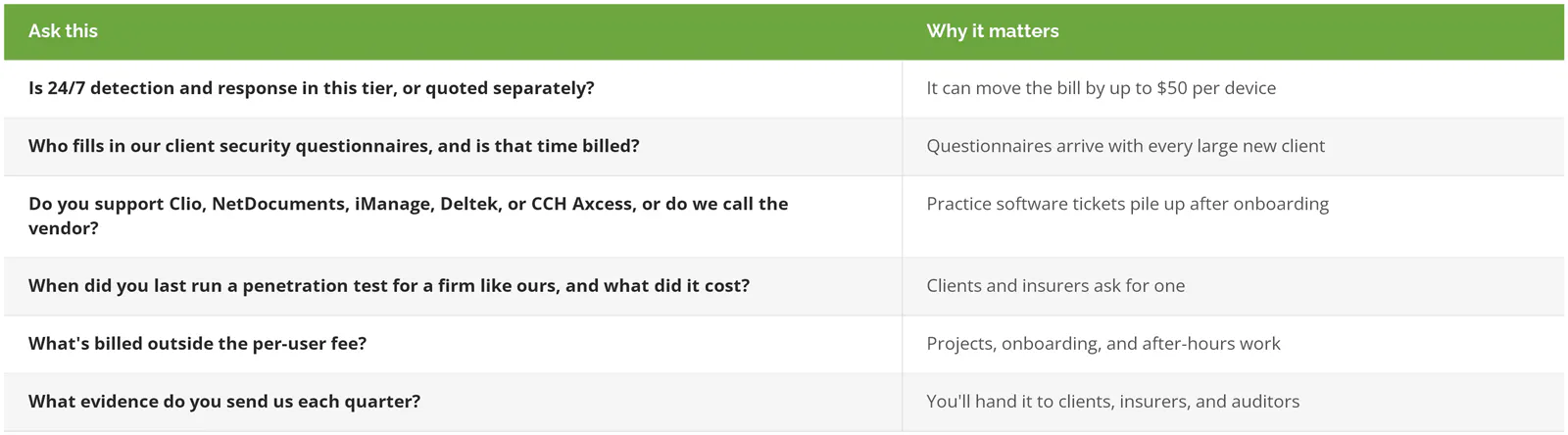
Ask every provider to price the same line items, then ask each one the questions below. For law firms, the answers also cover the vendor diligence the ABA describes, which also lists "reference checks and vendor credentials" and the "vendor's hiring practices."

Our ranking of the best MSPs for accounting firms compares providers by name, and law firms can start with our page on IT services for law firms.
For a line-item quote built around what your clients ask for, bring your headcount and device count and speak to a professional services IT expert at Consilien, a managed IT and cybersecurity provider for businesses nationwide.