How Much Does Managed IT Cost for Financial Services Firms?
A financial services firm should budget $150 to $300 per user per month for managed IT, where a typical business pays $100 to $250, and expect the email archive, overnight monitoring, and compliance work as separate lines.
Table of Contents
When the SEC finished amending Regulation S-P, it gave smaller advisers and broker-dealers until June 3, 2026 to put an incident response program in place, including written policies that make service providers (your IT provider among them) notify you "as soon as possible, but no later than 72 hours after becoming aware" of a breach in a system holding your customer information. You can meet that date with a revised policy binder and an IT contract that never mentions 72 hours or who pays for the monitoring that would catch the breach.
Those gaps are where managed IT cost for financial services firms gets confusing. The FTC Safeguards Rule (which reaches tax and accounting practices), Reg S-P (advisers and broker-dealers), and the books-and-records rules each turn into a control somebody runs, and a provider can price that control into the per-user fee, quote it as an add-on, or leave it out for you to discover in your first exam. What the rules require is covered in our guide to financial services IT compliance, so this post sticks to what they cost, using public prices I checked on November 6, 2026 and one worked budget that's an example rather than a quote.
Key Takeaways
Financial firms pay $150 to $300 per user per month for managed IT (hedge funds and private equity often $275 to $400), and the per-user fee rarely covers everything a regulator expects. A compliant email archive adds about $20 per user, 24/7 detection and response adds $9 to $50 per device when your tier leaves it out, and compliance work is its own engagement. For a 25-person adviser, that comes to roughly $5,000 to $7,500 a month.

How much does managed IT cost for a financial services firm?
Plan on $150 to $300 per user per month, depending on what kind of financial firm you run. Tax and accounting practices sit at the low end, advisers and broker-dealers in the middle, and hedge funds and private equity firms often pay $275 to $400.
For comparison, a business with no regulator watching typically pays $100 to $250 per user (the breakdown is in our guide to outsourced IT support cost per user), so financial firms sit toward the top of that national band and occasionally past it.
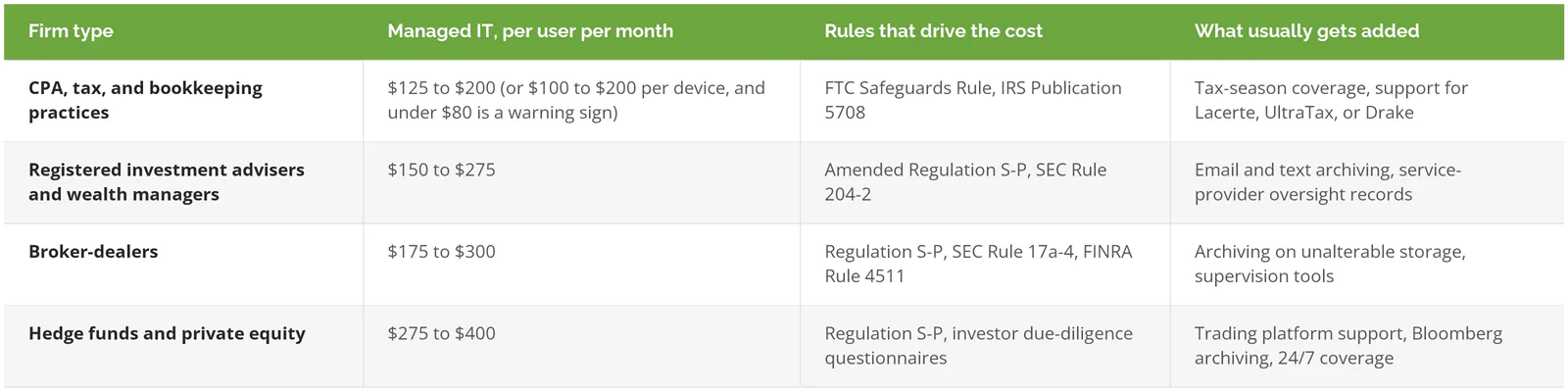
I compiled those ranges from MSP pricing pages that publish financial-firm rates in November 2026, so treat them as what providers say in public rather than a market survey (and they aren't Consilien's prices).
Why do financial firms pay more than the national average for managed IT?
A regulator has already written part of your IT scope. The FTC Safeguards Rule, Regulation S-P, and the recordkeeping rules each require specific controls, documents, or notice deadlines, and every one of them is work a provider has to staff and price.
The FTC's own Safeguards Rule guidance for businesses lists "tax preparation firms" among the covered financial institutions, and its list of required elements reads a lot like a managed IT scope of work:
- Multi-factor authentication "for anyone accessing customer information on your system" (a second login step, usually a code or an app prompt on a phone).
- Encryption of customer information "on your system and when it's in transit."
- Continuous monitoring, and if you don't have it, "annual penetration testing, as well as vulnerability assessments, including system-wide scans every six months." A penetration test is a hired specialist trying to get in, while a scan is software looking for known holes.
- "A written incident response plan."
- A Qualified Individual who runs the program and reports to the board in writing "at least annually."
- Notice to the FTC no later than 30 days after discovering a breach of unencrypted information on 500 or more consumers, a requirement that took effect in May 2024.
For tax professionals, the IRS removes any doubt. Publication 5708, the IRS template for a written information security plan (WISP), says that beyond being good business practice, "the law requires you to have one." Small practices included.
Advisers and broker-dealers answer to the SEC version. Under the amended Regulation S-P, larger firms had to comply by December 3, 2025 and smaller ones by June 3, 2026, which means you now need an incident response program, customer notice within 30 days of a breach, and written policies that make your service providers tell you within 72 hours when a breach touches a system holding your customer information. Both deadlines have passed. Your MSP is one of those service providers. The 72-hour clause belongs in its contract. Ask for it. A provider that has never been asked for one will want to talk about it before it signs.
Then there's the cost of getting it wrong. IBM's 2026 Cost of a Data Breach Report puts the average breach in financial services at $6.29M, up from $5.56M the year before, while the global average across all industries is $4.99M. Your firm isn't the average. Your insurer still prices the policy off numbers like that one, though, and asks which controls you run before it quotes (our cyber insurance requirements checklist lists the usual ones).
What's in the per-user fee, and what gets billed on top?
On a typical proposal the per-user fee buys help desk support, monitoring, patching, endpoint protection, and backup. What a financial firm also needs (a compliant archive, overnight detection and response on lower tiers, Microsoft 365 licenses, a penetration test, onboarding, and the compliance program itself) gets priced line by line.
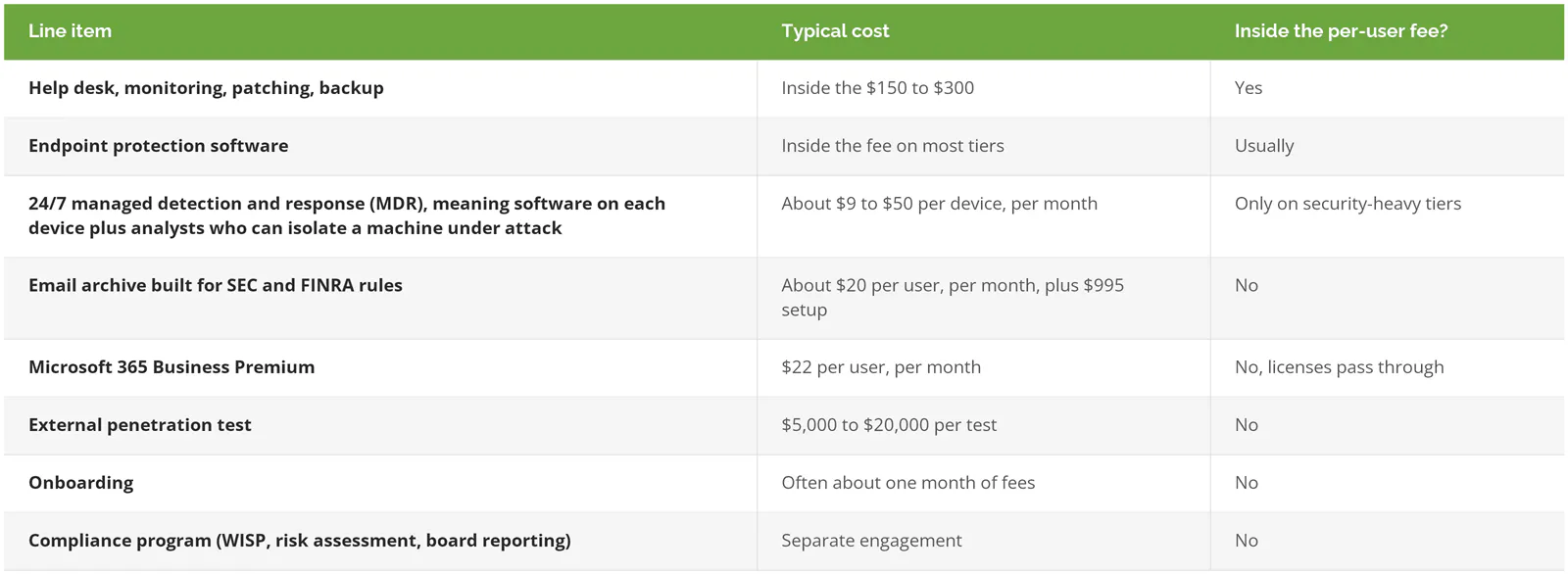
The MDR range matches our guide to managed cybersecurity cost, and the penetration test range comes from our IT assessment cost guide.
Archiving is the line that surprises advisers. SEC Rule 204-2 requires an adviser to keep "originals of all written communications received and copies of all written communications sent" on a list of topics that starts with recommendations and advice, and to preserve most required records "in an easily accessible place for a period of not less than five years," with "the first two years in an appropriate office of the investment adviser." In 2026 those communications are mostly email and texts. One Global Relay reseller publishes its compliance archive at $15 per user per month, plus $3 for the legal and compliance module and $2 for WORM storage (write once, read many, so nobody can quietly edit or delete a message), with a 10-user minimum and a $995 setup fee per tenant. Call it $20 a user.
Your MSP probably won't be the one selling you the archive, but it's the one connecting it to Microsoft 365, confirming that messages actually land in it, and adding each new hire to the journaling rule (the Exchange setting that copies every message into the archive), and that last job is where archives fail, because a mailbox that was never added doesn't throw an error or alert anyone, it simply goes unrecorded until an examiner asks for six months of one adviser's email.
What does a 25-person advisory firm actually budget?
Take a hypothetical registered investment adviser with 25 people, one office, Microsoft 365, a CRM like Redtail or Wealthbox, a custodian portal, and 28 devices once you count the conference room PC and the 2 servers nobody has moved to the cloud yet. The firm buys a standard managed IT tier and adds MDR because its insurer asked for 24/7 monitoring. Nothing exotic.
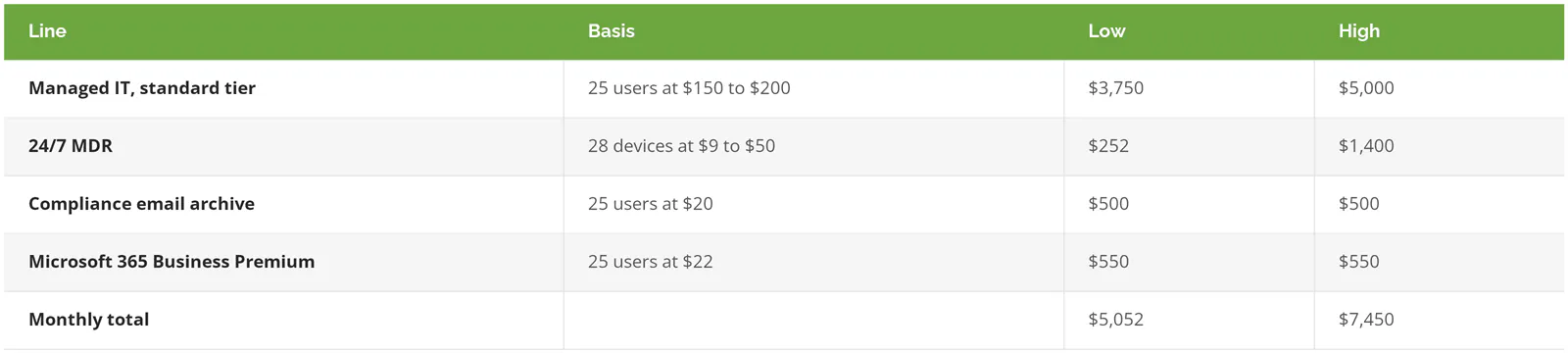

That's about $61k to $89k a year in recurring cost, which spread across 25 people comes to $202 to $298 per user (a good bit more than the $150 to $200 printed on the per-user line of the proposal), plus a start-up bill near $4,700 to $6,000 before the first month is over.
And notice what isn't in either table. The compliance work.
Is compliance included in managed IT?
No. Managed IT runs the controls, like MFA, patching, and backups, while a compliance program writes the policies, runs the risk assessment, keeps the evidence, and answers the examiner. At Consilien, compliance is a separate service from managed IT.
The FTC's wording makes the split plain. A covered firm has to "designate a Qualified Individual to implement and supervise your company's information security program," and "your risk assessment must be written and must include criteria for evaluating those risks and threats," which are governance jobs rather than help desk tickets. A good managed provider still makes that work cheaper, because patch reports, MFA enrollment lists, backup test results, and offboarding tickets are exactly the evidence a compliance lead pulls together before an exam, and a provider that sends them every quarter without being asked saves somebody a week in March. Our breakdown of IT compliance costs prices that work, and Consilien offers compliance as its own engagement for the businesses that want both from one firm.
Be wary of any proposal that says compliance is "included." Ask what, exactly, gets handed to the examiner.
Is managed IT cheaper than an in-house IT hire for a financial firm?

For a 25-person firm, yes, by roughly half. BLS puts the median network and computer systems administrator at $99,130, about $141,600 with benefits and payroll taxes, and that person still needs the same monitoring tools, archive, and licenses on top of their salary.
The math uses the BLS median for network and computer systems administrators and the BLS finding that wages make up 70% of private-sector employee compensation. Against $141,600, the example firm's $61k to $89k a year is 43% to 63% of one hire. Call it half. The hire also doesn't come with the tools. MDR, the archive, and the licenses from the example still run $1,300 to $2,450 a month whether the person running them is on your payroll or not.
Cost isn't the only gap, either. A single administrator works roughly 2,000 of the 8,760 hours in a year. Who covers the rest? Nobody. Nights, weekends, and the two weeks in August when that person is somewhere without cell service all go uncovered. That matters. Regulation S-P gives you 30 days from the moment you become aware of a breach to notify affected customers. We go through that tradeoff in more detail in in-house vs outsourced IT.
A firm that already has an IT manager on staff, and a compliance officer who actually owns the WISP, is usually overbuying with a fully managed contract. Co-managed IT fits that firm better, with the provider handling overnight monitoring, patching, and overflow tickets at a lower per-user rate while your own person keeps the admin passwords and the vendor relationships.
How do you read a managed IT quote as a financial firm?
Ask for the quote as line items, then ask the questions below. The answers show what the per-user number really covers.
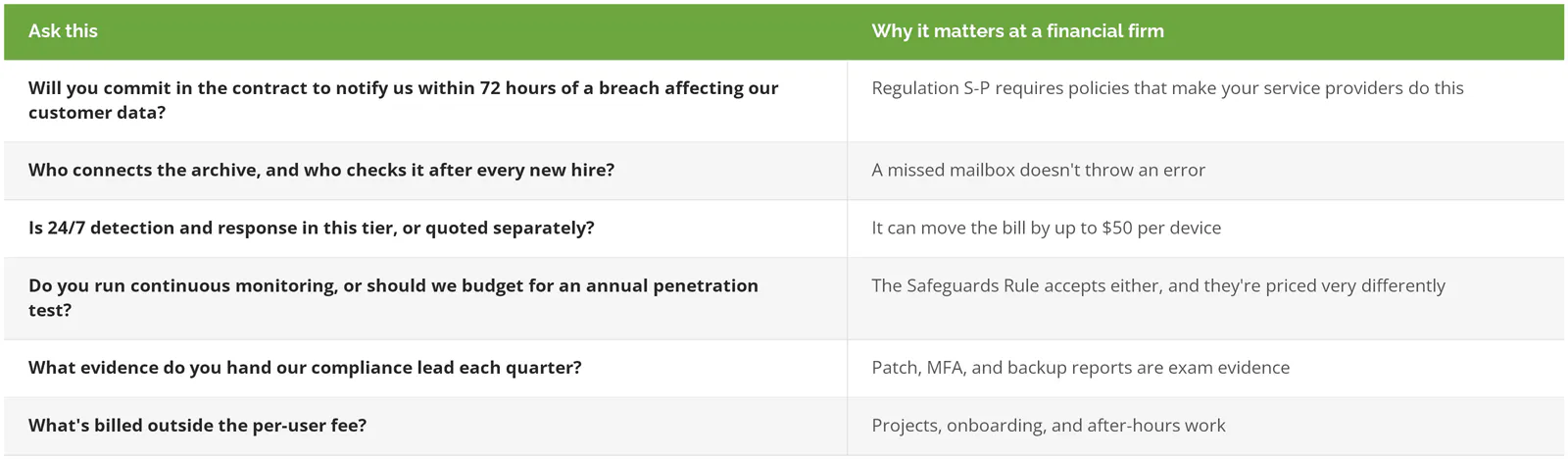

Still building a shortlist? Our rankings of the best MSPs for financial services and the best MSPs for accounting firms compare providers by name.
Bring two numbers to the first call, your headcount and your device count, and ask every provider to price the same list of lines from the table above. If you want a line-item quote built around the rules your firm actually answers to, speak to a financial services IT expert at Consilien, a managed IT and cybersecurity provider for businesses nationwide.