When Does Your Business Need a vCISO?
Your business needs a vCISO when someone outside the company, a regulator, insurer, customer, or buyer, asks who owns security and nobody inside can answer with a plan, a risk register, and a name. Exposure matters more than headcount.
Table of Contents
It usually arrives as paperwork. A cyber insurance renewal asks you to confirm multi-factor login on all email and remote access. A big customer's procurement team sends a security spreadsheet a few hundred rows long. Somebody forwards it to IT with a one-line note. Then it sits.
A vCISO (virtual chief information security officer) is a part-time, contracted security executive who owns that work. The risk decisions, the policies, the security roadmap, and the answers to outsiders all land on one desk. That's the seat Consilien's vCISO services fill. A vCISO isn't the person who patches your servers.
So when does your business need a vCISO? Headcount won't tell you. A 30-person machine shop whose biggest customer is a defense contractor may need one this quarter, while a 300-person distributor with no regulated data and a strong IT provider can reasonably wait a year or two.

When does your business need a vCISO?
You need a vCISO when three things are true at once. Someone outside the business is asking security questions. The answers need a named, accountable person behind them. And nobody on your payroll has the time or background to be that person.
Tools don't close that gap. A firewall can't sign an insurance application. Neither can your antivirus vendor.
The market has noticed. Cynomi's State of the Virtual CISO 2025 survey of 200 security leaders at managed service providers found 67% of providers offered vCISO services in 2025, up from 21% a year earlier, and 79% reported high demand from smaller business clients. Cynomi sells vCISO software, so read that as a supply number. It still tells you how many owners are getting the question.
Six triggers that put the question on your desk
A rule names an accountable person
This is the clearest trigger, because the government already wrote it down.
The FTC Safeguards Rule covers non-bank financial businesses like mortgage brokers, auto dealers, and tax preparers. Under 16 CFR 314.4, you must designate a "Qualified Individual" to oversee your information security program, and that person reports in writing to your board, or to a senior officer if you don't have one, at least once a year. Firms holding records on fewer than 5,000 consumers skip that report, though they still need the Qualified Individual. The rule lets that person work for a service provider. You keep the responsibility and assign someone senior to oversee them. Read it twice. That's a vCISO arrangement written into federal regulation.
Public companies have their own version. The SEC's cybersecurity disclosure rules, adopted July 26, 2023, require annual reports to describe management's role and expertise in managing cyber risk, along with how the board oversees it. If an IPO or a public acquirer is anywhere in your 3-year plan, someone has to be able to describe that expertise with a straight face.
Defense suppliers get a third one. The Pentagon paused CMMC Phase II, the third-party assessment phase, on July 13, 2026, but Level 1 and Level 2 self-assessments still apply. Each one needs a senior official to affirm it. Somebody signs.
Meeting any of these frameworks is its own body of work, which is why Consilien runs compliance as a separate service. The vCISO decides what the program needs. The compliance work produces the evidence an auditor will ask to see.
Your insurance renewal asks things you can't honestly attest to
Renewal applications now ask about multi-factor login, endpoint detection and response (software that watches each computer for attacker behavior and can cut it off the network), and backups you've actually tested by restoring them. The person filling it out often checks yes because the tool is installed.
Installed isn't enforced.
Say the application claims multi-factor covers all email, and the breach comes through a shared mailbox nobody enrolled. Now you're arguing with your carrier about what you attested, during the worst month your business has had, and IBM's 2026 Cost of a Data Breach report puts the average breach at $4.99M worldwide and $11.5M in the US. Our cyber insurance requirements checklist for 2026 walks through what carriers check. A vCISO makes sure the answers are true before anyone signs them.
A customer's security questionnaire is holding up a deal
Enterprise buyers send these before contracts, and some skip the spreadsheet and ask for a SOC 2 report, an independent auditor's opinion on your security controls. If sales is waiting on IT, and IT is guessing, you've found a trigger. The first questionnaire takes weeks. Once someone owns the answers, the fifth takes an afternoon. If a report is the ask, start with SOC 2 readiness.
Someone wants risk reporting you don't have
A board member, a lender, or a private equity buyer in diligence asks a simple question. What are our 5 biggest cyber risks, and what are we doing about each one? If the answer is a list of tools, you don't have a risk report. You have an inventory.
You just had an incident, or a close call
A wire transfer that almost went to a fake vendor account. Ransomware caught on one laptop before it spread. After the cleanup, the real question is what changes, who decides, and whether anyone owns the incident response plan next time. Security leadership often gets bought right after an incident. Better late than twice.
Growth outran the structure
Picture a manufacturer that doubled in 5 years. Security still belongs to the IT generalist who also runs the ERP (the system behind orders, inventory, and accounting), buys the laptops, and fixes the label printer, or to a managed IT provider that was hired to keep things running, not to set policy. Nobody decided that. It just happened.
The talent is short, too. ISC2's 2025 Cybersecurity Workforce Study, with more than 16,000 respondents, found 95% of security teams report at least one skills gap and 59% call their shortages critical or significant. Those are security professionals describing their own departments. A 2-person IT team isn't in better shape.
Three needs that look like a vCISO need, but aren't
Plenty of security problems don't need an executive at all. Before you hire one, check which problem you actually have.
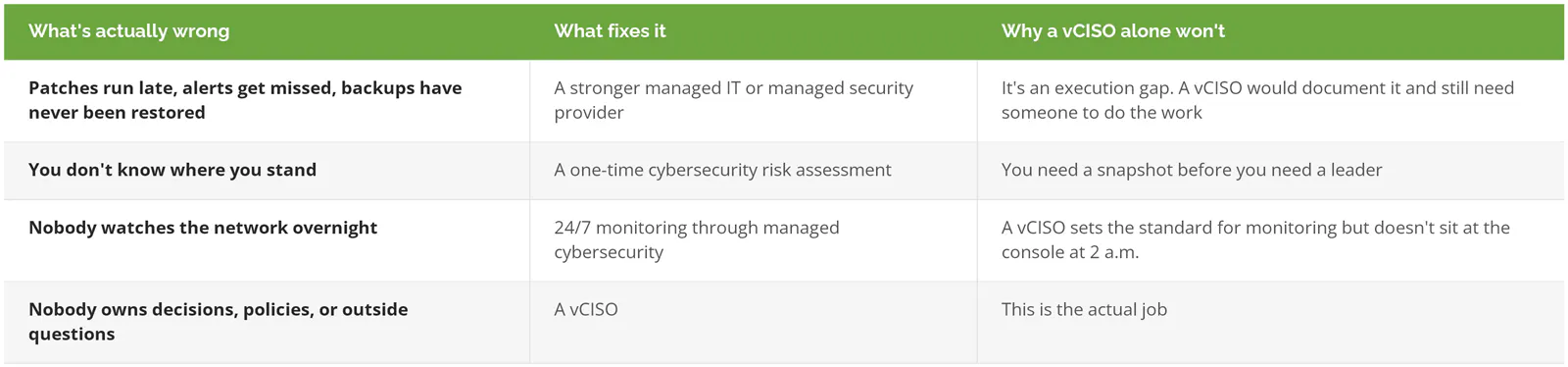
Buying a vCISO to fix an execution problem gets you a beautifully written document about late patches. The reverse mistake costs more. A business can spend heavily on tools and managed cybersecurity monitoring and still fail an insurance audit, because nobody decided which risks mattered, wrote the policies, or checked that the controls matched the paperwork.
Two of those rows often come in sequence. Start with a cybersecurity risk assessment, and the findings usually tell you whether the next step is better execution or someone to own the program.
vCISO vs full-time CISO: what changes the answer
A full-time CISO makes sense when security decisions come up daily, there's a security team to manage, or a board or regulator expects a security officer on staff. Short of that, a vCISO covers the same seat on a part-time schedule.
The full-time version is a big hire. The 2026 CISO Report from Cybersecurity Ventures and Sophos cites a Glassdoor median of $321k and a Salary.com figure of $385k, before benefits, equity, and the months a search can take.
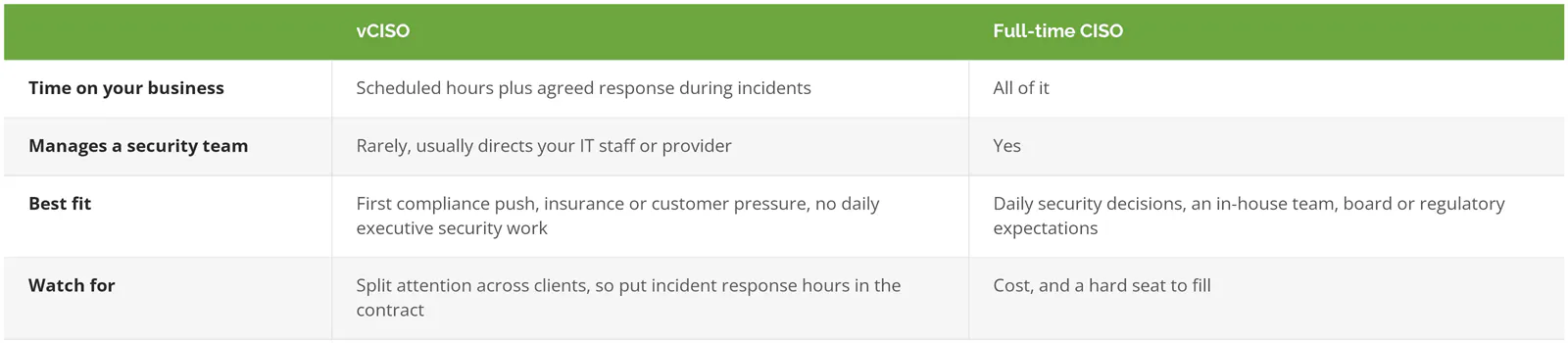
A hybrid is common and works well. An in-house security manager does the daily work and reports to a vCISO until the company is big enough to promote or hire a CISO. The vCISO cost and pricing guide has the numbers for each model.
A 10-question self-check
Answer yes or no. Be honest. Nobody's grading this but you.
- Has an insurer, customer, auditor, or lender asked a security question in the past 12 months that took more than a week to answer?
- Does a regulation or contract you're under require a named security owner or reporting to leadership?
- If someone asked who owns security, would the answer be your IT provider, or an IT person who also does everything else?
- Do you hold payment card data, customer financial records, or controlled defense information?
- Are your security policies more than 2 years old, or missing entirely?
- Have you had an incident or a near miss in the past 2 years?
- Is a sale, merger, IPO, or major funding round likely in the next 3 years?
- Did your last cyber insurance application include an answer you weren't sure was true?
- Would leadership struggle to name the company's top 5 cyber risks?
- Do security decisions get made by whoever happens to be closest to the problem?
0-2 yeses, you can probably wait. Revisit at your next insurance renewal. 3-5, start with a risk assessment and let the findings decide. 6 or more, you need someone in the seat now. That scale is my rule of thumb, not an industry standard, but it's held up across a lot of renewal seasons.
Question 8 is the one owners go quiet on.
What the first 90 days should produce

NIST added a Govern function to its Cybersecurity Framework 2.0 in February 2024, covering how organizations make and carry out decisions about cybersecurity strategy. That's the vCISO's lane, and the first 90 days should leave you holding documents, not impressions.
- A risk register ranked by business impact, not by how scary each threat sounds
- Security policies that match how your people actually work
- A 12-month security roadmap with a cost and an owner on every line
- A one-page report leadership can read in 5 minutes
- A bank of approved answers for insurance and customer questionnaires
Fred Romero, our CTO, covers what a vCISO does week to week in more depth. If day 90 shows up and all you've got is a slide deck, ask where the register is.
When you can wait
If you already have a full-time security leader, skip this. That person is doing the job.
You can also wait if you hold no regulated data, no customer or contract asks for security proof, your insurer renewed without follow-up questions, and your IT provider already enforces the basics. Multi-factor login everywhere, endpoint detection on every machine, and backups somebody has actually restored. Put the money there first. A vCISO steering a business without those basics spends the first 6 months asking for them anyway.
Consilien is a managed IT and cybersecurity company headquartered in Torrance, California, working with businesses nationwide. Its vCISO service covers this kind of work, from the first risk register and policy set onward, and runs alongside a separate compliance program when a framework is involved.
If any of those triggers landed on your desk this year, speak to a vCISO expert.