What Does a vCISO Do? A Guide for Mid-Market Companies in California

A virtual Chief Information Security Officer (vCISO) is an outsourced security officer who develops strategies, oversees cyber risk management, and compliance requirements without the need to hire a person as a full-time employee. vCISOs are useful for mid-sized businesses operating in California because they help integrate IT systems with standards such as NIST and handle CCPA and CPRA requirements.
Table of Contents
What are the roles of a Virtual CISO?
Roles and Responsibilities
- Designing and updating the company’s cybersecurity strategy
- Risk assessment and management of the risk register
- Risk measures aligned to the NIST framework
- Compliance assistance for SOC 2, CMMC, and HIPAA
- Incident response plan and business continuity plans
- Report cybersecurity status to management and the board
How a vCISO Operates Day-to-Day
This is where most competitors fall short. A real vCISO doesn’t just advise—they operate inside your business rhythm:
Weekly
- Review risks, vulnerabilities, and incidents
- Align with IT team priorities
Monthly
- Executive reporting (risk posture, KPIs)
- Compliance progress tracking
Quarterly
- Board-level updates
- Strategic roadmap adjustments
Ongoing
- Own and maintain the risk register
- Prioritize security investments
- Coordinate across IT, compliance, and leadership
How vCISO Services Map to NIST and Compliance
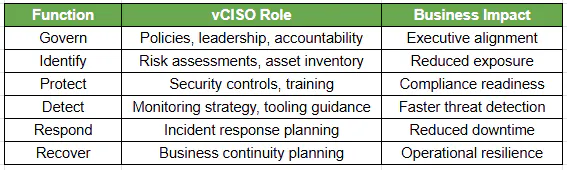
Why this matters: Frameworks from the Cybersecurity and Infrastructure Security Agency and NIST emphasize that security is a leadership function, not just IT.
vCISO vs Full-Time CISO: What’s the Difference?
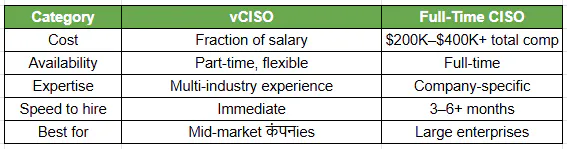
Reality: According to ISC2, there’s a global shortage of ~4 million cybersecurity professionals (2023). Hiring a full-time CISO is often unrealistic for mid-sized firms.
Why Mid-Market Companies in California Are Turning to vCISO Services
Key Drivers:
- Regulatory pressure
- Enforced by the California Privacy Protection Agency
- CCPA/CPRA increases accountability for data protection
- Rising breach costs
- IBM reports average breach cost of ~$4.45M globally (2024)
- Note: varies by industry and geography
- Internal IT overload
- IT teams are focused on uptime not governance
- Multi-site complexity
- Manufacturing, healthcare, and SaaS environments
When Do You Need a vCISO?
- Preparing for SOC 2, CMMC, or regulatory audits
- Experiencing rapid growth or expansion
- Managing multiple locations or systems
- After a security incident or near miss
- Facing board or investor pressure on risk
What a vCISO Does NOT Do
This is where clarity builds trust:
- Not your helpdesk or IT support
- Not a replacement for your internal IT team
- Not a “checkbox compliance” provider
- Not tied to selling tools or vendors
A true vCISO is vendor-neutral and strategy-first.
How Consilien Delivers vCISO Services
Most providers blur the line between IT services and security leadership. That creates risk.
Consilien operates differently:
Co-Managed Model (Core Differentiator)
- Works alongside your internal IT team
- Reduces overload without replacing staff
Security-First Approach
- Strategy before tools
- Risk reduction before spending
Compliance Readiness
- Aligns with:
- NIST CSF
- SOC 2
- CMMC
- Focus: readiness, not checkbox certification
Strategic Leadership Layer
- vCISO + vCIO alignment
- Executive-level reporting
- Board communication support
Built for Mid-Market Reality
- Multi-site environments
- Growing compliance demands
- Limited internal resources