The NIST Incident Response Lifecycle: 4 Phases Explained
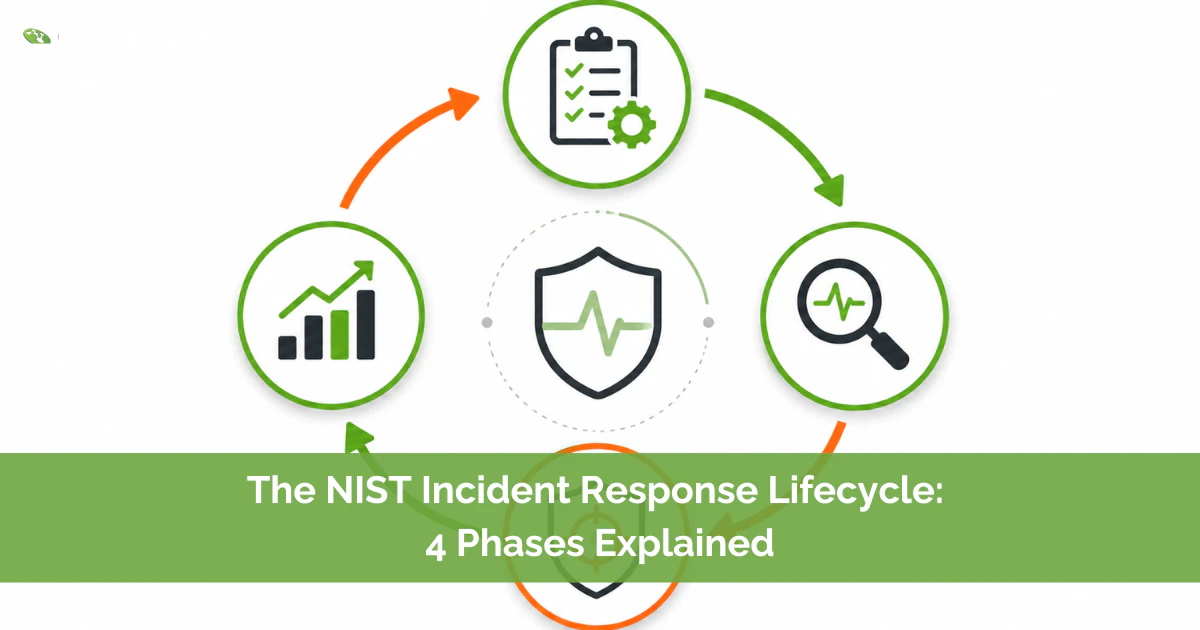
The NIST incident response lifecycle is a four-phase framework for handling a security incident from the moment you spot it to the day you close it out: Preparation; Detection and Analysis; Containment, Eradication, and Recovery; and Post-Incident Activity. You run it as a loop, not a checklist. What you learn cleaning up one breach is supposed to feed straight back into how you prepare for the next.
Table of Contents
The model comes from NIST Special Publication 800-61, the federal guide that quietly became the default playbook for everyone else. One detail most articles skip: NIST rewrote that guide in 2025, and the four neat phases are no longer the official structure. We'll get to what changed, and why the phases still earn their place anyway. The part that protects your business is the same either way: a plan that actually covers all four, backed by managed cybersecurity deep enough to run it.
The four phases, in one screen
If you read nothing else, read this. The NIST incident response lifecycle has four phases:
- Preparation. Build the plan, the team, the tools, and the muscle memory before anything goes wrong.
- Detection and Analysis. Notice something is off, then figure out what it actually is and how bad.
- Containment, Eradication, and Recovery. Stop the bleeding, remove the threat, and get back to normal operations.
- Post-Incident Activity. Hold the honest review and turn what you learned into a better Preparation phase.
Preparation is the only phase that happens entirely before an incident. The other three run in a loop during and after, and the loop is the point. A breach you handle without learning anything is a breach you are going to handle again.
What is the NIST incident response lifecycle?
It's a structured way to handle a cybersecurity incident without making it up as you go. NIST, the National Institute of Standards and Technology, published the lifecycle in Special Publication 800-61 so that federal agencies would respond to incidents in a consistent, repeatable way. Private companies adopted it because it works and because so many compliance frameworks point back to it.
The word that matters most is lifecycle. The four phases are not a one-way assembly line. Detection feeds Analysis, Analysis often sends you back to gather more data, Recovery can surface a second compromised system that drops you back into Containment, and Post-Incident Activity rewrites your Preparation. Treating it as a straight line is the first mistake teams make.
One more thing to set up front, because it changes how you read every other guide on this topic: NIST replaced the 800-61 lifecycle in 2025. The four phases still describe the work better than almost anything else, so we'll walk them, then explain what the update means for you.
The NIST incident response phases at a glance
Here are the four phases side by side, with the goal of each one and the spot where lean teams most often break down.
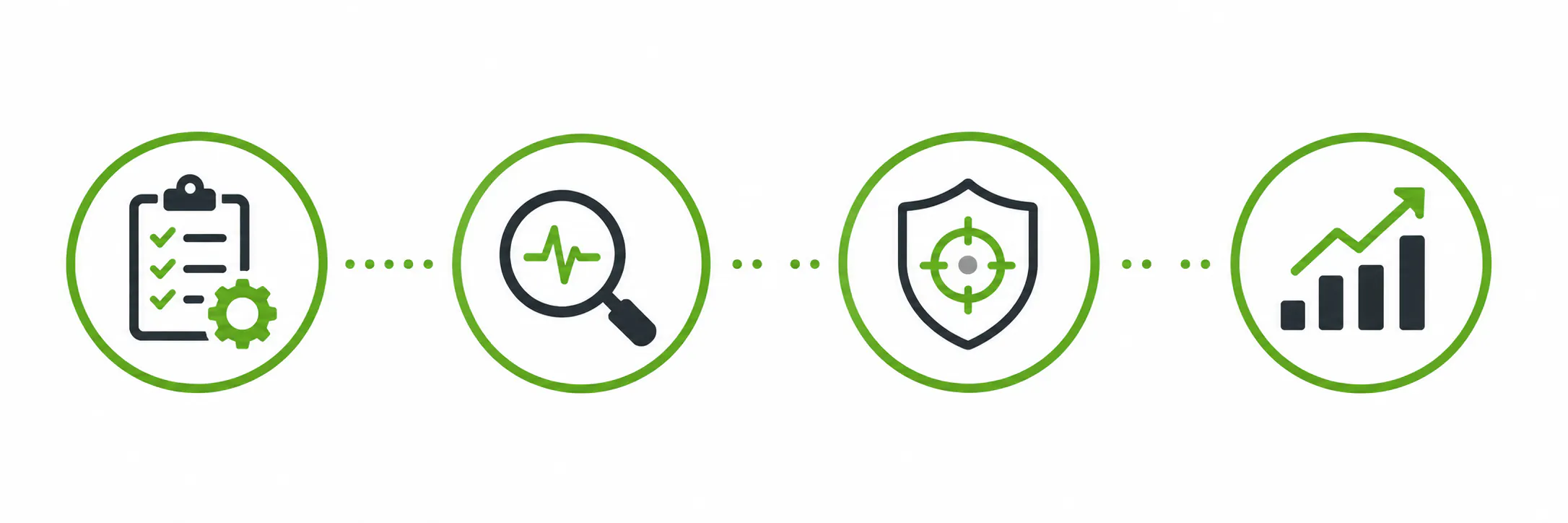
- Preparation. Goal: be ready before it happens. Where lean teams break: no written plan and untested backups.
- Detection and Analysis. Goal: know an incident is real and scope it. Where lean teams break: no monitoring, and alerts that fire into an empty inbox.
- Containment, Eradication, and Recovery. Goal: stop it, remove it, and restore. Where lean teams break: restoring from a reinfected or missing clean backup.
- Post-Incident Activity. Goal: learn and improve. Where lean teams break: the review never happens.
Phase 1: Preparation
Preparation is the phase that decides how the other three go. Every guide says so, and the data backs it. A tested incident response plan is one of the biggest cost reducers in a breach, according to IBM's research. You do that work now, when nothing is on fire, or you pay for skipping it later.

What preparation actually involves
Preparation is more than a document. A real Preparation phase includes a written incident response plan with named roles, so nobody is deciding who runs point while the network is down. It includes logging and monitoring that can actually see an attack. It includes backups that have been restored and verified, not just scheduled. It includes a contact list with your provider, your cyber insurance carrier, and outside counsel, and it includes training so your staff recognizes the phishing email that starts most incidents. CISA's free tabletop exercise packages are a low-cost way to pressure-test all of it.
Where most companies fall short
Here is the uncomfortable number. Roughly 47% of small businesses have no incident response plan at all, and only about a third have a formal one built with real security input. The plan that exists often lives in a drawer, written once for a compliance checkbox and never opened again.
The failure mode is predictable. The plan names a vendor who left two years ago. The backups have never been restored, so nobody knows they have been silently failing. The one person who understands the firewall is on a plane when the ransomware note appears. Preparation fails quietly, which is exactly why it gets skipped. We run incident response readiness reviews with clients for this reason, and the gaps that surface in a calm conference room are always cheaper to fix than the ones that surface at 2 a.m. Practical Preparation also leans hard on security awareness training, since the human inbox is still the front door.
Phase 2: Detection and Analysis
This phase is two jobs wearing one name, and conflating them slows everything down.
Detection and analysis are not the same job
Detection is noticing that something is wrong: an alert fires, a user reports a locked file, traffic spikes to an address in a country you don't do business with. Analysis is the harder part. It's deciding whether that signal is a real incident or noise, then scoping it: what's affected, how far it spread, what data is exposed, and how severe it is. Detection without analysis floods your team with alerts they can't rank. Analysis is where you separate the breach from the false alarm and decide how hard to hit the alarm bell.
The 181-day problem
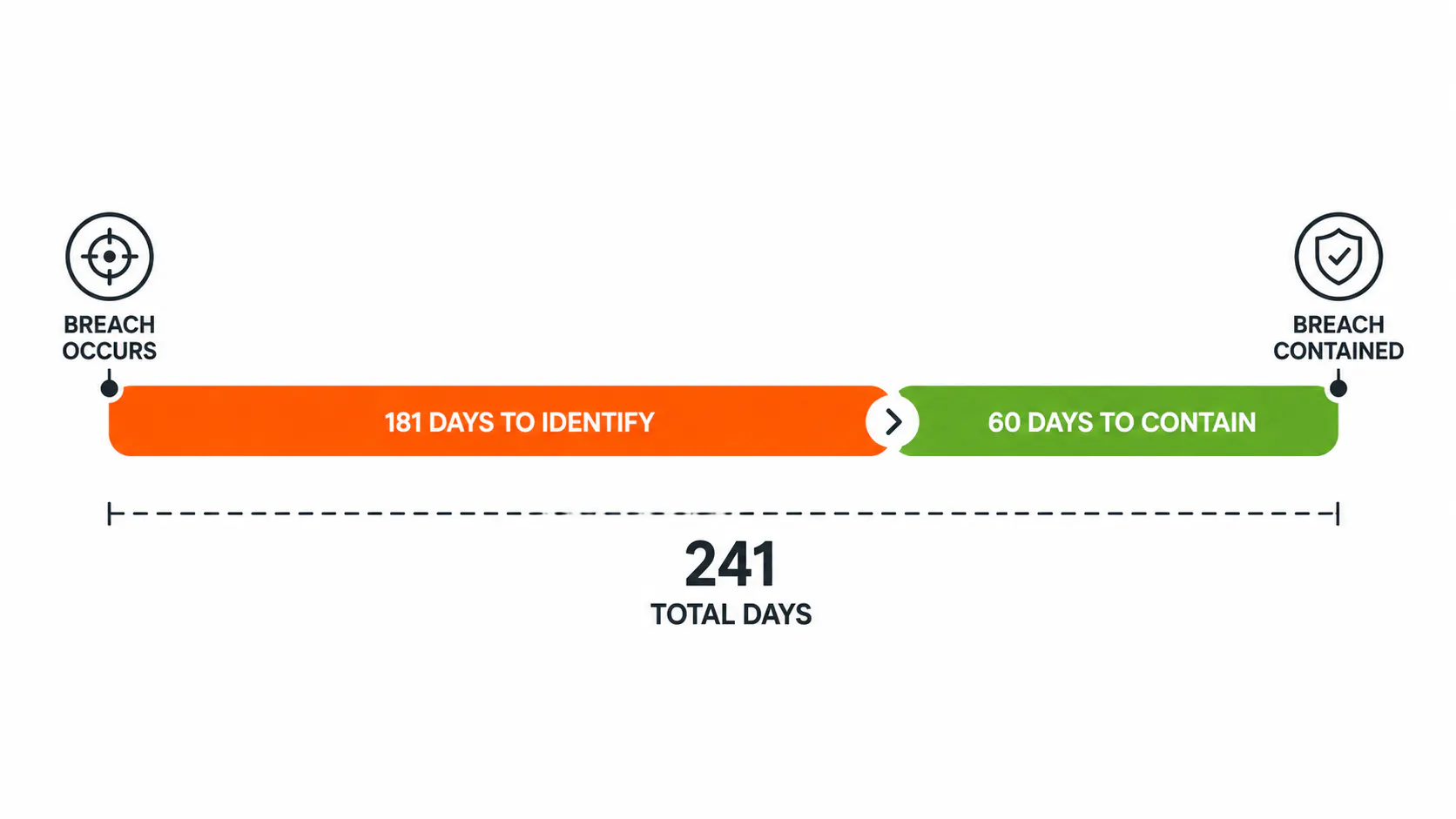
Most organizations are slow here, and slow is expensive. Across 2025, companies took a mean of 241 days to identify and contain a breach, with the lion's share, around 181 days, spent just identifying it. That is half a year of an attacker living in the environment before anyone confirms it. The lifecycle improved to its best level in nearly a decade, largely because more teams added AI-assisted detection, which IBM credits with cutting breach costs by close to $1.9 million on average.
Lean teams detect late for a simple reason: nobody is watching the logs at night, and an alert that fires into an empty inbox is the same as no alert. This is the phase where always-on coverage earns its money, and it is a core reason mid-market companies fold detection into managed IT services instead of hoping a stretched internal team catches it in time.
Phase 3: Containment, Eradication, and Recovery
NIST groups three actions into one phase because in a live incident they blur together. The order still matters.
Contain first, investigate second
Containment is triage. You stop the spread before you understand every detail, the same way you stop the bleeding before you ask how the patient fell. That means isolating affected machines from the network, disabling compromised accounts, and blocking the malicious traffic, fast, while preserving evidence for later. The instinct to fully diagnose before acting is natural and wrong. Every hour an attacker has reach is another hour of damage.
Eradicate, then recover without reinfecting
Eradication removes the threat: delete the malware, close the vulnerability it rode in on, reset the credentials it stole, and rebuild anything you can't trust. Recovery brings systems back to normal and watches them closely to confirm the threat is actually gone.
The classic mistake lives right here. A team restores from a backup to get the business running again, and the backup is either infected or carries the same hole the attacker used the first time. The threat walks right back in. This is why tested disaster recovery drills matter as much as the backups themselves. A backup you've never restored is a hope, not a recovery plan, and you find out which one it is at the worst possible moment.
Phase 4: Post-Incident Activity
The incident is over. The pressure is gone. So is most teams' motivation to do this last phase, which is precisely why it's the one that separates organizations that get safer from organizations that just get hit again.
The lessons-learned review almost everyone skips
Within a week or two of closing an incident, the people who handled it sit down and answer plain questions. What happened, and when did we first see it? How did they get in? What did we do well, and where did we lose time? Did the plan hold, or did we improvise? The output isn't a blame session. It's a short list of concrete changes: a control to add, a detection rule to write, a step in the plan to fix.
Closing the loop
This is where the lifecycle becomes a lifecycle. Those lessons feed directly back into Preparation. The detection gap that cost you three days becomes a new monitoring rule. The account that should have been locked sooner becomes a tighter access policy. Skip this phase and you keep the same weaknesses for the next attacker, who will find them the same way the last one did. Run it well and every incident, even a painful one, makes the next response faster. This loop is also the kind of forward-looking work a vCIO or vCISO is built to own, because it sits above day-to-day firefighting.
NIST vs. SANS: do the phases really differ?
You will run into the SANS framework if you research this for long, and the two look like rivals. They aren't. SANS uses a six-step model: Preparation, Identification, Containment, Eradication, Recovery, and Lessons Learned. The only real difference is grouping. SANS splits NIST's middle phases into separate, named steps for operators who want a more granular checklist during a live incident. NIST keeps them bundled and leans toward governance and policy.
The underlying work is identical. Pick NIST if you need framework alignment and compliance mapping, which most regulated companies do. Pick SANS if your responders want a tighter step-by-step runbook. Plenty of mature teams read both and build their own. There's no wrong answer, only the one your team will actually follow.
What changed in NIST SP 800-61 Revision 3 (2025)
Here is the part that almost no other explainer has caught up to. On April 3, 2025, NIST finalized Revision 3 of SP 800-61, its first real update since 2012, and it retired the four-phase lifecycle as the official structure.
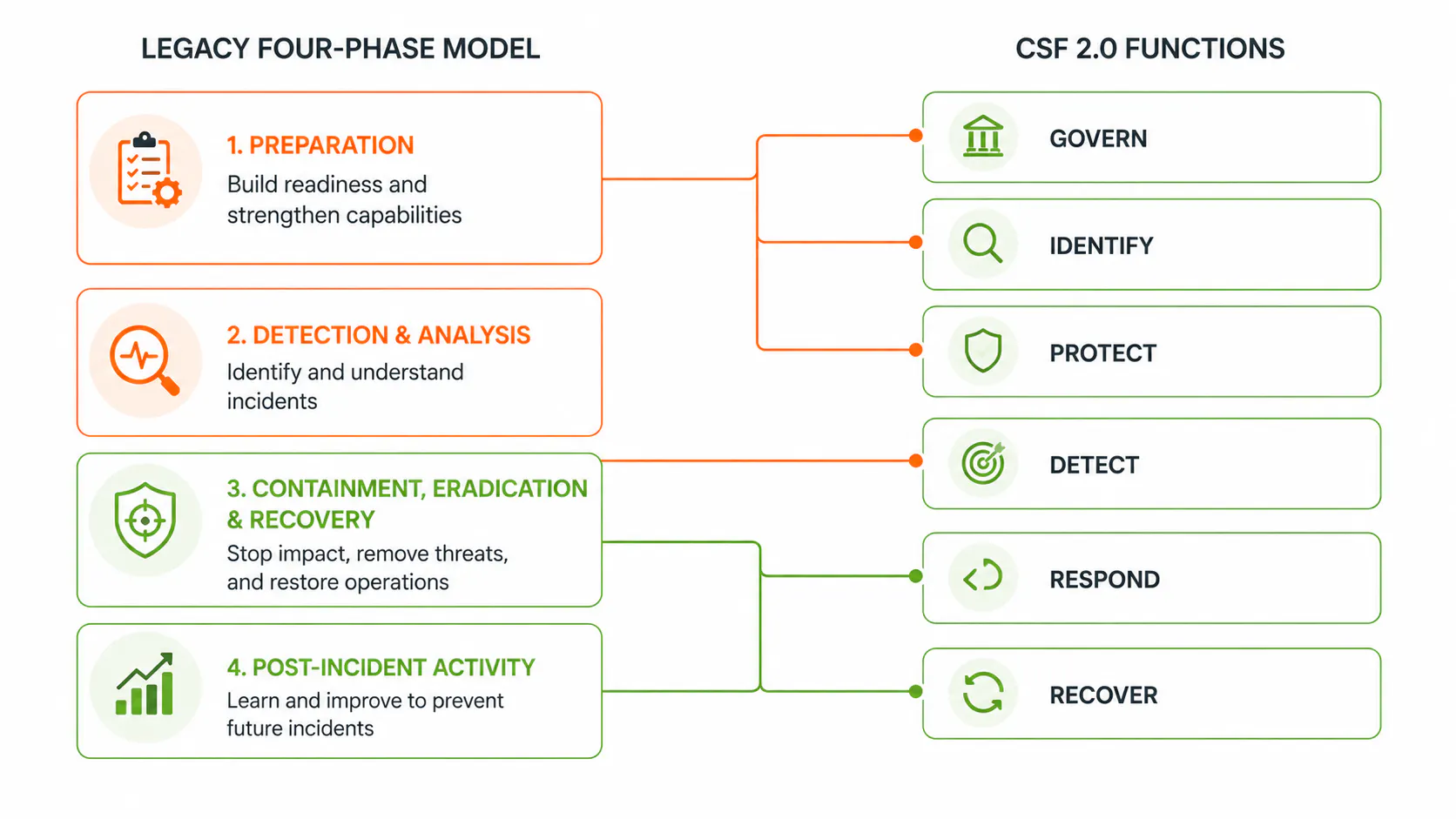
In its place, Revision 3 maps incident response onto the six functions of the NIST Cybersecurity Framework 2.0: Govern, Identify, Protect, Detect, Respond, and Recover. The logic is sound. NIST decided that incident response shouldn't sit in its own silo with its own diagram. It should live inside the same risk management language a company already uses for everything else, with governance and prevention treated as part of response rather than a separate exercise.
So are the four phases dead? On paper, as the official model, yes. As a way to think and train, no, and that's not a contradiction. The CSF functions are excellent for organizing a whole security program. The four phases are still the clearest way to explain what a team actually does once an alarm goes off, which is why they remain the common language in practice. Our honest read: use the CSF 2.0 functions to structure your program and your compliance posture, and keep the four phases as the mental model your responders run during an incident. The new revision doesn't break the old one. It zooms out around it.
How the lifecycle maps to compliance
For most California companies, incident response isn't optional and not abstract. It's written into contracts and regulations with clocks attached. The lifecycle is how you satisfy them.
Four common mandates, and the clock each one starts the moment an incident hits:
- DFARS 252.204-7012, for defense contractors handling CUI: report within 72 hours of discovery.
- CMMC Level 2, for most defense supply chain firms: maintain an operational incident response capability under NIST 800-171 controls 3.6.1 to 3.6.3.
- CMMC Level 3, for the highest-sensitivity contractors: run 24/7 monitoring with an incident response team that deploys within 24 hours.
- SEC Item 1.05 of Form 8-K, for public companies: disclose material incidents within 4 business days.
Read those clocks against the 181-day detection average and the problem jumps out. You can't report a breach in 72 hours under DFARS if it takes you six months to notice it, and you can't make the SEC's four-business-day window without a Detection and Analysis phase that works. Compliance is not a separate project from the lifecycle. It is the lifecycle, with deadlines. For regulated manufacturers especially, that link runs straight through manufacturing cybersecurity and broader compliance readiness work.
Putting the lifecycle to work with a lean team
The four phases are simple to read and hard to staff. Preparation needs planning time most internal teams don't have. Detection needs eyes after hours. Containment needs people who have done it before, calmly, under pressure. Post-Incident needs the discipline to hold a review when everyone wants to move on. For a two- or three-person IT team already buried in tickets, running all four well isn't realistic on top of the day job.
That gap is the whole reason the co-managed IT model exists. Your team keeps control and institutional knowledge. An outside partner supplies the after-hours monitoring, the incident experience, and the security depth a lean team can't carry alone. You don't have to choose between an empty plan and an executive security hire you can't justify. The point isn't to buy a thicker binder. It's to make sure all four phases have someone awake and accountable when the alarm goes off.
The bottom line
The NIST incident response lifecycle is four phases run as a loop: prepare, detect and analyze, contain and recover, then learn and feed it back. NIST's 2025 revision reframed that work inside the CSF 2.0 functions, but the phases are still the clearest picture of what a team does when something breaks. The frameworks are not the hard part. The hard part is having a plan that holds and people ready to run it at 2 a.m., not just on paper.
If you're not sure your plan would survive a real incident, that's worth knowing before one tests it for you. A free IT assessment shows you exactly which of the four phases you are ready for and which one would catch you off guard.