vCISO vs Full-Time CISO: Which Does Your Business Need?
A vCISO is a contracted, part-time security executive. A full-time CISO is an employee who owns security every working day. Pick by how often security decisions land on someone's desk and whether there's a team to lead, not by headcount.
Table of Contents
The title is the same. The job usually isn't.
A chief information security officer, the CISO, is the executive who owns your security program. That means deciding which risks matter, writing the policies, setting the budget, and answering for all of it when a regulator, insurer, or board asks. A vCISO (virtual CISO) does that same work on a contract, for a set number of hours, usually alongside a few other clients. Consilien's virtual CISO services are built on that model.
So the vCISO vs full-time CISO question isn't really about whether you need security leadership. If you're reading this, you probably already know you do. Our post on when does your business need a vCISO covers the triggers. This one picks up after that, once you've decided the seat needs filling and you're choosing who sits in it.
Price changes the answer less than you'd think. Authority, availability, continuity, and who signs the paperwork change it more.

What's the actual difference between a vCISO and a full-time CISO?
You contract a vCISO for scheduled hours and agreed incident response. You hire a full-time CISO as a salaried executive who works only for you. Either one can own the program. They differ in availability, continuity, independence, and cost.
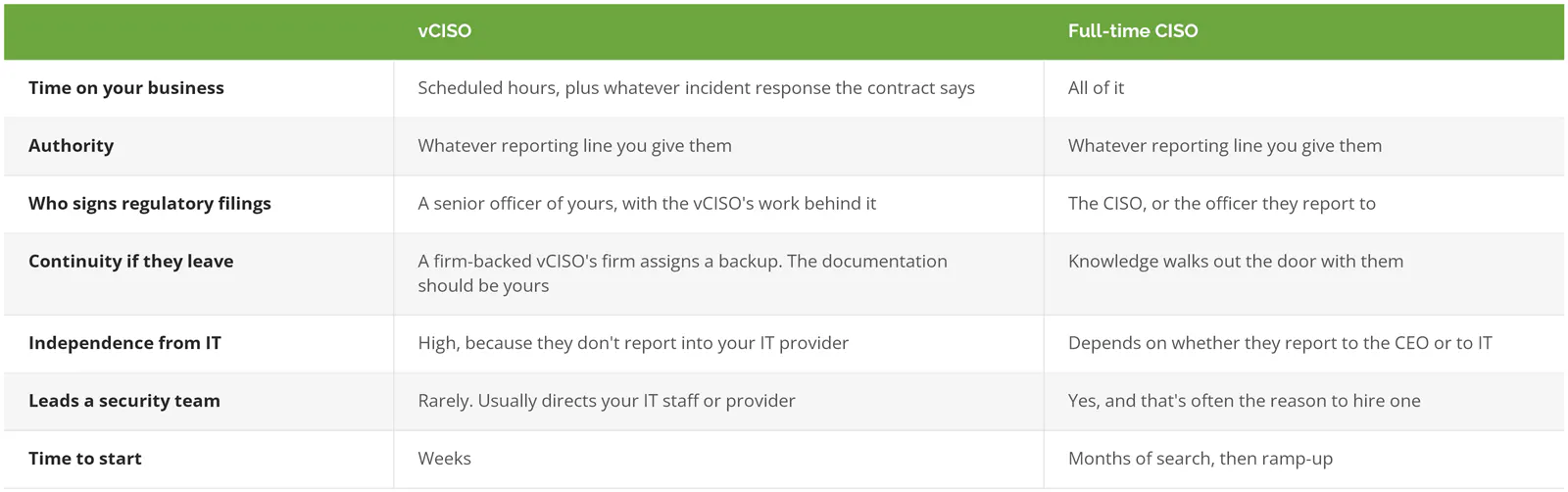
Look at the second row. Authority is identical, and that surprises people. Both models get exactly as much clout as you hand them.
Does a vCISO have real authority inside the company?
Yes, if you give it to them. Authority comes from the reporting line, not the W-2. A vCISO who reports to the CEO and sits in on quarterly leadership meetings carries more weight than a full-time CISO buried 3 levels under IT.
Reporting lines are moving fast for full-time CISOs, too. Heidrick & Struggles' 2025 Global CISO Survey of 371 security chiefs found 42% now report directly to the CEO, about triple the prior year, while the share reporting to a CIO or CTO dropped to 30%. Boards want security in the room where the money gets decided.
You can do the same thing with a vCISO for a fraction of the payroll. Put them on the leadership calendar. Give them a standing slot with the board or owners. Make the CEO their sponsor, in writing.
What kills a vCISO's authority is treating them as a vendor. If they're routed through the IT manager and only hear about a new ERP rollout (the system behind orders, inventory, and accounting) after the contract is signed and the data migration is half done, you've bought an expensive advisor nobody listens to and a security review that shows up too late to change anything. Same for a full-time hire, honestly.
The org chart does the work.
Who signs when a regulator asks?
You do. Regulators let an outside security leader run the program, but the legal accountability stays with your company and a senior person on your payroll. That's how the FTC Safeguards Rule and New York's NYDFS rule work, and CMMC affirmations land on a senior official inside the company too.
- FTC Safeguards Rule. Non-bank financial businesses (mortgage brokers, auto dealers, tax preparers) must name a Qualified Individual to run the security program. Under 16 CFR 314.4, that person can work for a service provider, provided you keep responsibility and assign a senior employee to oversee them.
- New York's financial regulator says almost the same thing in 23 NYCRR 500.4. The CISO "may be employed by the covered entity, one of its affiliates or a third-party service provider," with the covered entity keeping accountability and naming a senior overseer. The CISO reports in writing at least once a year to the board.
- Defense suppliers. Each CMMC self-assessment needs a senior official at the contractor to affirm it. The Pentagon paused CMMC Phase II on July 13, 2026, but Level 1 and Level 2 self-assessments still apply, and somebody inside your company still signs.
- Public companies describe management's cyber expertise in annual filings under the SEC's 2023 disclosure rules. An outside leader can be part of that story, but the 10-K is yours.
So the vCISO writes the program, builds the evidence, and briefs the person who signs. That person had better understand what they're signing. Part of a good vCISO's job is making sure they do.
None of this is compliance work in itself. Meeting a framework produces its own pile of evidence and controls, which is why Consilien runs compliance as a separate service from vCISO leadership.
What happens at 2 a.m. during an incident?
Incidents are where the vCISO model is thinnest.
Your full-time CISO picks up at 2 a.m. on a Sunday. A vCISO picks up at 2 a.m. only if the contract says so, and without that clause you'll get a callback whenever your vCISO finishes with another client's emergency, which might be Monday morning if the other client's week is going worse than yours.
Not ideal.
Fix it on paper before you need it. A vCISO contract should spell out a response time for declared incidents, who covers when the named vCISO is on vacation, and how many hours an incident can pull before the overage rate kicks in. Ask to see the firm's own incident response plan for how they run one, not just yours.
And be clear about who's actually doing the work. Neither a vCISO nor a full-time CISO sits at a console watching alerts at 2 a.m. That's a security operations center, either your own or a provider's managed cybersecurity service. The CISO, whichever kind, makes the calls. Do we take the plant offline? Do we call the carrier now? Who talks to customers?
Those are the 2 a.m. decisions. They need someone who already knows your business.
Continuity, and the 18-to-26-month problem
CISOs don't stay long. Cybersecurity Ventures puts average CISO tenure at 18 to 26 months, against nearly 5 years for the rest of the C-suite. The pressure isn't easing. In Nagomi's 2025 CISO Pressure Index, a survey of 100 US CISOs, two-thirds reported burnout weekly or daily, 40% had considered leaving, and 90% said a breach could cost them their job.
Do the math on a full-time hire. A few months of search. 6 months or so learning the business. A year of real work. Then a recruiter calls.
When that person leaves, the program often leaves with them. Risk decisions that lived in their head. Vendor relationships. The reasoning behind a policy nobody else wrote down. Gone.
Firm-backed vCISOs carry a different risk. The firm can swap people, and the documentation should belong to you, not the consultant. Freelancers are another story, because a solo vCISO with no bench behind them is really a part-time employee with the same single-point-of-failure problem as a full-time hire and worse availability on top of it. Ask who replaces your vCISO if they quit, and ask to see the handover file before you need one.
Independence, and who grades your MSP
Outside leaders have one built-in edge. A vCISO doesn't report to your IT department or your managed service provider, so they can tell you the provider is underperforming without worrying about a turf war.
Full-time CISOs can do that too, if they report to the CEO. One who reports to the IT director is in an awkward spot. Awkward is generous. They're being asked to audit their own boss's work.
Watch for the reverse, though. Some MSPs sell a vCISO as an add-on, and the person in that seat may end up signing off on the same provider's renewal, its patching reports, and its answers to your insurance questionnaire, all in the same quarter. That isn't automatically bad. It just needs a reporting line that runs to you, and a habit of asking the vCISO what they'd tell you if they didn't work for the provider. If the answer comes too smoothly, ask again.
Personal liability lands harder on a full-time CISO
Two cases made security leaders nervous about the job. Joseph Sullivan, Uber's former chief security officer, was convicted in 2022 of obstruction and concealing a felony over his handling of a 2016 breach, and sentenced to 3 years of probation and a $50,000 fine. Then the SEC sued SolarWinds and its CISO, Tim Brown, personally in 2023.
The second one fizzled. A court threw out most of the SEC's claims in July 2024, and the agency voluntarily dismissed the rest with prejudice on November 20, 2025. The chill stuck around anyway. A BlackFog survey cited by CSO Online found 70% of CISOs said hearing about personal liability cases had hurt their view of the role.
What does that mean for you? Good full-time candidates will ask whether your directors and officers insurance covers them, and some will turn the offer down if it doesn't. And a vCISO's exposure is set mostly by contract, and the regulations above keep accountability with a senior person on your side of the table anyway. Get your attorney to read that contract. I'm not a lawyer, and this isn't legal advice.
Sullivan wasn't convicted for being breached. He was convicted for hiding it. Honest disclosure is the protection, whichever model you pick.
A full-time CISO without a team is an expensive vCISO
Full-time CISOs earn the salary when they're running something, like a security team, a daily stream of decisions, or a product with security baked into it. Hire one into a company with no security staff, no budget line, and an IT provider doing the actual work, and you've paid executive wages for a part-time job.
Hard to justify.
They'll spend their first year writing policies, building a risk register (a ranked list of what could hurt the business and what's being done about each item), and answering questionnaires. That's exactly what a vCISO does in their first 90 days. Then they'll start asking for headcount, because that's how the role is designed.
So ask yourself an honest question. Will this person have people to lead within 12 months?
If yes, a full-time CISO might be right. If not, you're probably renting a person who'll be bored by spring. The vCISO cost and pricing guide walks through what each model costs, including the recruiting fee and benefits load that a salary quote leaves out.
The full-time seat makes sense when one or more of these is true:
- Security decisions come up every day, not every month.
- You have, or plan to build, an in-house security team that needs a manager.
- A regulator, a major customer, or a public-company board expects an officer on staff.
- Security is part of what you sell, say a software product or a hosted platform where customers audit you constantly.
The hybrid path, and how to hand it off

Plenty of companies never pick one model. They start with a vCISO who builds the program, add an in-house security manager who runs the daily work and reports to the vCISO, and then, once the workload and the team justify it, promote that manager or hire a full-time CISO while the vCISO steps back to an advisory role or leaves.
That route works. The part that goes wrong is the handoff.
Picture a 150-person distributor that spent 2 years with a vCISO and finally hires a full-time CISO. The new hire shows up on day one and finds the risk register locked in the vCISO firm's portal, the policies scattered across a shared drive nobody can search, and the insurance questionnaire answers sitting in a former employee's sent folder. Three months go to rebuilding what already existed. Painful, and avoidable.
Avoid that by deciding on day one that everything the vCISO produces lives in your systems, under your accounts. Then, when the handoff comes, the outgoing vCISO should deliver:
- The risk register, with the reasoning behind each ranking, not just the scores
- Every current policy, with an owner and a review date
- The bank of approved answers for insurance and customer security questionnaires
- A vendor list showing which contracts include security terms, and which don't
- The board reporting calendar and the last 4 reports
- 30 days of overlap with the new CISO, at minimum
Your vCISO can also help write the job description and sit in on interviews. They've seen your program up close, and they'll know which candidates are describing your problems and which are reciting a framework. Fred Romero, our CTO, covers what a vCISO does week to week if you want the day-to-day view.
When neither is the right answer
Sometimes the problem isn't leadership at all.
If backups have never been tested with a real restore, multi-factor login isn't enforced on email, and nobody watches the network overnight, you have an execution gap, and a CISO of either kind would spend the first quarter documenting that gap in careful detail and then waiting for someone else to fix it. Fix the basics through a stronger IT or security provider first.
Then revisit.
And if you don't know where you stand, start smaller. A one-time cybersecurity risk assessment gives you a baseline in weeks, and the findings usually make the next step obvious. Comparing outside providers? Our roundup of the best vCISO companies is a reasonable place to build a shortlist.
You can also skip this decision if you already have a full-time security leader with a team behind them. That person is doing the job. Let them.
Consilien is a managed IT and cybersecurity company headquartered in Torrance, California, working with businesses nationwide. Its vCISO service puts a senior security leader in the seat on a part-time basis, and it runs separately from compliance work when a framework like CMMC or SOC 2 is in play.
If you're weighing the two models right now, speak to a vCISO expert before you post the job listing.