Why Manufacturing Companies in California Are Switching to Managed IT
Manufacturing companies in California aren’t switching to managed IT because it sounds good. They’re switching because their IT team is underwater. You can see it. More downtime. Security issues lingering longer than they should. Compliance getting attention only when it has to.
Table of Contents
The environment keeps getting more complicated- more systems, more risk, more requirements. But the team size doesn’t change. So now they’re trying to do everything. Infrastructure, security, compliance, projects. And when everything’s a priority, nothing gets the depth it needs.
That’s where managed IT fits. Not as a replacement, but as support. Co-managed, in many cases. Filling the gaps and giving the business room to operate without everything feeling reactive.
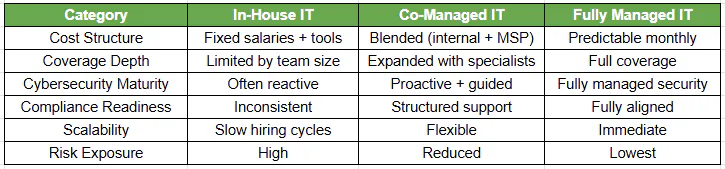
Managed IT vs In-House vs Co-Managed IT (Quick Comparison)
The Real Shift: Internal IT Teams Are Overwhelmed
This is what most executives are actually seeing.
Internal IT teams aren’t failing. They’re overloaded.
They’re trying to handle:
- Helpdesk tickets
- Infrastructure and network uptime
- Cybersecurity
- Compliance requirements like CMMC
- Vendor management
- Cloud and system upgrades
That’s too much for a small team. And when everything is a priority, nothing gets done deeply well.
So what happens?
- Security gets reactive
- Documentation falls behind
- Monitoring isn’t consistent
- Small issues turn into outages
That’s where managed IT comes in. Not to replace internal teams, but to support them where they can’t go deep.
Manufacturing IT Is More Complex Than It Looks
From the outside, it looks like standard business IT. It’s not.
Manufacturing environments typically include:
- ERP systems running operations
- MES or production systems on the plant floor
- Legacy systems that can’t be easily replaced
- IoT devices and connected equipment
- Multi-site networks across facilities
And none of these systems fail cleanly.
When something breaks, it cascades.
- ERP goes down → production stalls
- Network latency → machines can’t communicate
- Backup failure → recovery becomes a business event
This isn’t just IT. It’s operations.
Downtime Isn’t an IT Problem. It’s a Revenue Problem.
Most companies underestimate this until it happens.
Downtime in manufacturing means:
- Idle labor
- Missed production targets
- Delayed shipments
- Potential contract penalties
Even a few hours can create ripple effects across the business.
This is why proactive monitoring matters.
Not because it’s a feature, but because catching issues early prevents operational disruption.
Managed IT providers focus on:
- Early detection
- Root cause resolution
- Preventing repeat failures
That’s the difference between reacting and actually stabilizing the environment.
Cybersecurity and CMMC Are Driving Urgency
Manufacturing is a target. Especially in California.
You’ve got:
- Defense contractors
- Aerospace supply chains
- Sensitive data moving across vendors
And now compliance is catching up.
CMMC and NIST requirements aren’t optional anymore for many companies.
The problem is internal teams usually don’t have:
- Time to manage frameworks end-to-end
- Deep compliance expertise
- Dedicated security leadership
That’s where structure matters.
With the right support, companies can:
- Align with compliance frameworks
- Improve audit readiness
- Strengthen security posture without overwhelming internal staff
The Hiring Problem: You Can’t Build This Team In-House
This is where the model breaks down.
To fully support a modern manufacturing environment, you don’t just need “IT.”
You need:
- Security expertise
- Compliance oversight
- Infrastructure management
- Architecture planning
- Data strategy
Trying to hire all of that internally is expensive and slow.
And even if you do, retention becomes the next issue.
Managed IT gives you access to:
- Specialized roles
- Broader experience
- Immediate coverage
Without building a full internal department.
Co-Managed IT vs Fully Managed IT: What Manufacturers Are Choosing
Not every company wants to outsource everything.
That’s why co-managed IT is becoming more common.
Co-Managed IT works when:
- You already have an internal IT team
- They’re capable but stretched thin
- You need deeper expertise in key areas
Fully Managed IT works when:
- Internal IT is minimal or non-existent
- The environment is too complex to manage internally
- You need full accountability for IT operations
Both models solve the same problem, capacity and capability.
Just at different levels.
Why This Shift Is Accelerating in California
California adds pressure in ways other states don’t.
- Higher labor costs make hiring IT talent harder
- Strong manufacturing presence increases competition
- Regulatory and compliance expectations are higher
- Many companies are tied into defense and aerospace supply chains
So the margin for error is smaller.
Companies can’t afford:
- Extended downtime
- Security incidents
- Compliance failures
That’s why the shift is happening faster here.
What Managed IT Actually Looks Like in a Manufacturing Environment
This isn’t just remote support.
In manufacturing, it includes:
- 24/7 system monitoring
- Cybersecurity operations and threat detection
- Backup and disaster recovery planning
- Support for plant floor systems
- Vendor coordination across systems
- On-site support when needed across locations
And for multi-site organizations, it means consistency.
Same standards. Same visibility. Same response.
How the Right IT Partner Supports Growth
This part gets overlooked.
Managed IT isn’t just about fixing problems.
It enables:
- Digital transformation initiatives
- Cloud adoption
- Better data visibility across operations
- Scalable infrastructure as the business grows
This is where architecture matters.
When systems are designed correctly, growth doesn’t break them.