How manufacturers outgrow break fix IT

01/12/2026
News
How manufacturers outgrow break fix IT

For many manufacturers, break-fix IT feels like the simplest option. Something breaks. You call someone. They fix it. You pay the bill and move on. And early on, that approach works.

But as manufacturing operations grow, technology stops being background support and starts becoming part of production itself. At that point, break-fix IT quietly becomes a liability.

This is where the discussion around break fix vs managed IT manufacturing becomes unavoidable.

Why Break-Fix IT Still Exists in Manufacturing

Break-fix IT is common in manufacturing for practical reasons.

It’s familiar. It feels flexible. And it avoids long-term commitments.

Many manufacturers start with:

  • A small network
  • A limited number of users
  • One or two core systems
  • Minimal compliance pressure

When issues are infrequent, calling someone as needed feels efficient. But that model assumes IT problems are isolated and rare. Growth changes that assumption quickly.

What Changes as Manufacturers Grow

As manufacturers scale, IT becomes operational infrastructure, not just support.

Increased Production Downtime Risk

Downtime in manufacturing isn’t an inconvenience. It directly impacts revenue, delivery schedules, and customer trust.

When systems are connected, a single IT failure can:

  • Stop production lines
  • Delay shipments
  • Idle multiple shifts
  • Miss customer SLAs

Break-fix IT responds after downtime begins. Manufacturing environments can’t afford that delay.

More Systems, More Integration

Modern manufacturers rely on:

  • ERP and inventory systems
  • MES platforms
  • Automation and industrial controls
  • Secure remote access for vendors and engineers

Break-fix IT fixes individual problems. It rarely manages the full environment. That creates blind spots no one owns.

Compliance, Cybersecurity, and Insurance Pressure

Manufacturers now face:

  • Customer security questionnaires
  • Cyber insurance requirements
  • NIST or CMMC expectations
  • Vendor and partner audits

Break-fix IT does not provide continuous security management or documentation. And leadership is still accountable when something goes wrong.

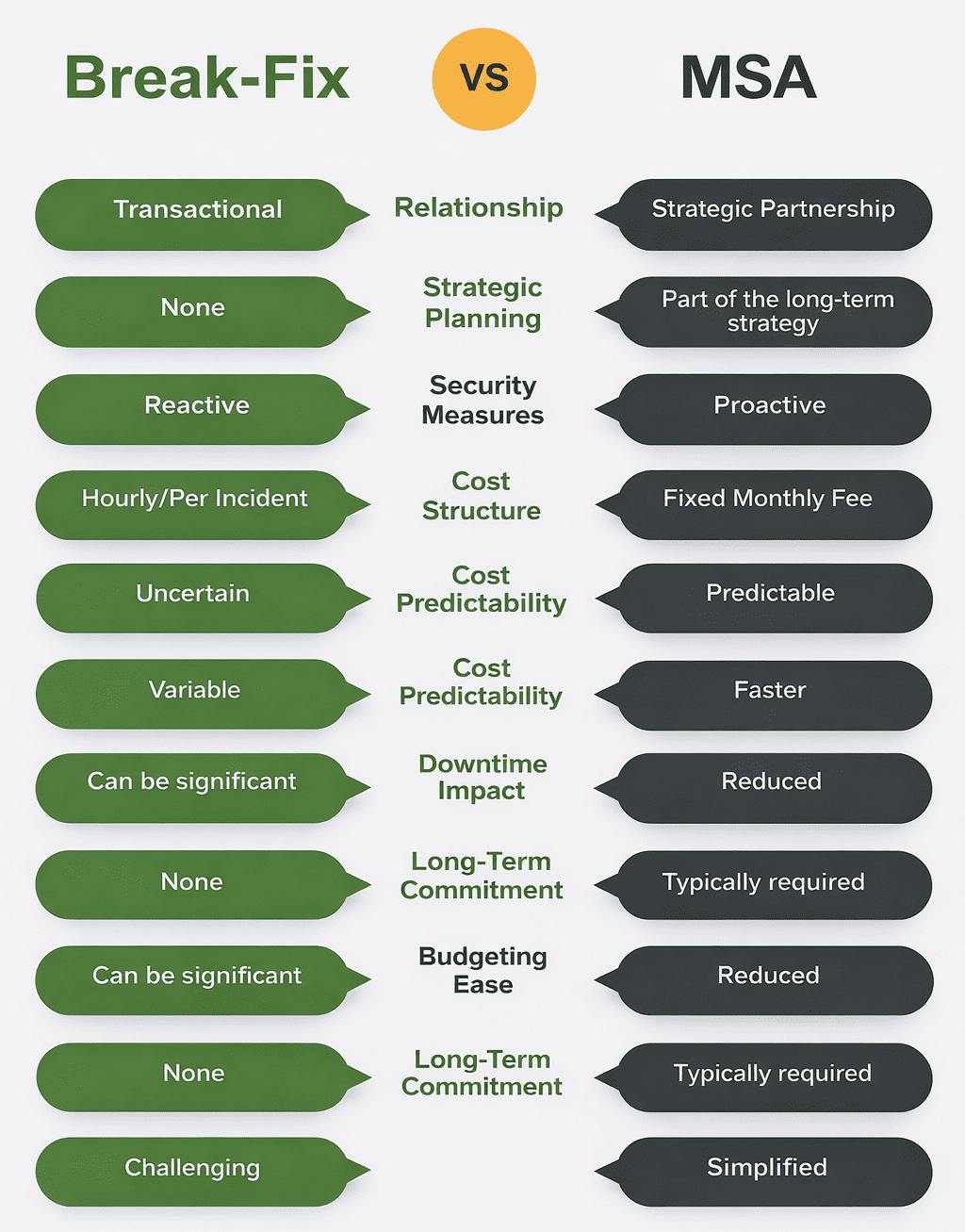
Break Fix vs Managed IT Manufacturing Comparison

Here’s how the two models differ once manufacturing operations mature.

Break Fix vs Managed IT Manufacturing Comparison

Area Break-Fix IT Managed IT for Manufacturing
Cost structure Unpredictable Flat, predictable monthly cost
Downtime prevention Reactive Proactive monitoring and maintenance
Security Inconsistent Built-in and continuous
Compliance support Minimal Documented and ongoing
Accountability Issue-by-issue Full environment ownership
After-hours support Limited or premium Included
Strategic planning None vCIO-led roadmap

This gap becomes obvious once IT affects production outcomes.

Why Break-Fix IT Fails Manufacturing Environments

Break-fix IT isn’t bad service. It’s simply not designed for modern manufacturing.

Reactive Support Has the Wrong Incentives

Break-fix providers are paid when problems occur.
Managed IT providers are measured by stability, uptime, and prevention.

That difference matters when downtime costs more than the IT bill.

No One Owns the Environment

In break-fix environments:

  • Patches happen inconsistently
  • Backups exist but aren’t always verified
  • Security tools are added without coordination

Manufacturing systems don’t fail all at once. They fail quietly until the impact is unavoidable.

IT Becomes a Production Bottleneck

Operations teams end up troubleshooting issues they shouldn’t own. Instead of supporting production, IT becomes a source of friction.

CEO Insight: Why Manufacturers Eventually Leave Break-Fix Behind

“We see manufacturers hold onto break-fix IT longer than they should because it feels cheaper and familiar. But once IT starts affecting production, security, or customer trust, the model breaks down fast. At that stage, IT isn’t a support function anymore. It’s operational infrastructure. And infrastructure can’t be reactive.”
- CEO of Consilien

This shift in mindset is usually the turning point.

When Manufacturers Know It’s Time to Move to Managed IT

Most manufacturers recognize the signs before they act.

You’ve likely outgrown break-fix IT if:

  • Downtime impacts production schedules
  • One IT issue affects multiple departments
  • Cyber insurance requirements keep increasing
  • Leadership wants predictable IT costs
  • No one owns patching, backups, or security end-to-end
  • You’ve had a security scare or audit close call
  • Growth depends on automation or system integration

If several of these apply, the risk of staying reactive is already higher than the cost of change.

What Managed IT Looks Like for Manufacturers

Managed IT isn’t just outsourced helpdesk. It’s operational support built around manufacturing realities.

Proactive Monitoring and Maintenance

Systems are monitored continuously.
Issues are addressed before production feels them.
Maintenance is planned around shifts, not emergencies.

Security Built Into Daily Operations

Security is ongoing, not project-based:

  • Patch management
  • Backup verification
  • Endpoint and network protection
  • Access controls aligned to shop-floor needs

Strategic IT Planning

Manufacturers need a plan, not just support.

Managed IT includes:

  • IT budgeting and forecasting
  • Hardware and software lifecycle planning
  • Alignment with automation and growth goals

The Real Cost Difference: Break-Fix vs Managed IT

Break-fix often looks cheaper upfront.

But manufacturers experience costs through:

  • Lost production hours
  • Emergency service premiums
  • Delayed orders
  • Increased risk exposure
  • Reputation damage

Managed IT reduces those hidden costs by preventing them in the first place.

A Simple Question for Manufacturing Leaders

If production stopped tomorrow due to an IT issue, would you know:

  • Who owns the response?
  • How long recovery would take?
  • Whether security or compliance exposure exists?

If the answer isn’t clear, it’s time to reconsider your IT model.

Talk with Consilien about whether managed IT makes sense for your manufacturing environment.
We help manufacturers move from reactive IT to predictable, production-aligned support without disrupting operations.

👉 Schedule a manufacturing IT assessment

Frequently Asked Questions

Is break, fix IT a cheaper option for manufacturing companies?
At first, the native cost of break, fix may seem cheap, but it usually ends up being more expensive over time. The losses in productivity, the cost of emergency labor, and the exposure to the risk factor usually outweigh the savings of a reactive model.
Can manufacturers use break, fix IT and still be secure?
Security requires continuous monitoring, patching, and validation. Break fix IT does not offer a regular prevention pattern, which becomes the lead problem as compliance and insurance requirements keep on advancing.
When should a manufacturer go from break fix to managed IT?
Generally, a manufacturer should change the moment IT starts to affect production, compliance, or growth plans. At that time, reactive support is more of a risk than a value.
Will managed IT replace the internal IT staff?
Not necessarily. Managed IT sometimes acts as an extension of the internal teams by taking care of monitoring, security, after hours coverage, and strategic planning.
How disruptive is the transition to managed IT?
When done right, nothing should be disrupted. A structured onboarding process can make sure manufacturing operations continue without any interruptions.

Final Takeaway for Manufacturing Leaders

Reactive support is no longer an option when IT becomes a critical part of production and security. Managed IT gives manufacturers the predictability and accountability they need to reduce risk, maintain predictable spend, and keep systems running to meet production schedules.  If your factory can’t rely on break fix IT anymore, Consilien can help you make the transition with clarity and confidence.

Start with a manufacturing IT strategy conversation