Vendor Risk Management for Manufacturing Supply Chains
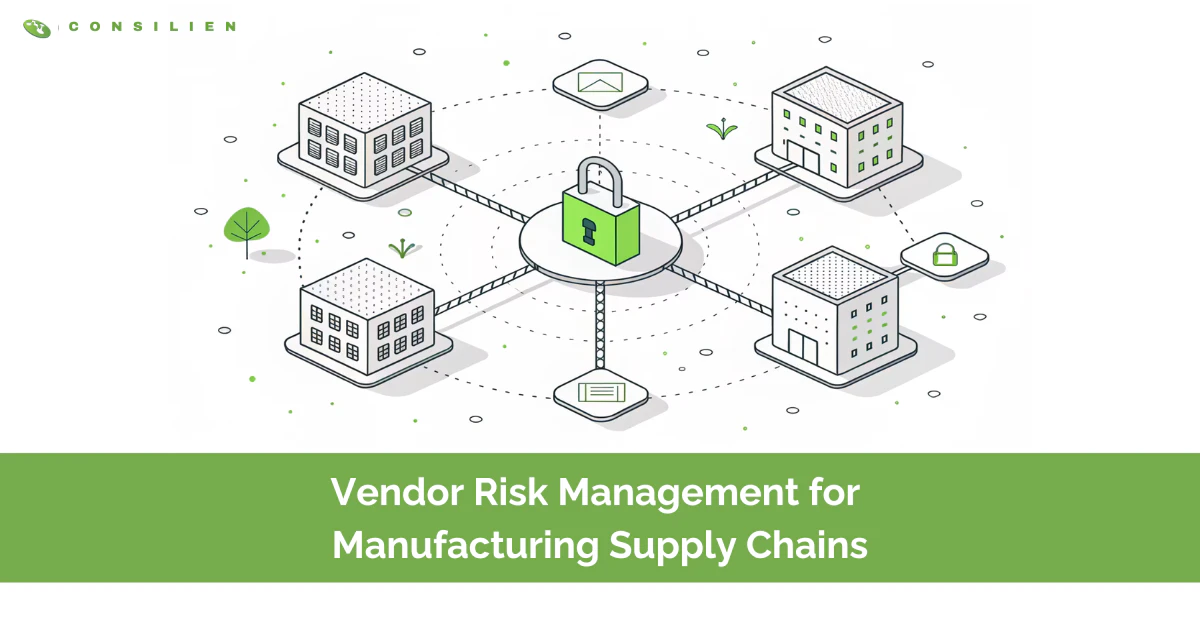
Vendor risk management is the work of knowing exactly which outside companies can touch your operation, how badly each one could hurt you, and what you have done to limit the damage before anything goes wrong. In a manufacturing supply chain, that list is longer than most leadership teams think. Your ERP host, your MSP, the integrator who programmed your PLCs, the logistics platform that schedules your trucks, the supplier who shares production data with you over a portal. Every one of them is a door into your business. Most manufacturers protect the doors they own and assume the rest are someone else's problem. They are not. If you run a plant in California, this is the same risk surface we map for clients across our manufacturing IT and security practice, and it is the part of the program that gets skipped most often.
Table of Contents
Here is the uncomfortable part. According to the Verizon 2025 Data Breach Investigations Report, the share of breaches involving a third party doubled in a single year, from 15% to 30%. That was the largest one-year jump Verizon has ever recorded. The attacker did not get smarter about breaking down your front door. They figured out it is easier to walk in through a vendor's.
What vendor risk management means in a manufacturing supply chain
Vendor risk management, sometimes called third-party risk management, is a repeatable process for identifying the outside parties that have access to your systems, data, or production, scoring how much risk each one carries, and applying controls that match that risk. It covers cybersecurity, but it does not stop there. It includes operational dependency, compliance exposure, and what happens to you when the vendor itself goes dark.
For a manufacturer, the vendor list is unusual because it spans both sides of the house. You have IT vendors, the cloud apps and managed providers most companies think about. You also have operational technology vendors, the people who installed and maintain the machines on your floor. A remote support connection into a CNC controller is a vendor relationship, and it is one of the most dangerous ones you have, because it bridges straight from the internet into equipment that was never designed to be online. We pull this thread apart in more detail in our look at OT versus IT security in manufacturing.
Third party, fourth party, and the risk you never see
Your direct vendors are your third parties. The companies your vendors rely on are your fourth parties, and you usually have no contract with them and no idea who they are. Your MSP runs on a cloud platform. Your ERP host depends on a data center and a backup provider. Those dependencies are real exposure even though they never appear on your purchasing list.
The numbers here are larger than they feel. SecurityScorecard's research on concentration of cyber risk found that a typical organization sits on top of roughly 45 third-party vendors and several hundred fourth-party relationships behind them. You are not managing a list. You are managing a web.
Concentration risk: the failure that hits everyone at once
Concentration risk is the quiet one. Several of your vendors may quietly depend on the same cloud provider, the same file-transfer tool, the same identity platform. When that shared dependency gets hit, every vendor that relies on it goes down together, and so do you. The MOVEit file-transfer compromise worked exactly this way, cascading through one tool into thousands of downstream organizations that had never heard of it. A per-vendor checklist will never surface this, because the danger lives in what your vendors share, not in any one of them.

Why manufacturing supply chains are the target right now
This is not a general warning bolted onto a manufacturing headline. Manufacturing is the sector taking the most fire. IBM's X-Force Threat Intelligence Index has ranked manufacturing as the most-attacked industry for several years running, and the gap over second place is not close. Ransomware operators in particular have settled on manufacturers as their preferred victims, a pattern Sophos documents in its State of Ransomware in Manufacturing research year after year.
The reason is straightforward, and it is about pressure. A manufacturer with idle machines is losing money by the hour, which makes you far more likely to pay quickly. Your floor often runs on equipment and operating systems that cannot be patched without scheduling downtime, so known holes stay open for years. And your supply chain is full of smaller partners with thinner defenses. Attackers have learned that breaching a small vendor with weak security is easier than hitting the larger target directly, so they get in through the supplier and pivot. The smaller the partner, the softer the entry point.
That dynamic is why a generic provider often misses the real exposure. We wrote about that specific gap in why generic MSPs fail in manufacturing environments, and vendor risk is one of the clearest examples.
What one vendor compromise actually costs you
Treat this as the line item, not the abstraction. When Jaguar Land Rover was hit in 2025, the company shut down production across its plants for roughly a month. Automotive News reported losses north of 1.3 billion dollars, and the ripple ran straight down the supply chain to suppliers who suddenly had no one to ship to. Most of those suppliers did nothing wrong. They were simply attached to a customer who got hit.
You do not need to be JLR's size for the math to ruin a quarter. A breach that reaches you through a vendor takes longer to find and longer to contain, because the entry point sits in a system you do not control and cannot see into. The IBM Cost of a Data Breach Report consistently shows supply-chain and third-party breaches carrying some of the longest lifecycles and highest costs of any attack path. The bill is not just the ransom. It is the downtime, the missed shipments, the contract penalties, and the customers who quietly move volume to a competitor while you recover.
How to build a vendor risk management program that holds
Most companies do this backward. They send a security questionnaire to a vendor they already signed, file the answers, and call it managed. A program is not a folder of PDFs. It is a small number of steps you actually run, in order, on every vendor that matters.
1. Inventory every vendor with access
You cannot manage what you have not listed. Build one inventory of every outside party that touches your systems, your data, or your production floor. Include the obvious IT vendors, the OT integrators and equipment service contracts, the logistics and EDI partners, and the suppliers you exchange data with. For each, write down one thing: what could this vendor reach if their own systems were compromised tomorrow. That single question does more than a fifty-page policy.
2. Tier vendors by the damage they could do
Not every vendor deserves the same scrutiny, and treating them equally is how programs collapse under their own weight. Sort vendors into tiers based on the sensitivity of the data they handle, how critical their service is to keeping the plant running, and how deeply they connect into your systems. The vendor with a live connection into your production network is a different animal from the one who prints your trade-show banners. Tiering tells you where to spend your limited attention, and it is the step that makes everything after it realistic.
3. Assess before you sign, not after
Your negotiating power is highest before the contract is signed, and it disappears the moment it is. For your top-tier vendors, ask the questions that matter before money changes hands. Do they carry a recognized security certification. Do they encrypt your data and segment their own network. How fast will they tell you if they are breached, and what does their own incident response actually look like. A short, pointed assessment scaled to the vendor's tier beats a generic 200-question survey nobody reads. This is the same discipline behind a real manufacturing cybersecurity assessment, applied to the people you let inside.
4. Put the requirements in the contract
A vendor's security promise is only worth what the contract makes enforceable. Bake your expectations into the agreement: breach notification timelines, the right to audit, minimum security controls, and clear liability if their failure becomes your incident. If you manufacture for defense or aerospace, this is not optional. Under the finalized CMMC rule and DFARS 252.204-7012, which entered active enforcement in late 2025, prime contractors must flow these obligations down to subcontractors who handle controlled information, and primes are on the hook when a sub falls short. We map that flow-down for clients through our manufacturing IT compliance services.
5. Monitor continuously, not once a year
A vendor you assessed in January can be breached in March, and an annual review will not tell you until it is far too late. The vendors in your top tier need ongoing monitoring, not a yearly questionnaire. That means watching for breach disclosures, tracking material changes in their environment, and reassessing the moment something shifts. The point of vendor risk management is not a clean audit file. It exists to feed decisions, so you find the problem while you can still do something about it.
Where compliance frameworks fit
You do not have to invent this from scratch, and you should not try to. The frameworks already exist and they were built for exactly this. NIST Special Publication 800-161 is the federal standard for cybersecurity supply chain risk management, and it lays out how to assess and control risk across the full vendor lifecycle. The updated NIST Cybersecurity Framework 2.0 went a step further in 2024 by adding a dedicated supply chain category, GV.SC, under its new Govern function. The message in that change is hard to miss. Supply chain risk is now treated as a leadership responsibility, not an IT task buried three levels down.
You do not need to adopt every control on day one. But these frameworks give you a credible starting structure and a language your customers, auditors, and insurers already recognize.
The reality for a 50 to 250 person manufacturer
Here is where most advice falls apart. The frameworks assume a security team you do not have. Mid-sized manufacturers rarely run a dedicated security function, and limited staffing is the most common barrier these companies name when asked why their protection lags. You are not going to assign someone to manage 45 vendors full time, and pretending otherwise is how good intentions die in a spreadsheet.
So start narrow. Take the handful of vendors who could stop your production or expose your most sensitive data, run the five steps above on those, and ignore the long tail for now. Risk reduction is not evenly distributed. A small amount of focused effort on your most dangerous vendors removes most of your real exposure. This is also where a fractional security leader earns the cost. A vCIO or vCISO can own the vendor risk program, run the assessments, and sit in the contract conversations, without you carrying a full-time hire. The companies that come through a supplier breach intact almost always did the un-glamorous work first. Not with a new tool. With the list.