How Manufacturing Companies in Los Angeles Reduce Downtime with Managed IT
Manufacturing companies in Los Angeles cut downtime through managed IT by proactively monitoring their systems, securing their networks, upkeeping their infrastructure, and helping the IT/OT environment. This method not only stops breakdowns from happening, but it also lowers the impact of production interruptions and helps operations stay in line with the compliance standards, such as the National Institute of Standards and Technology, which is very important in aerospace and supply chain-driven industries.
Table of Contents
What is Managed IT for Manufacturing?
Managed IT for manufacturing refers to a proactive service model in which an outside company oversees, protects, and keeps in good condition IT, as well as other operational systems (ERP, MES networks, endpoints) to avoid downtime, increase reliability, and enable production to continue without interruption.
Why Downtime Is a Critical Risk for Manufacturers in Los Angeles
Downtime isn’t just an IT issue. It’s a revenue, compliance, and supply chain problem.
In Los Angeles manufacturing environments:
- Aerospace and defense suppliers face strict uptime expectations tied to contracts
- Multi-site operations increase dependency on centralized systems
- Supply chain delays cascade quickly across partners
According to Deloitte, modern manufacturing depends on tightly integrated digital systems. When one fails, production stops.
7 Ways Managed IT Services Reduce Downtime in Manufacturing
Managed IT reduces downtime by preventing issues—not just reacting to them.
- 24/7 system monitoring detects issues before failure
- Predictive maintenance identifies failing hardware early
- Patch management closes vulnerabilities and stabilizes systems
- Network optimization prevents bottlenecks and outages
- Cybersecurity protection blocks ransomware and intrusions
- Backup and disaster recovery ensure rapid restoration
- IT/OT integration support keeps plant-floor systems connected
This aligns with guidance from Gartner, which emphasizes proactive IT operations over reactive models.
Cybersecurity and Downtime
Most competitors don't. A big mistake. Today, a cyberattack is one of the fastest ways to shut down a plant.
- Ransomware can freeze production lines in a flash
- OT devices such as PLCs and SCADA are usually vulnerable
- From one to several days may be needed to bring an operation back to normal
Per IBM Security, the manufacturing sector is among the most attacked industries worldwide. Besides data, even operational technology has become a target of attackers, as per the Cybersecurity and Infrastructure Security Agency.
Summary: Downtime prevention = implementing a cybersecurity approach.
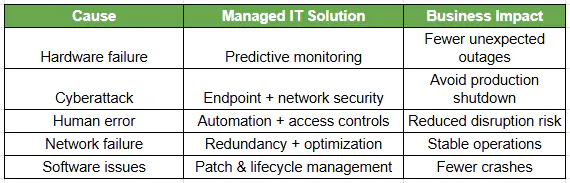
Common Causes of Downtime and How Managed IT Solves Them
Managed IT vs Break-Fix for Manufacturing Environments
Break-fix doesn’t work in manufacturing.

Reactive IT assumes downtime is acceptable. Manufacturing operations don’t have that luxury.
Why Co-Managed IT Works for Manufacturing Teams
Internal IT teams aren’t the problem. Capacity is.
Most manufacturing IT teams are:
- Supporting ERP, users, and plant systems
- Understaffed for 24/7 monitoring
- Lacking dedicated cybersecurity resources
A co-managed model:
- Extends internal IT without replacing it
- Adds specialized security and monitoring
- Reduces burnout and operational risk
This is where Consilien differentiates—supporting internal teams, not competing with them.
Compliance and Uptime: NIST and CMMC Considerations
For many Los Angeles manufacturers, uptime isn’t optional—it’s regulated.
- National Institute of Standards and Technology frameworks emphasize risk reduction and system resilience
- US Department of Defense CMMC requirements impact defense contractors
Managed IT supports compliance by:
- Enforcing security controls
- Monitoring systems continuously
- Maintaining audit-ready environments
Important: Managed IT supports compliance readiness, not certification.
What to Look for in a Managed IT Provider in Los Angeles
Not all MSPs understand manufacturing.
Look for:
- Experience with ERP, MES, and plant systems
- Security-first approach (not just help desk)
- Co-managed IT capabilities
- Compliance awareness (NIST, CMMC)
- Ability to support multi-site operations
Most providers stop at “monitoring.” You need one that understands production risk.
Manufacturing IT Downtime Prevention Checklist
- Continuous monitoring across IT + OT
- Endpoint and network security controls
- Regular patching and lifecycle management
- Backup and disaster recovery testing
- Network redundancy
- Compliance-aligned security policies