Managed IT Cost for Manufacturing Companies: A Real Budget Guide
Managed IT for a manufacturing company usually runs $100 to $250 per office user per month. Shop-floor devices, after-hours shift coverage, extra sites, and security monitoring are priced as separate lines, and they move the total more than headcount does.
Table of Contents
Two plants with the same headcount can get managed IT quotes where one is double the other. Same ERP. Same 60 people on payroll. The gap almost never comes from the office. It comes from the floor.
Managed IT cost for manufacturing companies gets misread because the pricing model was built for offices. One person, one laptop, one mailbox, one line on the invoice. A plant breaks that math in about five places, and a provider who actually works in IT for manufacturing companies will price those five places out loud instead of folding them into a mystery number.
So read a plant quote by its lines, not by its per-user rate. The per-user rate is the least surprising thing on it.
What does managed IT cost for a manufacturing company in 2026?
The core managed IT fee lands at $100 to $250 per user per month, the same national range any business sees. Plants then add lines for floor devices, servers, after-hours coverage, and security monitoring, which pushes the real figure toward $200 to $360 per office user.

Those tiers match the ranges in our guide to outsourced IT support cost per user, which also covers what counts as a user and how per-device and flat-fee pricing compare.
Expect a hybrid. Per user for anyone with a mailbox. Per device for the floor. Per site for each building. Then a line for the hours after first shift goes home. Four lines, minimum.
If a provider hands a 3-shift stamping plant one tidy per-user number, ask what it left out, because the answer is usually the floor, and the floor is where the 2 a.m. phone calls come from.
Why does a plant cost more to support than an office?
A plant has devices nobody logs into personally, machines that can't be patched on IT's schedule, and production that keeps running after 5 p.m. Each of those eats support time that a per-user price never counts.
Walk the floor and list what's plugged in. The shared PC at the shipping dock running UPS WorldShip. The time-clock kiosk by the break room. The CNC programming workstation that still has a USB key taped to it. Label printers on the packing line. RF scanners, the handheld barcode guns, roaming on warehouse Wi-Fi that somebody installed in 2017 and nobody's touched since.
None of those shows up as a user. All of them break.
Then there's operational technology, or OT, the controllers, sensors, and operator touch screens that run the physical process itself. NIST keeps a separate security guide just for it, SP 800-82 Rev. 3, updated in 2023. You can't treat a machine controller like a laptop. You don't reboot it on a Tuesday afternoon for a patch. You wait for a planned shutdown, you check with the machine builder that the patch won't break the software running the press, and sometimes you wait another month because the builder hasn't tested it yet.
Attackers know all of this. Check Point counted 1,466 ransomware attacks on manufacturers in 2025, up 56% from 937 the year before, and 713 of them hit U.S. companies. A stopped line costs money every hour it sits, and that's exactly the pressure a ransom note leans on. So manufacturing cybersecurity isn't an optional tier for a plant. It's part of the base cost of keeping the place running.
Which line items move the number?
Five lines do most of the moving. Shop-floor devices, old Windows machines tied to equipment, shift coverage, extra buildings, and security monitoring. Headcount is usually the smallest variable on a plant quote.
Shop-floor devices and shared logins
A floor PC with a shared login isn't a user. It's a device, and good quotes price it that way, at a per-device rate well under the per-user one.
Bad quotes skip it. Then the kiosk dies during second shift, and you find out it was never on the contract, so the visit gets billed hourly. Count your floor devices before you ask for pricing. The number is almost always higher than whoever's filling out the questionnaire thinks.
Windows 10 machines bolted to equipment
No office budget has this line. Some floor PCs can't move to Windows 11 because the software that drives the machine was only certified on Windows 10, and Windows 10 support ended on October 14, 2025.
You've got two options. Isolate the machine on its own walled-off section of the network, which costs setup time. Or pay Microsoft for Extended Security Updates, which start at $61 per device for Year One and double every year after, for up to 3 years. The program is cumulative. Enroll in Year Two and you pay for Year One too, so that's $183 per device, plus another $244 if the PC is still on the floor for Year Three.
Six of those PCs? About $1,100 now and nearly $1,500 more later. Small money. Easy to forget, though.
Second and third shifts
Standard contracts cover business hours, often something like 7 a.m. to 6 p.m. local. If your second shift runs until 11 p.m., a network outage at 9 p.m. waits until morning unless you've paid for after-hours response.
How much is that worth? Fluke's 2025 survey of more than 600 manufacturing decision-makers put the average cost of unplanned downtime at $1.7M an hour. That's an average across respondents in the U.S., the UK, and Germany, and your plant probably isn't losing that. Do your own math instead. A plant doing $15M a year across 2 shifts runs roughly 4,000 production hours, which works out to about $3,750 of output an hour, so a dead night shift costs around $30k before anybody calls a customer about a late order.
Hold that against an after-hours line on the quote. Usually not a hard call.
More than one building
Every site has its own firewall, switches, Wi-Fi, and usually a closet with a server or two in it. Providers often charge a per-site fee on top of users, plus on-site hours and drive time.
Small sites aren't cheap. A 15-person warehouse across town can cost more to support than 15 more people at headquarters. It's a second network to watch, not just 15 more mailboxes. Ask how many on-site hours each location gets per month, and what the hourly rate is once those run out. Get it in writing.
Security monitoring
Standard per-user pricing usually includes endpoint protection, meaning security software on each machine. It doesn't usually include people watching at 3 a.m. Different product.
MDR, short for managed detection and response, adds a 24/7 team of analysts who investigate alerts and shut down an attacker on the device. In our breakdown of managed cybersecurity costs, MDR runs about $9 to $50 per endpoint per month. Floor PCs count as endpoints. A plant with 57 of them lands somewhere between $513 and $2,850 a month for that line alone, which is a 5x spread, and the low end usually means fewer hours of human attention.
What isn't in the managed IT fee?
Software licenses, hardware, ERP vendor support, project work, onboarding, and compliance are billed separately almost everywhere. Budget them as their own lines from day one, or the managed IT number will look like it doubled by spring, when the first license renewal, a dead switch, and an ERP upgrade invoice all land in the same quarter.
- Microsoft 365. Business Premium lists at $22 per user per month, so 40 licensed users add $880 a month.
- Hardware, from replacement PCs to the core switch that dies in August.
- Your ERP and MES. The vendor or reseller behind Epicor, SYSPRO, or JobBOSS supports the application itself, while the MSP supports the server it runs on and gets on the call when something breaks. MES, short for manufacturing execution system, is the software that tracks jobs moving across the floor. Two bills, one problem.
- Projects. A Windows 11 refresh or wiring a new building gets quoted on its own.
- Onboarding, once.
- Compliance work like CMMC, NIST 800-171, or ISO 27001.
That last one trips people up. Consilien offers manufacturing IT compliance as its own engagement, scoped and priced separately from managed IT. Managed IT keeps systems patched, backed up, and running. Getting a plant ready for a CMMC assessor is a different job with different deliverables, and a quote that blurs the two is hiding the price of one of them.
What does a real monthly budget look like?
Take an example plant, built for the math rather than taken from a client. One building. 40 office and supervisory staff with email. 15 shared floor PCs. 2 on-site servers, one for the ERP database and one for files. A second shift that runs until 11 p.m. That's 57 endpoints in total.
Per-user rates come from the national range above. The device, server, and shift rates are example figures to show the structure, not a quote, so swap in your own.
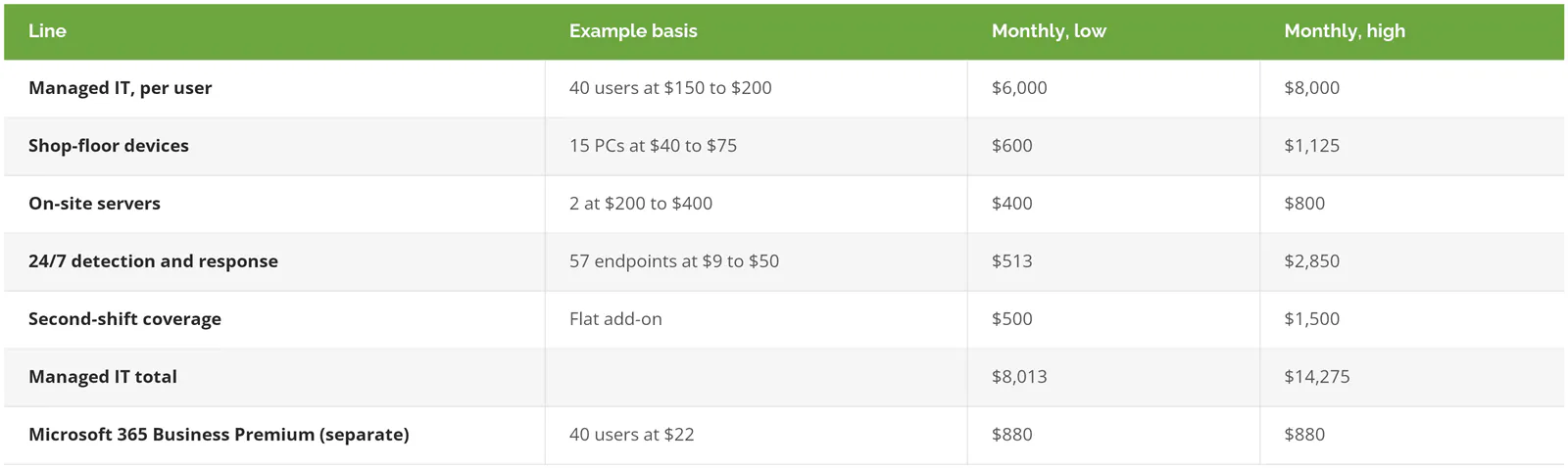
Call it $96k to $171k a year for managed IT, before licenses. Divide by the 40 office users and you're at roughly $200 to $357 per user, even though the per-user line on the quote says $150 to $200.
Look at what the spread is made of. Not headcount. On the low side, the per-user fee is 75% of the bill. On the high side it's 56%. Somewhere between a quarter and nearly half of what a plant pays for managed IT never shows up in the per-user rate, and that's the part two quotes disagree on.
Then the one-time costs. Onboarding often runs about a month of fees, though it varies with how much documentation already exists. Add $1,098 if 6 of those floor PCs need Windows 10 extended updates. Open a 15-person warehouse next year and you're adding a site fee, another firewall and switch stack, 15 users, and drive time, which belongs in your IT budget for 2027 now, not after the lease is signed.
Is managed IT cheaper than hiring for a plant?
Sometimes. The usual comparison, one salary against one quote, is wrong, though.
The BLS puts the median network and computer systems administrator at $99,130 as of May 2025. Wages are 70% of private-sector employee compensation, so that person really costs around $141,600 with benefits. One person. One shift. That person takes vacations, gets the flu, and isn't also a security analyst watching alerts at 2 a.m.
If your plant runs one shift, has one building, and already has a sharp IT person you trust, you may not need full managed IT at all. Co-managed IT, where an outside team backs up your internal person with tools, security monitoring, and overflow, often costs less than anything in the table above. Fred Romero's managed vs in-house IT for manufacturers breakdown runs the full comparison.
How do you compare two manufacturing IT quotes?
Line them up by what they cover, not by the per-user rate. Cheaper usually means smaller. A plant quote that looks $3k a month cheaper just covers less of the plant.
Before you compare totals, get written answers to these.
- Are the floor PCs on it? Count them yourself. If the quote lists 40 devices and you own 57, the other 17 get billed hourly the first time they break.
- What happens at 9 p.m. on a Tuesday when the dock PC won't print bills of lading?
- Is the OT in scope, out of scope, or best effort? Controllers usually belong to the machine builder or your controls integrator. The MSP should at least own the network around them and keep them walled off from email and web browsing.
- What does onboarding include, and is it a fixed fee or hourly?
Consilien is a managed IT and cybersecurity provider for businesses across the country, and manufacturing is one of the industries we support. If you want to see how the field stacks up first, there's a ranked list of the top IT services for manufacturing companies worth reading.
Got two plant quotes that don't line up? Speak to an IT expert and we'll walk through both, line by line, starting with the floor.