Gartner Magic Quadrant for SIEM 2026: What the Current Report Means for Businesses Buying a SIEM
There's no 2026 Gartner Magic Quadrant for SIEM yet, as of November 5, 2026. The one everyone's quoting is dated October 8, 2025, and its Leaders are Microsoft, Google, Splunk, Securonix, Exabeam, and Gurucul, with CrowdStrike and Elastic placed as Visionaries.
Table of Contents
On November 5, 2026, the most recent SIEM placements announced by Microsoft, Splunk, Google, and CrowdStrike all refer to the October 2025 report.
SIEM stands for security information and event management. It collects logs from servers, firewalls, laptops, and Microsoft 365, then runs rules against them to spot an intrusion. Gartner's Magic Quadrant compares the vendors that sell it, from the point of view of large enterprise security teams. For a 90-person distributor with one IT manager, the report leaves out the deciding question, which is who reviews the alerts at 3 a.m. That's the question managed SIEM answers.
Key Takeaways
My short version. The newest quadrant is still the October 8, 2025 one, with six Leaders (Microsoft, Google, Splunk, Securonix, Exabeam, Gurucul) and two Visionaries (CrowdStrike, Elastic). Gartner grades execution and vision, never price or analyst headcount, and its own disclaimer says don't shop only the Leaders box. No security team? Then I'd build the shortlist from your daily log volume, the Microsoft or CrowdStrike licenses you already pay for, and whoever's picking up the phone at night.
Is there a 2026 Gartner Magic Quadrant for SIEM?
Not yet. The latest Gartner Magic Quadrant for SIEM is dated October 8, 2025, by analysts Andrew Davies, Eric Ahlm, Angel Berrios, and Darren Livingstone. The edition before it was dated May 8, 2024, so the gap between reports isn't a tidy 12 months, and Gartner doesn't announce release dates in advance.
You'll know the new one is out because the vendors can't help themselves. After the 2025 report, Elastic posted its placement on October 15, and Microsoft and Google followed on the 16th. A week, give or take.
Gartner has put out other SIEM research in 2026. None of it re-ranks the quadrant.
Who are the Leaders in the current SIEM Magic Quadrant?
Six vendors have announced a Leader placement in the October 2025 report. They're Microsoft, Google, Splunk, Securonix, Exabeam, and Gurucul. CrowdStrike and Elastic were named Visionaries. Gartner keeps the full list of Challengers and Niche Players behind its paywall, so this table only includes placements the vendors announced publicly.
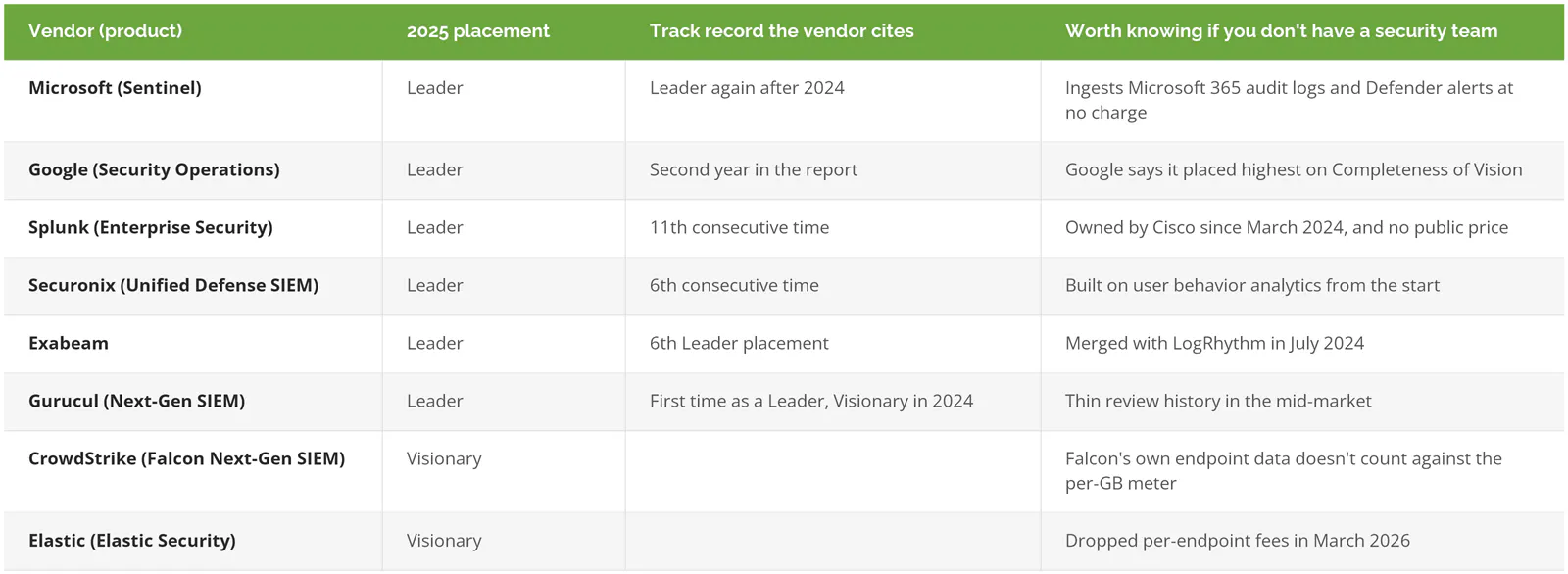
Sources for the track record column are the vendors' own announcements, from Splunk, Securonix, Gurucul, and CrowdStrike. Each of those announcements cites the same report, dated October 8, 2025.
CFOs ask me about IBM, because QRadar was on a lot of shortlists a few years ago. IBM's QRadar page still advertises a 14th consecutive Leader placement, but its download link is the 2024 report, and I couldn't find a public source placing QRadar in the 2025 edition. In 2024, Palo Alto Networks closed its purchase of IBM's QRadar SaaS business and began moving those customers to Cortex XSIAM, Palo Alto's security operations platform. On-premises QRadar stayed with IBM.
Ownership isn't on the chart. Since early 2024, Cisco has bought Splunk (the deal closed that March), Exabeam has merged with LogRhythm (July 2024), and QRadar's cloud customers have been moved to Palo Alto. A large security operations center (SOC) handles a forced migration as a funded project with an owner. A company running its SIEM with one IT manager tends to handle it late, and the risk is detection rules that stop matching after the move without anyone noticing.
What does Gartner actually score, and what does it leave out?
Gartner places each vendor on two axes. Ability to Execute measures how well the vendor sells, delivers, and supports its product today. Completeness of Vision measures its understanding of the market and its roadmap. Neither axis measures price, the staff needed to run the platform, or fit for a company without a security team.
Those four gaps are the ones to check yourself.
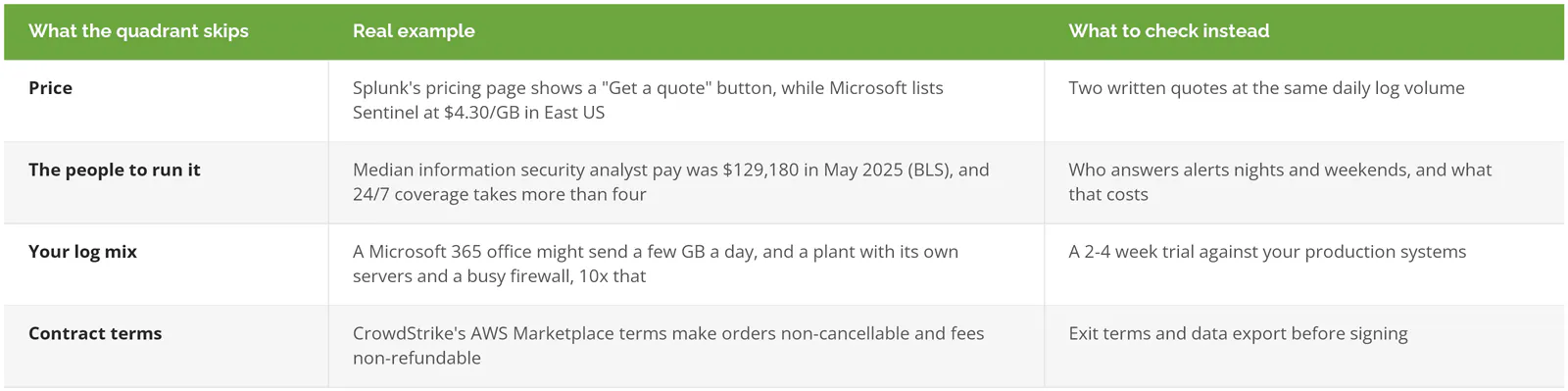
Sources for that table are Microsoft's Sentinel pricing page, the Bureau of Labor Statistics, and CrowdStrike's AWS Marketplace listing.
Gartner's standard disclaimer, which vendors reprint alongside the graphic, says Gartner "does not advise technology users to select only those vendors with the highest ratings or other designation." Read that line before you read the chart.
Why can a Leader be the wrong SIEM for your business?
Gartner ranks vendors for organizations that already employ security analysts. A business without analysts is buying a platform that a provider can run, at a log volume it can afford, ideally on licensing it already owns. Those three constraints usually decide the shortlist before quadrant position does.
Take a company on Microsoft 365. Sentinel ingests Office 365 audit logs and Defender alerts at no charge, and the 31-day trial covers 10 GB a day, which is enough to measure actual volume from your own systems. Its Leader placement is secondary.
Now a company that already has CrowdStrike Falcon on every laptop. Falcon Next-Gen SIEM is a Visionary, not a Leader, and it may still be the simpler buy, because the endpoint data you're already collecting doesn't count against the $0.00595 per MB charge. One console. One vendor to call.
Then there's Splunk, an 11-time Leader and a genuinely powerful platform, which I'd still steer a company away from running in-house unless somebody on staff writes Splunk search queries for a living. Powerful tools punish the unstaffed.
For a scored comparison that does weigh price, reviews, and mid-market fit, see the best SIEM tools for 2026. And if you're still fuzzy on what a SIEM does day to day, start there.
What changed in SIEM going into 2026?
The tools didn't sit still while the quadrant did. Four changes since the October 2025 report are worth knowing before you take a demo.
Gartner's Hype Cycle for Security Operations, 2026, dated June 5, 2026, put AI SOC agents at the Peak of Inflated Expectations with 1% to 5% market penetration, according to Dropzone AI's summary of the report. The same summary says XDR (extended detection and response, which ties endpoint, email, and network alerts together) is headed toward obsolete before it ever reaches the plateau, and that the traditional SIEM is splitting into integrated SOC platforms and cheaper security data lakes. Dropzone sells AI SOC agents, for what that's worth, and I haven't read the Hype Cycle itself.
That 1% to 5% figure is the one I'd tape to the monitor during demos. Every vendor will show you an AI agent closing an alert. Ask how many of their customers have it switched on in production.
In April, the 2026 Gartner Peer Insights Voice of the Customer report for SIEM named CrowdStrike a Customers' Choice. That one comes from verified user reviews, not analyst scoring, which makes it a useful second opinion on a Visionary.
Pricing moved too. Elastic Security Serverless stopped charging per endpoint on March 23, 2026, and Microsoft now sells a Sentinel data lake tier at $0.05 per GB to ingest plus $0.10 per GB to process, for logs you need to keep but rarely search.
How should you use the Magic Quadrant when buying a SIEM?
Use it to build a shortlist, not to pick a winner. Take 3 or 4 vendors that fit the systems you already run, then decide on measured log volume, a written quote, and who will answer the alerts. The quadrant is the first filter in that process and should be the lightest one.
- List what you already license. Microsoft 365 E5 or Business Premium, CrowdStrike Falcon, Google Workspace. A SIEM from a vendor you already pay often ingests that vendor's data cheaply or free.
- Measure your log volume before you take a quote. Two to four weeks of trial ingestion against production systems beats any vendor's sizing worksheet.
- Ask for the full report. Leaders give it away behind a lead form. Skip the dot and read the "strengths" and "cautions" Gartner writes about each vendor.
- Filter Gartner Peer Insights reviews by company size and industry. A 4.6 from banks with 40-person SOCs says little about your Tuesday.
- Price the people. If nobody on staff will answer a 2 a.m. alert, get managed SIEM quotes next to the license quotes and compare the totals.
Step 5 is usually where somebody's favorite drops off the list.
Should you buy a SIEM or a managed SIEM?
If nobody on your team watches alerts around the clock, buy the outcome rather than the software. A managed SIEM provider (some call it SOC as a service) runs the platform for you, tunes the rules so it isn't crying wolf all day, and has a person answer at night. Plenty of them run Sentinel or another Leader under the hood. Same engine. Someone else drives.
Got three-plus security analysts and an on-call schedule? Skip this section. Gartner wrote the quadrant for you, and buying the platform directly will probably be cheaper.
For everybody else it's arithmetic. Add up the license and the salaries it takes to run it, put a managed quote next to that, and see which total is smaller. Our breakdown of in-house SOC vs SOC-as-a-service costs walks through the staffing math, MDR vs MSSP vs SIEM sorts out which service does what, and SOC as a service covers what Consilien's analysts handle.
Holding two SIEM proposals and can't tell which one fits? Speak to a SOC expert.