Cybersecurity Risk Assessment Process: A Step-by-Step Guide
A cybersecurity risk assessment is the structured process of finding what could go wrong in your environment, judging how likely each thing is and how badly it would hurt, then deciding what to do about it. The assessment is the map. Every security dollar you spend afterward is a trip you take on it. Run in order, the process moves through seven steps: define the scope, inventory your assets, identify threats and vulnerabilities, score each risk by likelihood and impact, decide how to treat it, document and communicate the findings, then monitor and reassess.
Table of Contents
Most companies do this backward. They buy the firewall, the endpoint tool, and the email filter first, then assume they are covered. Then an incident hits the one system nobody scored, and they find out their spending never matched their actual exposure. The average U.S. data breach now costs $10.22 million, an all-time high, according to IBM's 2025 report. A cybersecurity risk assessment flips the order. It tells you which risks are worth spending on first, so the budget follows the exposure instead of the sales pitch.
This guide walks through the process step by step, the frameworks it rests on, how often to run it, where it connects to compliance, and the mistakes that quietly waste the whole effort.
What is a cybersecurity risk assessment?
A cybersecurity risk assessment is a study of how a threat could exploit a weakness in your systems and what that would do to the business. You take each asset that matters, your ERP, your customer data, your Microsoft 365 tenant, your production network, and ask a direct question: if an attacker got to this, what breaks, how likely is it, and what does it cost us?
The output is not a gut feeling. It is a ranked, documented picture of your risks, each one scored, prioritized, and assigned an owner and a decision. Two distinctions matter before you start, because people collapse them constantly:
- A risk assessment is not a vulnerability scan. A scan lists technical flaws. A risk assessment asks what those flaws would actually do to the business if exploited, and ranks them on that basis. The scan is an input. The assessment is the decision.
- A risk assessment is not a business impact analysis. A BIA measures what downtime costs you regardless of cause. A risk assessment focuses on threats and how likely they are. They overlap on impact, and strong programs run both.
Why the process matters before the tools
Here is the uncomfortable part. Most security budgets are built from vendor pitches and peer pressure, not evidence. A company buys what the company down the street bought, or what the last webinar pushed, and the controls pile up with no map underneath them.
A risk assessment is what makes spending defensible. When you can point to a ranked list and say we funded these five risks because they scored highest and left these three accepted because the cost to fix them outweighs the exposure, you have a security program a board can sign off on and an insurer can underwrite. IBM's data also makes the case on the back end. Organizations that detect and contain breaches faster pay dramatically less, and you cannot move fast on a risk you never identified. The assessment is not paperwork. It exists to direct money and attention.
The frameworks behind the process
The seven steps below are not invented. They are a practical version of methodologies that already carry weight with auditors, regulators, and cyber insurers. Knowing the source helps when someone asks why you did it this way.
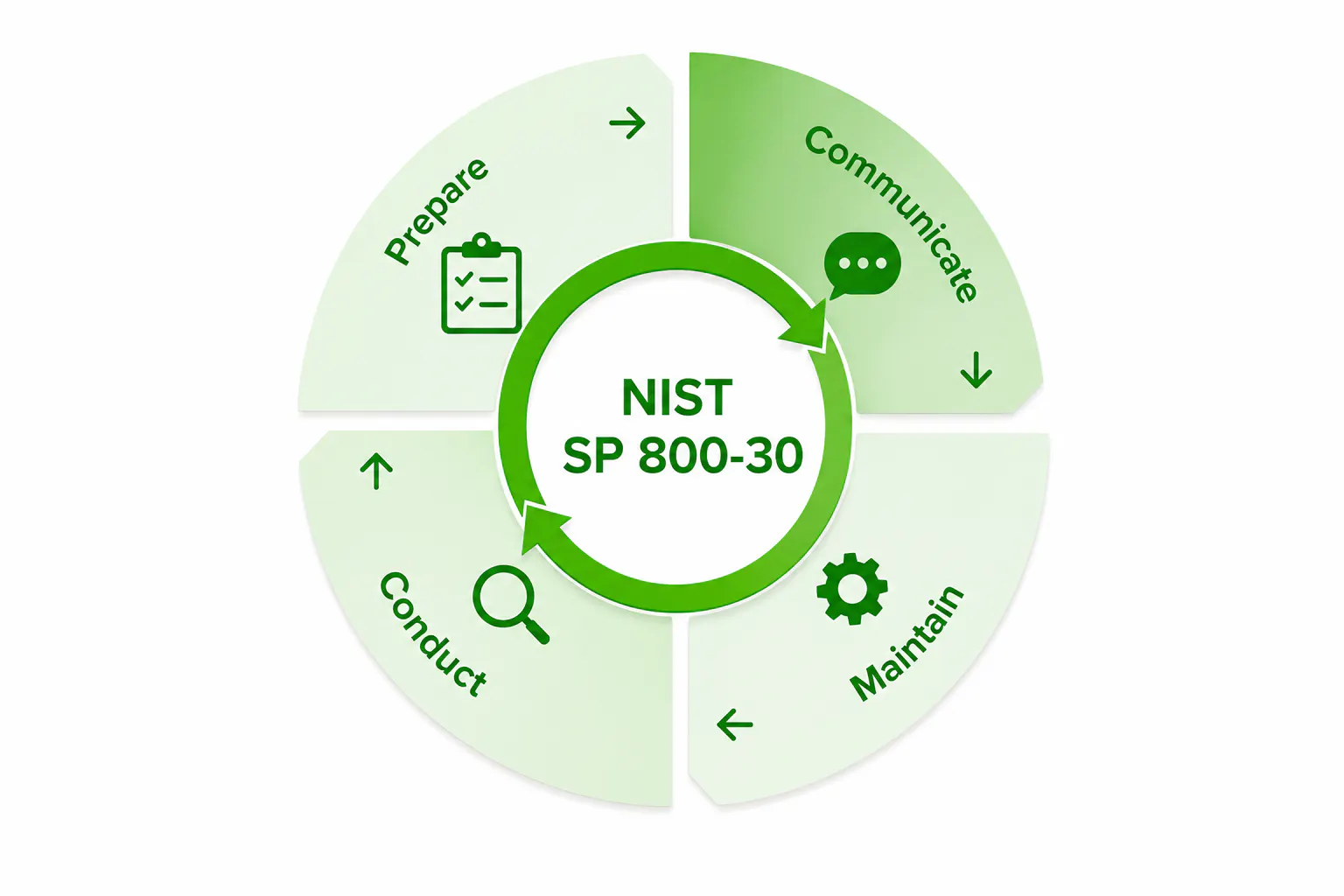
- NIST SP 800-30. The federal Guide for Conducting Risk Assessments organizes the work into four phases: prepare, conduct, communicate, and maintain. That spine runs straight through the steps in this guide.
- NIST Cybersecurity Framework 2.0. The CSF sets the wider program around the assessment. Its 2024 update added a Govern function and places risk assessment inside Identify, the function that tells the other five where to aim.
- ISO/IEC 27005. The international standard for information security risk management maps a similar path: establish context, identify, analyze, evaluate, treat, then monitor. If you run an ISO 27001 program, this is the method you will use.
You do not have to pick one. The steps that follow work whether your driver is NIST, ISO, a cyber insurance application, or a customer security questionnaire.
The cybersecurity risk assessment process, step by step
Step 1: Define the scope and prepare
Before you assess anything, decide what you are assessing. Scope is where most assessments go wrong on day one, in both directions. Scope too wide and you produce a report so broad nobody can act on it. Scope too narrow and you leave the gaps where breaches actually live.
Set the boundaries in writing. Which business units, locations, systems, and data types are in. Which are out, and why. Name the people who will provide information and the executive who owns the result. Decide your scoring method here too, because it shapes everything downstream. Preparation is the prepare phase of NIST 800-30, and skipping it is why so many assessments stall halfway through.
Step 2: Inventory and prioritize your assets
You cannot protect what you have not listed. Build an inventory of the assets in scope: servers, endpoints, cloud workloads, SaaS applications, network devices, and the data each one holds. Then rank them by how much the business depends on them.
This is the step everyone shortcuts, and it is where the damage hides. Mid-market companies almost always find something they forgot, a forgotten server still tied to a billing workflow, an unmanaged SaaS app full of customer records, a vendor connection nobody documented. Those blind spots do not show up on a network diagram, and they are exactly where an attacker looks. A real inventory is uncomfortable on purpose. It surfaces the things you stopped thinking about.
Step 3: Identify threats and vulnerabilities
For each prioritized asset, ask two questions. What could go after it, and how could it get in?
Threats are the sources of harm: ransomware crews, phishing, a careless or malicious insider, a compromised vendor, a misconfiguration, even a power failure. Vulnerabilities are the weaknesses those threats exploit: unpatched software, weak or reused passwords, missing multi-factor authentication, excessive access rights, flat networks with no segmentation. This is where technical testing earns its place. Vulnerability scans and a security assessment and penetration testing turn assumptions into a documented list of real openings. Pair the technical findings with threat intelligence so you are looking at what is actually being used against businesses like yours, not a generic checklist.
Step 4: Determine likelihood and impact, then score the risk
Now you turn a pile of threats and weaknesses into ranked risk. For each pairing of a threat and a vulnerability, judge two things: how likely it is to happen, and how badly it would hurt if it did. Risk is the product of the two. A flaw that is trivial to exploit but harmless ranks low. A flaw that is hard to reach but would take the business offline ranks high.
Most organizations score this qualitatively, on a five-by-five matrix. Likelihood runs from rare to almost certain. Impact runs from insignificant to catastrophic. Where they cross gives you a severity band, usually red, amber, or green. A simplified version of that matrix looks like this:
- Likely threat: minor impact scores Medium, moderate impact scores High, severe impact scores Critical.
- Possible threat: minor impact scores Low, moderate impact scores Medium, severe impact scores High.
- Rare threat: minor and moderate impact score Low, severe impact scores Medium.
Qualitative scoring is fast and easy to explain to non-technical leadership, which is its whole point. The tradeoff is subjectivity, so calibrate your scale with the people doing the scoring before you start. For risks tied to real money, a budget decision, an insurance limit, a board ask, consider scoring those few quantitatively, in dollars and percentages, so the number can stand on its own.
Step 5: Prioritize and decide how to treat each risk
A scored list is not the goal. A set of decisions is. For each risk, starting at the top of the ranking, choose one of four treatments. NIST calls these the risk response options:
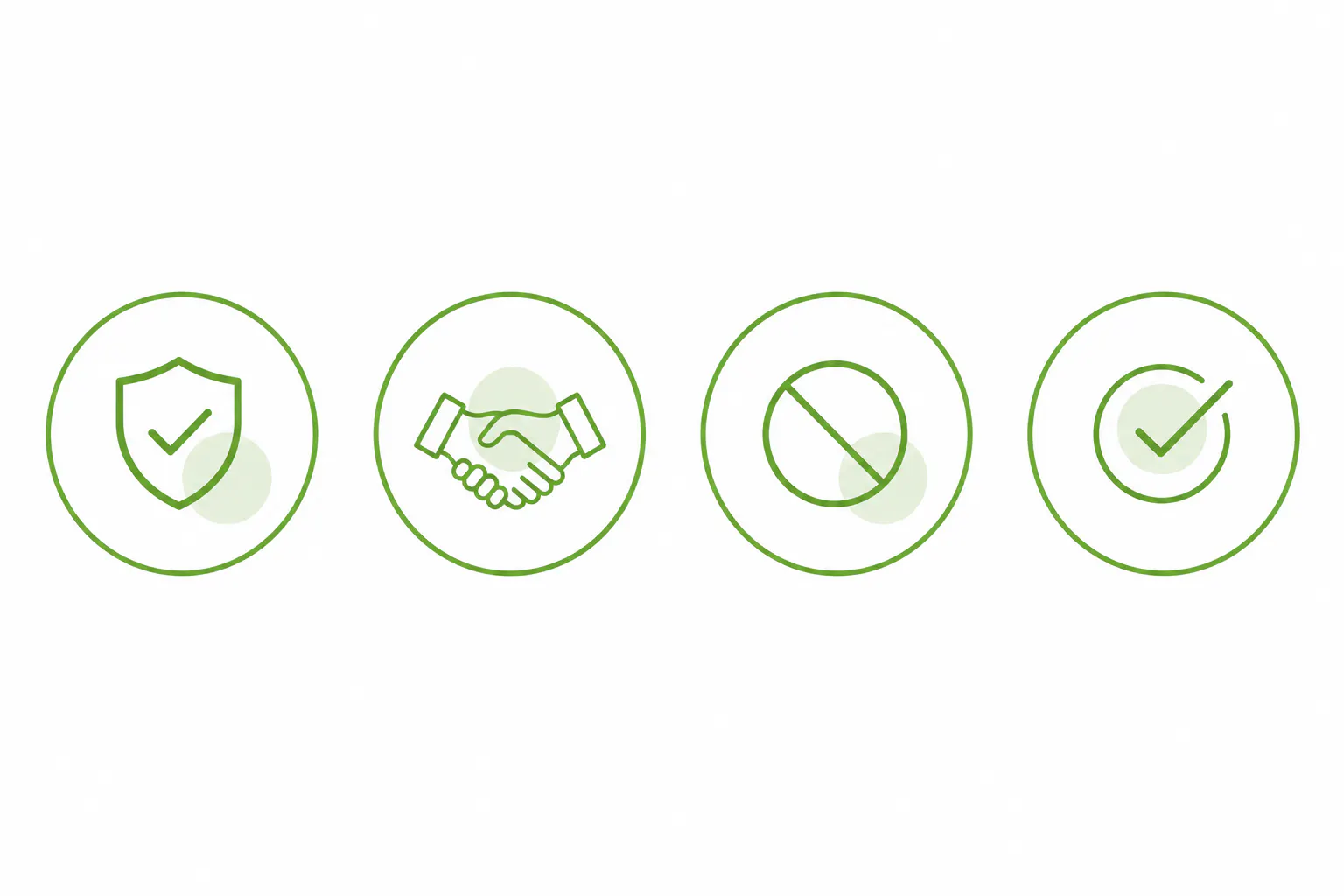
- Mitigate. Reduce the risk with a control. Patch the system, enforce MFA, segment the network, tighten access. This is the most common path.
- Transfer. Shift the financial hit to someone else, usually through cyber insurance or by moving the function to a vendor who carries the risk.
- Avoid. Stop doing the risky thing. Retire the legacy app, drop the feature, close the exposure entirely.
- Accept. Decide the risk is small enough or the fix expensive enough that you will live with it, and document that you chose to.
Record every decision in a risk register, with an owner and a date for the ones you are mitigating. Acceptance is a legitimate choice, but only when it is a choice. A risk you accepted on paper is governance. A risk you ignored is negligence, and after an incident the difference is the first thing investigators look for.
Step 6: Document and communicate the findings
The assessment only pays off if the right people act on it. Write it up in two registers. A short executive summary that tells leadership where the real exposure is and what you are asking them to fund. A detailed register that gives your technical team the specifics to execute. NIST 800-30 calls this the communicate phase, and it is the one most internal assessments fumble, because the team that did the analysis writes only for itself.
This documentation does double duty. It is also the evidence auditors and insurers want to see. A current, signed risk assessment is a baseline requirement for SOC 2, for cyber insurance renewals, and for compliance readiness generally. Doing the work and never writing it down means doing it twice.
Step 7: Monitor, review, and reassess
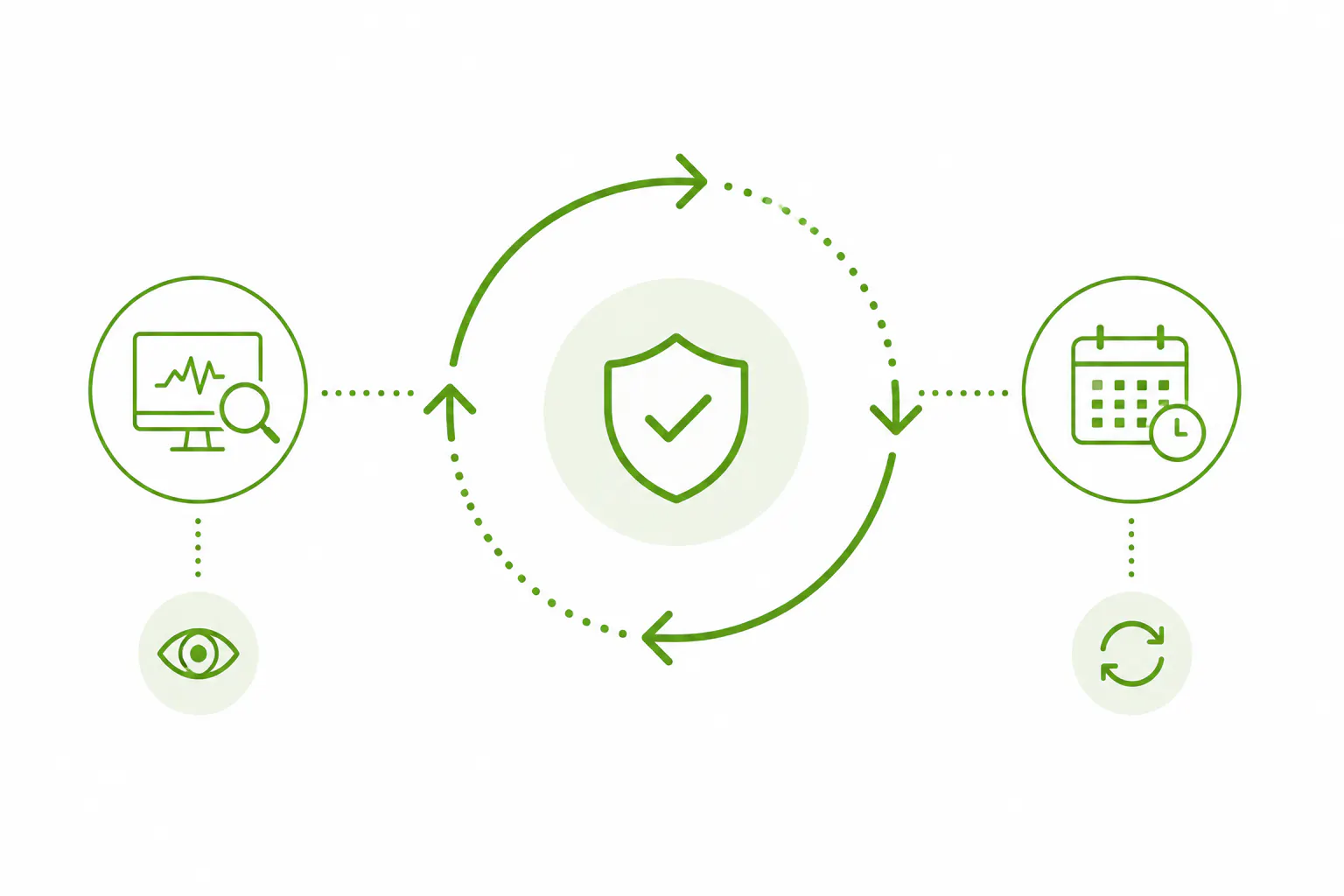
A risk assessment is a snapshot, and your environment does not hold still. New systems come online, vendors change, attackers shift tactics, and a control you rated effective last year quietly drifts. The final step is to keep the picture current.
That means two things running in parallel. Continuous monitoring of your environment, the daily work of watching for new vulnerabilities and suspicious activity, which NIST covers in its information security continuous monitoring guidance. And periodic reassessment, a fresh pass through the steps on a set schedule. The annual snapshot and the daily monitoring are not competitors. You need both.
How often should you run a risk assessment?
Run a full assessment at least once a year. That cadence satisfies most compliance frameworks and cyber insurers, and it forces a clean look at the whole picture.
Run one again, off schedule, whenever something material changes. A new ERP or core system. A merger or acquisition. A new office or facility. A major vendor change. A shift in how the business makes money. Any of those can rewrite your risk picture overnight, and an assessment dated before the change is describing a company that no longer exists. Between full assessments, keep vulnerability scanning on a monthly or quarterly rhythm and continuous monitoring running underneath. The formal assessment is the periodic deep look. Monitoring is what keeps you from being blind in between.
Risk assessment and compliance: NIST 800-171, CMMC, and SOC 2
For regulated companies, the risk assessment is not optional, it is a named control. If you handle Controlled Unclassified Information as a defense contractor or subcontractor, NIST SP 800-171 requires a risk assessment among its 110 controls, and CMMC builds its certification on top of that standard. The Department of Defense's CMMC rule took effect on November 10, 2025, and the requirement is now appearing in contracts. SOC 2, PCI DSS, and most cyber insurance applications ask for the same thing in different words.
If compliance is your driver, scope the assessment to the standard you are chasing and keep the evidence trail tight. For defense work specifically, a CMMC gap assessment is the focused version of this process, measured against the exact controls an assessor will check.
Common mistakes that undermine a risk assessment
The process is straightforward. The ways it fails are predictable. Watch for these:
- Scoping by ambition instead of focus. Trying to assess everything at once produces a report too broad to act on. Pick a defensible scope and finish it.
- A stale or incomplete asset inventory. If the inventory is wrong, every downstream score is wrong. This is the most common root cause of a useless assessment.
- Stopping at a vulnerability list. A list of technical flaws is not a risk assessment. Leadership cannot fund a CVE number. They can fund the risk of losing the order system for three days.
- Treating it as an annual checkbox. An assessment that gets filed and forgotten until next year is a document, not a program.
- No owner on remediation. A risk register with no names and no dates is a wish list. Every mitigated risk needs a person accountable for closing it.
When to bring in outside help
Mid-market companies sit in the most awkward part of the risk curve. You are big enough to depend on cloud apps, remote access, vendors, compliance obligations, and insurance controls, but often not big enough to staff a deep security team. The gaps tend to hide in the handoffs, between IT operations, vendors, leadership, and the people who own the business risk.
That is where an outside partner earns its keep, not to take the work away from your team, but to bring the method, the independence, and the framework fluency a once-a-year exercise rarely builds in-house. Consilien runs risk assessments as part of managed cybersecurity, and through vCIO and vCISO advisory for companies that need executive-level security leadership without a full-time hire. If you are staring at an insurance renewal, a customer security questionnaire, or a CMMC deadline, that is usually the signal to get help rather than improvise.