What Is a Business Impact Analysis? The First Step Before Disaster Recovery
What is a business impact analysis? A business impact analysis (BIA) is a structured process that identifies your most critical business functions and measures what it actually costs you when they stop. It answers three questions before a disaster ever happens: which operations have to come back first, how fast, and how much data you can afford to lose. The BIA is the blueprint. Your disaster recovery plan is the building you put on top of it.
Table of Contents
Most companies do this backward. They buy backup software, sign a recovery contract, and assume they are covered. Then an outage hits, and they find out the systems they spent the most protecting were not the ones that took the business down.
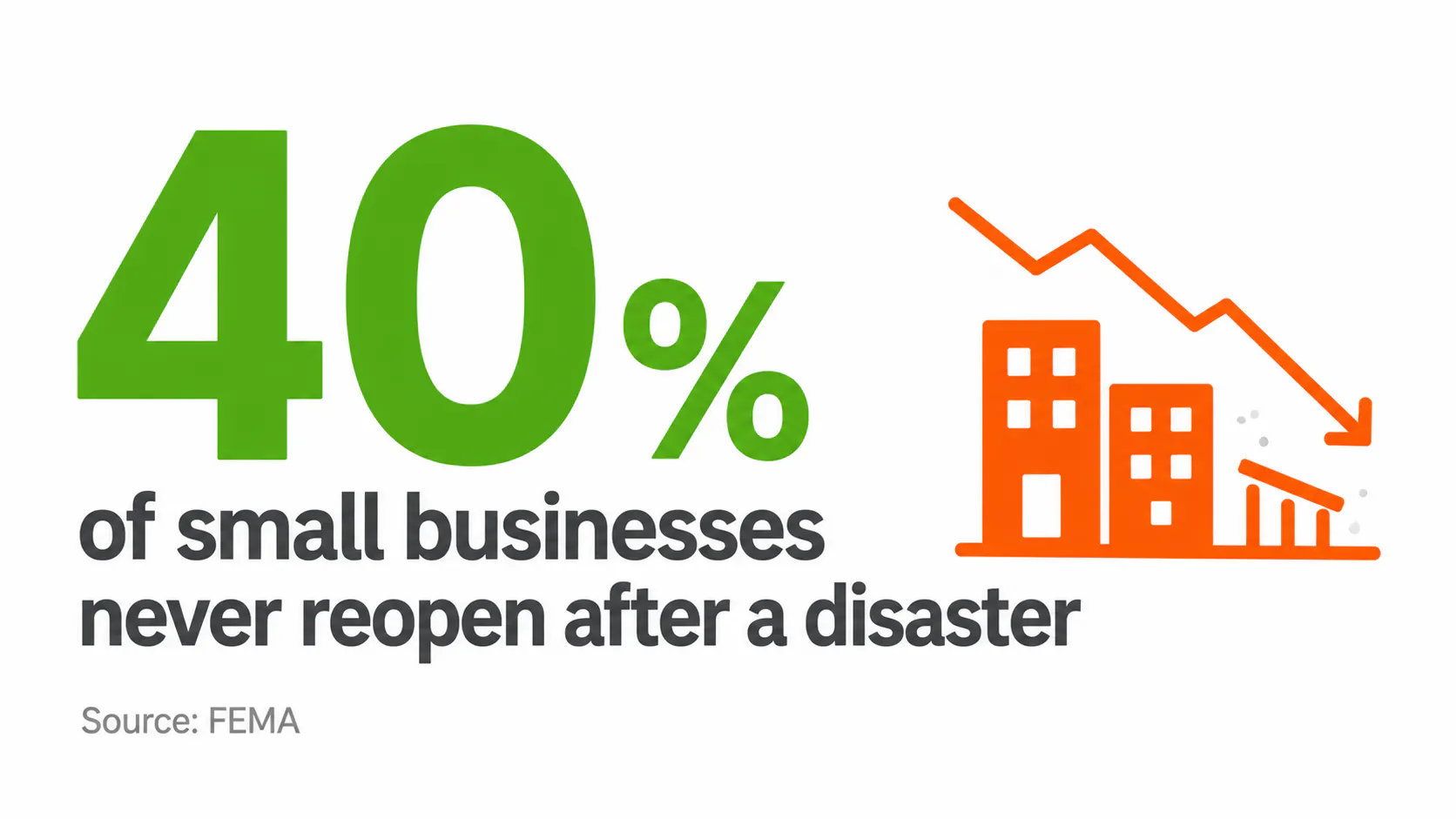
Here is the uncomfortable part. According to FEMA, roughly 40% of small businesses never reopen after a disaster, and another quarter fail within a year of one. The companies that survive almost always share one trait. They knew what mattered before the lights went out, because they ran a business impact analysis first. If you are standing up a backup and disaster recovery program, this is where it starts. Not with the technology. With the analysis.
This guide explains what a BIA is, how it differs from a risk assessment, the numbers it produces, how to run one, and the mistakes that quietly wreck the result.
What is a business impact analysis?
A business impact analysis is a study of how a disruption to your key operations would affect the business over time. You take each critical function, sales order entry, production scheduling, payroll, customer support, and ask a simple question: if this stopped right now, what breaks, how badly, and how fast does it get worse?
The output is not a gut feeling. It is a ranked, documented picture of which functions are mission-critical, what they depend on, and what an hour, a day, or a week of downtime costs you in dollars, contracts, compliance exposure, and reputation. Ready.gov frames it as predicting the consequences of disruption and gathering the information you need to build recovery strategies. That second half matters. A BIA is not an academic exercise. It exists to feed decisions.
It also forces a conversation most leadership teams never have on purpose. When you ask department heads to put a real cost on losing their systems, "everything is critical" stops being an acceptable answer. The BIA makes you choose.
BIA vs. risk assessment: they're not the same thing
People use these terms as if they are interchangeable. They are not, and confusing them is one of the fastest ways to build a recovery plan that misses.
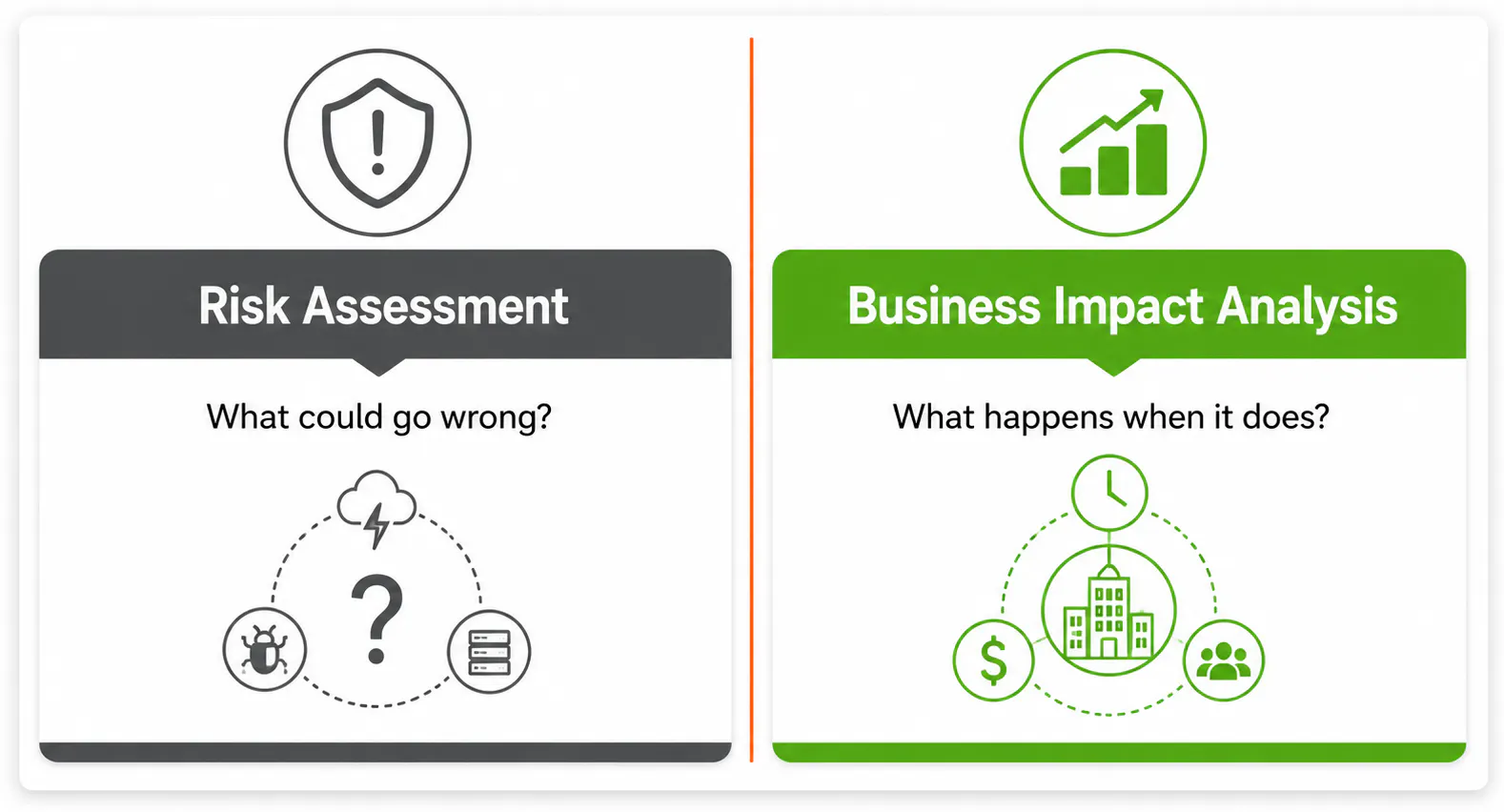
A risk assessment asks what could go wrong. It looks at threats and their likelihood: ransomware, a failed server, a burst pipe in the server room, a regional power outage. A business impact analysis asks what happens when something does go wrong. It ignores the cause and measures the consequence. As TechTarget puts it, a BIA is essentially an extension of a risk assessment, one that predicts how identified risks will actually hit the business.
You need both. The risk assessment tells you what to defend against. The BIA tells you what to protect first. Run only the risk assessment and you will harden systems without knowing which ones the business cannot live without.
Why the BIA comes before the disaster recovery plan
A disaster recovery plan is a set of decisions: what gets restored first, how quickly, from where, and at what cost. Every one of those decisions needs an input. The BIA is that input.
Skip it, and you are guessing. You buy a recovery solution sized for the wrong systems. You set backup frequencies based on what the vendor recommended instead of what each function can tolerate. You discover during the actual outage that the application everyone forgot about is the one holding up shipping. This is what people mean when they say a DR plan without a BIA is building without a blueprint. You have materials and a crew, but no drawing that says what goes where.
The stakes are not abstract. Downtime for a typical small or midsize business runs around $8,600 an hour, and most SMBs say a single hour costs them more than $10,000. FEMA data is blunter. 90% of businesses fail within a year if they cannot reopen within five days of a disaster. Yet only about 26% of businesses have an actual disaster plan in place. The gap between "we think we are covered" and "we tested it against what the business needs" is where companies die.
A BIA closes that gap. It turns recovery from a hopeful purchase into an engineered outcome. For a deeper look at what that recovery layer involves once the analysis is done, see our breakdown of IT disaster recovery services.
The three numbers every BIA produces: RTO, RPO, and MTD
A BIA is only as useful as the targets it sets. Three metrics do the heavy lifting, and every recovery technology decision flows from them.
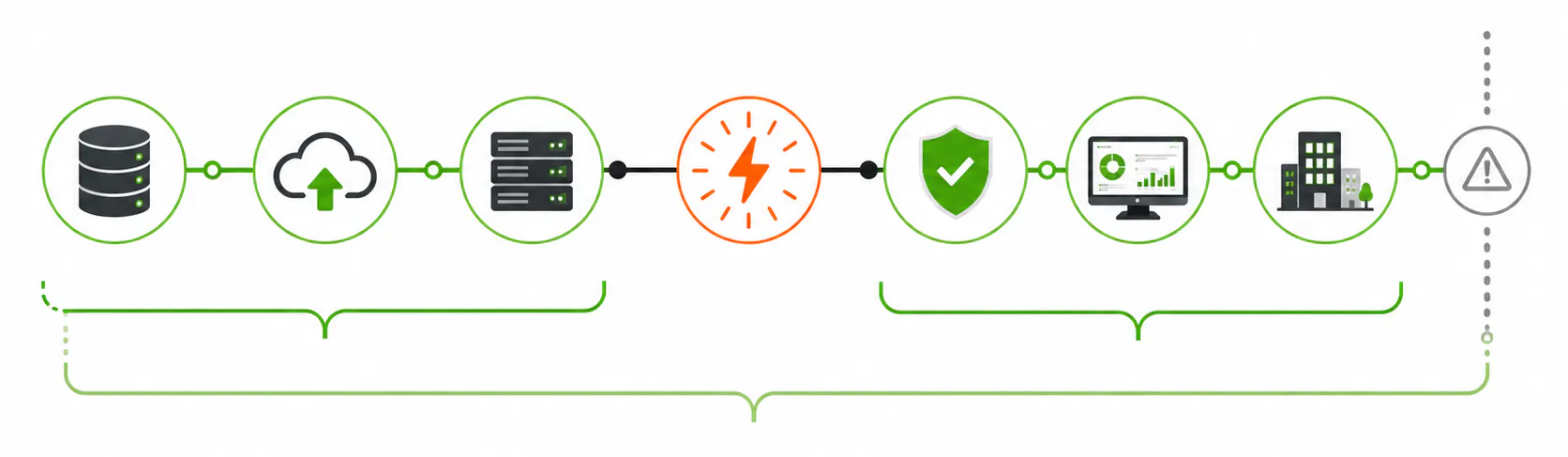
- RTO (Recovery Time Objective): the maximum acceptable time a function can be down before the damage is serious. The question it answers is how fast it must be back.
- RPO (Recovery Point Objective): the maximum amount of data, measured in time, you can afford to lose. The question it answers is how much work you can afford to redo.
- MTD (Maximum Tolerable Downtime): the absolute outer limit before a function failure causes lasting harm. The question it answers is when this becomes unsurvivable.
Here is how they connect in plain terms. Say your order management system has an RPO of one hour. That means you need backups at least hourly, because losing more than an hour of orders is unacceptable. Its RTO is four hours, so your recovery solution has to bring it back inside four hours, which rules out anything slower than a warm standby. The MTD might be 24 hours, the point past which lost orders and missed shipments do permanent damage to customer relationships. Every RTO and RPO has to sit comfortably inside the MTD.
Notice that these are business decisions wearing technical clothing. The BIA is what lets you set them with evidence instead of a finger in the wind. Get them right and your cloud-integrated disaster recovery design practically writes itself.
How to conduct a business impact analysis: 7 practical steps
NIST treats the BIA as a formal step in its contingency planning process, the SP 800-34 guide, and there is even an official BIA template that ships with it. You do not need to be a federal agency to use the structure. Here is the working version.
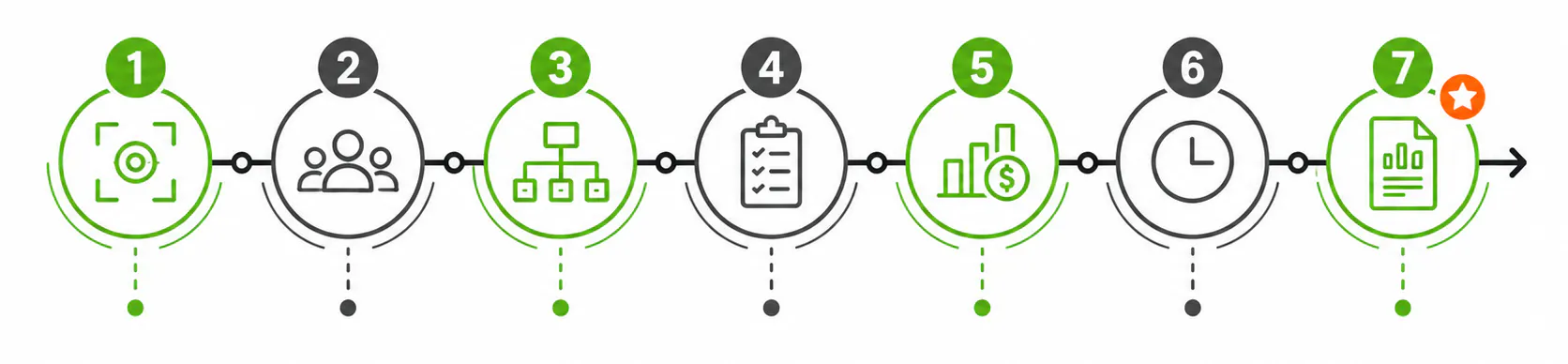
- Define scope and get a sponsor. Decide which functions, sites, and systems are in scope, and secure an executive sponsor. Without leadership backing, a BIA turns into a form-filling exercise nobody respects.
- Build the team. You need a project lead, the executive sponsor, and the process owners who actually run the work day to day. They know the dependencies nobody documented.
- Identify and map critical functions. List the functions that keep revenue flowing and obligations met. Then map what each one depends on: applications, data, vendors, people, facilities. This is where hidden interdependencies surface.
- Send a structured questionnaire. Survey process owners on impact over time, financial hit, operational impact, legal and compliance exposure, and any manual workarounds. Structured input keeps the analysis honest.
- Quantify the impact. Translate downtime into numbers: dollars per hour, contract penalties, regulatory exposure, reputational cost. This is the step that ends the "everything is critical" debate.
- Set RTO, RPO, and MTD for each function. Use the quantified impact to assign recovery targets. These become the design specs for the entire recovery strategy.
- Document, report, and maintain. Produce a BIA report that ranks functions and recommends recovery priorities, then revisit it on a schedule. A BIA written once and shelved is worth almost nothing.
For regulated manufacturers and contractors, the BIA also feeds your compliance readiness work, since frameworks like NIST and CMMC expect documented contingency planning, not improvisation.
What a business impact analysis reveals that executives usually miss
We have run this process inside enough mid-market companies to notice a pattern. The BIA almost always contradicts the org chart's assumptions about what is important.
The first surprise is interdependency. A leadership team will confidently name the ERP as the crown jewel, then discover that the ERP is useless without a small, unglamorous integration server that syncs it to the warehouse. Nobody listed that server as critical. It had no redundancy and no recovery priority. It was also a single point of failure for the entire crown jewel. BIAs find these because they trace dependencies instead of trusting reputation.
The second surprise is the gap between assumed-critical and actually-critical. Executives tend to overweight the systems they personally touch, dashboards, reporting, email, and underweight the boring transactional systems that keep cash moving. When you put real dollar figures on an hour of downtime, the ranking reshuffles. The function the CEO never thinks about is often the one with the shortest tolerable downtime.
The third is the "everything is priority one" trap. When every department insists its systems are mission-critical, you effectively have no priorities, which means in a real outage your team restores in whatever order feels right under pressure. The BIA forces ranking on paper, calmly, before the crisis. That ranking is the single most valuable thing it produces. This is also where a virtual CIO (vCIO) earns their keep, because pushing back on "everything is critical" is a leadership conversation, not a technical one.
5 common business impact analysis mistakes
A BIA can be technically complete and still produce a useless result. These are the failure modes we see most, echoed in industry analysis of common BIA mistakes.
- Backing into the answer. A manager understates the impact of losing their system because they assume protecting it will be expensive and they do not want the budget fight. The analysis gets quietly skewed before the data is even collected.
- Treating systems in isolation. Most applications depend on other applications. Analyze each one as an island and you will miss the chain reactions that turn a small outage into a company-wide stoppage.
- Rushing it. A BIA done in a hurry to check a box collects shallow input and produces shallow recovery targets. The time you save shows up later as the wrong RTO during a real event.
- No executive sponsor. Without leadership weight behind it, the BIA cannot compel honest participation or settle priority disputes. It becomes a survey people ignore.
- Confusing it with a risk assessment. Teams run a threat analysis, call it a BIA, and never actually measure business consequence. They end up knowing what might happen and not what it would cost.
Turning your BIA into a disaster recovery plan that holds
The BIA is the input. The disaster recovery plan is what you build from it. Once you have ranked functions and recovery targets, the rest of the plan follows a clear line: match each function's RTO and RPO to a recovery method, document the runbooks, assign owners, and then, critically, test it.
That last word is where most plans fall apart. A plan that has never been exercised against the BIA's targets is a hypothesis, not a capability. The point of setting a four-hour RTO is that you have proven you can hit it, not that you wrote it down. Our guide on how backup and disaster recovery saves your business in a crisis walks through what that tested capability looks like in practice. For manufacturers with production lines and physical dependencies, the stakes compound, which is why manufacturing disaster recovery and business continuity deserves its own dedicated planning.
None of it works without the analysis underneath. Skip the BIA and you are protecting systems by instinct. Run it first and every recovery decision after it has a reason.