Cybersecurity Compliance Standards: Which Ones Actually Apply to You
Cybersecurity Compliance Standards: Which Ones Actually Apply to You
Here is the honest answer most blog posts bury. Which cybersecurity compliance standards apply to your business comes down to three things: the kind of data you hold, the industry and contracts you work in, and who you are trying to sell to. Almost every mid-sized company we assess is subject to two to four standards at once, not one. The hard part is not learning what each acronym means. It is figuring out which ones are pointed at you, which are optional, and which a customer or insurer will quietly force on you whether the law requires it or not. That sorting exercise is what a compliance readiness program exists to do, and it is what this guide will walk you through.
Table of Contents
Skip the alphabet soup for a second. Start with your situation.
The short answer: three questions decide which standards apply to you
Frameworks do not attach to companies at random. Each one has a trigger. Answer these three questions honestly and you can map most of your obligations in an afternoon.
1. What data do you actually handle?
Data type is the cleanest predictor of all. If you store or process payment card numbers, PCI DSS applies. If you touch Controlled Unclassified Information for a government contract, NIST SP 800-171 and CMMC apply. If you hold personal information on California residents, the CCPA may apply. As the framework-selection guidance from Drata puts it plainly, the type of data you must secure is the key to figuring out what requirements you have to meet. Sensitive defense data points to CMMC. Card data points to PCI. Personal data points to privacy law.
2. What industry and contracts are you in?
Some standards ride in on the work itself. Sell to the Department of Defense and CMMC is non-negotiable. Process payments and PCI follows. Work with protected health information, even as a vendor to a healthcare client, and HIPAA's Security Rule reaches you. The contract is often the real regulator. Sometimes the law does not care how secure you are, but your biggest customer does, and the contract says so in writing.
3. Who are you trying to sell to?
This is the one founders miss. Enterprise buyers have turned security questionnaires into a gate. They will not wait for a law to require it. If you want their logo on your customer page, you will likely need a SOC 2 Type II report or ISO 27001 certificate before procurement clears the deal. More on that below, because it is the fastest-growing reason small companies pursue compliance at all.
Now let's sort the actual standards into three buckets: forced on you by law, forced on you by customers, and chosen by you.
The standards mandated by law or contract
You do not get to opt out of these. If the trigger applies, the obligation is real, and so is the penalty for ignoring it.
CMMC 2.0 and NIST SP 800-171: the defense supply chain
If your company sells to the Department of Defense, or sells to a company that sells to the DoD, this one is aimed straight at you. The Cybersecurity Maturity Model Certification program builds on the 110 controls in NIST SP 800-171 and verifies that contractors actually protect Federal Contract Information and Controlled Unclassified Information.
The timeline matters now. Per the CMMC final rule analysis from Buchanan Ingersoll & Rooney, starting November 10, 2026, contracts requiring CUI protection begin carrying mandatory third-party (C3PAO) certification at Level 2. Two details trip people up. First, the requirement flows down to subcontractors, so a prime can pull you into scope. Second, you need the required status at time of award. There's no grace period to get certified after you win the work. Manufacturers in the defense supply chain should treat this as a now problem, which is exactly why we built dedicated manufacturing cybersecurity support around it.
PCI DSS 4.0.1: anyone who takes a card payment
There's a myth that PCI is a big-merchant problem. It isn't. If you accept Visa, Mastercard, Discover, or American Express, in store or online, PCI DSS applies regardless of your size. The U.S. Chamber of Commerce spells out the four merchant levels, which are set by annual transaction volume. Most small businesses land in Level 4, under 20,000 e-commerce transactions a year.
What changed with 4.0.1, now in full effect since March 31, 2025, is the rhythm. Compliance is no longer a once-a-year scramble before an assessment. Controls have to be in place and documented year-round. That shift catches teams that used to treat PCI like a tax filing.
CCPA and CPRA: the California privacy thresholds
For Consilien's California clients, this is the privacy law closest to home. A for-profit business is covered if it meets any one of three thresholds, laid out by the California Attorney General: more than $26,625,000 in annual gross revenue, or 50% or more of revenue from selling or sharing personal information, or handling the personal data of 100,000 or more California residents or households a year.
Two things people get wrong. The revenue threshold looks at your whole company, not just your California activity. And the rules keep moving. A package of new CCPA regulations took effect January 1, 2026, adding obligations around automated decision-making, risk assessments, and cybersecurity audits for covered businesses.
HIPAA: a quick flag, because it might reach you sideways
Consilien does not serve healthcare providers, and you may assume HIPAA is somebody else's problem. Check anyway. The HIPAA Security Rule reaches business associates, not just hospitals and clinics. If you provide a service that creates, receives, maintains, or transmits protected health information for a healthcare client, a Business Associate Agreement can pull you into HIPAA scope. Worth a five-minute check of your client list before you rule it out.
The standards your customers force on you
These are voluntary on paper. In practice, a buyer's procurement team can make them as mandatory as any statute. The difference is that the enforcer is a sales contract, not a regulator.
SOC 2 Type II: the enterprise sales gate
SOC 2 has quietly become the price of admission for selling software or data services to larger companies. The numbers are stark. Reporting on 2026 enterprise buying shows that 83% of enterprise buyers now require SOC 2 certification from their SaaS vendors, and a sizable share of certified startups credit the report with directly closing deals. When a security questionnaire lands, "Do you have a current SOC 2 Type II report?" is often the first line. A "no" can end the conversation.
Why Type II and not Type I? Type I checks that your controls are designed correctly on a single day. Type II checks that they actually operated, consistently, over a period of months. Enterprise buyers want the second one because it is much harder to fake. This pressure traces back to third-party risk. Verizon's 2025 Data Breach Investigations Report found third parties involved in roughly 30% of breaches, so buyers have stopped taking vendor security on faith.
ISO 27001: when you sell across borders
ISO 27001 is the international cousin of SOC 2. If your buyers are in Europe or you are competing for global enterprise deals, an ISO 27001 certificate carries recognition that a U.S.-centric SOC 2 report does not. Good news if you are weighing both: the two frameworks share around 96% of their controls, so building one gets you most of the way to the other. You are rarely choosing between them so much as deciding which to lead with.
The standard you adopt for yourself: NIST CSF 2.0
Everything above is reactive. Someone, a regulator, a customer, an auditor, hands you a requirement. The NIST Cybersecurity Framework 2.0 is the one you pick up on your own, and it is the smartest backbone a mid-sized company can build on.
It's voluntary for most private businesses. So why bother? Because it organizes the rest. CSF 2.0 sorts your whole security program into six functions (Govern, Identify, Protect, Detect, Respond, Recover), which gives you a shared map to hang PCI, SOC 2, and 800-171 work off of instead of treating each as a separate fire drill. NIST publishes a Small Business Quick Start Guide so you are not starting from a blank page, and there is a Manufacturing Profile (NIST IR 8183r2) built specifically for plant-floor and operational technology risk. The framework is also the language your insurer and your supply-chain partners increasingly expect you to speak. This is the territory where vCISO guidance earns its keep, mapping a voluntary framework to the specific obligations bearing down on you.
The enforcer hiding in your filing cabinet: cyber insurance
Here is the one nobody puts on the compliance list, and it has more teeth than most of the frameworks above. Your cyber insurance policy is, functionally, a compliance standard with a financial penalty attached. Fail its requirements and you do not get fined. You get something worse: a denied claim after a breach, when you need the money most.
The bar has risen sharply. In 2026, multi-factor authentication is effectively mandatory, and carriers expect it enforced everywhere, on remote access, VPNs, email, and every admin account, not just switched on somewhere. Reporting on 2026 underwriting found that more than 73% of small businesses fail their cyber insurance assessments, facing either denial or premium hikes north of 300%. Carriers now want enterprise-grade controls across the board: enforced MFA, EDR rather than legacy antivirus, tested backups, and formal patch management. One public case saw a $5 million claim denied because MFA was not maintained consistently across every department. The policy was real. The enforcement was not, and the payout vanished.
Read your policy's control requirements as carefully as you would read a regulation. It's one, in everything but name.
What it costs to get this wrong
Compliance spending is easier to justify when you put it next to the alternative. The 2025 global average cost of a data breach sat around $4.4 million, and the figure climbs by sector. Then the fines stack on top of the breach itself.
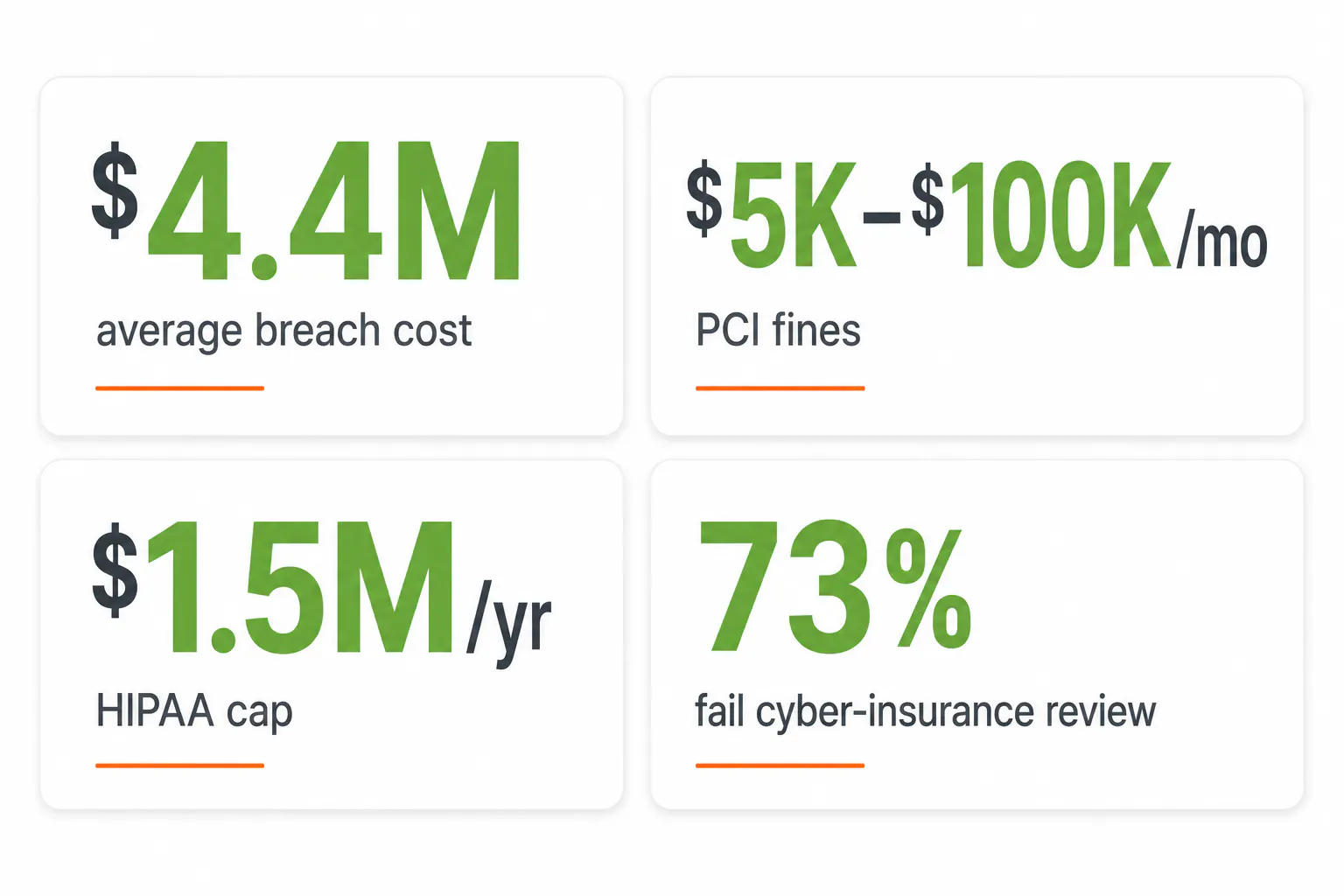
- PCI DSS: Non-compliance can draw fines from $5,000 to $100,000 per month from card processors, separate from per-record breach costs.
- HIPAA: Penalties can reach $1.5 million per year per violation category, and the HIPAA Journal tracks more than $161 million in OCR fines since enforcement began.
- GDPR: For companies with EU exposure, fines can hit €20 million or 4% of global turnover, whichever is larger.
- Privacy and other regimes: As Secureframe's enforcement tracking shows, regulators across privacy and security law are issuing larger penalties and more of them year over year.
None of these counts the cost that never shows up on an invoice: the enterprise deal you could not close because you had no report to hand over.
How to figure out your actual stack in an afternoon
You do not need a consultant to get the first draft of your obligations. You need an honest hour and this checklist. Run it, and you will know which frameworks are mandatory, which are coming, and which a customer will spring on you mid-deal.
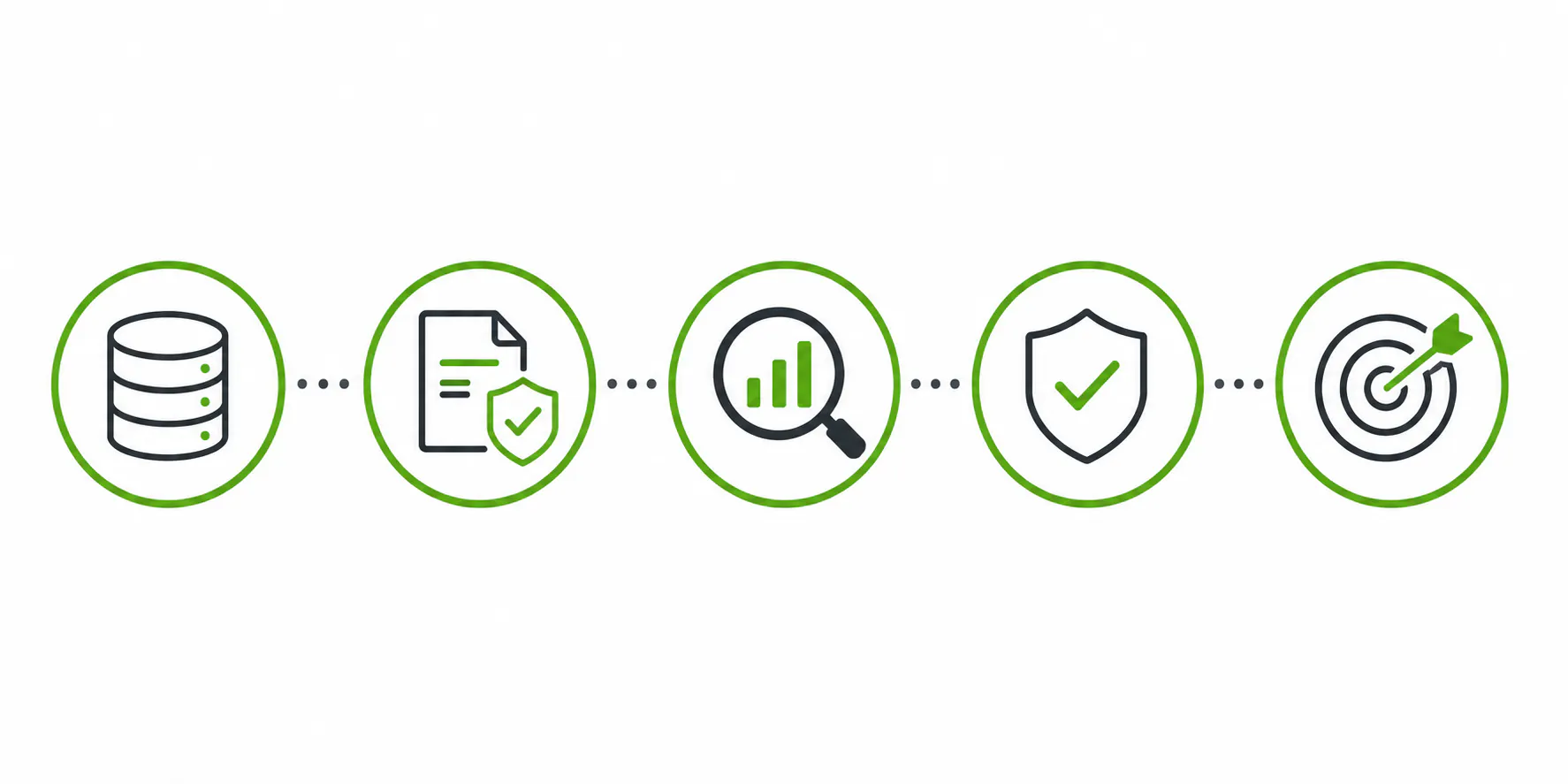
- List your data. Card data, CUI, personal information, health information. Each type maps to a framework. This is your fastest signal.
- List your contracts and your pipeline. Any DoD or government work, current or chased, puts CMMC on the board. Any enterprise prospect likely means a SOC 2 or ISO 27001 question is coming.
- Check the thresholds. Revenue, California residents, transaction volume. Privacy and PCI obligations turn on specific numbers, so confirm where you fall.
- Pull your cyber insurance policy. Read the required-controls section. That is a compliance checklist you already signed.
- Sequence, do not silo. Most companies end up running two to four frameworks. Do not build them in separate rooms. Start with NIST CSF 2.0 as the spine, then map the overlap. SOC 2 and ISO 27001 share most controls. 800-171 and ISO overlap by roughly two-thirds. Done in the right order, one body of work satisfies several auditors.
One operator note from doing this for California companies. The mistake we see most often is not under-compliance. It is redundant compliance, three teams documenting the same MFA control three different ways for three different audits because nobody mapped the overlap first. The framework you adopt for yourself is what prevents that waste. Get the spine right and the rest stops feeling like a tax. If you want a second set of eyes on your stack, that's what our managed security services team does before a single control gets written.