10 Best AI Governance Platforms for 2026
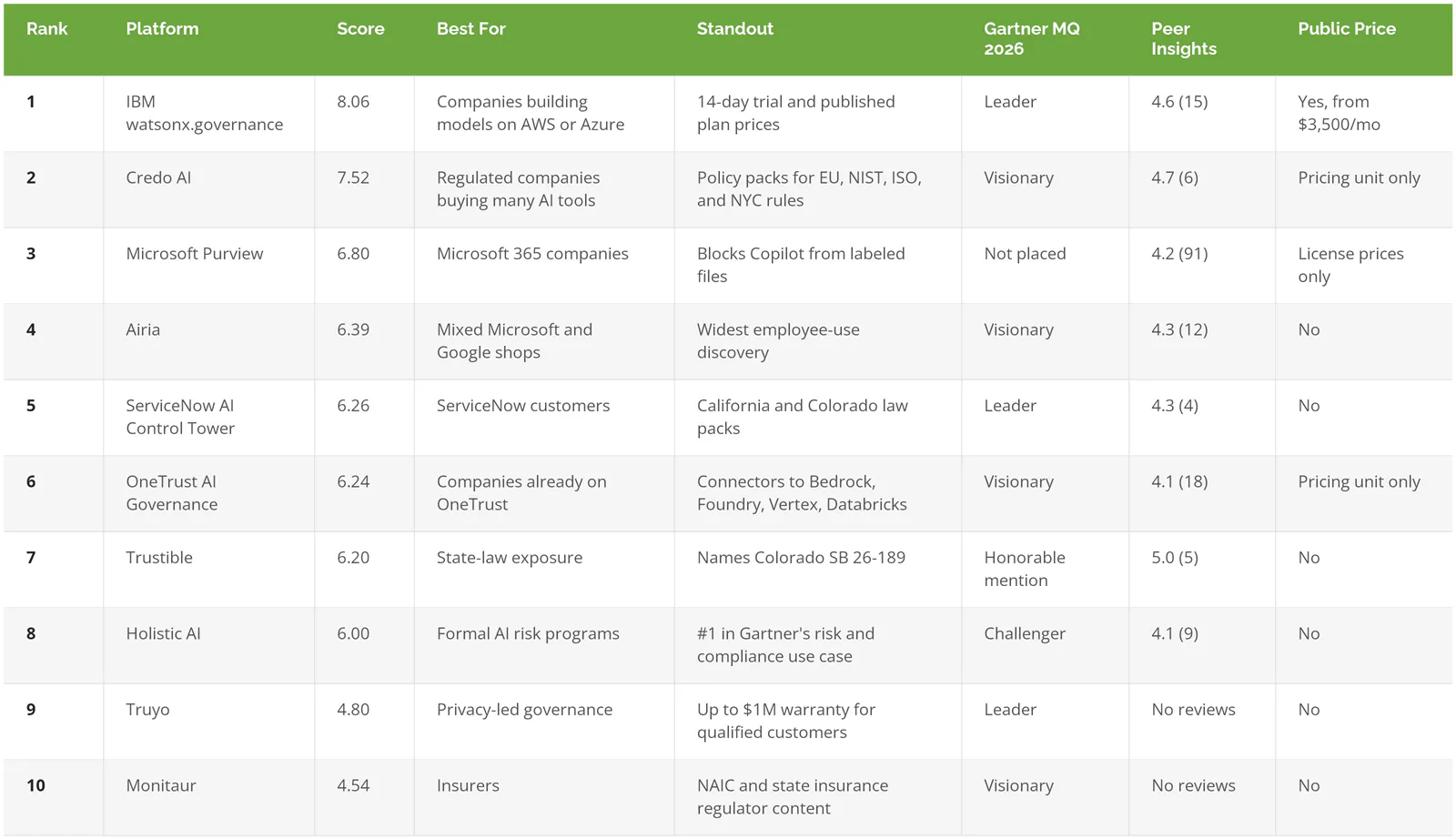
IBM watsonx.governance ranks first among the best AI governance tools for 2026 at 8.06 out of 10, a Leader for both Gartner and Forrester with a free trial and published prices. Credo AI (7.52) carries the deepest regulatory library, and Microsoft Purview (6.80) sees the most employee AI use. Six criteria, live Gartner Peer Insights data.
Table of Contents
Quick Picks
- Highest Confidence Score: IBM watsonx.governance
- Microsoft 365 companies watching Copilot and ChatGPT: Microsoft Purview
- Deepest regulatory library out of the box: Credo AI
- Finding the AI employees use outside Microsoft: Airia
- US state AI laws, including Colorado's rewrite: Trustible
- Companies already running ServiceNow: ServiceNow AI Control Tower
Ask a CFO how many AI systems the company runs and you'll usually hear a small number. Maybe one pilot. Then count the Microsoft 365 Copilot licenses, the ChatGPT seats someone expensed, the AI summaries switched on inside the CRM, and the agent a sales manager built in Copilot Studio last quarter. The number gets bigger fast, and almost none of it was built in-house, which means almost none of it went through the review a company would apply to software it wrote itself.
That's the problem the best AI governance tools are supposed to solve, and it's why this ranking scores them differently. Several of the best-known platforms started life as tools for companies that build and train their own models. Your business probably buys its AI instead. So the heaviest criterion after reviews asks one thing. Can the tool see and control AI you didn't build?
Gartner has put a date on the stakes. It predicts that by 2027, 40% of enterprises will demote or decommission autonomous AI agents because of governance gaps found only after something went wrong in production. Finding out afterward is expensive. It's also avoidable, and it belongs inside the same compliance program that already handles your SOC 2 or NIST work, not in a side project nobody owns.
Ten platforms, one scoring model, published below. No vendor paid for placement or supplied its own data.
Two Different Jobs Share One Label
"AI governance" gets stamped on two products that barely overlap.
The first governs AI you build. It keeps a model inventory (a register of every model the company has trained or deployed), runs bias and accuracy tests, stores documentation for auditors, and watches models drift after launch. Banks with model risk teams, insurers filing models with state regulators, and software companies shipping AI inside their own products need this, because an examiner or a customer will eventually ask to see the testing. It's where the category started, and it's what the Gartner and Forrester reports weigh most heavily.
The second governs AI you use. It finds the tools employees already have open in a browser tab, which is the core of shadow AI. It decides what data can go into Copilot or ChatGPT, keeps a record of which vendors have switched AI features on inside software you already license, and sends each AI vendor a risk review before anyone signs. For a manufacturer, a distributor, or a professional services firm, this second job is nearly the whole job.
Which one do you need? Look at your last 12 months of AI spend. If it's mostly licenses and subscriptions, you need the second. If it includes data scientists and GPU bills, you need both.
Some businesses need neither yet. If nobody has written down which AI tools are approved and what data stays out of them, a platform will automate confusion. Start with an AI acceptable use policy, a named owner, and a spreadsheet. Buy software once the spreadsheet stops being enough.
How the Confidence Score Works
Rankings are produced using a Confidence Score methodology, six independently researched criteria applied the same way to every platform. No vendor paid for placement. No vendor submitted its own data.
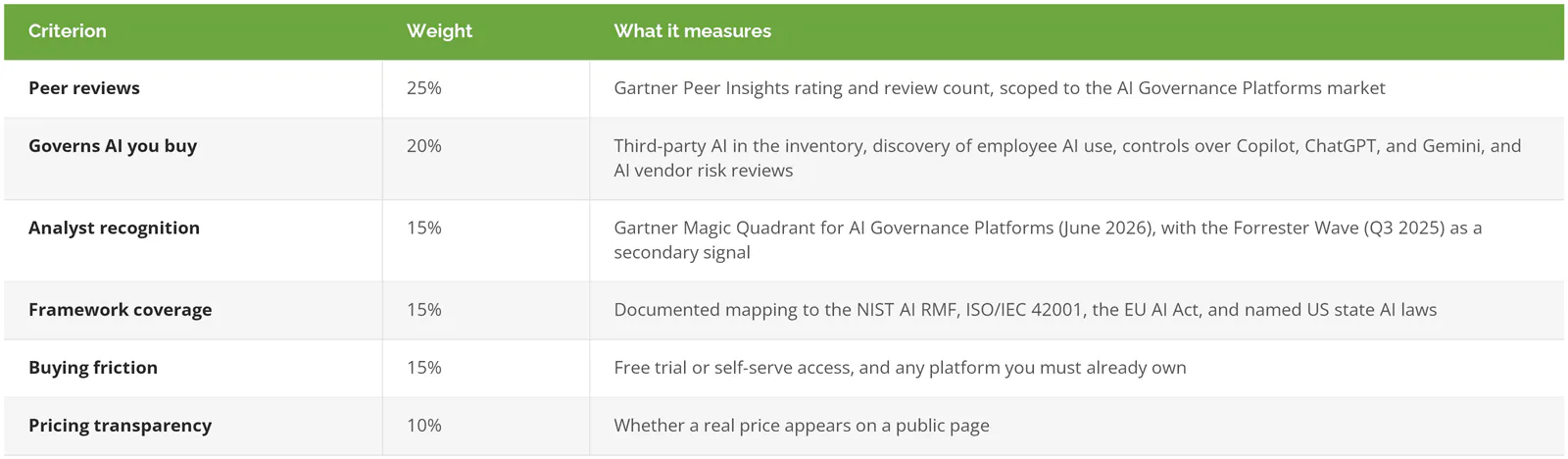
Reviews come from one source, and that's deliberate. G2 blocked every request with a captcha wall, so none of its numbers could be read live, and a rating nobody can check doesn't go in a ranking. Gartner Peer Insights does publish market-scoped figures, pulled on September 25, 2026. The samples are small. IBM has 15 reviews in this market. ServiceNow has 4. Two vendors on this list have none at all.
That gap has consequences. A product with no reviews scores zero on the largest criterion, the same rule applied to every listicle in this series. It drops Truyo, a Gartner Leader, to ninth. Remove the review criterion and reweight the other five, and Truyo scores about 6.4 and ranks fourth.
Analyst recognition leans on Gartner because Gartner's report is current and its placements are public. Gartner published its first Magic Quadrant for AI Governance Platforms on June 17, 2026, after screening more than 100 vendors down to 13. Forrester's Wave is a year older, and only four of its ten placements are publicly confirmable.
"Governs AI you buy" was scored on four questions, each worth a quarter of the criterion. Does the inventory include third-party and vendor AI? Can it discover what employees use, and how? Does it see or control Copilot, ChatGPT, or Gemini? Does it run risk reviews on AI vendors? Every answer came from the vendor's own documentation, press releases, or product pages fetched during research, not from sales calls, analyst summaries, or the claims that circulate on comparison sites. Where a capability couldn't be found in writing, it scored as absent.
All 10 Platforms Side by Side
1. IBM watsonx.governance, the Leader You Can Actually Try
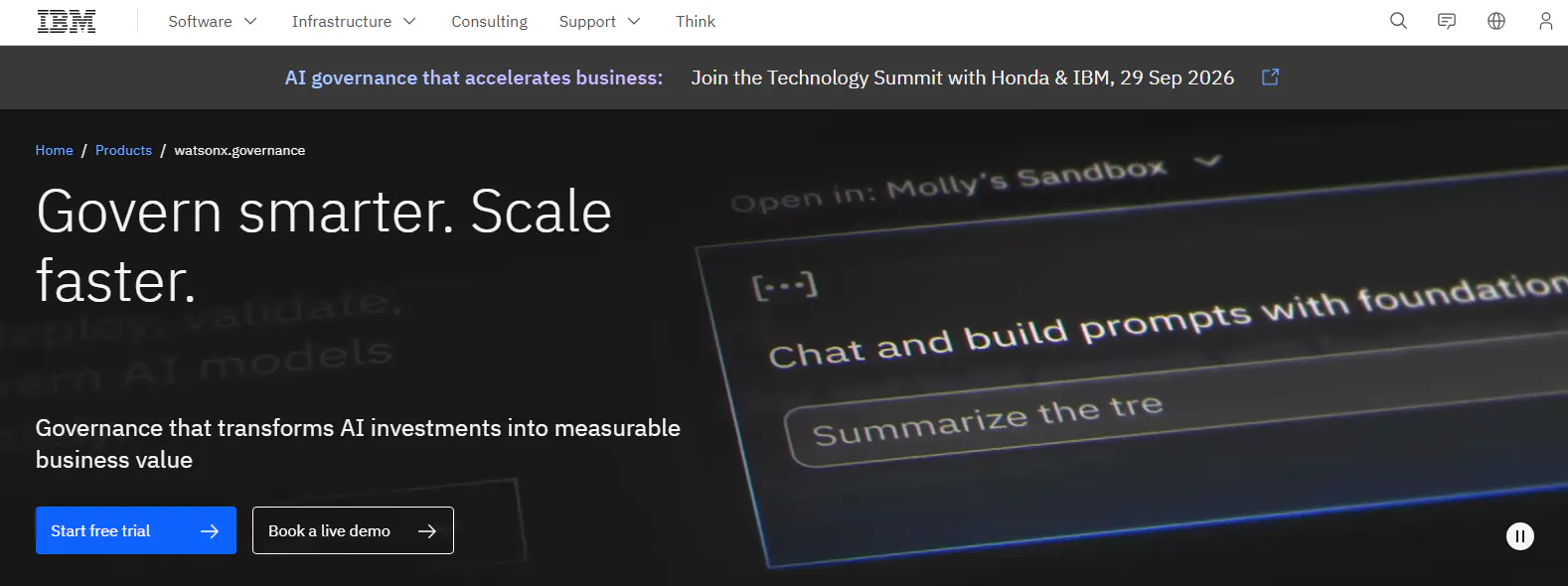
IBM wins this ranking because it's the easiest serious platform to evaluate, not because it sees the most.
Score: 8.06/10
Key Strengths
- Leader status from both Gartner and Forrester, in the June 2026 Magic Quadrant and The Forrester Wave for AI Governance Solutions, Q3 2025. No other platform on this list holds that pair.
- Free for 14 days, with included credits, and priced on the page. Risk and Compliance Basic starts at $3,500 a month, Advanced at $6,450, and Model Management runs pay-as-you-go from $0.64.
- Vendor review has real depth. IBM pulls third-party risk data from Dun & Bradstreet, RiskRecon, SecurityScorecard, and RapidRatings instead of relying on a questionnaire the vendor fills out about itself.
- Infosys runs more than 2,700 AI use cases through it, per IBM's product page.
- 4.6 out of 5 across 15 Peer Insights reviews in this market, the highest rating of any product in this market with 10 or more reviews.
The tradeoff
Check where IBM's discovery actually points. The AI Asset Discovery feature launched July 9, 2026 pulls assets from AWS Bedrock, Azure AI Foundry, and IBM's own watsonx Orchestrate. Those are places where AI gets built. Nothing in IBM's documentation describes seeing an employee paste a contract into ChatGPT or ask Copilot to summarize a payroll file. For a company whose AI is mostly licensed, that's the exposure IBM doesn't cover.
Setup takes effort, too. A reviewer on IBM's AWS Marketplace listing writes that connecting models from outside IBM's ecosystem "requires manual configuration" and that costs "rise significantly" in production. And the entry configuration of the $6,450 Advanced plan includes one concurrent user, which fills up the first time legal and IT both need to be in it at once.
No named US state AI law content turned up in IBM's materials either. The NIST AI RMF (the US government's voluntary AI risk framework), ISO 42001 (the certifiable AI management standard), and the EU AI Act are covered. Colorado, California, and Texas aren't mentioned.
Best For: Companies building, fine-tuning (retraining an existing model on your own data), or buying models on AWS or Azure, and anyone with a formal model risk function to feed.
Not Ideal For: A business whose AI is Microsoft 365 Copilot and a few dozen ChatGPT seats.
Why It Ranks #1: It scored highest on three of six criteria, analyst standing, ease of buying, and price transparency, and it's the only Leader you can try this week without a sales call. It placed sixth of ten on the criterion this ranking cares about most after reviews. If this ranking scored only visibility into employee AI use, Purview would top it. It doesn't, because a governance program also needs audit evidence, vendor reviews, and a price you can put in a budget, and IBM delivers all three.
2. Credo AI, the Deepest Rulebook
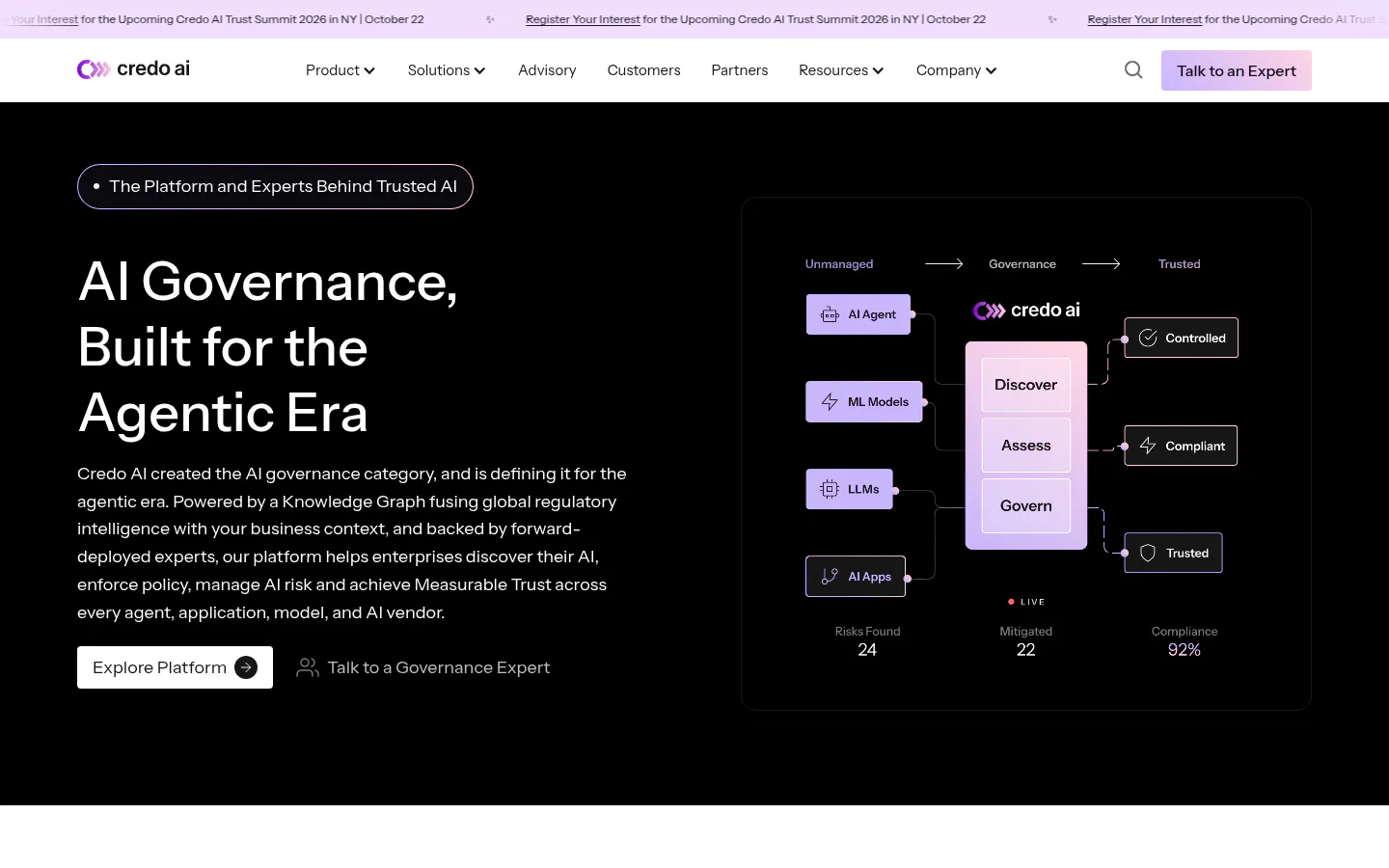
Credo AI treats regulation as the product.
Score: 7.52/10
Key Strengths
- Forrester named it a Leader in Q3 2025, and Credo reports top scores in 12 of that report's criteria, including policy management and regulatory compliance audit. Gartner placed it as a Visionary.
- Ready-made policy packs for the EU AI Act, NIST AI RMF, ISO 42001, and SOC 2, plus a pack for New York City's Local Law 144, which regulates AI used in hiring.
- Vendors do their own homework. Credo's vendor portal emails each AI supplier a login and makes them prove their system meets your policy pack.
- GAIA, Credo's governance assistant, reached general availability on May 13, 2026, and handles classification and evidence collection.
- 4.7 out of 5 on six reviews. Mastercard is a named customer.
Where it falls short
Its shadow AI discovery is still a private preview program. Credo registers third-party AI well once someone reports it, but it doesn't yet find the tools nobody reported, and in a company where marketing, sales, and finance each picked their own AI apps, that unreported list can easily be the longer one. There's no trial, and the AWS Marketplace listing says price scales "based on number of AI use cases," which means a growing program costs more each year. Microsoft 365 Copilot coverage wasn't documented anywhere.
Best For: Companies facing the EU AI Act or hiring-law exposure, with a steady stream of AI vendors to review.
Not Ideal For: A team that needs discovery working on day one.
Why It Ranks #2: Perfect marks on framework coverage and the strongest review score on the list. Demo-only buying and price opacity cost it about half a point against IBM.
3. Microsoft Purview, Already Watching Copilot
It isn't in Gartner's report at all, and it might still be the first platform a Microsoft 365 business should turn on.
Score: 6.80/10
Key Strengths
- Sees employee AI use directly. A one-click policy detects when users visit AI sites, and Microsoft publishes the list of covered sites, which includes ChatGPT, Gemini, Claude, DeepSeek, and Perplexity.
- Data loss prevention (rules that stop sensitive data leaving the company) catches files and text pasted or uploaded to AI sites in Edge, Chrome, and Firefox.
- One policy blocks Microsoft 365 Copilot and agents from processing anything with a chosen sensitivity label (a tag like Confidential that travels with the file). That one control keeps Copilot out of the files you've already marked off-limits, and it's covered in detail in locking down Copilot before rollout.
- 91 reviews at 4.2, the largest sample in the entire Peer Insights market.
- You may already own it. Microsoft 365 E5 is $60 per user per month, and the Purview Suite add-on for E3 is $12.
Worth knowing before you count on it
Third-party visibility comes with conditions. Devices must be onboarded to Purview, and the browser extension is required on Windows to see visits to outside AI sites. AI apps other than Microsoft's need pay-as-you-go billing tied to an Azure subscription. The regulation templates for the EU AI Act, ISO 42001, and NIST AI RMF are premium add-ons in Compliance Manager, and E5 customers get three premium templates free. No US state AI law template exists. And there's no AI vendor risk review at all.
Naming churn is real too. The preview was called AI Hub, then DSPM for AI, and since the new Data Security Posture Management reached general availability in May 2026, the old view is labeled "classic."
Best For: Microsoft 365 companies on E3 or E5, especially ones rolling out Copilot this year.
Not Ideal For: Google Workspace shops, or anyone who needs vendor reviews and audit workflows in the same tool.
Why It Ranks #3: It tied for the highest mark on governing AI you buy. The lowest analyst score on the list held it to third.
4. Airia, the Widest Net for Employee AI Use
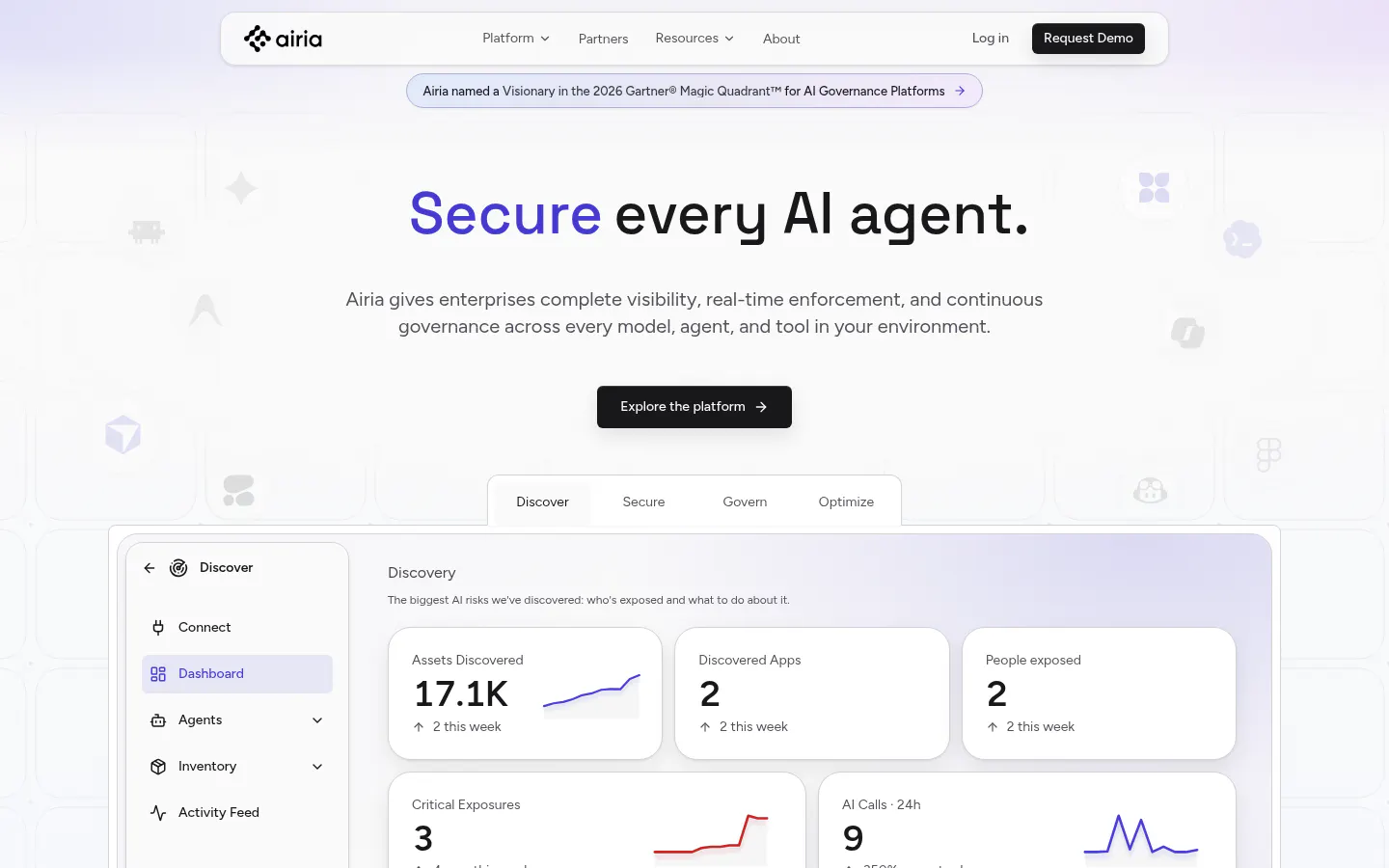
If the question is "what are people actually using," Airia has the most ways to answer it.
Score: 6.39/10
Key Strengths
- Discovery from five directions. A browser extension, logs from your identity provider (the system employees sign in through, like Microsoft Entra or Okta), network and SASE controls (cloud-based security that routes company web traffic), connectors into Microsoft 365 and Google Workspace, and code repository scans.
- Browser-level controls that block, warn, redirect, or audit. ChatGPT Enterprise, Gemini, and Claude are all listed as covered.
- Governance documentation mapped to the EU AI Act, NIST AI RMF, ISO 42001, and SR 11-7, the Federal Reserve's model risk guidance for banks.
- Visionary in Gartner's Magic Quadrant, with 12 reviewers averaging 4.3.
The catch
Airia is young. The company was founded in 2024, and its governance product launched on January 13, 2026. Its own guide to detecting shadow AI says SSL inspection (decrypting web traffic so the proxy can see where it goes) is required for full network visibility, and that identity-provider analysis can't see tools opened with personal accounts. Those are honest caveats, and they're real work for a small IT team that has never had to manage certificates on every laptop or explain to employees why the company can now see where their web traffic goes. The pricing page lists three tier names and no prices, and the open registration link now redirects to a demo request.
Best For: Companies running both Microsoft and Google, or with heavy browser-based AI use outside Microsoft.
Not Ideal For: Buyers who want AI vendor risk reviews in the same product.
Why It Ranks #4: Discovery breadth kept it ahead of two Gartner Leaders. No published price and demo-only access are what keep it out of the top three, and in the math those two gaps cost it 0.8 of a point against Purview.
5. ServiceNow AI Control Tower, Obvious If You're Already There
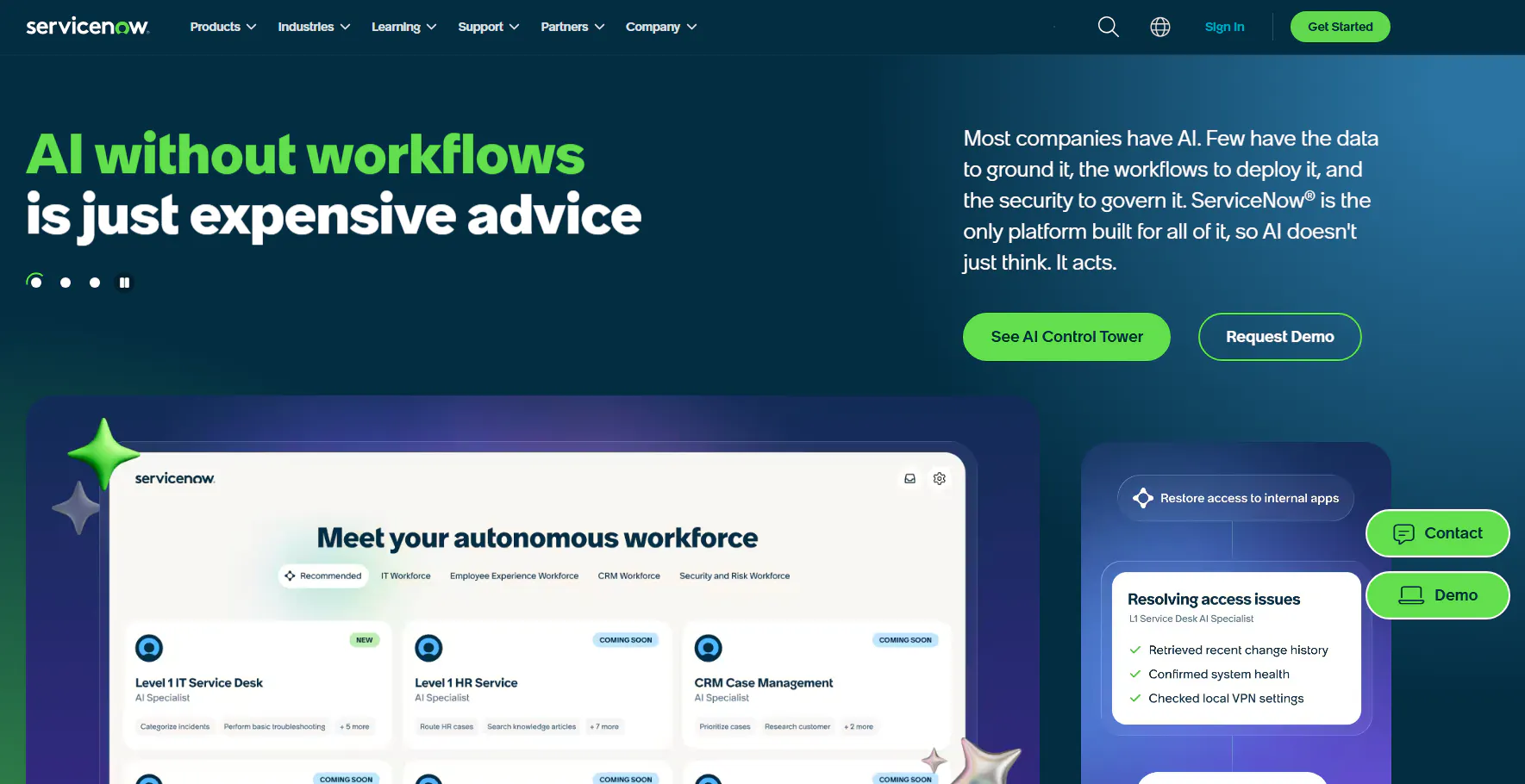
For ServiceNow customers this is close to an easy call. For everyone else it's a platform purchase first and a governance tool second.
Score: 6.26/10
Key Strengths
- Rated a Leader by Gartner, and its detection reaches past the cloud consoles. Armis covers the network side and ServiceNow's own agent client covers endpoints, so unsanctioned AI gets caught and detected services can be blocked.
- Its June 2026 release added packs for the California AI Act, the Colorado AI Act, and the EU AI Act, and one control can map across all three plus the NIST AI RMF.
- Discovers assets in Microsoft Foundry and Copilot Studio. HDFC Bank calls it "the common governance layer."
What to know going in
It runs on the ServiceNow platform and needs a current release, so there's no buying it alone. A lighter version installs automatically with ServiceNow's Pro Plus and Enterprise Plus tiers, which is worth checking before anyone signs anything new. ISO 42001 content was still "in legal review" as of the June notes, and the Microsoft Agent 365 integration is in preview. Four reviews is a thin sample for a platform this size. Ask whether Armis and the endpoint client carry their own licenses.
Best For: Existing ServiceNow customers with state-law exposure in California or Colorado.
Not Ideal For: Anyone without a ServiceNow instance.
Why It Ranks #5: Top-tier on analyst standing and discovery, pulled down hard by the prerequisite and a price that exists only on request.
6. OneTrust AI Governance, the Privacy Team's Extension
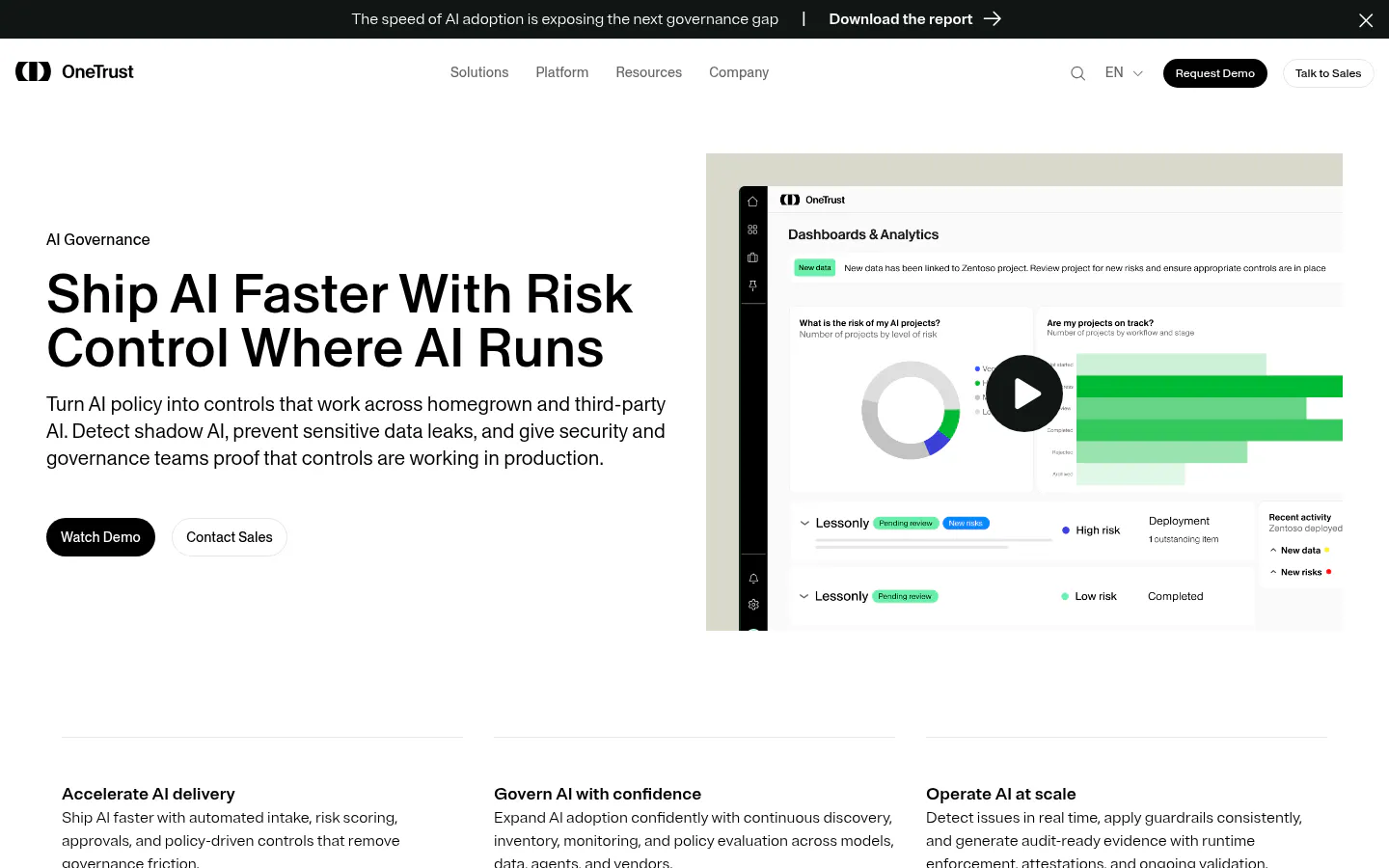
OneTrust makes the most sense when the privacy team already lives in OneTrust.
Score: 6.24/10
Key Strengths
- One inventory for AI systems, models, agents, datasets, vendors, and use cases.
- Out-of-the-box connectors to Amazon Bedrock, Microsoft AI Foundry, Google Vertex, and Databricks Unity Catalog, and policy enforcement on MCP (the protocol AI agents use to connect to other tools).
- Templates for the EU AI Act, NIST AI RMF, and ISO 42001, and a Gartner Visionary placement.
- OneTrust's pricing page at least says what drives the bill, admin users and the size of your AI inventory.
Limitations
Runtime monitoring is scoped to Bedrock and Microsoft Foundry. There's no documented connector for Microsoft 365 Copilot or ChatGPT, so employee chat use stays out of view. AI vendor reviews come through OneTrust's separate third-party risk product. Demo only.
Best For: Companies already running OneTrust for privacy or third-party risk.
Not Ideal For: A first governance purchase with no OneTrust footprint.
Why It Ranks #6: Solid across the board, and not first on any criterion.
7. Trustible, the State-Law Specialist
Trustible's website sorts the AI governance market into layers and then tells you which layer it isn't. That's rare candor from a vendor.
Score: 6.20/10
Key Strengths
- 5.0 out of 5 on five reviews, the highest rating on this list.
- State coverage goes deeper than anyone else's here. Its state and industry page names Colorado's SB 26-189, Texas TRAIGA, Illinois HB 3773, California SB 53, and New York's RAISE Act, alongside the EU AI Act, NIST AI RMF, and ISO 42001.
- Vendor risk questionnaires and use-case intake built in. Leidos is a published customer.
Honest limitation
Trustible places shadow AI detection in a different layer of the stack than its own product. Discovery happens through intake forms, meaning someone has to report the tool. It's a small company, headquartered in Arlington, Virginia, that has raised over $6M, and there's no trial and no price.
Best For: Companies selling into multiple US states, particularly ones that make hiring, lending, or insurance decisions with AI.
Not Ideal For: Anyone who needs to find unreported AI.
Why It Ranks #7: Perfect on frameworks and second on reviews, held down by an honorable mention rather than a quadrant placement and no discovery of its own.
8. Holistic AI, Gartner's Pick for Risk and Compliance
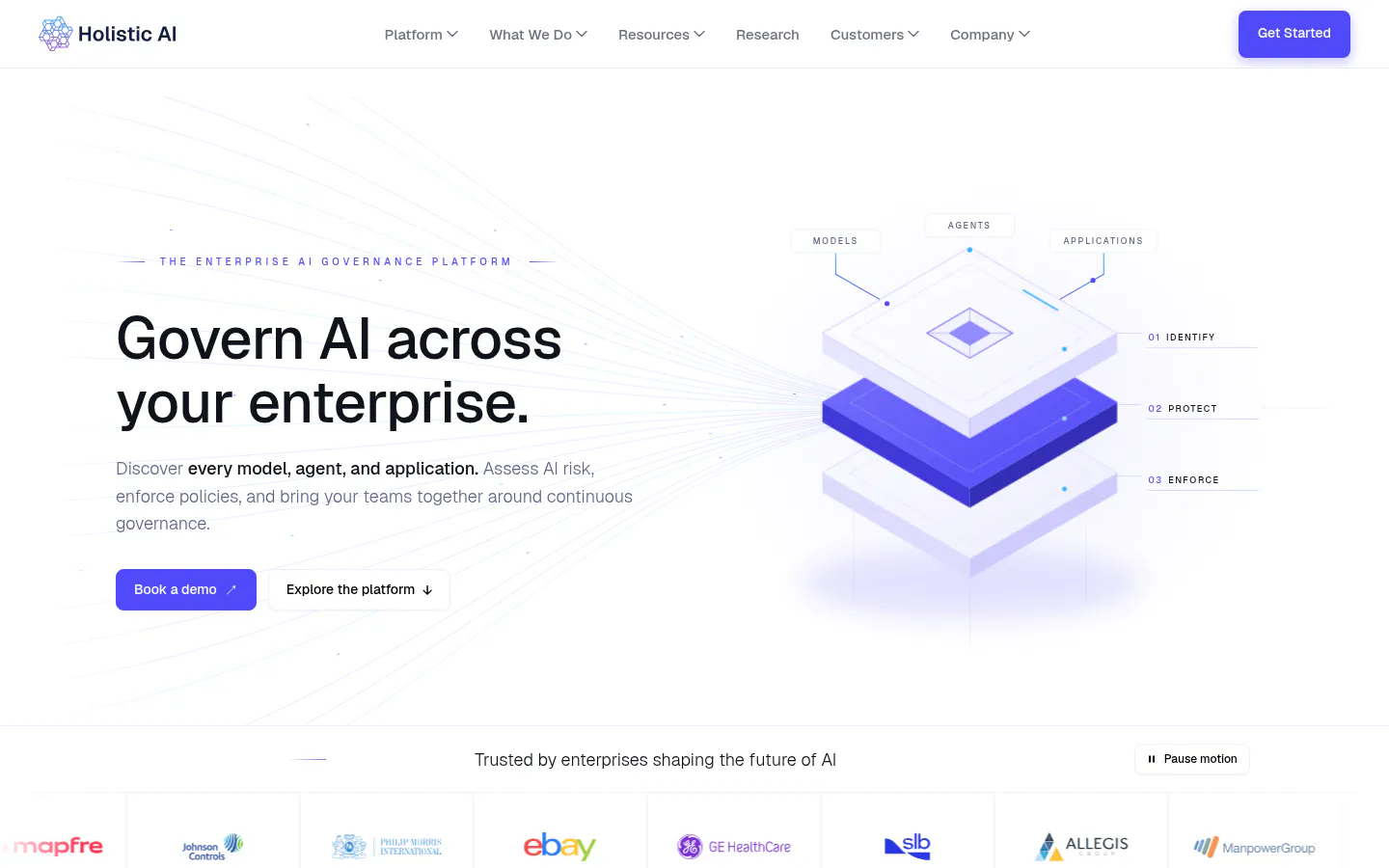
Only one vendor landed in Gartner's Challenger quadrant, and it ranked first in the companion report's risk and compliance use case. Here it's eighth.
Score: 6.00/10
Key Strengths
- Scored 3.90 out of 5 and ranked #1 for AI Risk and Compliance in Gartner's Critical Capabilities report.
- Read-only discovery across AWS, Google Cloud, GitHub, GitLab, Snowflake, BigQuery, Slack, and Notion, plus Zscaler and SharePoint integrations.
- NYC Local Law 144 bias audits get their own workflow, and agents built in Copilot Studio get governance.
- Started at University College London. Unilever is a named customer.
Tradeoffs
Discovery reads cloud, code, and data platforms through their APIs. A Zscaler integration handles policy enforcement, but no browser-level discovery of employee AI use is documented, so a sales rep on ChatGPT may never show up. No AI vendor review workflow was documented. And for LL144 audits, Holistic's own page notes you may still need a third-party auditor to sign off.
Best For: Companies with a formal AI risk program and cloud-hosted AI projects.
Not Ideal For: Governing licensed tools employees use every day.
Why It Ranks #8: Strong on frameworks, weakest of the ten on governing bought AI.
9. Truyo, a Leader Nobody Has Reviewed
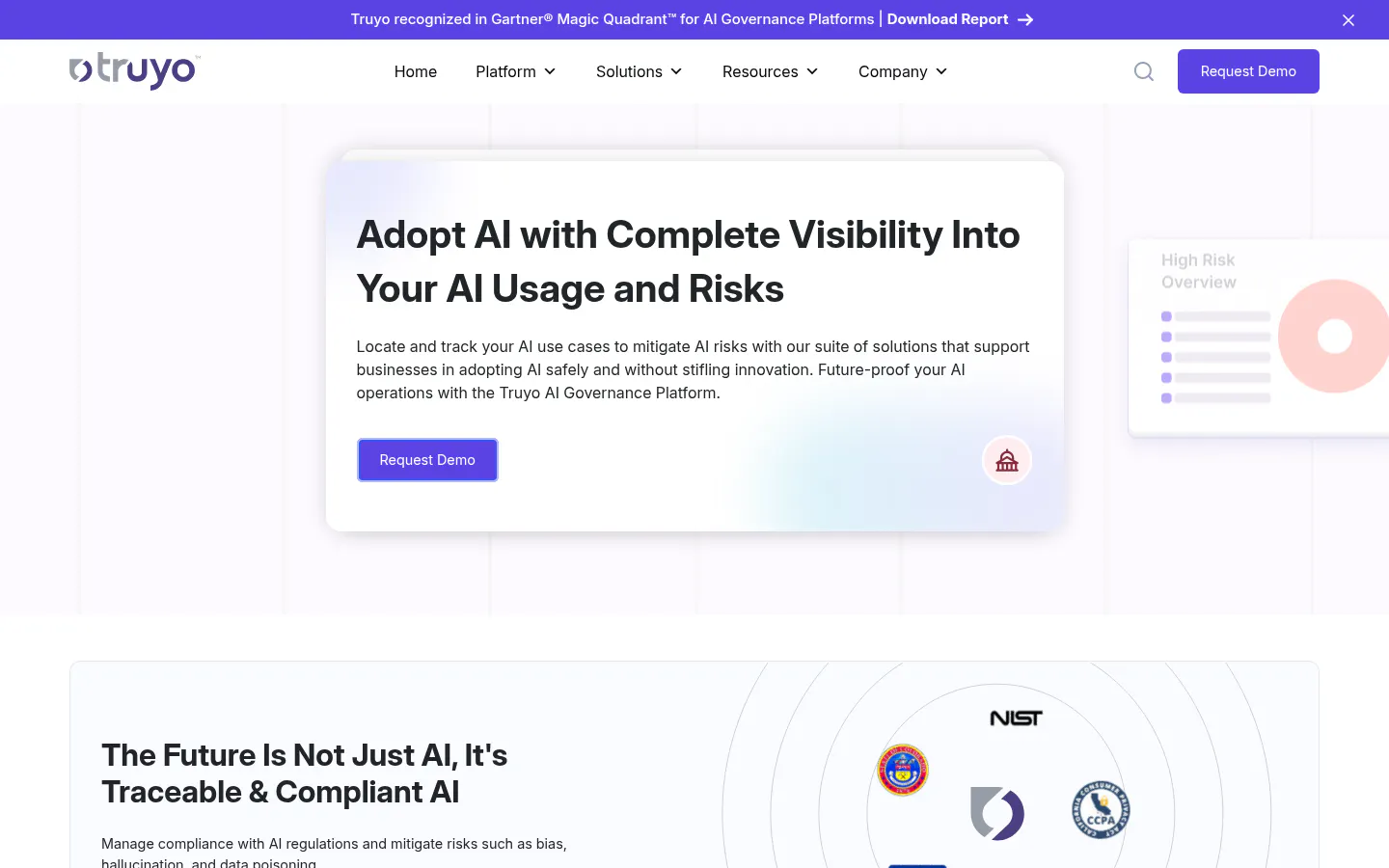
Gartner put Truyo in the Leaders quadrant. Peer Insights shows zero reviews for it in this market.
Score: 4.80/10
Key Strengths
- Sits in the Leaders quadrant of Gartner's first Magic Quadrant, beside IBM and ServiceNow.
- Scans websites, source code (GitHub, Bitbucket, Azure Repos), SharePoint content, and emails for signs of AI use, and assesses AI use at your vendors.
- Colorado gets its own page, covering both developer and deployer obligations.
- Truyo Trust, announced July 16, 2026, offers qualified customers up to $1M in protection. It's an unusual move for a software vendor.
What holds it back
No reviews. That's a zero on the heaviest criterion. Employee AI use is captured through questionnaires rather than live monitoring, ISO 42001 didn't appear anywhere in its framework list, and pricing is available only as a private offer through AWS Marketplace or a sales conversation.
Best For: Companies whose governance program grew out of privacy compliance.
Not Ideal For: Buyers who want peer evidence before a sales cycle.
Why It Ranks #9: Scored on reviews like everyone else, it lands here. Scored without them, it's fourth. Read the Gartner report before dismissing it.
10. Monitaur, Built for Insurers
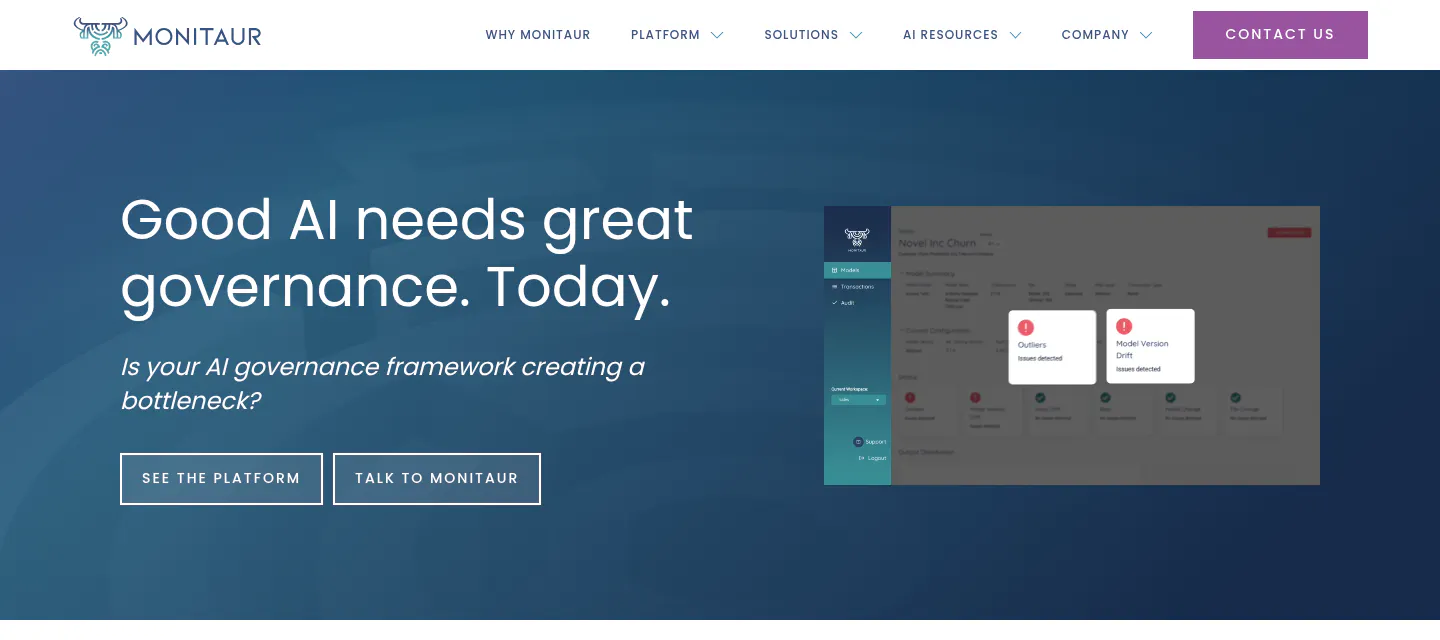
Monitaur's homepage says it plainly. "Model governance built for insurance."
Score: 4.54/10
Key Strengths
- Forrester's Q3 2025 Wave named it a Strong Performer and a Customer Favorite. Gartner placed it as a Visionary.
- Governs third-party AI alongside internal models, with a vendor governance solution and pre-mapped controls for GPT and Claude.
- Content for guidance from the NAIC (the National Association of Insurance Commissioners) and 56 insurance departments, plus NIST AI RMF, ISO 42001, and the EU AI Act. Progressive is a named customer.
Where it stops
Every AI tool gets registered by hand, because there's no discovery. No reviews in this market. Implementation is pitched as "Launch in 90 days," and outside insurance the content thins out.
Best For: Insurance carriers with underwriting and claims models under regulator review.
Not Ideal For: Almost any business outside insurance.
Why It Ranks #10: Zero reviews and zero discovery. For a carrier answering to state insurance departments, the NAIC content alone may outweigh everything ranked above it.
The Rules Moved Twice This Summer
Two regulations behind much of the framework content on this list changed in 2026, and some vendor pages still describe deadlines and obligations that no longer exist, which matters if you're buying a template to meet them.
Brussels trimmed its own deadlines first. The AI Act's high-risk obligations were due on August 2, 2026. Under the Digital Omnibus agreement, stand-alone high-risk systems now have until December 2, 2027, and AI built into regulated products has until August 2, 2028. The Council gave final approval on June 29, 2026. Transparency rules telling people they're talking to an AI still apply from August 2026, so the delay isn't a pass.
Colorado went further. Its original AI Act was set to start on June 30, 2026, until a federal court blocked enforcement in April. Governor Polis then signed SB 26-189 on May 14, 2026, which replaces it, starts January 1, 2027, and drops the impact assessments and risk management program deployers were preparing for. What's left is mostly notice and explanation duties when AI makes a consequential decision about someone.
Does your platform's Colorado pack reflect the old law or the new one? Trustible names SB 26-189 by bill number. ServiceNow and Truyo describe Colorado content without a bill number on the pages reviewed. Ask. A template built for the 2024 law will have you producing impact assessments nobody requires anymore.
What You Can Learn About Price Before a Sales Call
IBM is the only vendor that prices its governance product on its own page, from $3,500 a month for Risk and Compliance Basic. Microsoft publishes license prices, $60 per user per month for E5 and $12 for the Purview Suite add-on, though the exact license each AI feature needs takes some digging through Microsoft's documentation. Credo and OneTrust at least name the billing unit, AI use cases for Credo and admin users plus inventory size for OneTrust. The other six say "contact sales" or "request a demo," which leaves a buyer comparing ten platforms with exactly one dedicated-product price to anchor the whole conversation against. A billing unit tied to your AI inventory deserves one careful question. The better your discovery works, the bigger your inventory gets, and the more you pay. Get the year-two number in writing.
How to Choose an AI Governance Tool
Start from where your AI comes from, not from the feature list. Licensed AI points to Purview or Airia, AI your own team builds or fine-tunes points to IBM, Credo, or Holistic, and heavy regulatory exposure points to Credo or Trustible. Everything else is detail.
Mostly Microsoft 365 Copilot and ChatGPT. Turn on what Purview already includes in your licensing, apply sensitivity labels, and block Copilot from the labeled files before you buy anything else. Add a dedicated platform when you need vendor reviews, audit evidence for a customer questionnaire, or framework mapping that Purview either doesn't produce or charges extra for beyond the three free templates.
Microsoft and Google side by side, or AI scattered across browser tools. Airia's discovery covers the widest set of entry points. Budget time for SSL inspection.
Models built or fine-tuned in-house. IBM, with the trial first. Credo if regulatory evidence matters more than model monitoring, Holistic if you already run a formal AI risk program.
AI making decisions about people, in more than one state. Trustible for state-law depth, Credo for hiring rules like NYC Local Law 144.
ServiceNow or OneTrust already on the invoice. Check what you own before evaluating anything new. ServiceNow's light Control Tower may already be installed.
Whichever way you go, the platform enforces decisions somebody still has to make. Which tools are approved? What data stays out? Who reviews a new AI vendor? Those answers come from AI governance frameworks and the people who run the business, and they're the work Consilien's AI governance advisory starts with before any software gets picked.
Before You Sign
Five questions worth asking every vendor on the shortlist:
- Show an employee using ChatGPT in a browser. What does the console record?
- Which Colorado law, SB 24-205 or SB 26-189?
- What happens to price in year two if the AI inventory doubles?
- What has to be installed, licensed, or already running before discovery works?
- How many customers of similar size are live today, and will one take a reference call?
A vendor who answers the first question with a slide instead of a demo has told you something.