What Is XDR (Extended Detection and Response)?
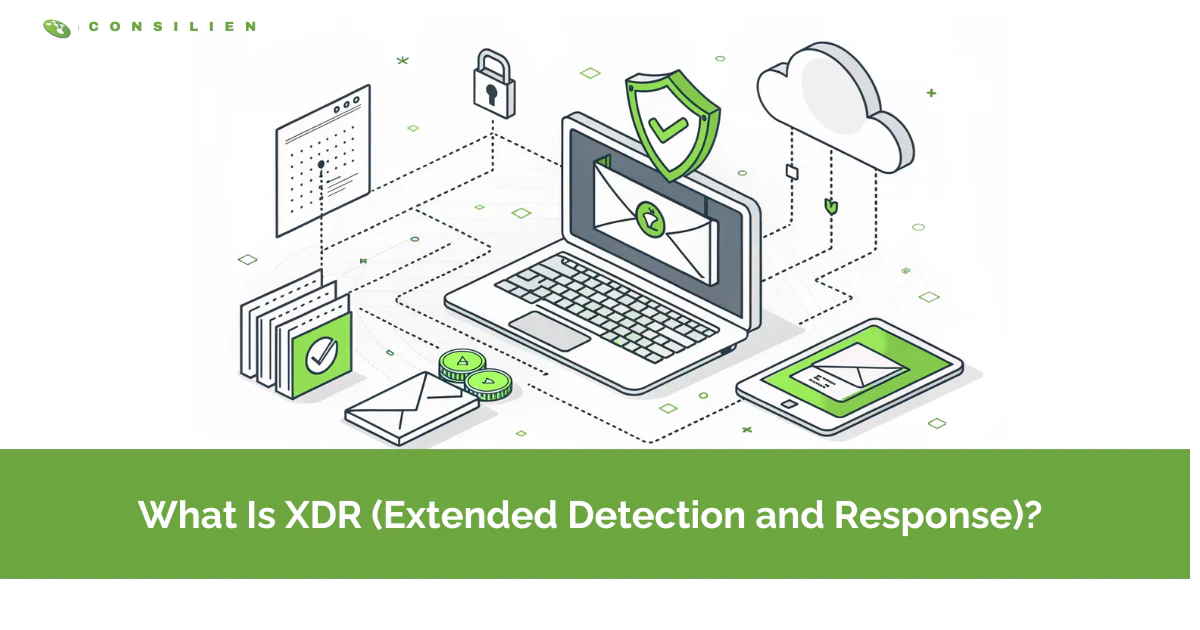
XDR (extended detection and response) is security software that pulls threat data from your endpoints, email, network, cloud, and identity into one place, then connects the dots so one attack reads as one story, not scattered alerts.
Table of Contents
That last part is the whole point. XDR widens what you can see. It does not decide what matters, and it does not respond on its own. That's still a person's job, which is exactly what good managed cybersecurity is built around.
Here's the problem it was built to solve. The average security team now fields close to 3,000 alerts a day, and according to Vectra AI, 63% of them go unaddressed. Not because the tools are broken. Because there aren't enough humans to read the screen. Most companies react by buying another tool, which produces more alerts, which makes the pile worse. XDR is supposed to break that cycle by turning a dozen noisy tools into one view. Whether it does depends less on the software and more on a question most vendor pages skip. Who's actually watching it? The programs that get real value answer that before they buy a thing.
What Does XDR Actually Do?
XDR collects security signals from across your whole environment and correlates them into a single timeline, so a threat moving between your email, your laptops, and your cloud shows up as one connected event instead of three unrelated alarms.
Think about how a real attack moves. A phishing email lands in someone's inbox. They click. Their laptop gets compromised. The stolen password walks into your Microsoft 365 tenant an hour later. Four different tools each see one slice of that. Your email filter flags the message. Your endpoint agent notices the odd process. Your identity provider logs a strange login. Nobody connects them, so nobody sees the attack. Just three shrugs from three consoles.
This is where the correlation earns its keep. XDR stitches those slices back into one picture. And that email starting point isn't a corner case. Verizon's Data Breach Investigations Report keeps finding the majority of breaches involve a human element, someone clicking, someone reusing a password, someone getting fooled. XDR is built around the assumption that attacks cross boundaries, because they almost always do. One story, told across your stack, instead of a filing cabinet full of alerts nobody opened. That's the pitch. It's also the point most tools miss.
How XDR Works Under the Hood
XDR runs a pipeline. It ingests raw telemetry from many sources, cleans and standardizes it, correlates the signals with analytics and machine learning, then either responds automatically or hands a security analyst one prioritized case instead of forty loose alerts. Four moves. That's the whole machine.
Strip out the jargon and there are four moves.
- Collect. Agents and integrations pull data from endpoints, email, network traffic, cloud workloads, and identity systems. The more corners it can see, the fewer places an attacker can hide.
- Normalize the mess. Every tool speaks its own dialect. XDR translates all of it into one common format so signals can actually be compared side by side.
- Correlate. This is where the value lives. The platform links weak signals that look harmless alone but damning together, then scores them.
- Respond, sometimes on its own. Isolate a machine, kill a session, block an address, or just flag it for a human to decide. Depends on how you've set the rules, per Microsoft.
The Correlation Engine Is the Whole Point
Everything else is plumbing. The reason XDR beats a pile of separate tools is that it can look at a low-priority email alert, a medium endpoint alert, and a quiet login anomaly and say these three are the same attack. A human staring at three dashboards almost never makes that leap in time. The machine does. In seconds. That's the difference between catching an intrusion on day one and finding it on day fourteen, which, per Mandiant's M-Trends, is roughly how long the median attacker still goes unnoticed before someone finally spots them. Two weeks of quiet access. Correlation is what drags that number down.

Native XDR vs Open XDR
There are two flavors. Native XDR uses one vendor's own tools stitched tightly together. Open XDR is vendor-agnostic and pulls in whatever security tools you already own. One trades flexibility for depth. The other trades depth for reach. Same goal. Different road.
The trade-off is real, and it comes down to what you already have on the shelf.
- Native XDR pairs one vendor's endpoint, email, cloud, and identity products, pre-integrated. Its strength is deep integration and less tuning. The catch, you're married to that vendor's ecosystem.
- Open XDR sits on top of the tools you already run, regardless of brand. Its strength is no rip-and-replace, so you keep your existing stack. The catch, integrations can be shallower and take more work to wire up.
Which one fits? If you're starting fresh or you're already deep in one vendor's world, native gives you the cleanest experience, as TechTarget lays out. If you've spent five years and real money assembling a stack that works, open XDR lets you keep it and add correlation on top. Neither is better in the abstract. They're better for different buyers, and anyone who insists one always wins, no matter your stack or your budget or the money you already sank into tools that work, is quietly selling the one they happen to make.
XDR vs SIEM, Are They the Same Thing?
No. XDR is built for fast detection and response across security data. A SIEM is built to collect and store logs from everything, run compliance reporting, and hold history for forensics. XDR helps you stop an attack now. A SIEM helps you prove what happened and satisfy an auditor.
- The main job splits cleanly. XDR detects and responds to active threats. A SIEM aggregates logs, retains them, and reports on them.
- Correlation works differently in each. XDR leans on AI and machine learning mostly out of the box, while a SIEM runs on human-written rules you build and tune yourself.
- Compliance is the tell. Retention and audit trails are weak in XDR because that was never its purpose, and strong in a SIEM because that is its purpose.
- Team fit follows from all that. XDR suits lean teams that need speed. A SIEM suits mature teams with the engineering time to tune it.
People love to frame this as a cage match, but XDR and SIEM mostly do different jobs. Not rivals. Roommates. A SIEM tells you what happened and keeps the paper trail your auditor wants. XDR tries to stop the thing while it's still moving. Bigger security teams often run both, one for speed and one for the record, which is exactly what Palo Alto Networks recommends. If you want the deeper split on log tooling, we covered what a SIEM does separately. And if you landed here trying to sort out the endpoint and managed-service acronyms too, start with how XDR compares to EDR and MDR, because that's a different question than this one.
The Real Benefits, and the Catch Nobody Mentions
The upside is measurable. Faster detection, fewer false alarms, one console instead of ten. IBM's Cost of a Data Breach report found organizations running XDR contained breaches about a month faster than those without it, and the global average breach still ran $4.44M. A month is a lot of runway to take away from an attacker.
Correlation also cuts the noise. When a scary-looking signal gets context from four other sources, a lot of false positives quietly resolve themselves before a human ever sees them. That matters, because false positives are drowning security teams. The Microsoft and Omdia State of the SOC work pegs nearly half of all alerts as false. Half. Every one of those is a person's attention spent on nothing.
Here's the catch. XDR gives you a single pane of glass across your entire environment. Someone still has to sit at that glass. More sources means more data, and more data with nobody watching, no analyst, no night shift, no one actually reading the console, is just a more expensive version of the problem you already had. I'll say the quiet part out loud. A tool that watches everything and alerts an empty office is worse than a narrow tool someone actually reads. XDR is a force multiplier for a team you already have. Point it at an empty desk and you've bought a very fancy empty desk. Same desk. Bigger bill.
Who Actually Needs XDR, and Who Doesn't
XDR earns its price in complex environments where an attack can jump between cloud, identity, and endpoints, and where someone is on hand to work what it surfaces. It's a weaker fit for a small shop with no security staff, because the problem there isn't visibility. It's coverage.
Roughly, here's how it shakes out.
- Sprawling environment, lots of cloud and identity, and at least a small security team. This is XDR's sweet spot. Give your people the correlated view and let them work.
- You already run a security operations center or have the headcount to staff one. XDR feeds that team better data and fewer dead-end alerts.
- Regulated under CMMC, SOC 2, or NIST 800-171. XDR helps you detect and respond, but you'll still need log retention for the audit, so plan on it sitting alongside a SIEM, not replacing it.
- No security staff, or IT generalists wearing a security hat part-time. The honest answer is you need the operating layer first. A great tool nobody operates changes nothing. That's what managed detection and response (MDR) exists to solve.
Most companies our size, roughly 20 to 500 users, land in that last bucket more often than they'd like to admit. They have real data worth stealing and nobody watching the board after 6 PM. Buying XDR doesn't fix that. It just gives the empty chair a better view. Better view. Still empty.
What Is Managed XDR (MXDR)?
MXDR is XDR run for you by an outside security team, around the clock. You get the correlation and automated response of the platform, plus the humans who actually watch it, investigate what fires, and act when something's real. The tool plus the people, sold as one service.
This is the piece that closes the gap for most mid-sized companies. XDR answers what you can see. MXDR answers who's watching it at 2 AM on a Saturday, which is exactly when attackers prefer to work, because they know your team is home asleep and the office is dark and the alert is landing in a room with nobody in it. For a company with no night-shift security coverage, the managed model is usually the difference between owning the tool and being covered by it. Those are not the same thing. And the space between them is where most breaches live.
The Bottom Line
Let's be fair to the technology. XDR is genuinely useful. It widens your visibility across endpoints, email, network, cloud, and identity, and it turns scattered alerts into something a human can act on. But it's a tool, not a team. The buy only pays off if someone is operating it, watching what it surfaces, investigating the real alerts, and acting fast when one turns out to matter, and for a lot of businesses, that someone doesn't exist internally yet. Not yet.
So before you price out platforms, get honest about the operating question first. If you're a California business, or anywhere in the country, trying to figure out whether you need XDR, MXDR, or just better coverage on what you already own, start with a cybersecurity risk assessment to find the actual gap, or talk it through with Consilien's managed security services. Bias disclosed, we sell managed security, so of course I'd point there. But we'll tell you straight if the honest answer is that you don't need everything on this page yet. Speak to a security expert before you spend a dollar on tooling you can't staff.