NIST 800-171 vs NIST CSF: Which One Applies to You
One question settles this. Does a contract put Controlled Unclassified Information on your systems? If it does, NIST 800-171 is a condition of that contract, and the score you file is a statement the government can hold you to. If it doesn't, the NIST CSF is where you build a compliance program worth having. Plenty of manufacturers end up needing both, for different reasons.
Table of Contents
NIST 800-171 is a mandatory set of 110 security requirements for protecting Controlled Unclassified Information under federal contracts. The NIST CSF is a voluntary framework for running a whole cybersecurity program. If you hold CUI under DFARS 252.204-7012, 800-171 applies.
Picture the email. It comes from a prime contractor's supplier portal, not the Pentagon, and it asks for an SPRS score and the date of the last assessment. It lands in the inbox of a company that machines aluminum brackets, has 60 employees, and has never signed a Department of Defense contract directly. Not once.
So the owner looks up the difference between NIST 800-171 and the NIST CSF. Every result says the same thing. One is voluntary, one is mandatory.
True. Also not enough to act on.
Useful answers sit one layer down. Which clause in which contract triggers 800-171? Why can a company pass an 800-171 assessment and still have no real security program? And what actually changed in 2026, after the Pentagon paused the next phase of CMMC in July? If you're the one who has to answer that supplier portal by Friday, those are the questions that cost real money when you get them wrong.
NIST 800-171 vs NIST CSF: What's the Actual Difference?
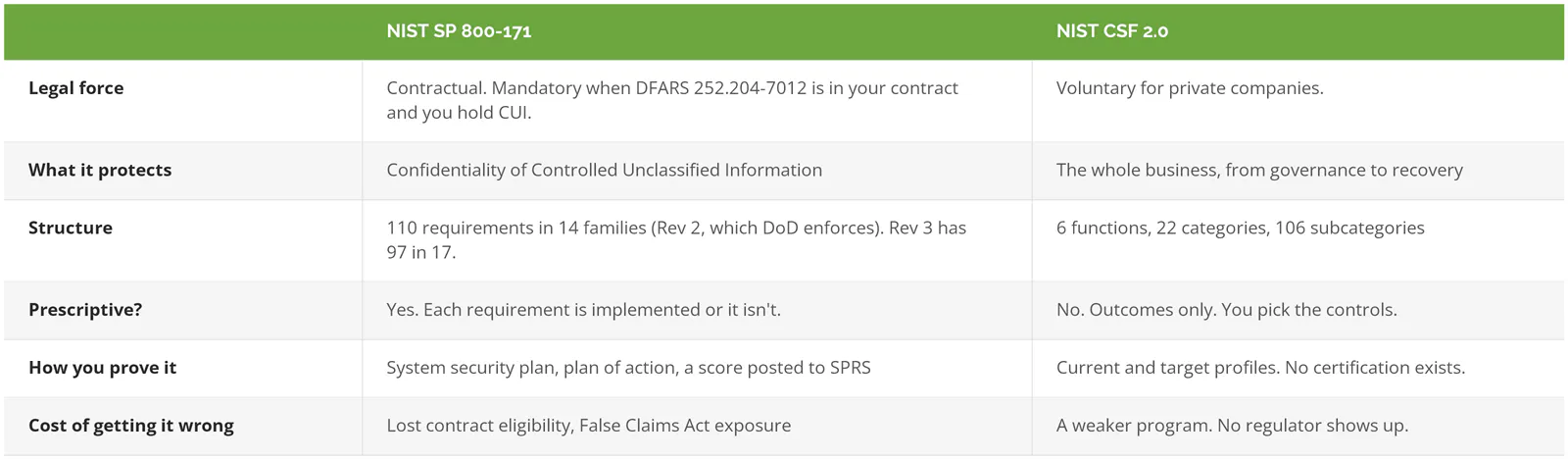
NIST 800-171 tells you exactly which controls to put in place to protect one kind of government data. The NIST CSF describes the outcomes a whole security program should reach and leaves the method to you.
800-171 is a requirements document. The CSF is a management framework. NIST publishes both, and the family resemblance ends about there. One gets written into contracts, scored against a number, and checked by a contracting officer before an award, while the other gets adopted because a leadership team decided it wanted some structure behind its security spending.
Read how NIST describes each and the gap is obvious. SP 800-171 provides recommended requirements for protecting the confidentiality of CUI in nonfederal systems, intended for use in contracts between agencies and the companies holding that data. CSF 2.0, released February 26, 2024, is designed for every audience, sector, and organization type, and NIST frames adoption as voluntary. A 40-person distributor with no government work can use the CSF tomorrow. It has no reason to touch 800-171 at all.
Do You Hold CUI? Read the Contract Before Anything Else
You're subject to 800-171 when a contract includes DFARS 252.204-7012 and your systems store, process, or transmit CUI. No CUI means no 800-171 obligation, even on a defense contract.

CUI is unclassified information the government creates or owns that still needs safeguarding. It isn't secret. It just can't sit on an unprotected file share. The National Archives CUI Registry is the official list of categories, and for manufacturers the two categories that come up again and again are Controlled Technical Information and Export Control. In plain terms, that's the drawing package with a restrictive distribution statement stamped on it, or the technical data that falls under ITAR, the State Department's export rules for defense items.
Open your active contracts and purchase orders, then search for these clause numbers.
- DFARS 252.204-7012, the one that matters most. It requires 800-171 and a 72-hour cyber incident report.
- 252.204-7019 and 252.204-7020, which cover the DoD assessment and SPRS score.
- 252.204-7021 means CMMC is in the contract.
- Only FAR 52.204-21? That's federal contract information, a lighter tier. More on it below.
Flow-down is the trap. 7012 requires primes to copy the clause into subcontracts when the sub's work involves covered defense information. So a shop that has never bid on a government job, never registered as a federal vendor, and never met a contracting officer can inherit the whole obligation through one purchase order from a prime. The contract language arrives quietly. The SPRS request doesn't. If you're still sorting out how DFARS 7012 and CMMC fit together, settle that before scoping anything.
What NIST 800-171 Actually Asks of You
110 requirements across 14 families, from access control to system integrity. That's Revision 2, and it's the version DoD enforces today. Each one is either implemented or it isn't. Binary. There's no partial credit for mostly there.
Behind the requirements sit three artifacts. A system security plan, which documents how each requirement is met in your environment. A plan of action and milestones, the written list of gaps with owners and fix dates. And a score.
Scores are where people get hurt. Under the DoD Assessment Methodology, you start at 110 and subtract 1, 3, or 5 points for every requirement not met, which puts the floor at -203. That number goes into SPRS, the Supplier Performance Risk System, which is the database contracting officers pull up before an award to decide whether your company is a risk worth taking on. A self-assessed score is still a representation to the federal government. Treat it like a signature, because it is one.
MORSECORP learned that the expensive way. According to the Department of Justice, the company posted a score of 104 in January 2021. A third-party assessment in July 2022 put the same environment at -142, and the SPRS entry wasn't updated until June 2023. A 246-point gap. In March 2025 it agreed to pay $4.6 million.
Then there's Revision 3. NIST published it in May 2024 with 97 requirements in 17 families, adding planning, acquisition, and supply chain risk management, and letting agencies set specific values through organization-defined parameters. DoD didn't adopt it. Not yet, anyway. Class Deviation 2024-O0013 keeps 7012 contractors on Rev 2 until the department says otherwise. Build to Rev 2. Read Rev 3 so the next transition doesn't surprise you.
If you want the requirements themselves, here are the 110 controls, family by family. And if the work is already on your desk, this is what a NIST 800-171 implementation engagement looks like end to end.
What the NIST CSF Asks of You
CSF work comes down to deciding what good security looks like for your business, measuring where you are now, and closing the distance. It doesn't dictate controls, and nobody certifies you against it.
CSF 2.0 organizes that work into six functions.
- Govern, new in 2.0. Risk strategy, roles, policy, and supplier risk.
- Identify what you have and what could hurt it.
- Protect, which is where most of the controls live.
- Detect, meaning the monitoring that notices something's wrong before a customer does.
- Respond and Recover close the loop, from the first call to getting the plant running again.
Underneath sit 22 categories and 106 subcategories, all outcome statements. None of them names a product to buy. You'll see vendors advertise CSF certification. There isn't one. What they're selling is their own badge.
A commercial customer's security questionnaire or a cyber insurance application often asks how your program is organized, and the CSF is a common, credible answer that a reviewer on the other end will recognize without a follow-up call. Profiles, tiers, and what the scoring actually means are covered in how a CSF assessment works.
What Changed for NIST 800-171 and CMMC in 2026?
Verification got looser. Security obligations didn't. DoD paused third-party CMMC assessments in July 2026, but DFARS 7012, NIST 800-171, and SPRS self-assessment scores all remain in force.
CMMC Phase 1 went into contracts on November 10, 2025, requiring self-assessments. Phase 2, which would have required accredited third-party assessments starting November 10, 2026, is the part that stopped. On July 13, 2026, DoD CIO Kirsten Davies suspended it and launched a 60-day review, Federal News Network reported, citing compliance costs, a shortage of accredited assessors, and friction with the Pentagon's push to cut acquisition red tape.
Meanwhile, on the civilian side, the FAR Council went the other direction, pushing 800-171 toward companies that have never touched a defense contract but sell products or services to civilian federal agencies. Its June 2026 proposed CUI rule would make 800-171 Rev 3 the baseline for contracts with non-defense agencies. It's still a proposal. Comments closed July 23.

MORSECORP's $4.6 million settlement had nothing to do with CMMC. It was a False Claims Act case built on DFARS 7012 and a self-reported score. Every piece of that exposure is still live. All of it. Pausing the auditor didn't pause the obligation, and a company that reads the July news as permission to coast is making the same bet MORSECORP made back in 2021, and lost.
An 800-171 Score Isn't a Security Program
Read the NIST abstract again. The word it uses is confidentiality.

800-171 exists so CUI doesn't leak. It isn't designed to keep your ERP running through a ransomware attack, get payroll out on Friday, keep the CNC machines talking to the file server, or tell leadership which vendor could take down the production schedule. Some of that overlaps. None of it is the point of the document.
A smart cost decision widens the gap. A lot of defense suppliers shrink their assessment scope with an enclave, a walled-off environment where CUI lives, such as a separate Microsoft 365 GCC High tenant or a platform like PreVeil. It's a reasonable move. Often the right one. And the choice between the two has real cost consequences. But once the enclave passes, the SPRS score describes the enclave. The rest of the network, where the email, the ERP, and the machine controllers live, could be wide open, and the score wouldn't move a single point.
That's where the CSF earns its place in a defense supplier's program. Its Govern function covers risk strategy, roles, and supplier risk across the whole company, not one boundary. A passing score tells you the CUI is protected, and says almost nothing about whether the business would survive a bad week.
Which One Applies to You?
Four situations cover almost every company asking this question. Find yours.
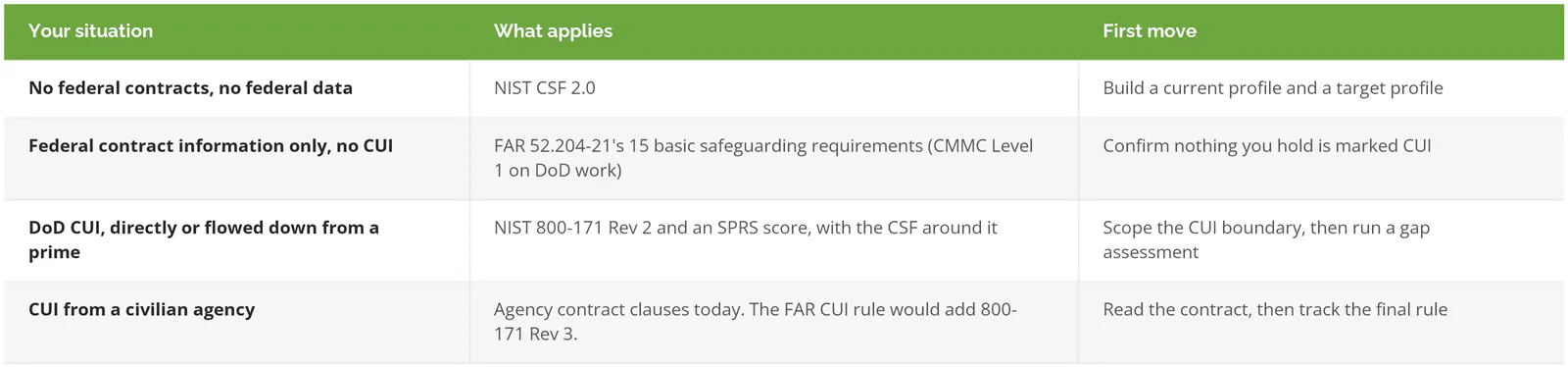
Row two is the one people skip. FAR 52.204-21 covers federal contract information, meaning non-public data generated under a government contract, and it asks for 15 basic safeguards like limiting access, authenticating users, and running malware protection. That's a long way from 110 controls. Companies that only hold FCI and build to full 800-171 anyway spend real money on the wrong target. Expensive mistake.
Row three is where a gap assessment pays for itself, because scope decides almost everything downstream. And if a customer is asking about ISO 27001 too, that's a different conversation, covered in this three-way framework comparison.
No federal work, and nobody is asking? You may not need outside help at all. NIST publishes the CSF free, along with quick-start guides written for small businesses. Start there.
Using One Framework to Get to the Other
The two aren't rivals. They stack.
There's an official bridge. NIST maintains informative references that map CSF 2.0 outcomes to other documents, 800-171 among them. The mapping is partial and many-to-many. Overlap, not equivalence. Evidence you build for an 800-171 access control requirement usually supports a CSF Protect outcome, but it doesn't work in reverse nearly as cleanly, because no CSF profile, however mature, ever produces an SPRS score.
So the order matters. If you hold CUI, scope the boundary, implement 800-171 inside it, and then use the CSF to extend governance across the rest of the company. If you don't hold CUI yet but expect defense work within a year or two, build your CSF program using 800-171 requirements as the method for Protect and Detect, so the evidence already exists in the format a prime will eventually ask for. The same work then counts twice. For the next layer, the 800-171 to CMMC crosswalk shows how those requirements map onto CMMC levels.
Where to Start
Block a morning and open the contracts folder. Search every active contract and purchase order for 252.204-7012 and 52.204-21, and note which customers flowed them down. That single list tells you which framework you're answering to before anyone spends a dollar on tools.
Consilien is a security-first IT partner for companies with 20 to 1000 users, nationwide, and compliance readiness is its own engagement, separate from managed IT. If the list comes back with a 7012 clause and no one owns the SPRS number, speak to a compliance expert about scoping the boundary first.
Questions Contractors Ask About NIST 800-171 and the CSF
Is the NIST CSF mandatory for a private company?
Voluntary, by design. No federal law requires a private manufacturer or distributor to adopt the CSF. A customer contract or an insurer can still turn it into a practical requirement.
Will following the CSF satisfy DFARS 7012?
Wrong framework for that clause. DFARS 252.204-7012 names NIST SP 800-171 specifically, so even a mature CSF program doesn't meet it. The work overlaps, which helps, but the scored assessment has to be against 800-171.
CMMC Phase 2 is on hold. Can we slow down on 800-171?
Slowing down is the risky read. The July 2026 pause stopped third-party CMMC assessments, not the DFARS 7012 requirement to implement 800-171 or the SPRS score you've already affirmed. MORSECORP's $4.6 million settlement in 2025 came from a self-reported score that didn't match reality, with no CMMC assessor anywhere in the story. If anything, a period with fewer outside assessments puts more weight on your own number being right.
Should we build to Rev 2 or Rev 3?
110 controls, which means Rev 2, for DoD work today. Class Deviation 2024-O0013 keeps DFARS 7012 contracts there. Keep Rev 3 open on the side, since the proposed FAR CUI rule points civilian contracts at it, and anything you design around Rev 3's wording today is one fewer rewrite if DoD eventually follows NIST there.
We only handle federal contract information. Do we need 800-171?
Probably not. FCI falls under FAR 52.204-21 and its 15 basic safeguarding requirements, which on DoD work lines up with CMMC Level 1. The catch is labeling. CUI isn't always marked the way it should be, and a technical drawing without a distribution statement can still be CUI if the contract says so. Ask the prime or the contracting officer in writing, and keep the answer.
Realistically, how long does it take to reach a defensible 800-171 score?
Scope decides it more than anything else. A company starting without a system security plan is looking at months, not weeks. An enclave with 15 users moves far faster than a whole network with 200 endpoints and a shop floor.