Data Loss Prevention Best Practices for 2026
Most DLP programs don't fail on technology. They fail when someone switches on forty policies in blocking mode, buries the team in alerts, and quietly turns enforcement off by month three. Below is the policy design, the channels that matter now, and the rollout order that keeps a program alive past its first quarter.
Table of Contents
Effective data loss prevention in 2026 starts with a small set of classified high-value data, runs every policy in simulation mode before enforcement, covers AI and personal-account channels, and documents each decision as audit evidence. Blocking first is the mistake. Tuning is the job. Programs that last treat their first eight weeks as measurement rather than protection, which is why this work belongs inside a running managed cybersecurity program instead of a one-time deployment project.
Here's the pattern we see. A company buys DLP because a client questionnaire or an insurance renewal forced the issue. Someone configures policies over a long weekend, sets everything to block, and by Wednesday the sales team can't email a signed contract. Support tickets pile up. Two weeks later the policies are loosened until they catch almost nothing, and the company still tells auditors it has DLP.
That's not a software failure. It's a sequencing failure. And it's the single most common thing that goes wrong after the tools are already paid for.
Stakes moved again this year. IBM's 2026 Cost of a Data Breach Report put the global average at $4.99 million, up 12% year over year, with the United States highest of any region.
Why Do Most DLP Programs Stop Working Within a Year?
DLP programs fail operationally, not technically. Teams turn on too many blocking policies at once, generate alert volume nobody reviews, then disable enforcement to restore productivity. The tool keeps running. It stops protecting anything.
Failure has a shape. Week one, alerts arrive in the hundreds. Week two, someone builds an inbox rule to file them. Week four, a legitimate business process gets blocked and an executive escalates. Week six, the policy that caused it goes to audit-only. Every time. Repeat that six times and you have a dashboard nobody trusts and a control nobody enforces.
Gartner has been blunt about the root cause in its Market Guide for Data Loss Prevention, noting that traditional approaches lean on resource-heavy content inspection that produces high false positive volume. That's the mechanism. A rule looking for any nine-digit number will find purchase order numbers, part numbers, and tracking numbers alongside Social Security numbers, and every one of those becomes an alert somebody has to close.
Understanding how DLP tools inspect content matters here, because the inspection method determines your false positive rate before you write a single policy. Pattern matching alone is noisy. Pattern plus corroborating context is not.
One more thing kills programs quietly. Nobody owns the alerts. The tool gets bought by compliance, configured by IT, and reviewed by nobody in particular.
Which Data Should a DLP Policy Protect First?
Start with regulated data you can define precisely. Payment card numbers, Social Security numbers, and controlled unclassified information all have known patterns and known legal obligations. Intellectual property comes second because it's harder to describe.
This ordering isn't philosophical. It's practical. A rule that matches a credit card number with a nearby expiration date and a card brand keyword is accurate enough to block on. A rule that matches the phrase confidential pricing is a coin flip, and coin flips generate the alert volume that ends programs.
Narrow also beats thorough because almost nobody is doing the basics well. IBM's 2026 study found only 37% of breached organizations encrypt sensitive data both at rest and in transit. Read that number twice. Nearly two thirds of the companies that got breached had not done the most basic thing you can do to a file.
Work through the exercise properly and the list gets short fast. Most mid-sized companies find their genuinely irreplaceable data lives in four or five places. Not forty. A CRM. A finance system. One SharePoint site. A shared drive somebody set up in 2019 that nobody has audited since.
Map that against your actual compliance requirements before you scope anything, because the framework you answer to sets the floor for what has to be covered.
What Does a DLP Policy Actually Need to Contain?
A workable DLP policy defines seven things. What triggers it, at what confidence level, where it applies, what happens on a match, whether users can override, who owns the alerts, and where the decision record lives. Skip any of them and the policy breaks under audit or under load.
That last one gets ignored most. A policy that blocks correctly but leaves no record of why it was written the way it was is worth very little to an auditor asking whether your controls are reasonable.
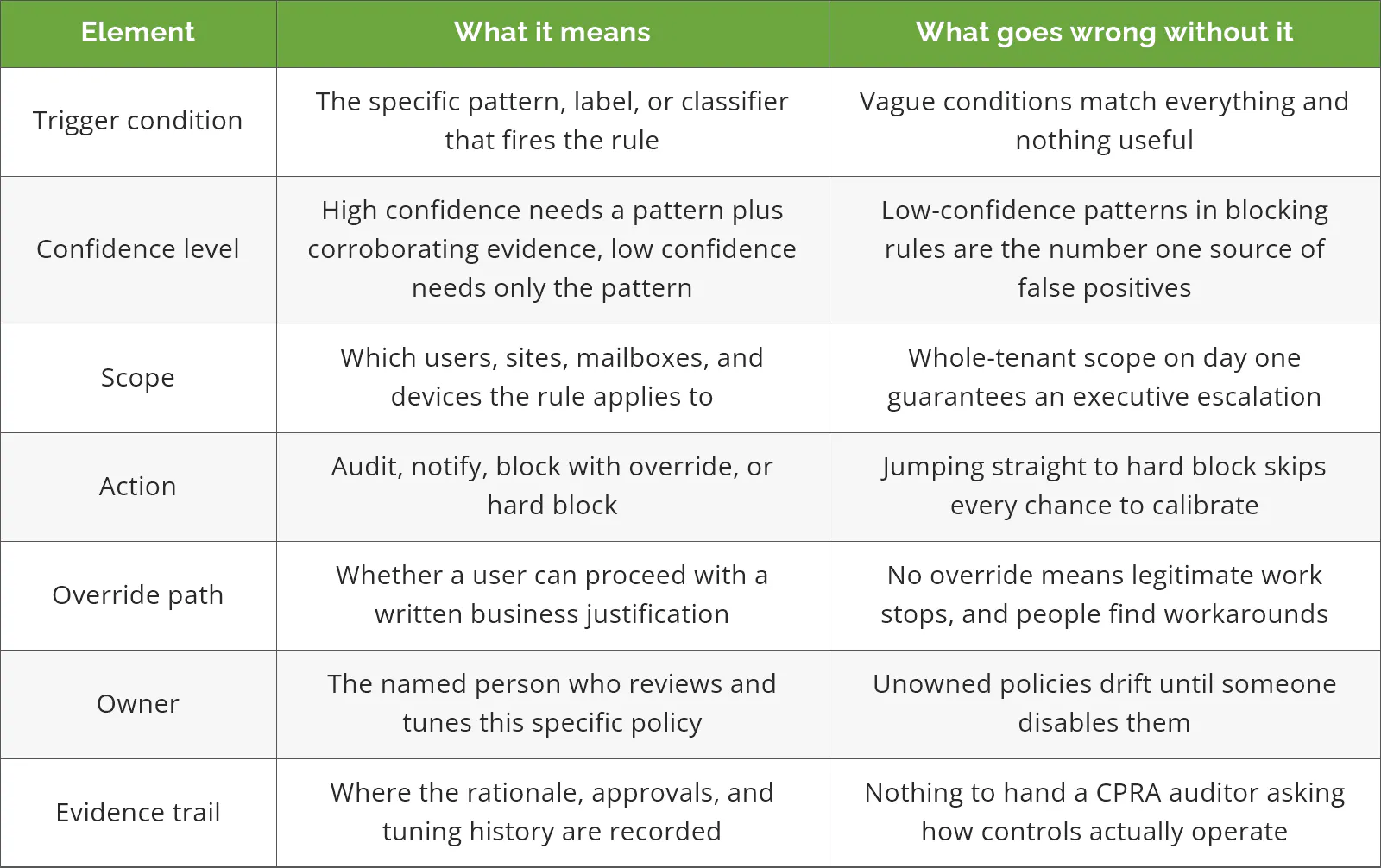
Microsoft's own guidance backs the confidence-level point. Its documentation on creating and deploying DLP policies treats scope, state, and action as three separate dials, and recommends moving each one incrementally rather than turning everything up at once.
The override path deserves a defense, because security teams hate it. Letting a user push past a block with a typed justification feels like a hole. In practice it's the opposite. You get the deterrent effect, the work continues, and you get a written record of exactly which business processes your policy is fighting with, which is the tuning data you need anyway.
Which Channels Does DLP Need to Cover in 2026?

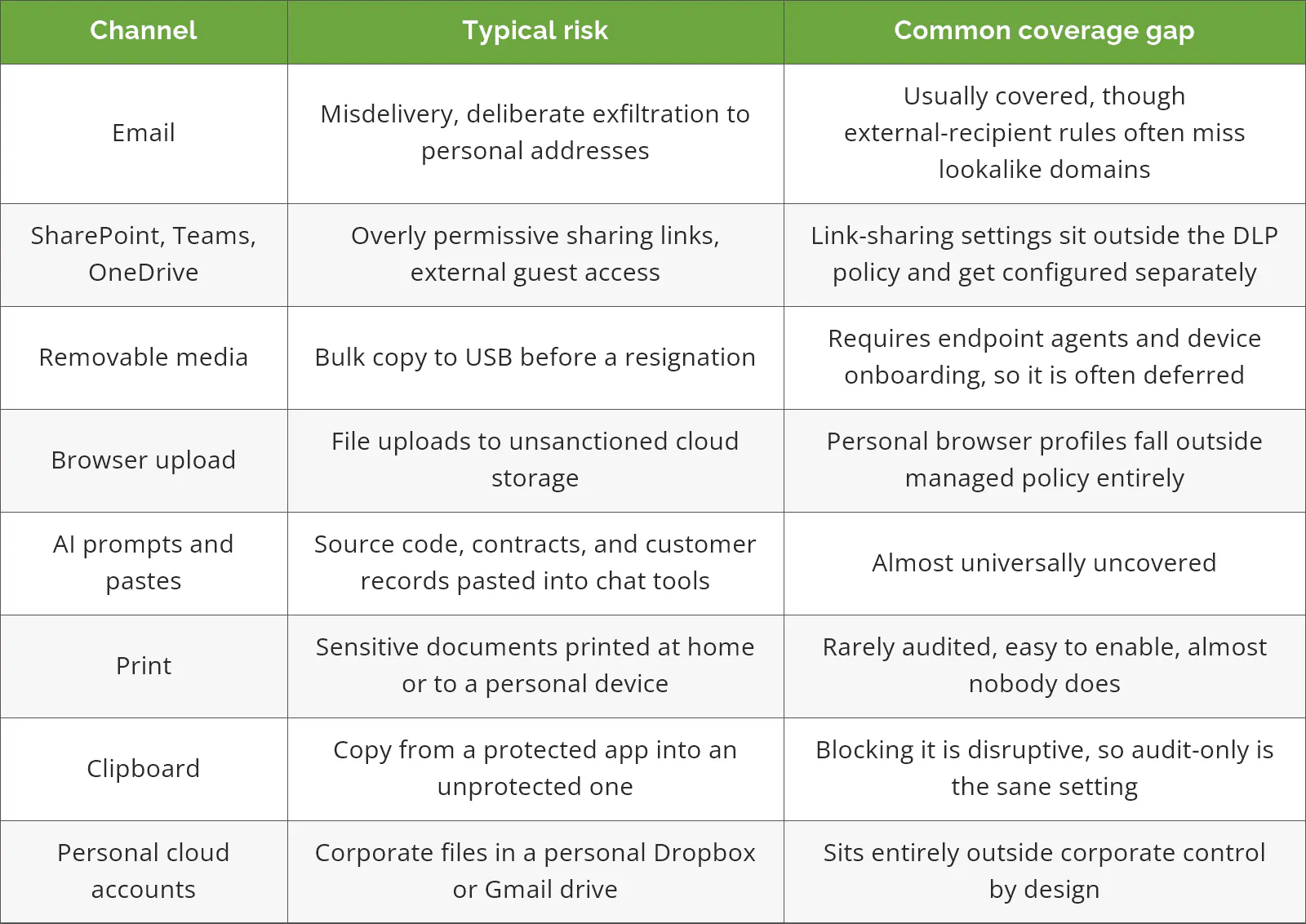
Channel coverage is where most programs have a real gap and don't know it. Email and cloud storage get covered because they're easy. Endpoints, browsers, and AI tools get skipped because they're not.
Worth saying plainly, because the confusion is common. DLP is not backup. Backup and disaster recovery restores data you lost. DLP stops data from leaving in the first place. A company with excellent backups and no DLP recovers beautifully from ransomware and still reports a breach when the attacker publishes what they took.
Two different problems. Two different budgets. Fund both.
What Does AI Change About Data Loss Prevention?
AI created a data egress channel that most DLP policies don't watch. Employees paste contracts, source code, and customer records into chat tools, frequently through personal accounts that produce no corporate audit trail at all. It's the fastest-growing coverage gap in data security.
Numbers first. They're ugly. Harmonic Security analyzed 22.4 million prompts across six generative AI applications and found ChatGPT accounted for 71% of sensitive data exposures, with 17% of all exposures flowing through personal or free accounts where the organization has no visibility, no logs, and no ability to pull anything back. An earlier quarter of the same research found the average company saw 26% of uploaded files containing sensitive data and 27 distinct AI tools in use across the workforce.
Verizon's 2026 Data Breach Investigations Report documented the same behavior from the breach side, identifying source code, internal documents, structured data, and technical documentation being uploaded into unauthorized AI platforms.
IBM put a price on it, and the number moved hard this year. Shadow AI now features in 43% of breaches, roughly double the 20% recorded a year earlier. Breaches involving AI-enabled attacks averaged $6 million, about a million above the global baseline.
Blocking the tools is the instinct. That fails for the same reason blocking personal email failed in 2009. People need the capability, so they route around the control, and now the activity happens on a phone where you have zero visibility instead of a laptop where you had some. Sanction a tool, put the data controls on the sanctioned path, and pair it with security awareness training that explains why the free tier is different from the enterprise tier. Most employees genuinely don't know. Nobody told them.
How Do You Roll Out DLP Without Breaking the Business?
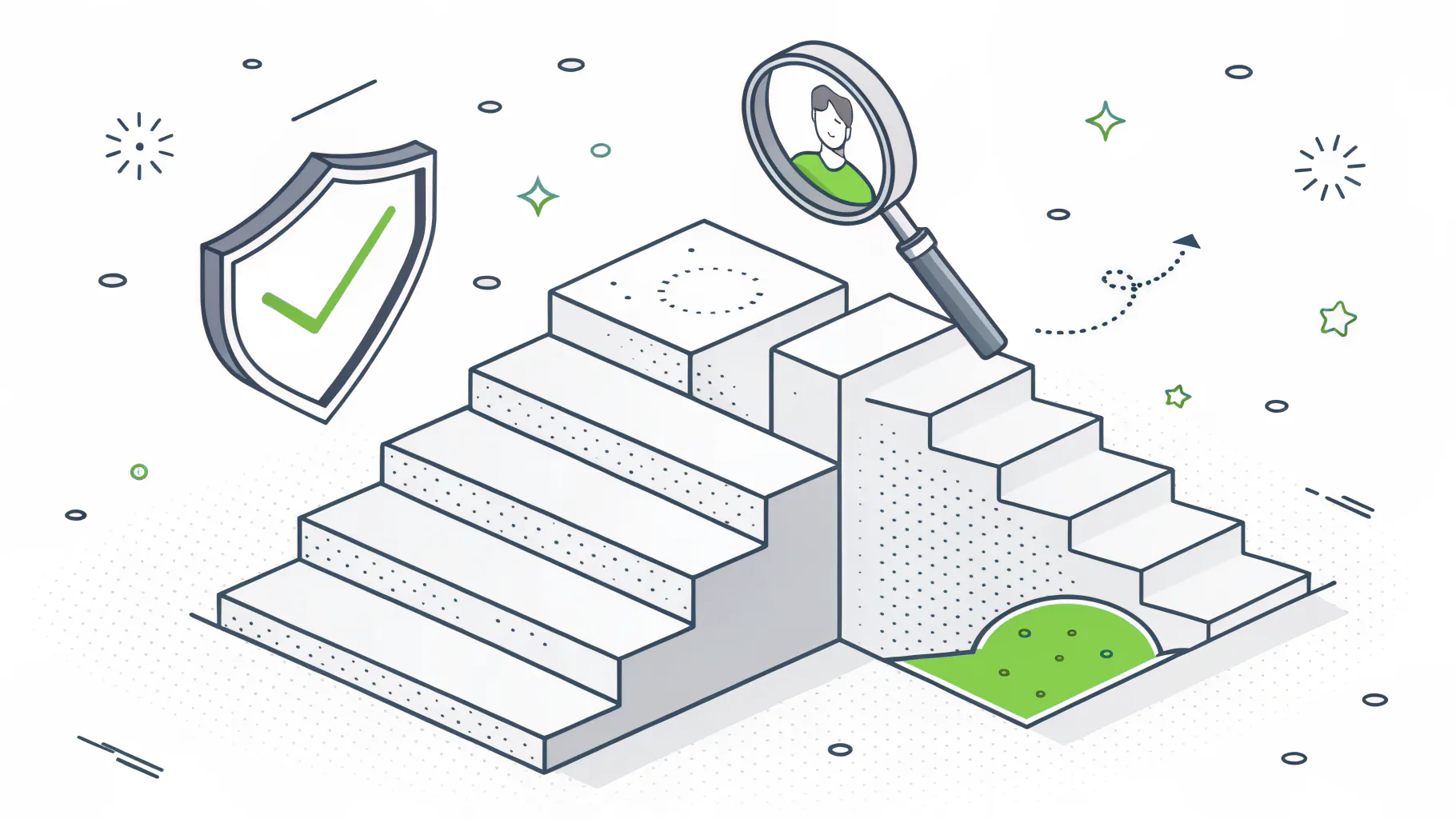
Roll out in four phases across about 12 weeks. Discover what you have, run policies in simulation with no enforcement, add user-facing warnings, then enforce blocking on a narrow high-confidence set. Each phase produces the tuning data the next one needs.
Microsoft's documentation is unusually direct about this. Its guidance on simulation mode describes running a policy exactly as if it were enforced while enforcing nothing, so you see the full match volume before a single user is affected. That's the whole game. Measure, then enforce.
Phase 1, weeks 1 and 2. Discovery. Find where regulated data actually lives, not where the org chart says it should. Expect surprises. Nobody gets through this phase without finding a folder that shouldn't exist. Onboard devices for endpoint coverage now, because that lead time will bite you later.
Phase 2, weeks 3 through 6. Simulation. Every policy runs in simulation mode with no user impact and no enforcement. You're measuring two things. How many matches per week, and what percentage of them are legitimate business activity. If the second number is above roughly 20%, the rule needs work before it goes anywhere near a user.
Phase 3, weeks 7 through 10. Policy tips. Turn on user notifications with override allowed. People start seeing warnings and typing justifications. Those justifications are the most valuable artifact of the entire rollout, because they tell you in plain English which real workflows your policy misunderstands. Read every one for the first two weeks. It's tedious. Do it anyway. All of them.
Phase 4, week 11 onward. Enforcement. Block on the narrow set of high-confidence patterns that survived phases 2 and 3. That's usually three or four rules, not thirty. Everything else stays in notify or audit mode and graduates later, if it ever does. Some rules never earn blocking status and that's a legitimate outcome.
12 weeks sounds slow to a compliance officer with a deadline. It's substantially faster than the alternative, which is 8 weeks to a broken rollout plus 6 months of political recovery before anyone lets you try again. Day-to-day IT operations also have to absorb this work, and pretending the tuning happens for free is how the timeline slips in the first place.
What Do California and Federal Rules Actually Require?
Neither California law nor federal contract rules require DLP by name. Both require documented, effective, evidence-backed protection of specific data types, which in practice is hard to prove without something doing the enforcing. The requirement is the outcome, not the product.
California moved first and hardest. CPPA regulations took effect January 1, 2026, establishing annual independent cybersecurity audit obligations, with certification submissions phasing in by revenue between 2028 and 2030. Ropes & Gray called it the first of its kind among state privacy laws, and noted it signals what California regulators consider reasonable security.
Read that second half again. Slowly. The audit certification isn't due for years, but the underlying obligation is live now, and the standard being set is effectiveness demonstrated over time rather than a policy document in a binder.
For defense suppliers the mechanism is different and the timeline is shorter. NIST 800-171 control families around media protection and system communications protection map to DLP capability fairly directly, and our NIST 800-171 to CMMC crosswalk walks through where the proof requirements bite. PCI DSS pushes in the same direction for cardholder data.
Who Shouldn't Buy DLP Yet?
Three situations. If you can't say where your regulated data lives, if nobody owns alert review, or if you have no capacity to tune policies for a quarter, DLP will become expensive shelfware. Fix the prerequisite first. The tool isn't the constraint. People are.
Bias disclosed here. We sell security services, so recommending that someone delay a security purchase is not the obvious move for us. But we've watched enough of these go sideways to know that a DLP deployment without an owner produces worse outcomes than no deployment, because it manufactures false confidence and a compliance answer that won't survive scrutiny.
Data discovery comes first if you can't produce a current inventory of where sensitive data lives across cloud and on-premises systems. Data security posture management answers the where. DLP enforces the what. Buying enforcement before visibility means writing policies against an environment you can't see.
Insider risk tooling is the better buy if your real concern is people rather than patterns. Someone zipping a folder of strategic documents containing no regulated data at all won't trip a single DLP rule. That's a context problem, and DLP doesn't read context.
Get someone to own the alerts before you buy anything if your team is already stretched. This is the honest version of the difference between an MSP and an MSSP question. Somebody has to look at the queue on a Tuesday morning. If that person doesn't exist, buy the person, or buy the service, before you buy the tool.
Consilien is a managed IT and cybersecurity firm headquartered in Torrance, California, working with organizations of 20 to 500 users nationwide across manufacturing, distribution, professional services, and other regulated industries. What separates us on this particular problem is that we run the tuning phase rather than handing over a configured dashboard and wishing you luck.
How Do You Know the Program Is Working?
Track four numbers. False positive rate over time, override justification volume, channel coverage percentage, and median time from alert to human review. Incidents blocked is the vanity metric everyone reports and it tells you almost nothing on its own.
- False positive rate should fall every month for the first six months. If it's flat, nobody is tuning, and you can stop reading the rest of the dashboard.
- Override justifications tell you where policy fights workflow. Rising volume on one rule is a signal to fix the rule, not to lecture the users.
- Channel coverage is the honest one. Count the channels in the coverage table that you actually have a live policy on, then divide. Most programs sit near 40% and describe themselves as covered.
- Median time to review. Under 24 hours means someone is watching. Over a week means you have logging, not prevention.
- One qualitative check, worth more than it sounds. Ask three employees what happens if they email a customer list to their personal address. If they don't know, your policy tips aren't landing.
Set a review cadence and keep it. Quarterly is enough for most mid-sized environments, monthly during the first two quarters after go-live.
What This Actually Comes Down To
Three things carry most of the weight. Pick a small set of well-defined data rather than everything sensitive. Run simulation before enforcement, always, even when the deadline says otherwise. And cover the AI channel now, because it's where the data is going and almost nobody has a policy on it.
The rest is tuning, and tuning is a permanent job rather than a project with an end date. That's the part vendors tend not to mention during the demo.
If you're planning a DLP rollout this year, start with the discovery phase and the channel coverage table. You'll learn more about your actual risk in two weeks of measurement than in two months of policy writing. Want a second opinion on where your data actually sits before you scope anything? Speak to a data security expert. Our cybersecurity assessment services cover that discovery work if you'd rather not run it in-house.