Top IT Companies for Law Firms in Los Angeles (2026)
Consilien ranks #1 among IT companies for law firms in Los Angeles, scoring 8.6/10 under a model that weights security and compliance governance at 25%. CyberDuo (8.4) leads on legal software depth. Advanced Networks (7.7) holds the strongest verified review and award record. Scores come from seven criteria applied identically to all seven providers, and the per-criterion scorecard is published below.
Table of Contents
Quick Picks
- Best Overall: Consilien
- Best for document management depth: CyberDuo
- Best for verified operational track record: Advanced Networks
- Best for mid-size firms of 50 to 350 users: Lawgistics
- Best for small firms standardizing on Clio: ALT Consulting
Picking an IT company for a law firm in Los Angeles isn't the same decision as picking one for any other business on the same block. A firm carries confidentiality duties that a marketing agency does not. Its document management system holds work product that opposing counsel would pay to see. And increasingly, its corporate clients send security questionnaires that a general help desk can't answer.
Seven providers made this list. All seven operate in Los Angeles County or serve it from a documented office, and all seven publicly state that they support law firms.
Scores came from live data pulled on August 19, 2026: Clutch ratings, Google Business Profile ratings, Cloudtango listings, founding years, verified office addresses, and what each provider actually documents on its own site about legal work. Nothing was estimated. Where a number couldn't be confirmed, it is marked rather than guessed. The underlying data has not changed since that pull. The weighting applied to it has, and the next section explains why.
Why Legal IT Is a Different Problem
The American Bar Association's 2025 legal technology survey found that 29% of law firms have experienced a security breach, with firms of 10 to 49 attorneys reporting the highest incident rates. Not the giants. The mid-size firms.
Three obligations shape what a law firm needs from an IT provider, and none of them appear on a standard managed services quote.
Rule 1.6(c) makes confidentiality an infrastructure question. Lawyers have to make reasonable efforts to prevent unauthorized disclosure of client information, whether that information sits on a server, moves through email, or lives in a cloud platform. That's not a policy document. That's access control, encryption, logging, and someone who reviews all three.
Comment 8 to Rule 1.1 created a duty of technology competence, now adopted in 42 jurisdictions. It does not require a partner to become a security engineer. It does require the firm to understand its own technology risk well enough to make informed decisions, or to retain someone who can advise on it. The second option is why legal IT exists as a category.
[ABA Formal Opinion 483](https://www.americanbar.org/content/dam/aba/administrative/professional_responsibility/ethics-opinions/aba-formal-op-483.pdf) sets what happens after a breach. Stop the access. Restore system integrity. Investigate what was reached. Notify current clients whose information was or may have been compromised. A firm can't do any of that without logs it can actually read.
Then there's the newer pressure, and it comes from clients rather than the bar. Corporate legal departments now send outside counsel guidelines with security requirements attached, along with vendor questionnaires that ask about encryption standards, incident response timelines, and third-party attestations. Firms that can't answer lose panel spots. The US average cost of a data breach reached $11.5 million in 2026 against a global average of $4.99 million, and general counsel have noticed.
Practice management software is the other half. iManage, NetDocuments, Worldox, Clio, LEAP, Smokeball. A provider who has never administered a document management system will learn on your matters.
How These Providers Were Ranked
Rankings come from a Confidence Score, seven independently researched criteria applied the same way to every provider. No provider paid for placement. No provider submitted its own data.
The weighting changed in this update, and it changed the top three. The August 19 version of this list put review volume at 35% and third-party awards at 20%, which ranked Advanced Networks first. Two problems with that. Awards in managed services are largely self-nominated and revenue-indexed, so a top-40 MSP 501 placement measures how big a company is more than what a law firm gets from it. And security governance, the thing Los Angeles firms are now graded on by their own corporate clients, sat buried inside a 10% service documentation bucket. It stands on its own at 25% in the revised model. Under that model Consilien ranks first and Advanced Networks third. Both weightings and every per-criterion score appear below, so the change can be checked rather than taken on faith.
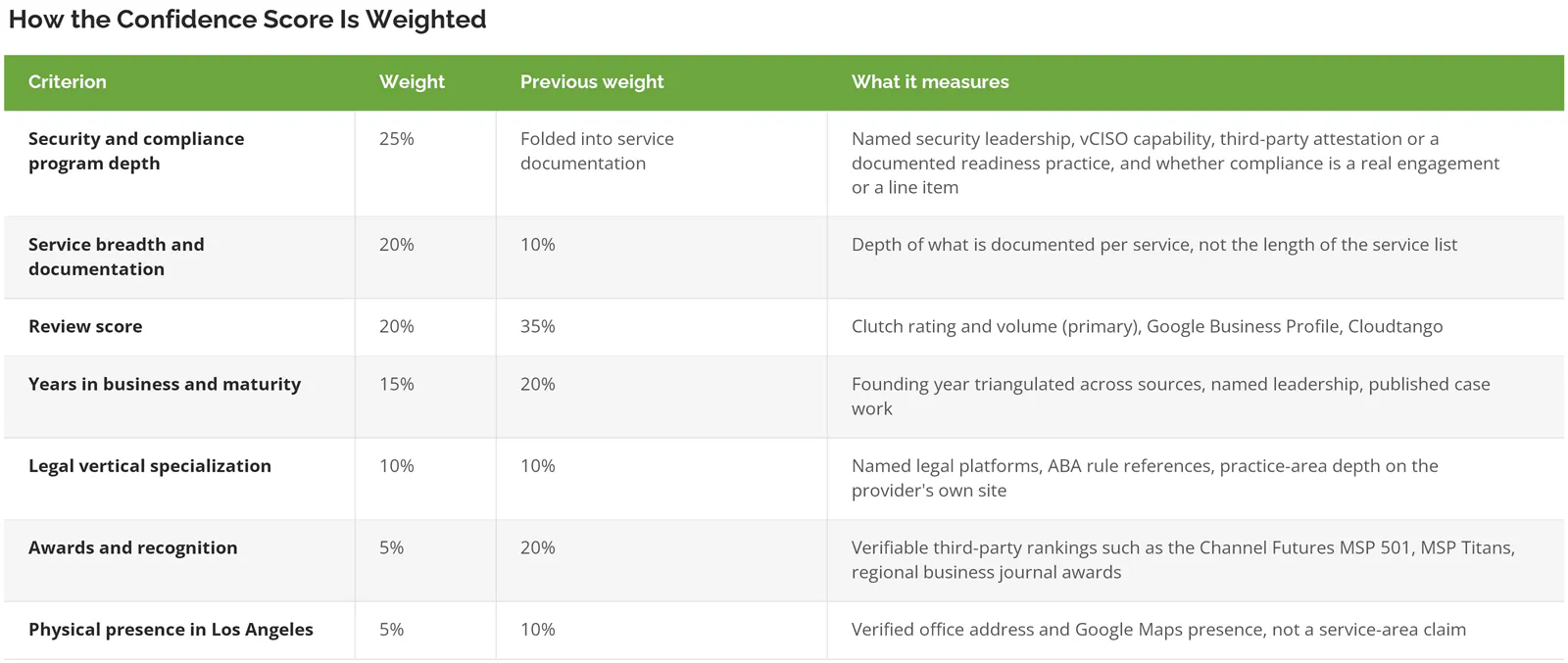
Ratings and review counts were pulled live through the Apify Google Maps and Clutch scrapers on August 19, 2026. A provider with no verified reviews on the primary platform loses half that weight outright rather than having it redistributed, which is why three law-firm-only specialists score lower here than their reputations suggest. Absence from a verified review platform is treated as a soft negative, not a neutral.
Legal specialization was scored from published evidence only. A provider that names iManage and NetDocuments and cites ABA Model Rule 1.6 scores higher than one that says it "understands law firms." Claims without documentation score in the middle of the range.
Security and compliance depth was scored the same way. A published third-party attestation outscores a self-assessment, a named security leader outscores a ticket queue, and a compliance practice a firm can engage on its own outscores compliance described as one line inside a managed services plan.
Consilien published this list and appears on it at #1, having placed third under the previous weighting. Its score was produced by the same seven criteria applied to every other provider, with no provider-specific adjustments. The full scorecard follows.
Every Provider's Score, Criterion by Criterion
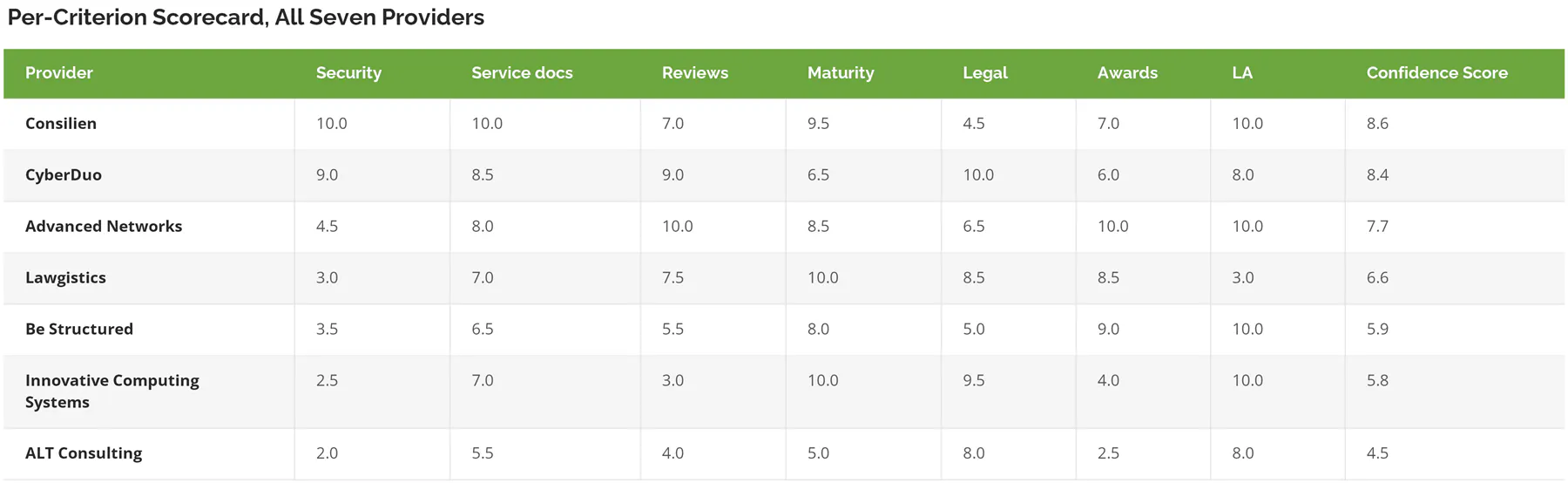
Weights are 25% security, 20% service documentation, 20% reviews, 15% maturity, 10% legal specialization, 5% awards, 5% Los Angeles presence. Only the top three change position against the previous model. Ranks four through seven hold.
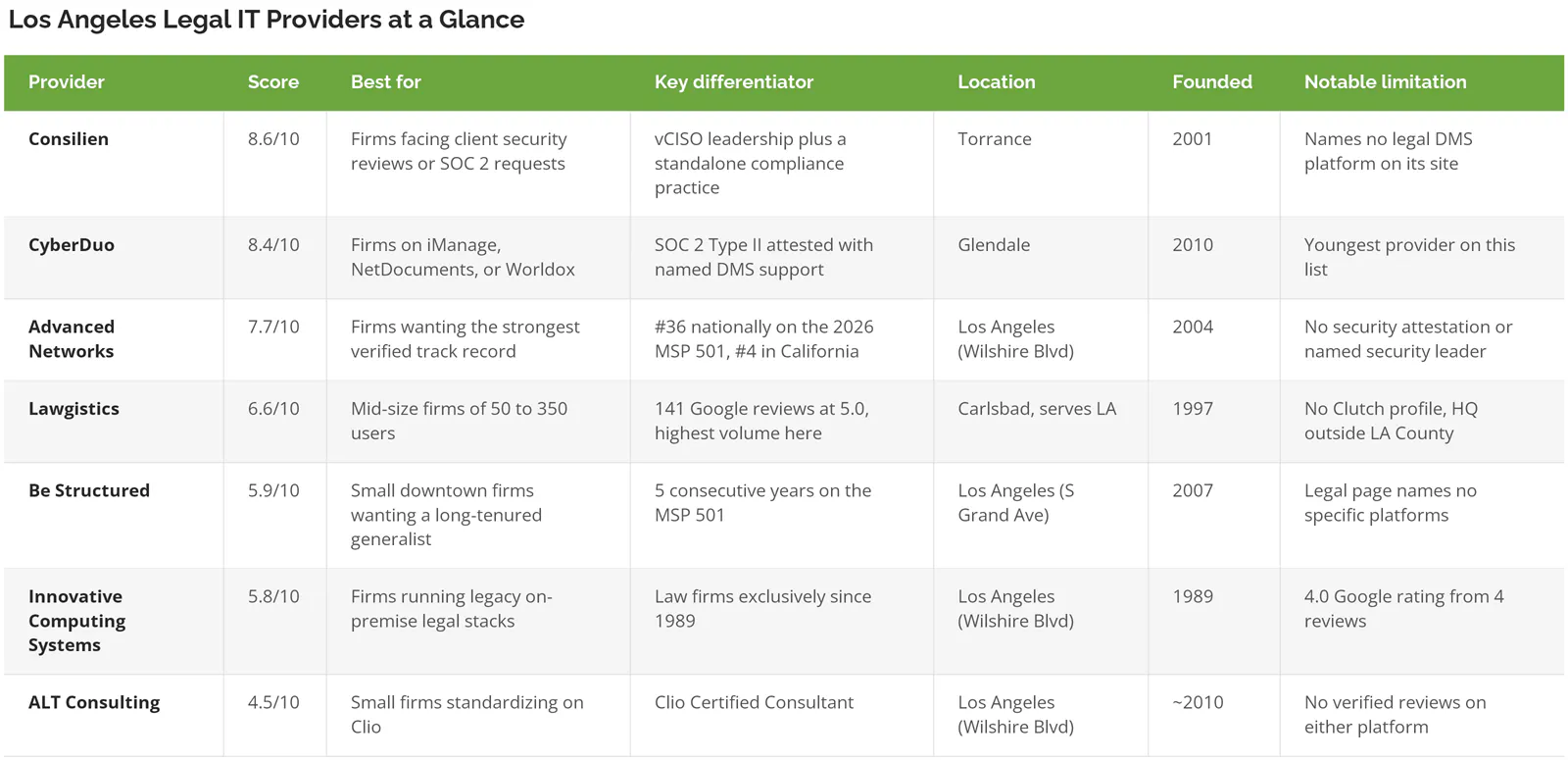
Los Angeles Legal IT Providers at a Glance
The 7 Best IT Companies for Law Firms in Los Angeles
1. Consilien, built for firms whose clients audit them
Confidence Score: 8.6/10
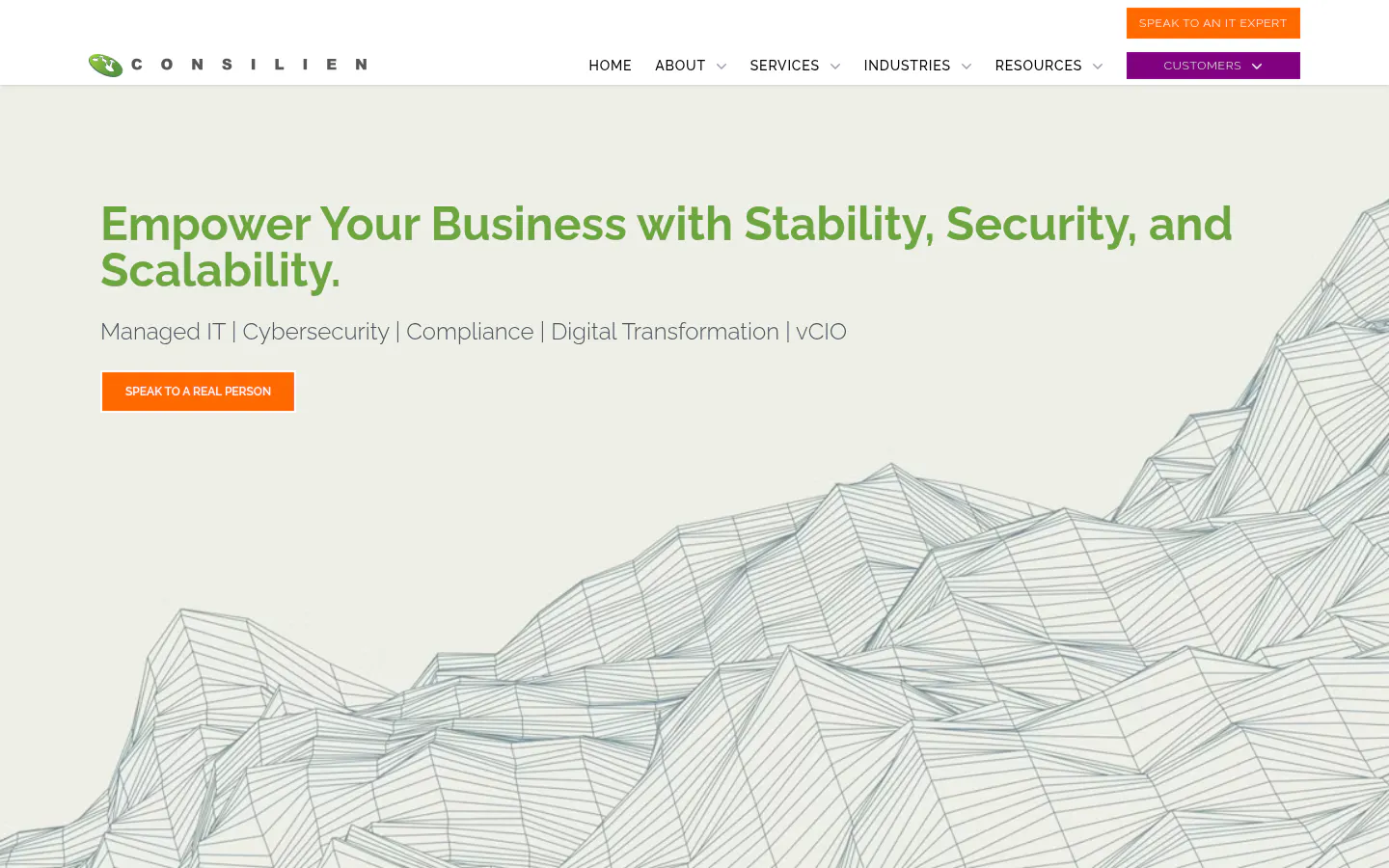
Consilien is a security-first managed IT and advisory firm in Torrance, founded in 2001, serving companies of 20 to 1000 users nationwide across manufacturing, distribution, real estate management, media, and professional services. Law firms sit inside that last category. What it solves for a firm is narrower than general IT support. It answers a corporate client running its own compliance program when that client asks whether outside counsel is the weak link.
Key strengths
- The deepest documented service stack on this list. Live, individually documented practices for vCISO leadership, SOC 2 compliance, ISO 27001, PCI DSS, cybersecurity gap analysis, and maturity assessment. Competitors list these as bullet points. Here each one has its own page and scope.
- In-house security and compliance leadership, including vCISO engagements, meaning a named person owns security decisions rather than a ticket queue absorbing them.
- Compliance is a standalone practice, not a line item folded into a managed IT plan. A firm can engage the compliance work without moving its help desk.
- Named on the 2026 Channel Futures MSP 501 at #306 globally, its second consecutive year.
- 4.9 on Clutch and 4.9 on Google, both verified live. Its professional services page references ABA guidance, SOC 2, CPRA, GLBA, eDiscovery tooling, and secure storage for class action work.
- Independently owned since 2001, with a standard agreement carrying a 1-year opt-out on 60 days notice.
Where it falls short, and it's a real gap. Consilien names no legal document management or practice management platform anywhere on its site. No iManage, no NetDocuments, no Worldox, no Clio. Three providers on this list do, and one of them scores it in detail. There is also no published law firm case study, and the verified review base of 13 Google and 6 Clutch reviews is the smallest among the top five, which reflects a client roster weighted toward larger manufacturing and distribution accounts that leave fewer reviews than a high-volume small-business book would. A firm whose first requirement is DMS administration should ask hard questions here before anything else.
Best for: Firms of 20 to 1000 users whose corporate clients have started sending outside counsel guidelines, security questionnaires, or SOC 2 requests, and who need a compliance program rather than a completed form.
Not ideal for: Small firms wanting straightforward help desk coverage at the lowest number, or firms whose primary requirement is deep iManage or NetDocuments administration.
Why it ranks #1: It scores 10/10 on security and compliance depth and 10/10 on service documentation, and under a model that puts those two at 45% combined, nothing else on this list closes the gap. Six documented compliance practices with individual scope, a named vCISO function, and a compliance engagement a firm can buy without switching help desks is a different product from a managed services plan with a security bullet. The 4.5/10 on legal specialization is the honest cost of that position, and it is why the margin over CyberDuo is 0.2 points rather than a full point.
2. CyberDuo, the deepest published legal security work
Confidence Score: 8.4/10
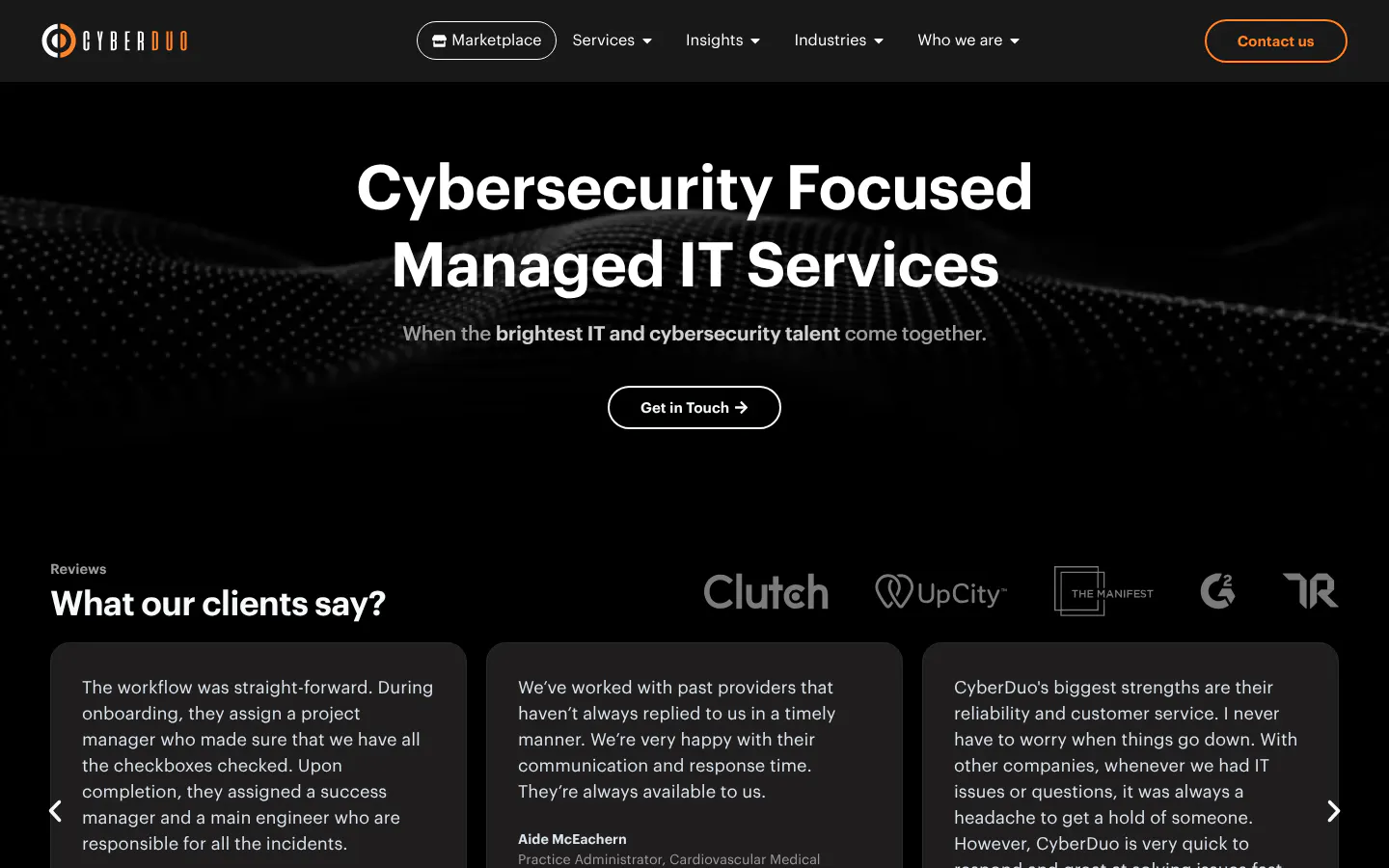
CyberDuo publishes the most specific law firm page of any provider reviewed for this list, and specificity is the thing that separates real legal capability from a vertical landing page.
Key strengths
- Names iManage, NetDocuments, Clio, and Worldox directly, with support framed around the document management system rather than around the endpoints.
- CyberDuo states it is SOC 2 Type II attested. That's a third-party audit result rather than a self-assessment, and it answers the question corporate clients ask first.
- Cites ABA Model Rule 1.6, Model Rule 1.1, and Formal Opinions 477R and 483 on its legal page, then builds services around them.
- Practice-area pages for litigation, corporate and M&A, IP, estate planning, personal injury, real estate, family law, and immigration.
- Offers help answering the client security questionnaires that decide panel placement. Few providers name that as a service.
- 5.0 on Clutch across 39 reviews, 5.0 on Google across 23, and recognition on Cloudtango's MSP Select 2026 list.
Tradeoffs. Founded in 2010, CyberDuo is the youngest firm on this list by three years. Its Google review base of 23 is smaller than what Advanced Networks or Lawgistics carry, though the Clutch count is strong. Law is one of six industries it serves. And the Glendale office is a real drive from Century City or the South Bay if same-day onsite work matters.
Best for: Firms standardizing on a document management platform who also need to answer a client security questionnaire this quarter.
Not ideal for: Firms that weight provider longevity heavily, or firms in the South Bay wanting frequent onsite coverage.
Why it ranks #2: It carries the highest legal specialization score on this list at a flat 10/10, and it is the only provider besides Consilien scoring above 5 on security. What separates 8.4 from 8.6 is the shape of the security work rather than its quality. A SOC 2 Type II attestation proves CyberDuo's own environment was audited. It does not put a named security leader inside the law firm's decisions or give the firm a compliance practice it can engage on its own. A firm choosing on legal software fit rather than on governance has a straightforward case for putting CyberDuo first, and 0.2 points is not a margin anyone should treat as settled.
3. Advanced Networks, the strongest verified track record on this list
Confidence Score: 7.7/10
No other provider here comes close on independently verified review and award data, and that is the whole case for shortlisting it.
Key strengths
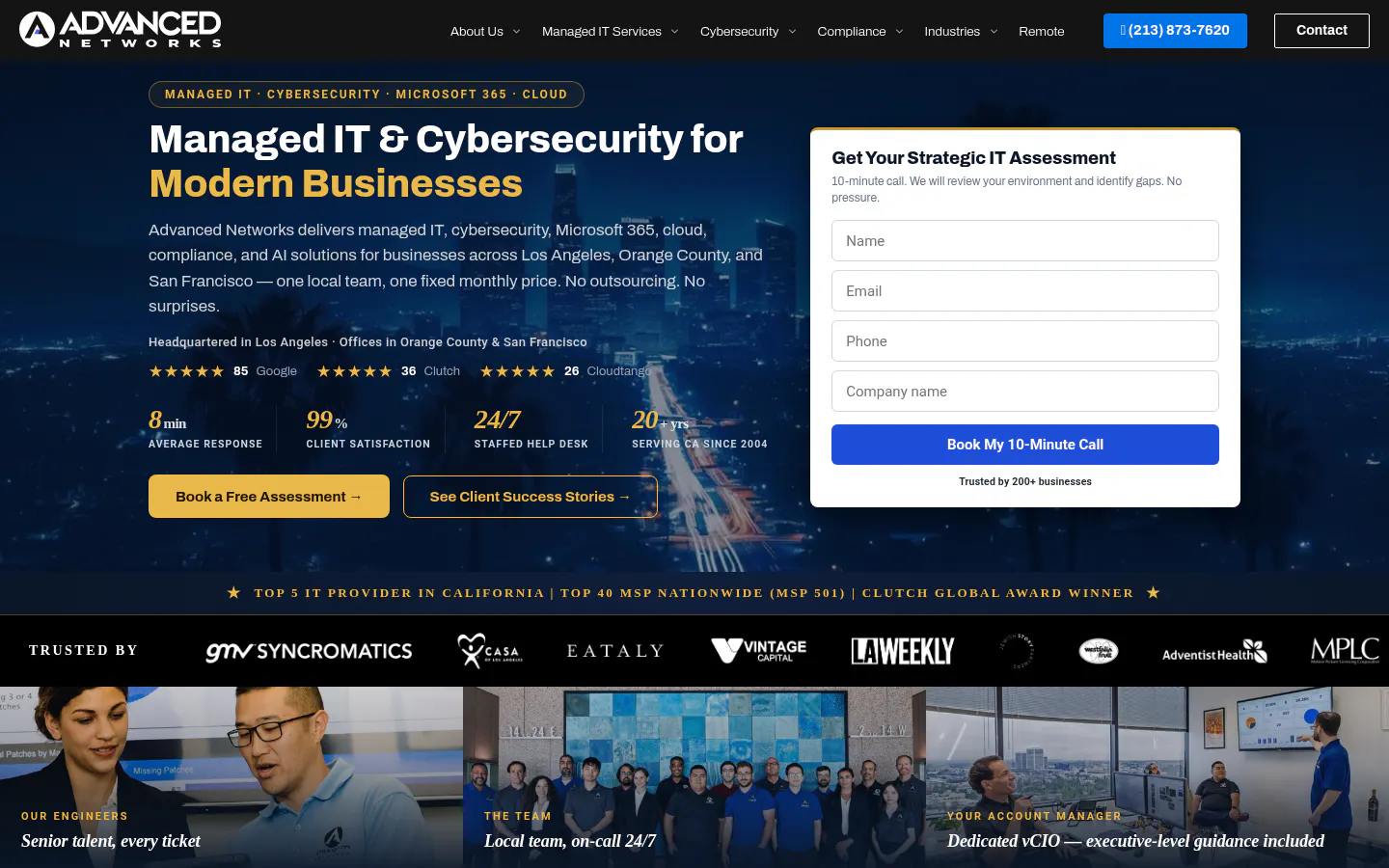
- 5.0 on Clutch across 36 verified client reviews, and 5.0 on Google across 87. Both were confirmed live rather than taken from the company's own marketing.
- #36 nationally and #4 in California on the 2026 Channel Futures MSP 501, its third consecutive year on the list.
- A dedicated iManage support page covering server patching, database and indexing maintenance, storage, backups, and 24/7 monitoring. Firms running on-premise iManage often have never had proactive maintenance on it.
- Offices in Los Angeles, Orange County, and San Francisco, with the LA office on Wilshire Blvd in Westwood.
- Published operational commitments including an 8-minute average response time.
Worth knowing. Legal is one of several verticals here, not the whole business. Advanced Networks serves a broad book of Los Angeles companies, and a firm that wants a provider whose only client type is law firms will find that elsewhere on this list. No SOC 2 Type II or ISO 27001 attestation appears on the site, no vCISO or named security leader is published, and no standalone compliance practice exists. That is the 4.5/10 on security, and it is what moved this provider from first place to third.
Best for: Firms of 20 to 200 users that want the most verifiable operational track record available in Los Angeles and run a mainstream document management system.
Not ideal for: Firms whose corporate clients require a formal third-party security attestation, or firms that want a provider working exclusively in legal.
Why it ranks #3: It holds a perfect 10/10 on reviews and a perfect 10/10 on awards, the only provider on this list to take both. A top-40 national ranking held for three straight years is difficult to manufacture, and 123 combined verified reviews at a flat 5.0 across two independent platforms is a genuinely unusual result at this size. What it does not have is any published security governance, and moving that criterion from a shared 10% bucket to a standalone 25% is the entire difference between 9.9 under the old model and 7.7 under this one. A firm whose corporate clients are not asking security questions should weight this list's top row differently than a firm whose clients are.
4. Lawgistics, mid-size firms only, and it shows
Confidence Score: 6.6/10
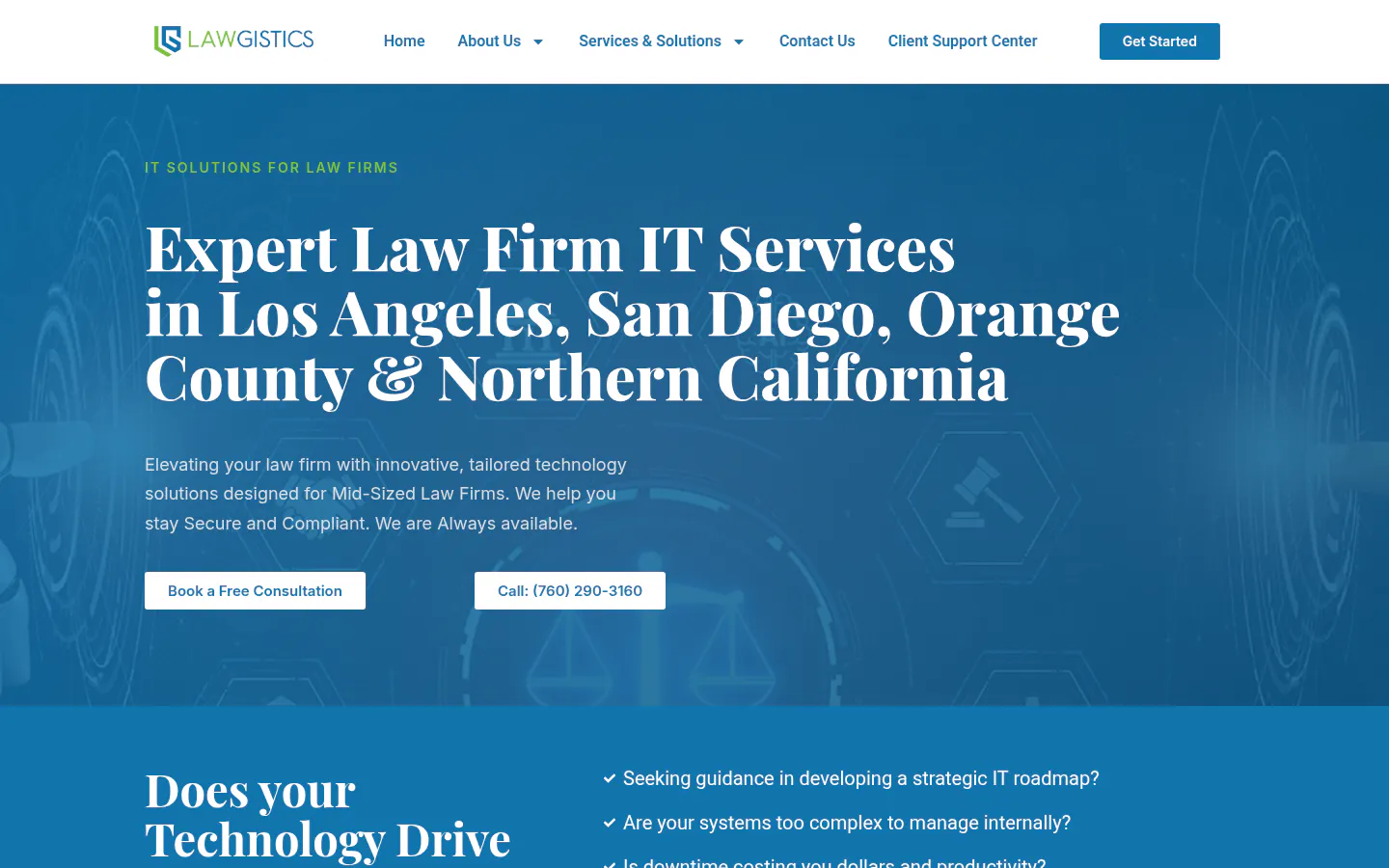
29 years serving law firms and nothing else, with the review volume to match.
Key strengths
- 141 Google reviews at 5.0, the highest verified volume on this list by a wide margin.
- Named Best MSP in the Nation for Legal Services Firms at the MSP Titans of the Industry Awards, which is the most category-exact recognition any provider here holds.
- Founded in 1997 and built exclusively for law firms since day one.
- Explicit targeting of mid-to-large firms of 50 to 350 employees, with published flat-rate pricing rather than a quote request.
- References ABA and California State Bar confidentiality standards directly in its service framing.
The tradeoffs are structural. No Clutch profile exists, which costs Lawgistics half the primary review weight under this model. Headquarters sit in Carlsbad in San Diego County, and while dedicated Los Angeles service pages exist, no LA office address is published. It also names no specific document management or practice management vendor, which is unusual for a firm this specialized. No security leadership is identified either.
Best for: Mid-size Los Angeles firms of 50 to 350 users that want a provider working only in legal and value predictable flat-rate billing.
Not ideal for: Firms under 25 users, or firms that want an onsite engineer in LA County within the hour.
Why it ranks #4: The award is real and the review volume is genuine. What holds the score down is verification breadth and a 3.0 on security, because a single platform carrying 141 reviews still tells you less than two platforms carrying 60 between them, a headquarters 90 miles south of the courthouse changes what same-day onsite support actually means, and nowhere on the site is there a named person who owns security decisions.
5. Be Structured, the downtown generalist with staying power

Confidence Score: 5.9/10
19 years at 500 S Grand Ave, and an unusually strong record as an employer.
Key strengths
- 5 consecutive years on the Channel Futures MSP 501, plus SMB Hot 101 recognition.
- Four straight Los Angeles Business Journal Best Places to Work awards. Retention isn't a vanity metric in managed services. The engineer who knows a firm's environment either stays or doesn't.
- 4.9 on Clutch, verified live.
- A dedicated law firms and attorneys page covering document management and compliance monitoring, backed by a downtown office a short walk from the civic center courts.
Worth knowing. The live pull returned no Google rating, and while the company's own site claims 5.0 across 62 reviews, that figure is self-reported and wasn't usable here. Its Clutch review count of 5 is thin. The legal page describes document management in general terms without naming a single platform, so a firm on iManage should treat it as an open question rather than an assumption.
Best for: Small downtown or mid-Wilshire firms that want a stable, long-tenured local provider and don't run a specialized legal software stack.
Not ideal for: Firms with document management administration as the primary requirement, or firms that need a third-party security attestation.
Why it ranks #5: Strong awards and real longevity, held back by the thinnest verified review base in the top five, a legal page that stays general where the higher-ranked providers get specific, and a 3.5 on security that reflects compliance monitoring described as a feature rather than a practice.
6. Innovative Computing Systems, the longest legal track record anywhere on this list
Confidence Score: 5.8/10
Founded in 1989 by Michael Kemps and focused on law firms ever since, which makes it the most tenured legal IT provider in Los Angeles by roughly 8 years.
Key strengths
- 37 years serving law firms exclusively, with a named founder and a published leadership team.
- Names iManage, NetDocuments, Clio, LawToolBox, and Centerbase, covering both document management and deadline calculation.
- Offices in Los Angeles on Wilshire Blvd, plus San Francisco and Austin.
- Backs fixed-fee managed services with a money-back guarantee, which almost nobody in this category publishes.
- Kemps is active in both ILTA and the Association of Legal Administrators, which is where legal technology decisions actually get discussed.
The problem is verification. Its Google rating sits at 4.0 across only 4 reviews, the lowest verified rating here. Its Clutch profile exists but carries zero reviews, which triggers the full primary-platform penalty. No CISO, vCISO, or security leadership is named, and no SOC 2 or ISO 27001 attestation appears anywhere. For a firm being asked to prove its outside counsel's security posture, that's a gap.
Best for: Firms running legacy on-premise legal infrastructure who want the longest institutional memory in the market.
Not ideal for: Firms under client security review, or buyers who weight third-party verified reviews heavily.
Why it ranks #6: Tenure and platform knowledge are genuinely excellent, and the model scores it 10/10 on maturity and 9.5/10 on legal specialization, both near the top of the list. A 3.0 on reviews and a 2.5 on security are what pull it down. A scoring system built on public evidence can only credit what it can see, and on the two criteria carrying the most weight here there is almost nothing to see.
7. ALT Consulting, the Clio specialist
Confidence Score: 4.5/10
A law-firm-only MSP on Wilshire Blvd that has built its practice around Clio rather than around enterprise document management.
Key strengths
- Clio Certified Consultant, handling migrations and ongoing customization rather than just keeping the software running.
- Also supports LEAP, Smokeball, and Caret, which together cover most of the small-firm practice management market.
- 4.7 on Google across 15 reviews, verified live.
- Law firms only, across firms ranging from solo practices to several hundred employees.
Tradeoffs. No Clutch reviews, which costs half the primary review weight. Its founding year isn't published anywhere, only a claim of "over 15 years," so maturity was scored conservatively. Operations split between Los Angeles and Ottawa. And no security leadership, SOC 2, ISO 27001, or ethical wall configuration appears on the legal pages.
Best for: Small and mid-size firms running Clio, LEAP, or Smokeball that want a provider who knows the platform rather than one learning it.
Not ideal for: Firms on iManage or NetDocuments, and firms facing client security audits.
Why it ranks #7: The Clio specialization is real and useful to the firms it fits, and the 8.0 on legal specialization reflects that. The score reflects an almost complete absence of independently verifiable signal everywhere else, which is a documentation problem more than a delivery problem.
How to Choose an IT Provider for Your Law Firm
Start with the requirement that's hardest to fix later. For most Los Angeles firms that's either document management administration or client-driven security review, and the two point at different providers.
If your firm runs iManage, NetDocuments, or Worldox, the shortlist narrows fast. Ask who administers the DMS today, how patching and indexing get handled, and what happens when the index corrupts on a Friday. CyberDuo, Advanced Networks, and Innovative Computing Systems all name these platforms. Providers who describe "document management solutions" without naming a vendor are describing file storage.
If corporate clients are sending security questionnaires or outside counsel guidelines, the question changes from software to governance. Who owns security decisions by name? Is there a third-party attestation, or only a completed self-assessment? Can the provider produce access logs that satisfy Formal Opinion 483 after an incident? Consilien runs vCISO and compliance readiness as separate practices. CyberDuo states it is SOC 2 Type II attested. Nobody else on this list documents either.
If your firm has 20 to 50 users and no specialized stack, cost and responsiveness carry more weight than either of the above. Be Structured and ALT Consulting both sit in that range, and both have LA offices. Ask about the actual escalation path rather than the advertised response time.
If your firm sits between 50 and 350 users, look hard at Lawgistics, which targets exactly that band, and at Advanced Networks, which has the operational depth for it.
Two questions worth asking every finalist. What is the notice period to leave, and what happens to your data on the way out? A provider confident in delivery publishes both. Consilien's standard agreement runs three years with a 1-year opt-out on 60 days notice, and asking competitors for their equivalent terms is a fast way to sort the shortlist. The broader vetting framework for evaluating any managed IT provider applies here too, with the legal-specific questions layered on top.
One more. Ask which of the firm's practice groups the provider has actually supported. Litigation runs on document volume and discovery deadlines, IP runs on docketing and prosecution calendars, and estate planning runs on long-retention records that have to stay readable for decades, so a provider whose entire book is personal injury shops will say yes to everything and learn the differences on your matters.
Where This Leaves You
Consilien takes the top spot under a model that weights security governance above award count, and that ordering only holds if client-driven security review is the problem a firm is actually facing. For a lot of Los Angeles firms in 2026 it is. For a firm whose real problem is a document management system nobody administers, it isn't, and CyberDuo or Innovative Computing Systems is the better call.
Advanced Networks still holds the strongest verified operational record here by a wide margin, and a firm that weights proof of delivery above security program depth has a defensible case for putting it first. The scorecard above is published specifically so that a firm can do exactly that.
Which one is right depends on which problem is currently costing the firm money. A DMS that nobody administers properly is one problem. A general counsel asking for a security attestation the firm can't produce is a different one, and it tends to arrive with a deadline attached. Firms in the second situation should look at Consilien's compliance and security practice for law firms and at CyberDuo, then compare how each one would handle the specific questionnaire currently sitting in the inbox.
Speak to an IT expert about what your firm's client security requirements actually demand before shortlisting anyone.
What Firms Ask Before They Switch
How much should a Los Angeles law firm expect to pay for managed IT?
$125 to $225 per user per month is the working range for firms of 25 to 150 people, with legal-specific work landing at the higher end. A 40-person firm should budget roughly $6,000 to $9,000 monthly. Document management administration, after-hours coverage tied to filing deadlines, and compliance documentation are what push a quote toward the top of the band. Note that these figures come from published provider pricing pages rather than an independent survey, so treat them as directional.
Does a general MSP actually cause problems, or is that just what legal IT providers say?
Both, honestly. A capable general MSP handles email, endpoints, backup, and network security for a law firm as well as it handles them for anyone. Where it breaks down is narrower than the marketing suggests: document management administration, deadline-aware change control, ethical wall configuration, and answering a client security questionnaire without a week of scrambling. Firms with none of those requirements are fine with a generalist. Firms with two or more aren't.
A major client just sent a security questionnaire. What now?
Read it before shopping for a provider. Most questionnaires ask about encryption at rest and in transit, MFA enforcement, incident response timelines, backup testing, employee security training, and whether a third-party attestation exists. Two of those are configuration questions any provider can answer in a week. The attestation isn't, and SOC 2 readiness typically runs 3 to 6 months before an audit even starts. The realistic move is to answer honestly, document a remediation timeline, and start the work.
Is a law-firm-only provider automatically the better choice?
Not automatically, no. Three of the seven providers here work exclusively with law firms, and two of those three score in the bottom half, entirely because they have almost no independently verifiable review record or security credentials. Exclusivity buys platform familiarity and a shared vocabulary. It does not buy operational maturity or an audit result. Weigh both.
How long does switching providers actually take?
30 to 60 days for a clean transition at a firm under 100 users, assuming the outgoing provider cooperates. Documentation handover is where it goes wrong. Get administrative credentials, network diagrams, license inventories, and DMS configuration details written into the transition plan before signing anything, because a provider on the way out has very little incentive to be thorough.
What is a virtual CISO, and does a 40-person firm need one?
A vCISO is a part-time senior security leader who owns risk decisions, policy, and audit readiness without being a full-time hire. A 40-attorney firm with no compliance pressure probably doesn't need one. A 40-attorney firm whose corporate clients require annual security reviews almost certainly does, because someone has to own the answers and it should not be the managing partner between depositions.