Top 7 IT Services for Manufacturing Companies in Los Angeles
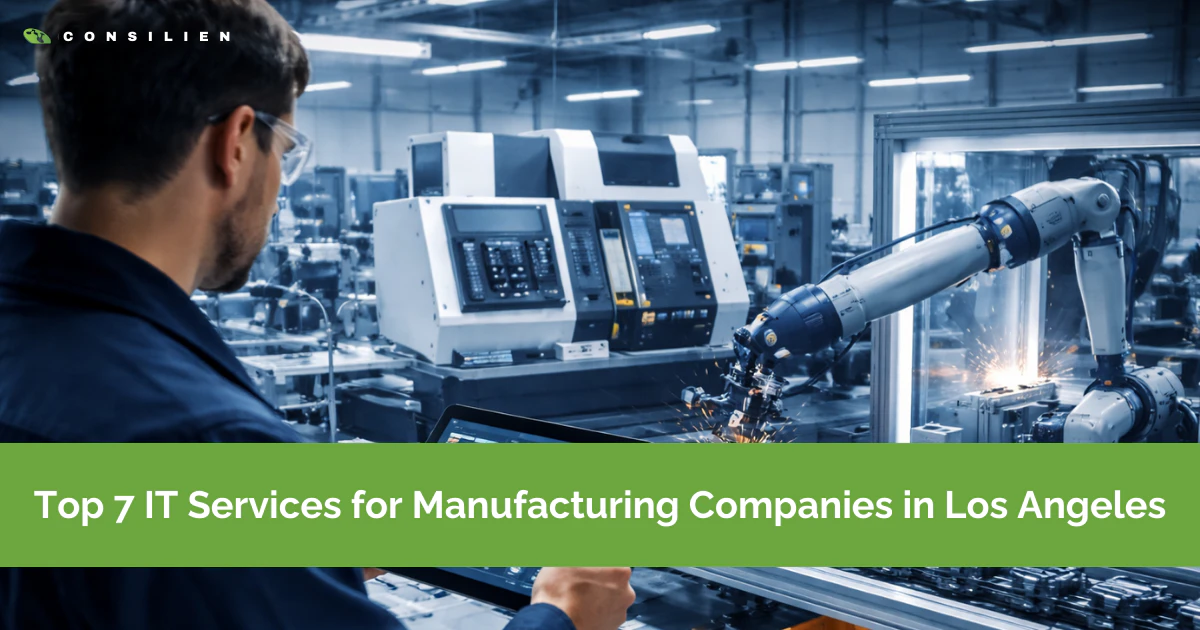
The seven IT services with the greatest impact on manufacturing companies in Los Angeles are managed IT, cybersecurity, network infrastructure, backup and disaster recovery, ERP support, compliance management, and strategic IT planning.
Table of Contents
Margins can be very thin, and errors can be extremely costly in the manufacturing sector in Los Angeles. Companies face ongoing challenges securing labor, while production interruptions are expensive and compliance requirements continue to tighten. It’s rare for production schedules to slow down simply because IT systems are malfunctioning.
Yet many manufacturers still rely on general IT support that was never designed for the factory floor, operational technology, or production-critical systems.
The following sections highlight seven IT services that have the greatest impact on manufacturing operations in Los Angeles. The rankings are based on real operational results rather than theory or marketing language, and focus on what actually reduces risk, protects uptime, and supports long-term growth.
Why Manufacturing IT in Los Angeles Is Different
Downtime Costs More Here
In Los Angeles, downtime isn’t just lost output. It’s idle labor, delayed shipments, contractual penalties, and damaged customer trust. One hour offline can ripple through an entire operation.
Cyber and Compliance Risks Are Higher
Manufacturers are prime ransomware targets. Add proprietary designs, supplier data, and regulatory requirements, and the stakes get even higher. IT failures here don’t stay contained.
That’s why manufacturing IT needs to be intentional, not reactive.
How We Ranked These IT Services
This list isn’t based on what’s trendy. We ranked each service using three criteria:
- Downtime prevention
- Risk reduction
- Operational scalability
If a service doesn’t protect production or reduce business risk, it didn’t make the cut.
1. Managed IT Services Built for Manufacturing Environments
Generic helpdesk support isn’t enough for manufacturers.
Manufacturing-focused managed IT services provide:
- 24/7 system monitoring
- Rapid response when production systems degrade
- Support teams that understand factory operations, not just office IT
When IT issues are caught early, production keeps moving. When they aren’t, everything stops.
2. Cybersecurity Designed for Manufacturing and OT Systems
Manufacturing cybersecurity is different from office security.
Factory environments often include:
- Legacy systems
- Industrial controllers
- Equipment that can’t be patched easily
Without proper segmentation and monitoring, attackers move fast. Manufacturing cybersecurity services focus on visibility, containment, and protection of both IT and operational technology.
3. Network Infrastructure That Prevents Production Downtime
Unstable networks are one of the most common causes of manufacturing outages.
Manufacturing-grade network services address:
- Redundant connectivity
- Factory-floor wireless reliability
- Segmentation between office, production, and vendor access
If your network fails, your production line usually follows.
4. Backup and Disaster Recovery That Actually Works
Backups that haven’t been tested don’t count.
Manufacturers need disaster recovery solutions designed for:
- Large data sets
- ERP systems
- Short recovery time objectives
When systems go down, the question isn’t whether you have backups. It’s how fast you can restore operations without data loss.
5. ERP and Manufacturing Software Support
ERP systems sit at the center of manufacturing operations.
Effective ERP support includes:
- Performance monitoring
- Patch and version management
- Integration support with production systems
When ERP slows down or fails, planning, purchasing, and production scheduling suffer immediately.
6. Compliance and Risk Management IT Services
Manufacturers face growing scrutiny from customers, regulators, and insurers.
Compliance-focused IT services help with:
- Documentation and audit readiness
- Access controls
- Vendor and supply chain risk management
This isn’t about checking boxes. It’s about proving your operation is resilient and trustworthy.
7. Strategic IT Planning (vCIO and vCISO Services)
The most overlooked service is often the most valuable.
Strategic IT planning provides:
- Budget forecasting
- Lifecycle management
- Alignment between IT investments and production goals
Without a roadmap, IT becomes reactive. With one, it becomes a business enabler.
Quick Check: Are These IT Services Covered?
Reviewing your existing IT environment is a good time to ask some practical questions.
- Are your production-critical systems under continuous monitoring, or are they only monitored during office hours?
- Do your backups run successfully, but haven’t been tested recently to confirm they can actually recover data during a real disaster?
- How effective are your cybersecurity measures in a plant or factory environment, especially with legacy systems and operational technology in place?
- If your ERP platform receives less attention, is support still proactive enough to prevent disruptions, or does it only react after problems occur?
- Do you have documented compliance controls in place?
- And is there a clear IT strategy defined for the next three years?
If several of these answers are unclear, that’s a signal worth paying attention to.
CEO Insight: What Manufacturing Leaders Get Wrong About IT Risk
After working with manufacturing companies across Los Angeles, one pattern shows up again and again.
Most manufacturers don’t underinvest in IT because they don’t care. They underinvest because nothing looks broken.
From a leadership perspective, systems appear to be working. Production is running. Orders are shipping. But under the surface, risk is quietly building.
The biggest misconception we see at the executive level is believing that:
- “We’ve never had a serious outage, so we’re fine”
- “Our vendor says everything is backed up”
- “Cybersecurity is an IT issue, not an operations issue”
Such assumptions in manufacturing are highly risky.
Downtime doesn’t typically result from a single failure. It’s a consequence of a chain reaction. A missed patch. An unsupported ERP upgrade. A flat network. A backup that was never tested. The moment something breaks, the cost is no longer measured in IT hours only. It is also in lost production, delayed shipments, and customer relationships being strained.
Manufacturers, who are resilient, view IT differently. They integrate it with their preventive maintenance on critical equipment. The logic is: It’s wrong to wait for the machine to fail to service it. Planning for reliability is the only way because of the high costs of betting on downtime.
That mindset shift, from reactive IT to operational risk management is what separates stable manufacturers from those constantly firefighting.
What to Do Next if You’re Unsure About Your IT Coverage
Most manufacturing leaders don’t wake up thinking about IT. They think about output, schedules, labor, and margins. IT only gets attention when something breaks.
The problem is that by the time IT becomes visible, production is already at risk.
If you’re not fully confident that your current IT setup can:
- Prevent unplanned downtime
- Recover quickly from ransomware or system failures
- Support growth without constant firefighting
Then the next step isn’t buying new tools. It’s getting clearer.
Consilien works with manufacturing companies across Los Angeles to assess operational risk, identify gaps, and build IT strategies that support production instead of slowing it down.
A focused manufacturing IT assessment can help you understand:
- Where your biggest downtime risks are
- Which systems need immediate attention
- What can wait, and what can’t
No pressure. No generic sales pitch. Just practical guidance you can act on.