The Role of a vCISO in Manufacturing Risk Management
A vCISO (virtual Chief Information Security Officer) is an outsourced cybersecurity executive who manages cyber and operational risk for manufacturers without the cost of a full-time hire. For manufacturers, that means OT-aware security leadership scaled to actual production risk.
Table of Contents
In manufacturing environments, cyber risk and operational risk converge. A ransomware incident doesn't just expose data, it stops production lines, delays shipments, and creates safety exposure. A vCISO provides strategic governance, framework alignment (NIST CSF, CMMC, FSMA), and OT-IT coordination most mid-market manufacturers can't justify hiring full-time but can't afford to skip.
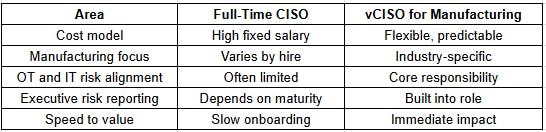
Full-Time CISO vs vCISO for Manufacturing
Why Manufacturing Risk Management Is Different
Manufacturing risk management isn’t just about protecting data. It’s about keeping lines running, people safe, and orders shipping on time.
In this sector, cyber risk quickly becomes operational risk. A ransomware incident doesn’t just lock up files. It can shut down machines, hold up shipments, and cause safety shutdowns. And the price of downtime is usually much higher than the price of the attack itself.
Cyber risk meets operational risk
The manufacturers depend on connected systems which were not even thought about in terms of security at the time. Old equipment, flat networks, and production environments that are always on, determine that traditional security methods are not feasible.
OT, IT, and supply chain exposure
Most manufacturers handle a combination of office IT, plant, floor OT, and third party vendors. Each introduces risk. Few organizations have a single leader accountable for seeing the full picture. That gap is where problems grow.
What a vCISO Actually Does for Manufacturers
A vCISO isn’t a technical administrator. The role exists to bring clarity, prioritization, and leadership to risk management.
A manufacturing-focused vCISO typically:
- Defines a clear cyber risk strategy aligned to production goals
- Identifies which risks threaten uptime, safety, and revenue
- Aligns IT and OT teams around shared priorities
- Communicates risk to executives in business terms
- Guides investments so security improves without slowing operations
This is cybersecurity leadership for manufacturers, not another tool or alert stream.
How a vCISO Improves Manufacturing Risk Management
Identifying the Risks That Matter Most
Not every vulnerability deserves the same attention. A vCISO helps manufacturers focus on the threats most likely to disrupt operations, such as ransomware, remote access into OT systems, and supplier access risk.
Translating Cyber Risk Into Business Impact
Executives don’t need technical jargon. They need to understand what risk means in dollars, downtime, and missed commitments. A vCISO reframes cyber risk in those terms, making decisions clearer and faster.
Reducing Risk Without Slowing Production
Manufacturing environments can’t tolerate heavy-handed controls. A vCISO prioritizes phased improvements that reduce exposure while respecting uptime and safety constraints.

vCISO vs Internal IT Leadership in Manufacturing
Internal IT teams are essential. But they’re often stretched thin keeping systems running. Risk management, governance, and executive reporting fall to the bottom of the list.
A vCISO complements internal IT by owning the risk program. They provide outside perspective, benchmarks, and the power to say no if risk is a factor against convenience. This division of labour is good, especially within the manufacturing business, where the pressure is constant.
When Manufacturers Should Consider a vCISO
Many organizations wait too long. A vCISO is most effective before a major incident.
Consider a vCISO if:
- There’s no documented manufacturing cyber risk strategy
- OT and IT teams operate in silos
- Security decisions are reactive
- Compliance expectations are increasing
- Leadership lacks clear visibility into cyber risk
If several of these sound familiar, the risk is already higher than it needs to be.
Real-World Manufacturing Risk Scenarios a vCISO Addresses
A production line goes down after a phishing email spreads ransomware into shared systems. A supplier’s compromised credentials expose OT networks. An audit fails because policies exist on paper but not in practice.
These aren’t edge cases. They’re common manufacturing risk scenarios. A vCISO’s role is to anticipate them, reduce the likelihood, and limit the impact when something goes wrong.
How vCISO Services Support Long-Term Manufacturing Resilience
Effective risk management isn’t about fear. It’s about resilience.
Virtual CISO services help manufacturers:
- Improve business continuity
- Support growth and expansion
- Be ready for both customer and regulatory scrutiny
- Boost the insurance and compliance aspects of your business
Eventually, managing risks internally becomes part of the company's culture and not an isolated effort.