CMMC SSP and POA&M Development for Defense Contractors
The System Security Plan is the first thing your assessor reads. Most companies get it wrong.
Schedule a Documentation Review CallCMMC SSP and POA&M development is the process of building a System Security Plan that accurately maps all 110 NIST SP 800-171 controls to a contractor's specific environment, paired with a Plan of Action and Milestones that tracks any unresolved gaps through a 180-day remediation window. Consilien authors custom SSPs and POA&Ms for Southern California defense contractors and manufacturers, replacing generic templates with documentation that reflects how the organization actually operates.
Twenty-five percent. That's the share of defense contractors who fail their C3PAO pre-assessment because of an incomplete or inaccurate System Security Plan, according to Greenberg Traurig's October 2025 analysis of third-party assessor findings. Not because they lack security tools. Not because their controls aren't working. Because their documentation doesn't match reality.
That number is worth sitting with.
A contractor can have multi-factor authentication deployed across every endpoint, a patched environment, endpoint protection running 24/7, and a network that's genuinely well-configured. If the SSP doesn't accurately describe how those controls are implemented, who owns them, what evidence proves they're operating, and how they map to the 110 NIST SP 800-171 Rev 2 requirements, the assessor has no verifiable foundation. The assessment stalls. Or fails.
Most SSPs on the market right now are templates. A generic document with the company name and some checkboxes filled in. Assessors can tell within the first few pages. The language is identical across organizations. The control descriptions don't name real tools, real roles, or real escalation paths. The system boundaries don't match the actual CUI environment. And the POA&M, if it exists, isn't realistic about timelines or prioritized by assessment risk.
We build SSPs the other way. From the environment out, not from the template down.
See the full picture of CMMC compliance for Southern California defense contractors
What an SSP Actually Has to Do
Here's what most content about SSPs misses.
The SSP isn't just a required document. It's the artifact the entire C3PAO assessment is organized around. Every verification method the assessor uses — Examine, Interview, Test — anchors back to it. When they review a policy document, they're checking it against what the SSP says the policy covers. When they interview a staff member, they're asking whether that person can explain the role the SSP assigned them. When they run a test, they're verifying that the control the SSP describes is actually operating.
An SSP that doesn't match the real environment doesn't just create a gap. It creates a contradiction. And contradictions in a CMMC assessment become findings.
A CMMC System Security Plan is a required compliance document under NIST SP 800-171 control 3.12.4. It describes how a defense contractor's specific information system implements each of the 110 security requirements across 14 control families. It defines system boundaries, CUI data flows, responsible roles, control implementation status, supporting policies and procedures, and the evidence trail that proves each control is operating as described. It's a living document — it changes when the environment changes, and assessors will ask when it was last updated.
A template satisfies none of that. It describes someone else's environment.
The Five Failures That Kill SSPs in Assessment
Patterns from contractor readiness work across Southern California's defense industrial base.
1. The boundary diagram doesn't match the real environment. The SSP says CUI lives in email and a file share. The assessor walks a manufacturing floor and finds CUI-marked customer drawings on machinist workstations, in the ERP system, on printed job travelers, and in the quality lab. The boundary is wrong. Every control mapped to that boundary is now suspect.
2. Controls are described generically. "Multi-factor authentication is enabled" is not an SSP entry. An SSP entry names the specific MFA solution deployed, the user population it covers, what happens when an exception is needed, who owns the policy, and what evidence demonstrates it's running. Generic descriptions don't survive the Test phase.
3. Responsible roles don't match real people. The SSP assigns "the IT Administrator" as the control owner for audit log review. The assessor asks the IT administrator to walk through the audit log review procedure. The IT administrator has never seen this section of the SSP. That's a finding under the Interview method.
4. The POA&M is aspirational, not realistic. A POA&M that lists 40 open items with no prioritization, no realistic timelines, and no evidence of progress isn't a compliance tool. It's a liability. Certain controls cannot be placed on a POA&M at all. Others require full remediation and a closeout assessment within 180 days or conditional certification expires.
5. The SSP was written once and never touched again. The CMMC Final Rule requires the SSP to be current at the time of assessment. An SSP authored 18 months before the assessment date, with no documented updates reflecting environment changes, personnel changes, or control modifications, fails the basic currency test before an assessor reads page one.
What We Build
The SSP and POA&M aren't standalone documents. They're the top of a documentation hierarchy, and everything beneath them needs to be consistent.
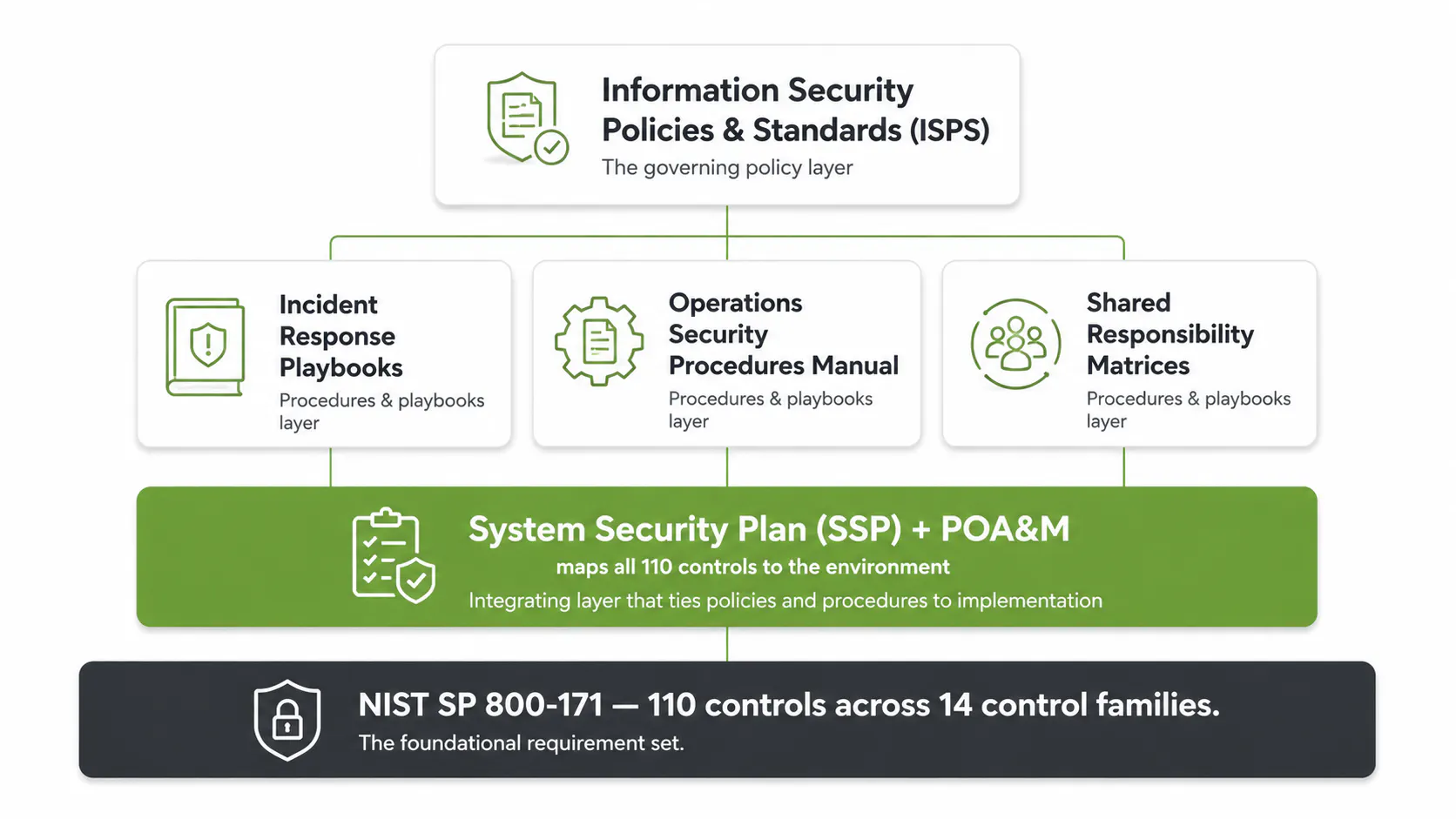
The Information Security Policies and Standards document sits above the SSP in the hierarchy. It establishes the organization's policy positions across every control family — access control, audit and accountability, awareness and training, configuration management, identification and authentication, incident response, maintenance, media protection, personnel security, physical protection, risk assessment, security assessment, system and communications protection, and system and information integrity. The SSP references it. Every downstream procedure references it. Building the ISPS first sets the vocabulary the entire architecture uses and is signed by the affirming official.
Five incident response playbooks differentiated by incident type, not a single generic IR policy. Separate playbooks for data exfiltration, denial of service, malware and ransomware, social-media-originated attack, and system compromise. Each names detection triggers, triage steps, escalation criteria, notification requirements including the DFARS 252.204-7012 72-hour reporting obligation, containment actions, recovery steps, and post-incident review. Accompanied by an Annual Review Memo and a DFARS 72-Hour Quick Reference formatted for operational use under pressure.
An Operations Security Procedures Manual covering the five operational disciplines assessors verify most closely: audit log review cadence and escalation, change management authorization and recording, media sanitization for both physical and digital CUI, personnel onboarding and offboarding with account lifecycle management, and visitor escort on production floors and in CUI-bearing areas. Each chapter names a specific owner and a specific cadence. Procedures that don't produce evidence get rewritten until they do.
Shared Responsibility Matrices for every external service provider handling CUI. Cloud platforms, email providers, file-sharing services, managed security providers, managed IT providers. Each SRM documents which NIST 800-171 controls the provider implements, which the contractor implements, and which are shared. The provider's FedRAMP authorization status or Moderate Equivalency posture is captured with supporting documentation. These become exhibits to the SSP and get pulled during the Examine phase whenever an external provider's role comes up.
The SSP itself then maps all 110 NIST SP 800-171 Rev 2 controls to the specific environment — naming real tools, real roles, real escalation paths, real data flows. Every entry links to its supporting documentation in the document hierarchy. The boundary diagram reflects the actual CUI footprint, including shop-floor systems for manufacturers. The control implementation status is accurate.
The POA&M tracks any not-fully-implemented controls with realistic close dates, responsible owners, and a prioritization that accounts for what can and can't carry through to conditional certification.
Why Templates Fail
Let's be direct about this.
Templates exist for a reason. They give contractors a structural starting point and a sense of what sections an SSP needs to include. That's fine. The problem is when contractors submit a template as if it's documentation, and the assessor opens it to find language identical to what they've reviewed in a dozen other engagements.
Strike Graph's March 2026 analysis of CMMC SSP standards is explicit: a template doesn't provide the necessary content to pass a CMMC or NIST 800-171 assessment. The template has no content. The contractor must supply the details, the evidence, and the operational context. Most contractors don't do that work thoroughly enough, because it's genuinely hard and time-consuming.
The Kiteworks September 2025 guide to SSP best practices puts it this way: "Generic security claims" fail to demonstrate that controls are actually implemented. The SSP has to describe a specific system, with specific controls, verified by specific evidence.
An SSP built from a template that hasn't been substantially customized is functionally a disclosure of what the contractor doesn't know about their own environment. Assessors read it that way.
We start from the environment, not from a template. The template, if we use one at all, is a structural reference only. What goes in each section comes from working sessions with the client's actual IT team, operations leads, and executive stakeholders.
What the 180-Day POA&M Window Means in Practice
Not all gaps can wait. This is one of the most misunderstood aspects of the CMMC Final Rule.
Certain controls, including the SSP requirement itself, cannot be placed on a POA&M. They must be fully implemented at assessment time. The absence of a current SSP results in a finding that the assessment couldn't be completed, per the Final Rule language at 89 Fed. Reg. 83237.
For controls that can carry through a POA&M, the contractor receives conditional certification. All open POA&M items must be remediated and confirmed through a closeout assessment within 180 days. Miss that window and the conditional certification expires. The contractor starts the full assessment process over, back to the end of the C3PAO waitlist.
A POA&M is not a compliance crutch. It's a structured remediation roadmap that must reflect realistic timelines, named owners, and controls prioritized by assessment risk. The items that are hardest to carry through a POA&M are the ones in access control, CUI handling, and documentation quality. The ones that are easier to carry are configuration gaps in lower-risk controls.
We build POA&Ms that account for what the assessor will and won't accept as a carry item, and we set timelines that are actually achievable given the contractor's resources and operational calendar.
Who This Is Right For
This engagement fits:
- Defense contractors and subcontractors in California preparing for a C3PAO assessment in the next 6 to 18 months who don't have a current, accurate SSP
- Companies that received a template SSP from a previous consultant and need it replaced with documentation that reflects the actual environment
- Manufacturers with AS9100D or NADCAP certifications where the SSP boundary needs to account for shop-floor CUI handling events, specialized OT assets, and physical protection controls
- Organizations with an existing SPRS score that doesn't match their real control posture, creating legal exposure under the False Claims Act
- Contractors that attempted a pre-assessment and received an adverse readiness determination tied to documentation quality
Not the right fit:
Your primary gap is technical, not documentary. Controls are genuinely missing and the environment needs significant remediation before documentation work is worth doing. In that case, the gap assessment and technical remediation come first. We'll tell you honestly if that's where you are.
The Numbers That Define the Stakes
of contractors fail their C3PAO pre-assessment due to an incomplete or inaccurate SSP (Greenberg Traurig, October 2025)
— the window to remediate all POA&M items after conditional certification before the certification expires (32 CFR Part 170 Final Rule, October 2024)
per violation — potential False Claims Act penalty for misrepresenting cybersecurity compliance posture, including an inaccurate SPRS score (DoD CMMC Final Rule enforcement language)
What Consilien Brings to Documentation Work
Founded in 2001 and based in Torrance, Consilien has worked with manufacturers, defense subcontractors, and mid-market businesses across Southern California for over two decades. Our CMMC documentation work is led by a dedicated consultant with direct experience authoring SSPs and POA&Ms against real environments, not against templates.
The documentation we produce is built in working sessions with the client's actual team. IT administrators walk us through configurations. Operations leads describe how CUI moves through their production process. Quality engineers explain how inspection records are handled. What the assessor reads in the SSP is what actually happens in the building.
That's the test. If the assessor can walk your floor and find the environment the SSP describes, the documentation is doing its job.