Cyber Risk Score: What It Is and How to Improve Yours
Cyber Risk Score: What It Is and How to Improve Yours
A cyber risk score is a single number that rates how exposed your business is to a cyberattack, the way a credit score rates how likely you are to repay a loan. Higher is safer. Lower means an attacker, or an underwriter, sees an easy target.
Table of Contents
Here is the part most companies get backward. They never look at their own score. They find out what it is the day a cyber insurance renewal gets denied, or a customer's security team sends a vendor questionnaire and quietly walks away. By then the number is already working against you. If you've never run a structured cybersecurity risk assessment, someone else has already scored you and you just haven't seen the result.
Your score is not a grade you pass once. It moves every day, based on what you expose to the internet and how fast you fix what breaks. The good news: almost everything that drags it down is something you control.
What Is a Cyber Risk Score?
A cyber risk score is a numerical rating that measures how exposed an organization is to cyber threats, based on its security controls, its internet-facing assets, and its history. Insurers, partners, and investors use it to decide how risky you are to do business with.
The credit score comparison is useful, and it has limits. A credit score answers one question: will this company pay its bills. A cyber risk score answers a different one, as the U.S. Chamber of Commerce frames it, whether you're doing enough to protect against a breach. Same idea, two very different ledgers.
Scores show up in three formats, and you'll run into all of them:
- Letter grades (A to F). SecurityScorecard uses this. An executive understands an "A" or a "D" in half a second, which is exactly the point.
- A number on a fixed scale. BitSight rates companies from 250 to 900. The higher half of that range is where you want to live.
- A percentage. Some tools express your score as the portion of identified risk your controls have actually mitigated.
Different vendor, different math, same job. The score compresses a messy pile of technical findings into one figure a non-technical decision maker can act on. That compression is the feature. It's also where the trouble starts, and we'll get to that.
How a Cyber Risk Score Is Calculated
Underneath every score is one formula. Risk equals the likelihood of a loss event multiplied by the impact of that event. A vulnerability that's trivial to exploit and would shut down production scores far worse than one that is hard to reach and would cost you an afternoon.
The FAIR model, the closest thing the industry has to a standard for risk quantification, takes that formula a step further and puts the impact in dollars. It multiplies how often a loss event is likely to happen by how much each one would cost. The output is not a gut feeling. It's a number a CFO can argue with.

Two ways to get scored: outside-in and inside-out
This distinction matters more than any single vendor's scale, so hold onto it.
Outside-in ratings are what BitSight, SecurityScorecard, and UpGuard produce. They scan what the public internet can see about you, without ever asking your permission, and grade it. Open ports, expired certificates, leaked credentials, the patching habits of your web servers. Your customers and your insurer can buy your outside-in score tomorrow. You do not get a vote.
Inside-out assessments are framework-based, and you run them on yourself. The NIST Cybersecurity Framework 2.0 organizes this around six functions: Govern, Identify, Protect, Detect, Respond, and Recover. It scores you on controls a scanner can't see from the street, like whether you have an incident response plan and whether anyone has ever tested it.
You need both. The outside-in score is the one other people use to judge you. The inside-out assessment is the one that tells you whether you're actually safe. They're not the same thing, and assuming they are is how companies with clean external grades still get breached.

What a "good" cyber risk score looks like
Across the common scales, the safe zone lines up roughly like this:
- Letter scale: A or B. A C is a warning. Anything below that is a finding your insurer will ask about.
- Numeric (BitSight-style): 700 and up out of 900 signals strong performance. Under 600 starts costing you money.
- Percentage: 90 to 100 is the target. The gap to 100 is your unmitigated risk, in plain view.
Treat these as the floor, not the finish line. A "good" score keeps you in the conversation. It does not win you the deal, and it does not make you breach-proof.
Why Your Cyber Risk Score Matters Right Now
A few years ago this was a number security teams cared about and almost nobody else did. That changed, and fast, because three groups of people now make real decisions based on your score.
Your insurer is scanning you whether you apply or not. Cyber insurance underwriting stopped being a paper questionnaire. In 2026, carriers run their own scanners against your external attack surface before they quote, and they write exclusions that void a claim if your real posture doesn't match what you told them. S&P Global Ratings has forecast a 15% to 20% rise in cyber premiums for 2026. Businesses that can't show the basic controls are paying two to three times market rate, or getting declined outright.
Your customers are scoring you before they sign. Third-party risk stopped being a formality. According to the Verizon 2025 Data Breach Investigations Report, the share of breaches involving a third party doubled in a single year, from 15% to 30%. Your prospect's security team saw that headline too. A weak score on their vendor scan can lose you a contract before a salesperson ever calls.
The cost of being wrong went up. The IBM 2025 Cost of a Data Breach Report put the average supply-chain compromise at $4.91 million, with the longest containment timeline of any breach type. Your score is a proxy for that exposure. When it's low, the people who would have to absorb that loss notice.
What Drags a Cyber Risk Score Down
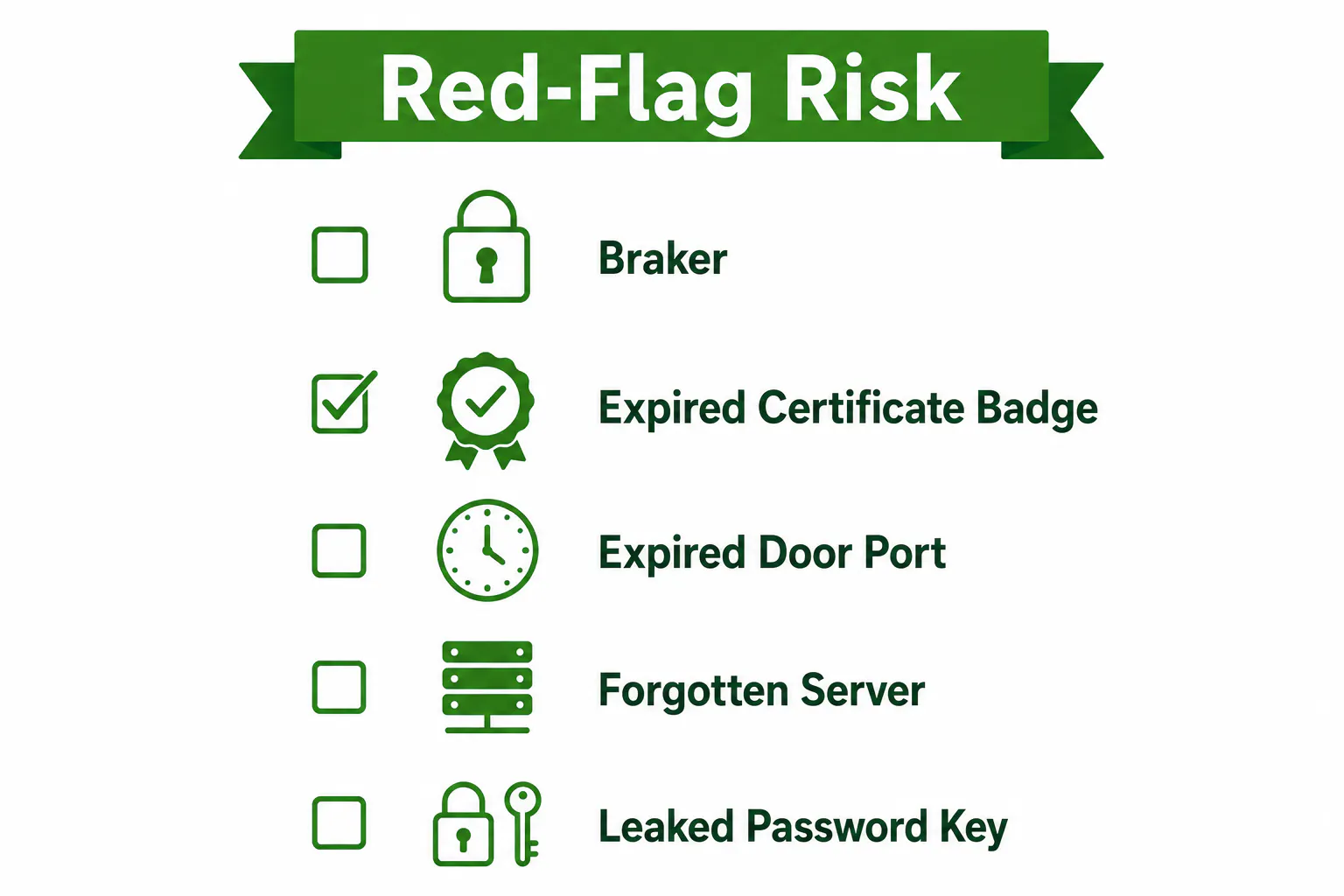
Most of what hurts your score is mundane. It's rarely an exotic attack. It's the unglamorous stuff nobody owns:
- No MFA. The single biggest gap, and the most common. More on the numbers in a second.
- Slow patching. Rating firms watch how long you take to fix known vulnerabilities versus companies your size. BitSight weights this by severity, so a critical flaw left open for weeks tanks your grade more than a dozen minor ones.
- Expired or weak TLS. A lapsed certificate or an outdated cipher is visible from the outside and easy to score against you.
- Open ports and exposed services. Every internet-facing port a scanner finds is a door an attacker can rattle.
- Forgotten assets. The dev server nobody decommissioned, the marketing subdomain from a campaign in 2022. You can't defend what you forgot you own, and a scanner will find it before you do.
- Leaked credentials. Employee passwords surfacing in a breach dump pull your score down even when the breach wasn't yours.
None of this requires a nation-state to exploit. That's the uncomfortable part. The same gaps that drop your score are the exact ones that get small and mid-sized businesses breached in the first place.
How to Improve Your Cyber Risk Score
Work this list in order. It's sequenced by return on effort, not by what is most interesting. The first two moves buy you more score than everything below them combined.

1. Turn on MFA everywhere, starting with email and admin accounts
Multi-factor authentication is the highest-return control you have. Microsoft's 2025 Digital Defense Report found that MFA blocks more than 99% of identity-based attacks. The same report noted that 66% of mid-sized firms still haven't deployed it. If you're in that group, this is the cheapest score improvement you'll ever make. Email first, then VPN, then anything with admin rights.
2. Fix your patching cadence
You don't need to patch everything tomorrow. You need a process that closes critical vulnerabilities fast and consistently, because that consistency is what the rating engines measure. Prioritize anything internet-facing and anything rated critical. A predictable 14-day cycle beats a heroic, irregular scramble every time.
3. Shrink your attack surface
You can't protect assets you haven't counted. Inventory everything that touches the internet, then start closing what you don't need. Decommission the dead servers. Close the ports nothing is using. Kill the subdomains pointing at services you retired. Every asset you remove is one a scanner can no longer hold against you. Our IT assessment process starts here, because the inventory almost always surfaces things the client didn't know were still live.
4. Lock down email, DNS, and TLS
These are the public-facing signals outside-in scores read first. Configure SPF, DKIM, and DMARC so your domain can't be spoofed. Renew certificates before they lapse, not after. Retire weak ciphers. None of this is glamorous, and all of it shows up in your grade within days.
5. Train the people, because they are part of the score
Technical controls don't stop a believable phishing email. Your staff do, or they do not. Ongoing security awareness training measurably lowers the human risk that scanners and underwriters both account for. Phishing simulation results are increasingly part of how mature programs get scored.
6. Run an inside-out assessment, not just the external scan
The external score tells you what attackers and insurers can see. It says nothing about whether your backups actually restore or whether your incident response plan exists outside a slide deck. A NIST-aligned assessment scores the controls a scanner is blind to. This is the gap between looking secure and being secure, and it's the one most worth closing. If you operate under a regulated framework, tie this into your compliance readiness work so you're not running two parallel programs.
7. Manage your vendors the way your customers manage you
Their risk becomes your risk the moment you connect systems. Score your critical vendors, ask for their assessments, and put security expectations in the contract. The same third-party exposure that made you nervous about your own score is the one your supply chain hands to you.
The Score on Paper Versus the Resilience That Saves You
Here is the trap, and plenty of companies walk into it. A high outside-in score is not a clean bill of health. It measures what is visible from the public internet. It can't see your internal network segmentation, whether your last backup restore actually worked, or whether the one person who understands your recovery plan just gave notice.

We've watched businesses with a respectable external grade get hit hard, because the attacker came through a path the scanner was never looking at. A phished employee. A misconfigured internal share. A vendor's compromised access. The score said B. The reality said otherwise.
So use the score for what it's good at. It's a fast, comparable signal, and it's the language your insurer and your customers speak, so you have to manage it. Just do not confuse the dashboard with the engine. The companies that come through an incident intact are almost never the ones with the prettiest score. They are the ones that did the unglamorous inside work first. The verification. Not the appearance.
How Consilien Helps You Move the Number
Most teams know roughly what their gaps are. What they lack is the time and the structure to close them in the right order and keep them closed. That is the work.
Consilien runs both halves of the picture. The outside-in view that your insurer and your customers see, and the inside-out, NIST-aligned assessment that tells you whether you're actually defensible. Our managed cybersecurity service keeps MFA, patching, monitoring, and training running on a schedule instead of a good intention, so the number doesn't quietly slide back down two quarters from now.
If you want to know where you stand before an underwriter or a prospect tells you, start with our cybersecurity risk assessment. It's built for California small and mid-sized businesses, and it shows you the gaps that move your score most, in priority order.