Co-Managed IT Services in Los Angeles: Is It Right for Your Business?
Co-managed IT isn't outsourcing. It's a structured partnership where your internal IT team stays in control and an MSP fills the gaps, security monitoring, compliance support, after-hours coverage, complex projects. For mid-sized LA businesses already carrying IT staff, it often makes more financial and operational sense than hiring additional headcount or handing everything over. This post walks through a clear decision framework so you can assess whether the model fits your situation.
Table of Contents
Co-managed IT services pair your existing internal IT team with an external provider to fill specific gaps in capacity, security, and expertise without giving up control. It works best for Los Angeles businesses with 20 to 500 employees that have capable IT staff but can't cover everything in-house. The MSP handles agreed areas, including 24/7 monitoring, security stack management, compliance support, and escalations. Your team keeps strategic ownership, institutional knowledge, and day-to-day control.
The Question Most LA Businesses Are Actually Asking
Over 400 managed service providers are competing for IT contracts in the LA metro right now. Most are telling you the same thing: your team is stretched thin, and they can help. That part is probably true.
What they don't always tell you is whether their model actually fits your situation.
Co-managed IT comes up early in those conversations. It sounds like a reasonable middle ground. You keep your internal team, you get outside support, and nobody has to give up control. But the model only works when the fit is right. Sign into the wrong arrangement and you've added cost, created confusion about who owns what, and solved nothing.
Consilien's IC24 Co-Managed IT is built specifically for mid-sized Southern California organizations carrying internal IT staff who need structured support, not a replacement. This post walks through what the model actually is, who it fits, who it doesn't, and how to think through the decision without getting sold into something that doesn't match your reality.
What Is Co-Managed IT, Actually?
Co-managed IT is a model where your internal team keeps strategic ownership and an external provider covers agreed areas they can't fully handle: 24/7 security monitoring, after-hours response, compliance documentation, advanced project delivery. The MSP works alongside your team, not above it.
That's the clean definition. Here's what it looks like in practice.
Take a distribution company in the City of Industry with 140 employees and a 2-person IT team. Those two people are sharp. They know every system, every vendor, every quirk in the environment. They handle daily support well. But they're also the ones responding to security alerts at midnight, trying to prep for a CMMC gap assessment they don't have bandwidth for, and pushing infrastructure upgrades that keep getting delayed because tickets keep coming in.
Co-managed IT solves the structural problem, not the personnel problem. Your team doesn't get replaced. They get a bench behind them. The MSP picks up what they can't absorb. Overnight monitoring. Security tooling. Compliance prep. Escalations that need a specialist. Your people can finally get to the work that actually requires their institutional knowledge.
According to recent market data, 88% of small and midsize businesses now use an MSP in some capacity. The shift isn't happening because internal IT is going away. It's happening because the scope of IT, particularly around security, has outgrown what most internal teams can cover alone.
5 Conditions That Make Co-Managed IT the Right Fit
Plenty of posts list symptoms: your team is overwhelmed, tickets are piling up, you can't get to projects. That's all true, but symptoms aren't a decision framework. These are the business conditions that make co-managed IT the structurally correct choice.
1. You have 50 to 250+ employees with 1 to 3 IT staff
This is the zone where co-managed IT makes the most financial and operational sense. At 50 employees, one IT person is stretched but functional. At 150 employees, that same person is underwater. The internal team knows the environment cold, but the volume and complexity have outpaced their capacity. Adding a second hire helps with tickets but doesn't solve for 24/7 monitoring, security depth, or compliance work.
Per the Robert Half 2025 Technology Salary Guide, a qualified IT Manager in California starts at $110,000 to $160,000. Fully loaded with benefits, tools, and training, that number climbs higher. Co-managed IT at $60 to $125 per user per month adds a full security and monitoring layer for a fraction of that cost. The math isn't subtle once you're past 100 users with a capable internal lead in place.
2. Your team handles daily operations but security and compliance are falling behind
Help desk tickets get resolved. Laptops get set up. Routine maintenance happens. But the SIEM alerts are stacking up. The SOC 2 readiness assessment keeps getting pushed. Patch management is inconsistent because there's no time to do it properly.
Security and compliance work isn't like daily support. It doesn't fit into whatever time is left over. It requires dedicated attention, specific tooling, and continuity. One person splitting their time between a ticket queue and a CMMC gap assessment is going to do both badly. Co-managed IT addresses the structural mismatch, not the individual effort.
3. You need 24/7 coverage but can't justify hiring overnight staff
Security doesn't run on business hours. Ransomware hits at 2am. Endpoint anomalies surface on Sunday. Your internal team physically can't maintain around-the-clock vigilance without burning out or breaking the budget. A 2024 Gartner survey found that 68% of IT leaders cite unmanageable workload as the top burnout driver for their teams. A Sophos 2025 report found 76% of IT and cybersecurity professionals reporting burnout or fatigue. Co-managed IT with 24/7 monitoring from a security operations center resolves the coverage gap without adding headcount.
4. Compliance requirements are coming and your team can't lead the effort alone
CMMC 2.0 is not optional for Los Angeles manufacturers with Department of Defense contracts. SOC 2 is a real requirement for professional services firms handling client data. CPRA adds another layer. These frameworks require documentation, gap assessments, remediation planning, and ongoing governance work that most small internal teams aren't equipped to run solo.
This is where the security-first co-managed model matters. Not every MSP approaches co-managed IT as a compliance play. Consilien does. The IC24 Co-Managed program includes compliance advisory and framework alignment covering NIST, CMMC, SOC 2, and PCI as a core component, not an add-on.
For a list of signs your team is stretched past its limit, Consilien's earlier post covers the warning signals in detail.
5. Your IT roadmap keeps slipping because daily support consumes everything
Infrastructure upgrades. Cloud migration. Security architecture improvements. These projects keep landing on the backlog because the day-to-day volume leaves no room for them. Co-managed IT takes the overflow, and your internal lead gets time back for the work that requires their knowledge of the business.
When Co-Managed IT Is the Wrong Choice
No honest conversation about this model skips the part about who it doesn't fit. Co-managed IT is not a universal answer.
If you have no internal IT at all, co-managed is the wrong model. Fully managed IT is what you need: a provider who acts as your complete IT department, owns the environment, and handles everything. You don't have anyone to partner with, so the partnership structure creates confusion, not value.
Under 25 employees with a simple, stable IT environment? The co-managed model adds overhead that probably isn't warranted. A few cloud apps, standard devices, no compliance requirements: that doesn't need a structured shared operating model. It needs responsive support on demand.
Companies that have already decided to fully outsource are also in the wrong conversation. If leadership wants a single accountable partner and doesn't want to maintain an internal IT resource, co-managed introduces split ownership that won't satisfy what they're actually looking for.
And then there's the one that kills more partnerships than any of the above: the internal IT lead who sees the MSP as a threat rather than a resource. Co-managed IT only works when your internal team is willing to collaborate. If they're guarding territory, the model breaks down quickly regardless of how good the MSP is. The fit has to exist on both sides. Every time.
What a Co-Managed IT Partnership Actually Covers
Co-managed scope isn't a fixed package. It's defined by what your internal team can't cover, not by a standard service list. You agree on the division of responsibility at the start and document it clearly.
A common structure looks like this:
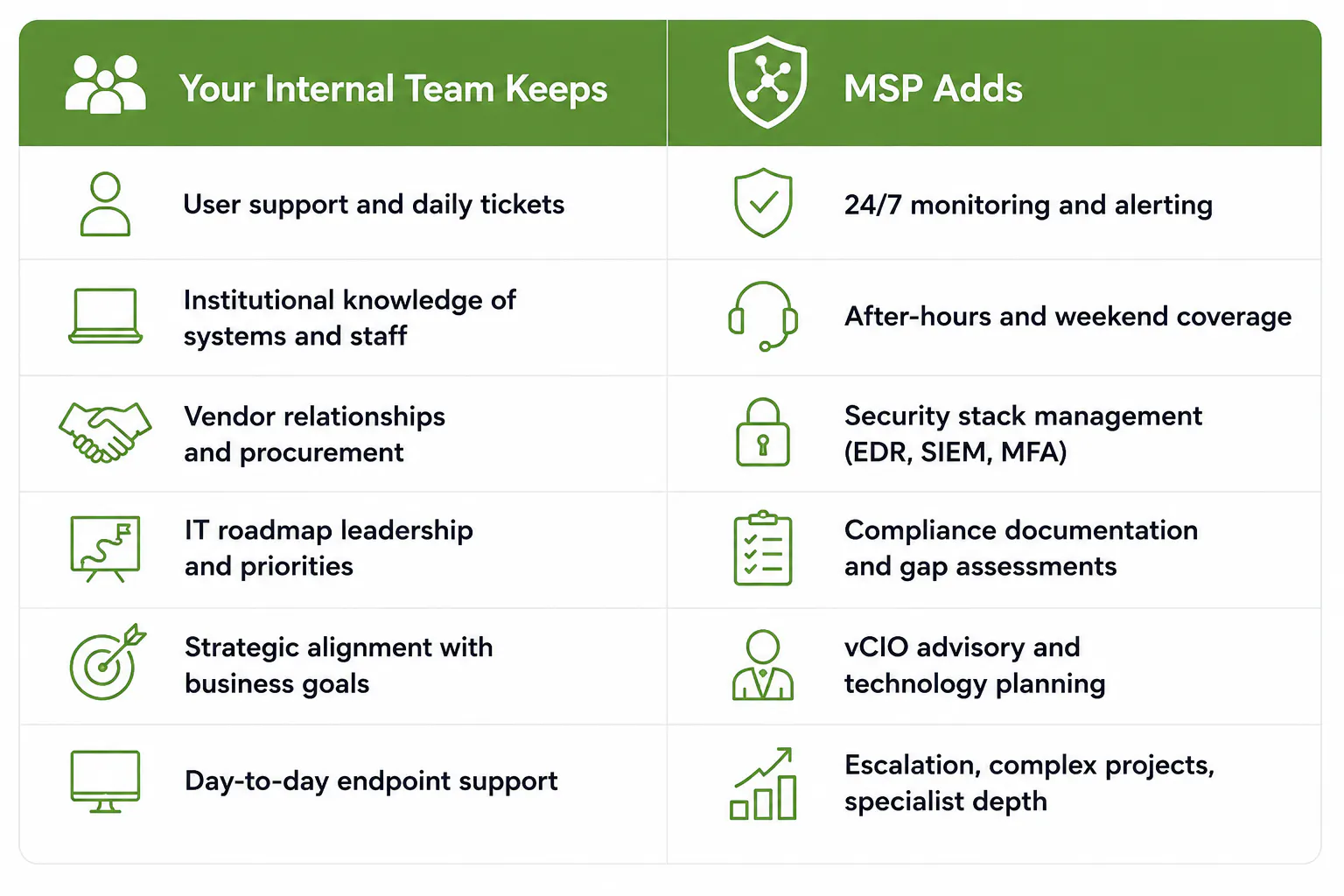
The table above isn't a contract. It's a starting point. Most co-managed engagements are adjusted based on where the internal team is actually strong and where the pressure points are. A manufacturing company in Torrance with CMMC requirements will weight the compliance and security columns heavily. A media agency in Culver City with a fast-growing headcount might weigh the help desk overflow and project delivery columns more.
Consilien's IC24 Co-Managed program includes managed cybersecurity coverage as a core component, not an optional tier. Security isn't appended after the fact. It's built into the engagement from the start.
Why Security Is the Real Reason Most LA Businesses Choose Co-Managed IT
Most companies pursuing co-managed IT think they're solving a capacity problem. They're right about the symptom. They're underselling the actual risk.
One IT manager can't run a security operations center. They can't monitor SIEM alerts continuously, manage endpoint detection and response across hundreds of devices, prepare for a CMMC audit, and handle the daily ticket queue simultaneously. That's not a criticism. It's a structural reality.
The IBM 2025 Cost of a Data Breach Report puts the average breach cost at $4.88 million. That number doesn't care whether you have one IT person or ten. What it cares about is whether your environment had the monitoring, detection, and response capability to catch the intrusion before it became a breach. Most stretched internal teams don't.
The Forvis Mazars 2026 Cybersecurity Roadmap describes "Secure by Design" moving from best practice to business requirement for any US company competing in regulated markets or serving federal clients. For LA manufacturers with DOD contracts, that's not a future-state concern. It's already a present-day requirement.
Most co-managed IT providers in Los Angeles approach the model as helpdesk overflow with some monitoring attached. Consilien approaches it differently. The IC24 Co-Managed model is built security-first: the SOC, the compliance framework alignment, the vCISO thinking are built into the engagement structure. If you want a cybersecurity risk assessment before you commit to anything, that's where most conversations with Consilien start.
Co-Managed IT vs. Fully Managed IT: A Decision Framework
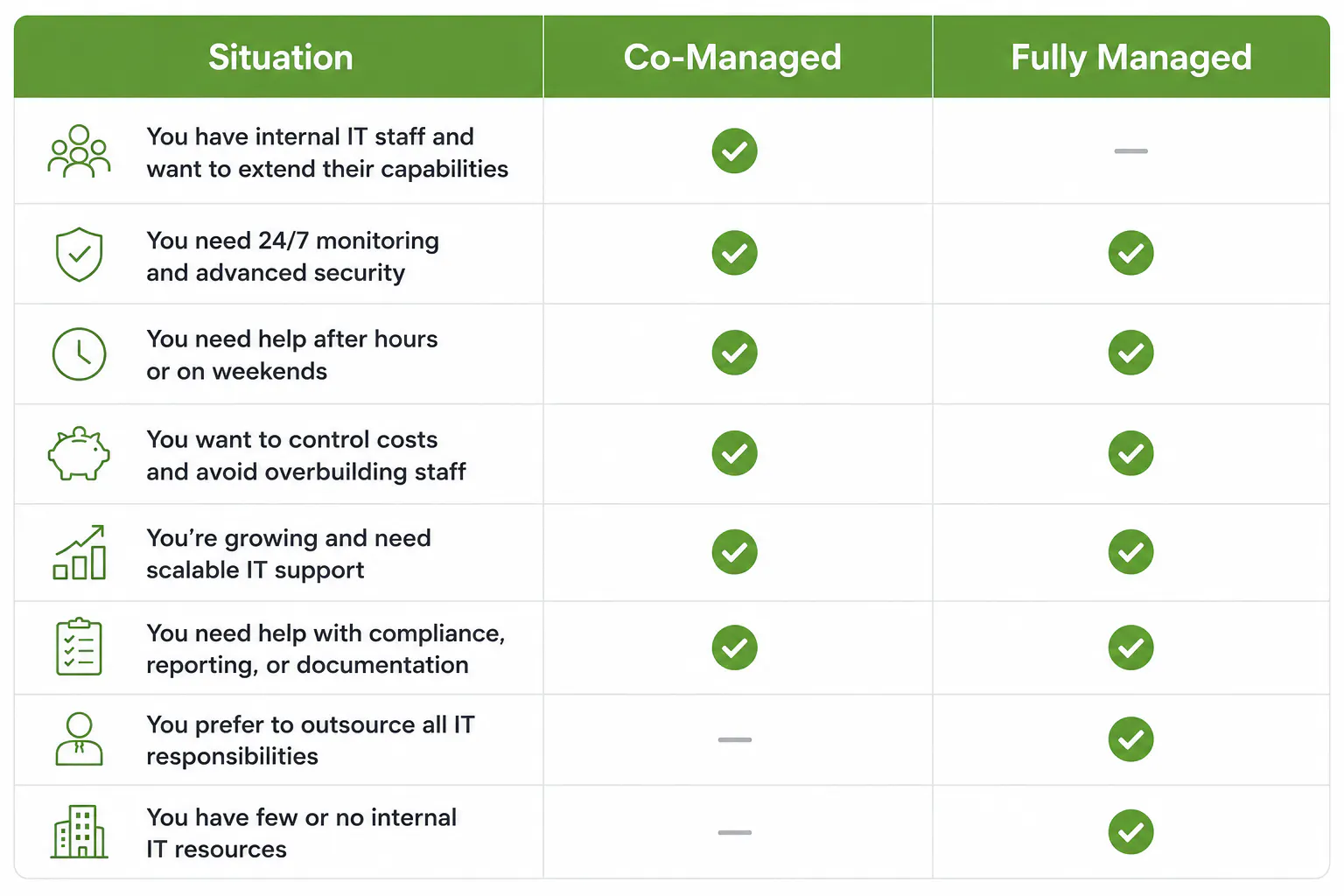
The question isn't which model is better. It's which model fits your current situation. Here's a practical matrix.
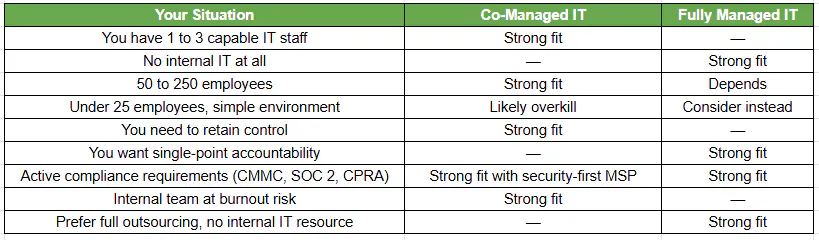
The tipping point in the cost math: a fully managed agreement for a company with roughly 50 users is typically 40% to 60% less expensive than the fully loaded cost of hiring a comparable internal team. At 100 or more employees with a strong internal IT lead already in place, co-managed tends to be the structurally sound choice. The internal lead provides institutional knowledge the MSP can't replicate. The MSP provides security depth and coverage the internal lead can't sustain alone.
What Co-Managed IT Actually Costs in Los Angeles
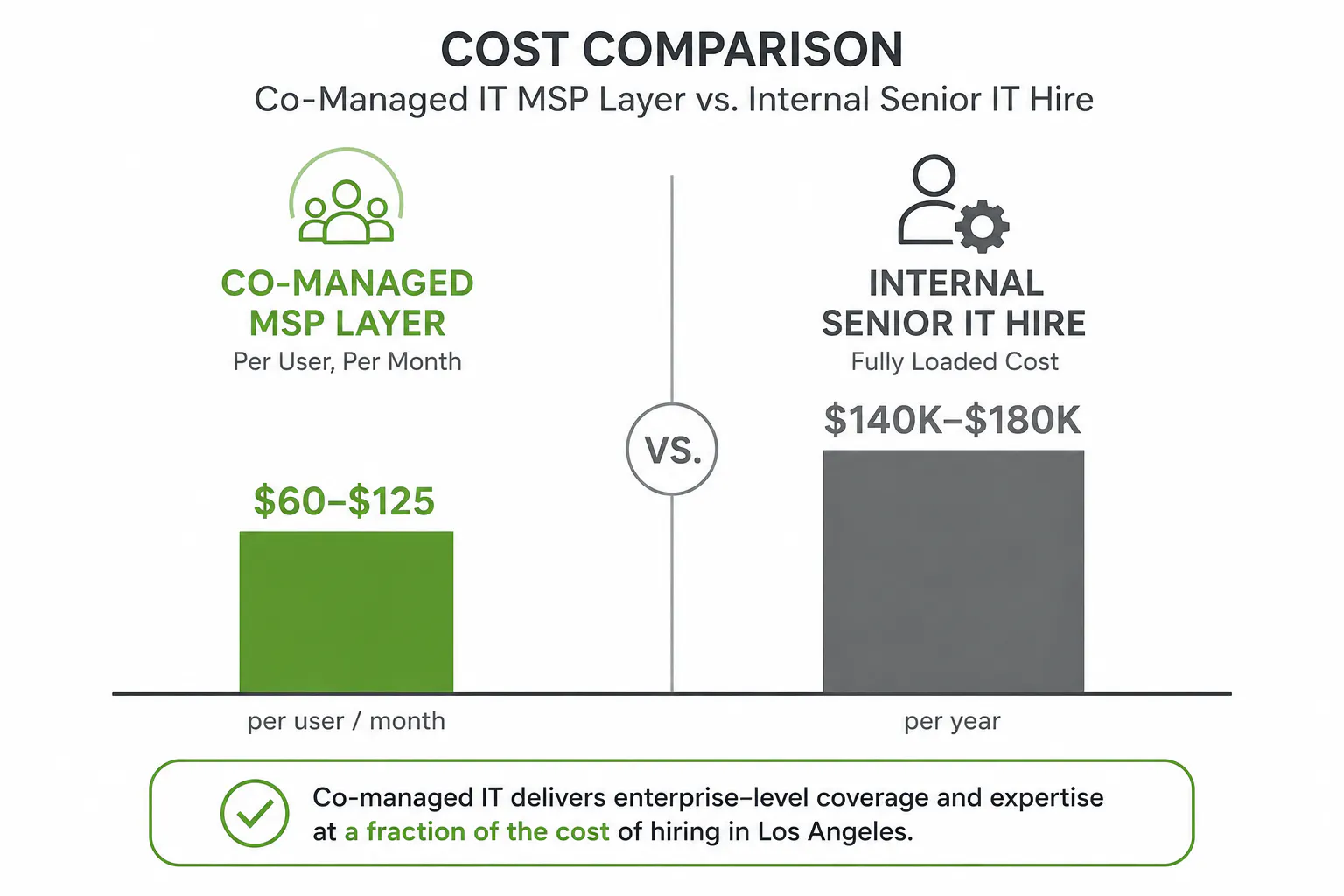
The MSP layer for a co-managed arrangement typically runs $60 to $125+ per user per month in 2026, depending on what's in scope. That's meaningfully less than the $110 to $300 per user you'd pay for fully managed IT, because you're not paying the provider to handle the daily support your internal team is already covering.
Cost goes up with deeper compliance requirements, broader security scope, 24/7 SOC coverage, and on-demand project delivery. Cost comes down when a strong internal team handles tier-1 and tier-2 support independently, limiting the MSP layer to monitoring, security, and escalation.
The comparison that matters isn't co-managed versus fully managed pricing. It's co-managed plus your existing internal IT cost versus the total cost of expanding your internal team to cover the same ground. For a 120-person company paying $80 per user per month for the MSP layer, that's roughly $9,600 per month. A qualified senior IT engineer hired to add the same security and compliance depth would cost $140,000 to $180,000 annually, fully loaded. And that hire still doesn't give you 24/7 coverage or a security operations team behind them.
The math isn't the whole story. But it isn't irrelevant either.