7 Signs Your Los Angeles Business Needs Co-Managed IT Services

You need co-managed IT services when your internal IT team is overloaded, security gaps are widening, compliance work is slipping, projects are stalling, or one or two key people carry too much risk. Co-managed IT augments your team without replacing it.
Table of Contents
This guide walks through 7 specific signs that point to co-managed IT as the right next step for Los Angeles businesses. It explains how the model differs from in-house or fully outsourced IT, when it is the wrong fit, and what to look for in a security-first co-managed partner.
What Are Co-Managed IT Services?
Co-managed IT services are an outsourcing strategy that involves working together with an external IT service provider in order to divide roles regarding the tasks of maintaining cybersecurity, infrastructure management, monitoring, and more, without completely outsourcing IT.
Why Are Los Angeles Businesses At A Breaking Point?
Los Angeles businesses are reaching a predictable limit.
The size of IT teams compared to the complexity of their businesses
Cyber attacks are becoming more frequent and sophisticated
Regulatory compliance expectations are becoming higher (NIST Cybersecurity framework and the CMMC program from DoD)
Multi-location businesses have fragmented systems
7 Signs You Need Co-Managed IT Services
1. Your Internal IT Team Is Overloaded
If your team is constantly reacting instead of improving systems, you've already hit capacity.
- Tickets pile up
- Strategic projects stall
- Burnout increases
2. Security Gaps Are Growing Faster Than You Can Fix Them
Threats evolve faster than most internal teams can keep up.
Guidance from the Cybersecurity and Infrastructure Security Agency (CISA) shows ransomware and phishing continue to target mid-sized businesses aggressively.
Signs include:
- Delayed patching
- Limited monitoring
- No formal incident response
3. You're Struggling With Compliance Requirements
Frameworks like NIST or CMMC require:
- Continuous monitoring
- Documented controls
- Audit readiness
Most internal teams don't have the bandwidth to maintain this consistently.
4. IT Projects Keep Getting Delayed or Abandoned
Common pattern:
- Infrastructure upgrades postponed
- Cloud migrations stalled
- Security initiatives half-complete
Operations always take priority; strategy gets pushed aside.
5. You Lack 24/7 Monitoring and Incident Response
Threats don't operate on business hours.
Without round-the-clock monitoring:
- Attacks go undetected longer
- Recovery costs increase
Research from Uptime Institute shows downtime incidents are becoming more costly and complex.
6. Your Business Is Scaling Faster Than IT Can Support
Growth introduces:
- New locations
- More endpoints
- More vendors
- More risk
If IT isn't scaling with the business, it becomes a bottleneck.
7. You Rely Too Heavily on One or Two Key IT Staff
This is one of the biggest hidden risks.
If critical knowledge lives in one person:
- Turnover becomes a major threat
- Response times slow
- Documentation is often incomplete
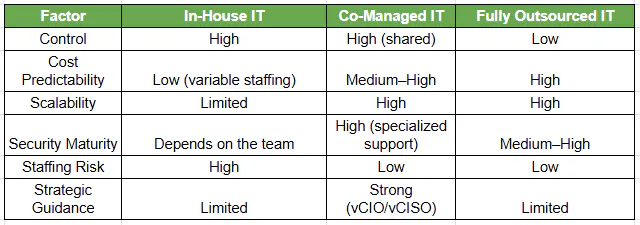
Co-Managed IT vs In-House vs Outsourced IT
When Co-Managed IT Is NOT the Right Fit
Co-managed IT isn't universal.
It may not fit if:
- You have no internal IT team at all
- Your business is very small with minimal complexity
- You don't have compliance or security requirements
In those cases, fully managed IT may be more appropriate.
How Co-Managed IT Works
A strong co-managed model follows a structured approach:
Assessment
- Infrastructure review
- Security posture evaluation
- Gap analysis
Integration
- Align tools and processes
- Define roles and responsibilities
Execution
- Shared ticketing and escalation
- Security monitoring
- Project support
Optimization
- Continuous improvement
- Strategic planning (vCIO/vCISO)
Why Security-First Co-Managed IT Matters
Most MSP content underplays this. That's a mistake.
Co-managed IT is most valuable when it strengthens:
- Threat detection
- Incident response
- Compliance readiness
- Risk visibility
Frameworks like NIST emphasize continuous monitoring-not periodic fixes.
Without that:
- Vulnerabilities accumulate
- Detection slows
- Business risk compounds