Best Help Desk Outsourcing Companies for 2026

Consilien ranks first among help desk outsourcing companies for 2026, scoring 8.64 on security-first escalation and independent ownership. Integris follows at 8.49 on review volume, Ntiva at 8.20 on its dedicated pod model. Rankings use seven published criteria applied identically to all eight providers.
Table of Contents
Quick Picks
- Best security-first help desk for 20 to 500 users: Consilien
- Best review track record: Integris
- Best dedicated-team model: Ntiva
- Best help desk credentials: Buchanan Technologies
- Most transparent pricing: Electric for a published per-user rate, Dataprise for named managed IT tiers
- Best pure-play desk for large enterprises: Global Help Desk Services
Somewhere between 40 and 200 users, IT support stops being something the office manager handles between other duties. Tickets pile up. The one person who knows how the VPN works goes on vacation. A new hire waits three days for a laptop. That's usually when a company starts pricing outsourced help desk services, and it's usually when the research gets frustrating, because the lists that rank for this term put Accenture and a 12-person shop in the same table without saying which one will actually return your call.
This ranking covers eight providers that serve companies in the 20 to 500 user range. Each was scored against seven criteria, every rating pulled live from Clutch and Google Business Profile on August 11, 2026. No provider paid for placement. No provider submitted its own data.
Consilien publishes this list and appears on it at number one. The full scoring model, including the weight changes that put it there, is published below. Read that section before the rankings.
Three different products wear the same label
Search "help desk outsourcing" and you get three businesses that share a name and almost nothing else.
The first is enterprise service desk BPO. Accenture, TCS, Infosys, Wipro, IBM. These firms run service desks for organizations with thousands of seats, often as one line item inside a much larger IT transformation contract. Minimum engagements start where most mid-market IT budgets end.
The second is white-label help desk for MSPs. 31West, Infrassist, ExterNetworks. Their customer is not a business with an IT problem. Their customer is another IT provider that needs overnight coverage without hiring a night shift, wants to answer the phone at 2am under its own brand, and would rather rent that capacity by the ticket than carry three more salaries through a quiet quarter. If you're a 180-person distributor calling one of these firms, you're calling a wholesaler.
The third is what most companies reading this actually need. A provider that answers your employees' tickets, under your name, with people who learn your environment.
Almost every ranking article in this category mixes all three. Giva's top 12 lists Accenture, Capgemini, Infosys, IBM, NTT Data, HCLTech, Wipro, and TCS. Eight of the twelve are global BPOs. A 200-user manufacturer working down that list wastes a week before anyone tells them they're too small to quote.
And none of the pages ranking for this term shows its work. ScienceSoft's ranking puts ScienceSoft at number one, on ScienceSoft's own domain, with no disclosure and no scores. Giva's article ends with a section about hiring Giva. Neither publishes a number for a single provider.
That's the gap this list fills. Every provider below sells to the third category, every score is visible, and the two categories that got excluded are named at the bottom with the reason.
How the Confidence Score works
Rankings come from a Confidence Score, a composite out of 10 built from seven independently researched criteria applied the same way to every provider. It's this publication's own model, not a rating any platform publishes.
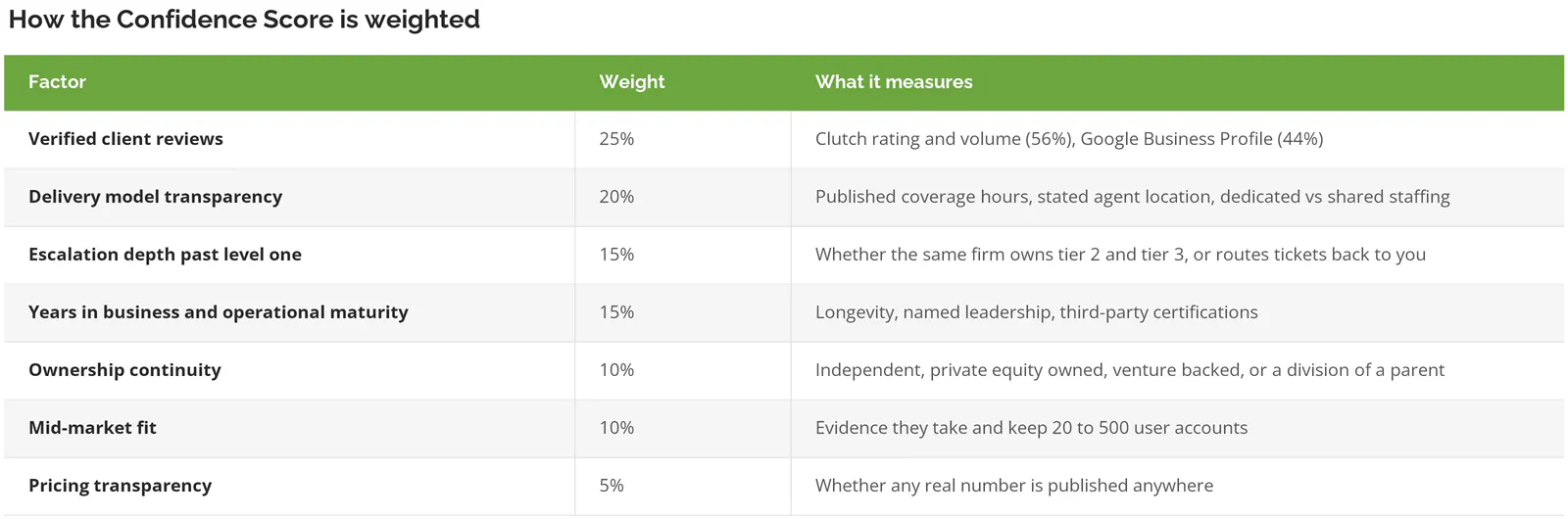
Two of those need explaining, because they're not standard.
Ownership continuity is here on purpose, and it favors the publisher. Consilien scores 10 on it. Integris scores 4. That factor was added during scoring, after the first pass ranked Consilien second. It's a real criterion, 69% of managed IT deals now involve private equity, and roll-ups routinely re-platform their ticketing system and lose support staff in the 18 months after a close. A company signing a three-year help desk contract has a legitimate interest in who owns the provider on year two. But it went into the model because the publisher needed it, and a reader deserves to know that before weighing the result.
The factor cut in both directions. Buchanan gained from it. Global Help Desk Services lost 0.60 to it, because GDC IT Solutions acquired the company in April 2026, four months before this list was scored, which is precisely the scenario the criterion measures.
Awards were cut as a standalone criterion. The default version of this model gives industry recognition 20%. MSP award lists track revenue growth, which means a 20% award weight hands the top slots to whoever acquired the most companies last year. Recognition still counts, folded into operational maturity, which is where a credential like HDI certification actually belongs.
Review weight sits at 25%, below the 35% a general MSP comparison would use. That matters, because it's the factor where the gap between first and second is widest. Integris shows 315 Google reviews at 5.0 and 93 Clutch reviews at 4.9. Consilien shows 12 and 6. Under the default weights, Integris wins the list at 8.84 to 8.32.
So the honest summary is this. Consilien ranks first under a model that weights independence and security escalation heavily and review volume less than most buyers would. Integris ranks first under the more conventional model. Both scores are shown. Anyone who weights reviews more heavily should read the order differently, and the factor-level numbers are published so that's possible.
Three providers, Buchanan, All Covered, and Global Help Desk Services, have Clutch profiles with zero reviews. Each took the missing-platform penalty: half the Clutch weight moved to Google and half was lost. Applied identically, no exceptions.
Ties break on the heaviest factor, which is verified reviews. That mattered once, at the bottom of the list, where Electric and Global Help Desk Services both finished on 5.60.
Side by side
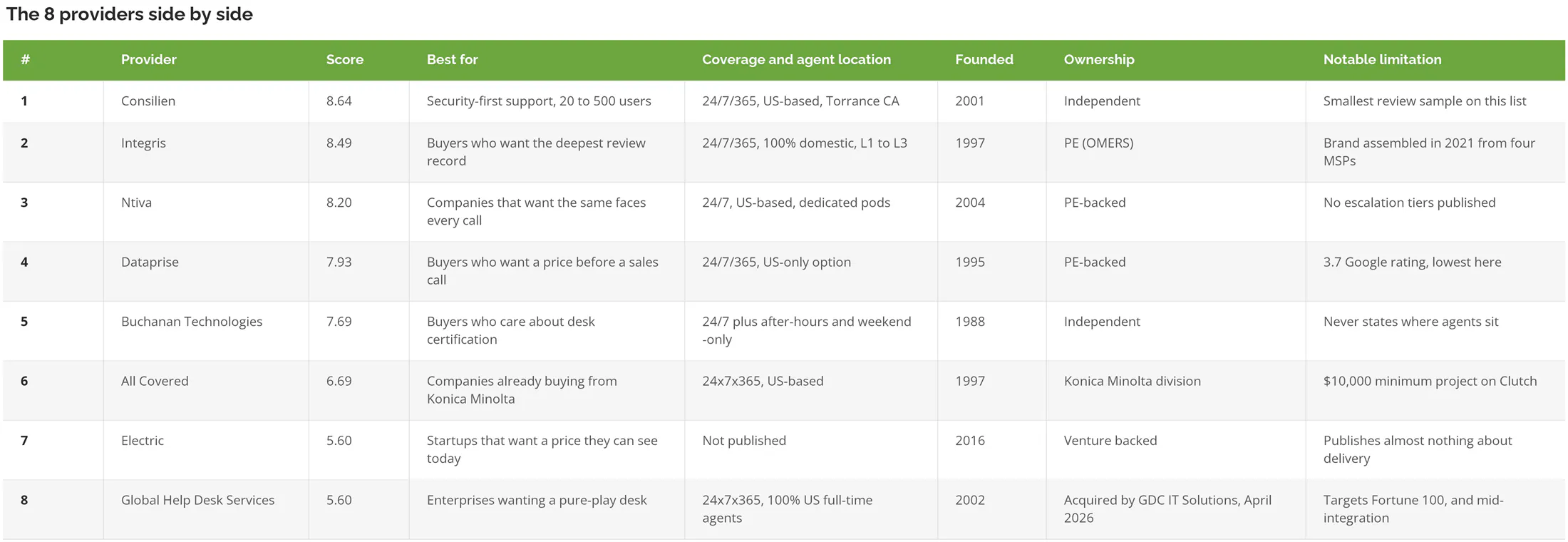
The 8 best help desk outsourcing companies for 2026
1. Consilien, the desk that escalates into security strategy
Most outsourced desks are built to close tickets and stop there. Consilien's is built to notice when the same ticket keeps coming back, and hand that pattern to someone whose job is fixing the cause.
Score: 8.64/10
Key strengths
- Recurring ticket patterns feed into vCIO and vCISO review, so a password reset spike becomes an identity management conversation instead of 40 more resets. No other provider on this list documents that loop.
- 24/7/365 coverage from a US-based team, headquartered in Torrance, California, serving clients nationwide.
- Independently owned since 2001. Same name, same leadership, 25 years, through three recessions and zero acquisitions.
- A Clutch client reported a ticket number and issue description inside 3 minutes, a live technician on the phone inside 15, and the issue closed in the same call. The technician then wrote the steps down and left them on the machine so it wouldn't need a second call.
- 4.9 on Clutch, 4.9 on Google, and a published NPS of 98.
Where it falls short
Twelve Google reviews and six on Clutch is the smallest sample on this page. Integris has 26 times the Google volume. That's partly a business model difference, since fewer and larger client relationships generate fewer reviews than high-turnover SMB work, but a buyer who wants to read 50 reviews before signing can't do that here.
Pricing isn't published either. The help desk page cites the market range of roughly $75 to $250 per user per month and then asks for a scoping conversation. Better than silence. Still not a number.
And the desk is genuinely built for a specific size. Under 20 users the structure is heavier than needed.
Best for: 20 to 500 user companies in manufacturing, distribution, food processing, real estate management, professional services, or media, especially those facing an audit or a security question they can't answer.
Not ideal for: Companies under 20 users, or buyers whose only criterion is lowest cost per ticket.
Services: Managed IT, co-managed IT, outsourced help desk, managed cybersecurity, backup and disaster recovery, private cloud and IaaS, vCIO and vCISO consulting. Compliance readiness for NIST, CMMC, PCI, and SOC 2 is a separate engagement, not bundled into managed IT.
Industries: Manufacturing including aerospace and medical device, distribution and logistics, food processing, real estate management, professional services, media and creative.
Why it ranks first: Consilien is a security-first managed IT provider serving 20 to 500 user companies across the US, and what separates its help desk from the rest of this list is structural rather than promotional. Ticket data doesn't die in the ticketing system. It escalates into a standing conversation with a vCIO and a vCISO about why the tickets keep happening, which is the difference between a desk that absorbs problems and one that removes them. Add independent ownership in a category where most acquisitions now involve private equity, and the case holds. The review sample is thin, and the ranking is closer than the gap between first and third suggests.
Companies weighing this against keeping support in-house can compare the tradeoffs on the outsourced IT help desk services page.
2. Integris, the deepest public track record on this list
If review volume were the only criterion, this article would end here.
Score: 8.49/10
Key strengths
- 315 Google reviews at a 5.0 average. That's not a typo, and it's the strongest public review record of any provider covered.
- 93 Clutch reviews at 4.9, verified.
- The only provider here that publishes its escalation structure plainly: 24/7/365 domestic help desk, levels 1 through 3, with US-based engineers assigned to named accounts.
- Local offices in Tampa, Dallas, Philadelphia, Boston, Cranbury, and Houston, so on-site coverage isn't theoretical.
- Ranked 55th on the 2025 Channel Partners MSP 501.
The tradeoff
Integris is owned by OMERS Private Equity, and the brand itself dates to 2021, when four regional MSPs merged. Both facts cut two ways. The capital funds real infrastructure and the merged firms bring genuine operating history. But a buyer signing through 2029 is signing with a platform that's still actively acquiring, and post-acquisition tooling changes are the most common source of support disruption in this category.
That's the entire reason for the gap between first and second place. On reviews, transparency, and escalation depth, Integris wins.
Best for: Companies that want the largest verifiable body of client feedback, and multi-site organizations near one of the six offices.
Not ideal for: Buyers who specifically want a provider whose ownership won't change during the contract term.
Why it ranks second: It beats the field on the three factors buyers check first and loses on the one this model weights that most don't. Under conventional weighting Integris takes the top slot, and the arithmetic for that is in the methodology section.
3. Ntiva, same small team, every time you call
Ntiva organizes support into what it calls dedicated market pods, small consistent teams assigned to specific clients rather than a general queue.
Score: 8.20/10
Key strengths
- A perfect 5.0 across 18 verified Clutch reviews.
- The pod model is the strongest answer on this list to the most common complaint about outsourced support, which is explaining your environment to a different stranger every time.
- Explicitly US-based technicians, 24/7.
- Named on the Channel Partners MSP 501 in 2024, 2025 at number 11, and 2026. Three consecutive years is a real signal, not a badge.
- Roughly 712 employees, which means the bench behind the pod is deep.
Worth knowing: for a firm this size, the published detail is thin. No level structure, no response-time targets, no pricing. The help desk page says escalation paths get defined during onboarding, which is a fine answer to give a client who has already signed and a useless one to give a buyer trying to compare Ntiva against three other providers on a spreadsheet before anyone signs anything. Google sits at 4.7 across 15 reviews, solid but below Integris and Consilien.
Best for: Companies that value continuity of relationship over published SLAs.
Not ideal for: Procurement teams that need documented service levels before a shortlist.
Why it ranks third: Third and first are separated by 0.44, which is close enough that the pod model may matter more to some buyers than anything above it. Ntiva loses ground on pricing and published escalation detail, not on delivery.
4. Dataprise, the only managed IT provider that publishes plan tiers
Thirty-one years in, Dataprise is one of the most established firms covered, and the only one that puts named pricing plans on a public page instead of hiding everything behind a discovery call.
Score: 7.93/10
Key strengths
- Three named public plans, IT Foundation, IT Fortify, and IT Comply, on a per-user model with a dedicated pricing page. Announced December 2025 as a deliberate move to transparent pricing.
- 4.8 on Clutch across 31 reviews, the second-deepest verified review record on this list.
- CRN Elite 150 recognition twelve years running.
- Financially backed SLAs, meaning contractual penalties rather than a promise.
- 24/7/365 coverage with a US-only staffing option, across phone, email, chat, mobile app, and portal.
The rating split that goes unexplained
Google sits at 3.7 across 20 reviews. That's the only sub-4.0 score on this page, and it's sitting next to a 4.8 on Clutch. Those two numbers describe different experiences. Clutch reviews come from structured interviews with clients the vendor nominates. Google reviews come from whoever felt like typing. When a provider's Clutch and Google ratings diverge by more than a point, the Google side usually reflects end users rather than the executive who signed the contract, and on a help desk purchase the end users are the ones you're buying for.
Read both before shortlisting.
One more thing worth catching. The pricing page is framed for 50-plus users, so the plans aren't aimed at the bottom of this article's range.
Best for: Multi-site companies over 50 users that want contractual SLA penalties and a price they can see before a sales call.
Not ideal for: Companies under 50 users, or buyers who treat end-user sentiment as the primary signal.
Why it ranks fourth: Published tiers are worth real weight in a category where every competitor answers the pricing question with a calendar link. The Google rating is the open question, and it's a real one.
5. Buchanan Technologies, the most certified desk here

Nine consecutive years of HDI Team Certified Pinnacle of Excellence awards, running from 2017 through 2025.
Score: 7.69/10
That credential deserves a sentence of explanation, because it's the one genuinely help-desk-specific certification on this page and none of the ranking articles reviewed for this list mentions it. HDI is the industry body for service desk operations. Team Certified Pinnacle of Excellence means every person in the support organization, agents through directors, holds individual HDI certification. Not the manager. Everybody. The 2021 award announcement documents the standard.
Buchanan also publishes four distinct delivery models rather than one: fully remote, on-site customized, leveraged where you share a support pool with other companies to cut cost, and hybrid with dedicated agents by day and a shared team overnight. That's the most useful delivery disclosure on this list. It lets a buyer price the tradeoff instead of guessing at it.
Founded 1988. Still independent. Supports more than 500,000 end users.
The problem: Buchanan never says where its agents sit. The site describes global reach with a North American focus and stops. For a category where offshore versus onshore is often the deciding question, that silence is conspicuous, and it's the main reason a firm with this credential ranks fifth. Zero Clutch reviews, so the missing-Tier-1 penalty applied here too.
Best for: Buyers who weight formal desk certification heavily, or who want a leveraged model to control cost.
Not ideal for: Companies that need a written commitment that support stays onshore.
Why it ranks fifth: Best-credentialed desk on the list, paired with the thinnest disclosure about who's actually answering.
6. All Covered, Konica Minolta's IT division
Backed by a multinational parent, with US-based 24x7x365 support and field technicians across hundreds of locations.
Score: 6.69/10
The stability argument is genuine. A Konica Minolta division isn't going out of business, and for organizations already buying print and document services from Konica, consolidating IT support onto an existing vendor relationship removes a procurement cycle, a second set of contract negotiations, and the quiet overhead of managing one more vendor who blames the other one whenever something breaks.
But the public evidence is unusually thin for a firm of this size. Zero Clutch reviews. A single Google review on the branch listing the search returned. No published escalation structure, no service levels, no performance data. Clutch lists a $10,000 minimum project size, the highest here, and its client mix skews 25% enterprise.
Mid-market fit is the weak point. Nothing suggests All Covered won't serve a 150-user company. Plenty suggests that company won't be the priority account.
Best for: Existing Konica Minolta customers, and larger organizations that want a parent company balance sheet behind the contract.
Not ideal for: Companies under 200 users, or anyone who wants to read client reviews first.
Why it ranks sixth: Real scale, almost no public proof of how the desk performs.
7. Electric, the only published per-user price on this page
Founded 2016, more than $100M raised, and the only provider here that publishes a dollar figure.
Score: 5.60/10
Electric publishes three tiers outright: Free at $0 per user monthly, Essentials at $10, Pro at $25, with volume pricing noted on both paid tiers. Every other provider on this page routes that question to a form. Whether those numbers are comparable to the rest of the list is a separate matter, and they mostly aren't, because Electric is selling a lighter product. It now positions itself around autonomous IT tied to HR workflows, handling devices, apps, and access as employees join, change roles, or leave. That's adjacent to a help desk rather than the same thing.
Clutch shows a 50/50 mid-market and small business split, the tightest SMB match here, at 4.4 across 18 verified reviews.
Then the delivery detail runs out. No coverage hours, no agent location, no escalation structure, no service levels. Public reviews split in a way the others don't: alongside genuine praise, a SoftwareAdvice reviewer wrote that the hardware management tool was a disaster and the help desk "more or less useless," leaving staff to handle their own IT. Another cited unresolved escalations at the highest level of customer service.
One gap worth naming. A Google Business Profile lookup for Electric returned an unrelated New York electrical contractor, so no Google rating appears for them in the table above. Rather than substitute a plausible number, this list leaves the cell empty and scores Electric on Clutch alone.
Best for: Sub-100-person startups that want ticket deflection, fast onboarding, and a price they can budget against today.
Not ideal for: Companies that need documented coverage, a defined escalation path, or support for anything running in a plant.
Why it ranks seventh: Ten years old against competitors averaging 27, with the thinnest delivery disclosure on the page and the clearest price tag. It ties GHDSi at 5.60 and takes seventh on the review-score tiebreak.
8. Global Help Desk Services, the pure-play that just got acquired
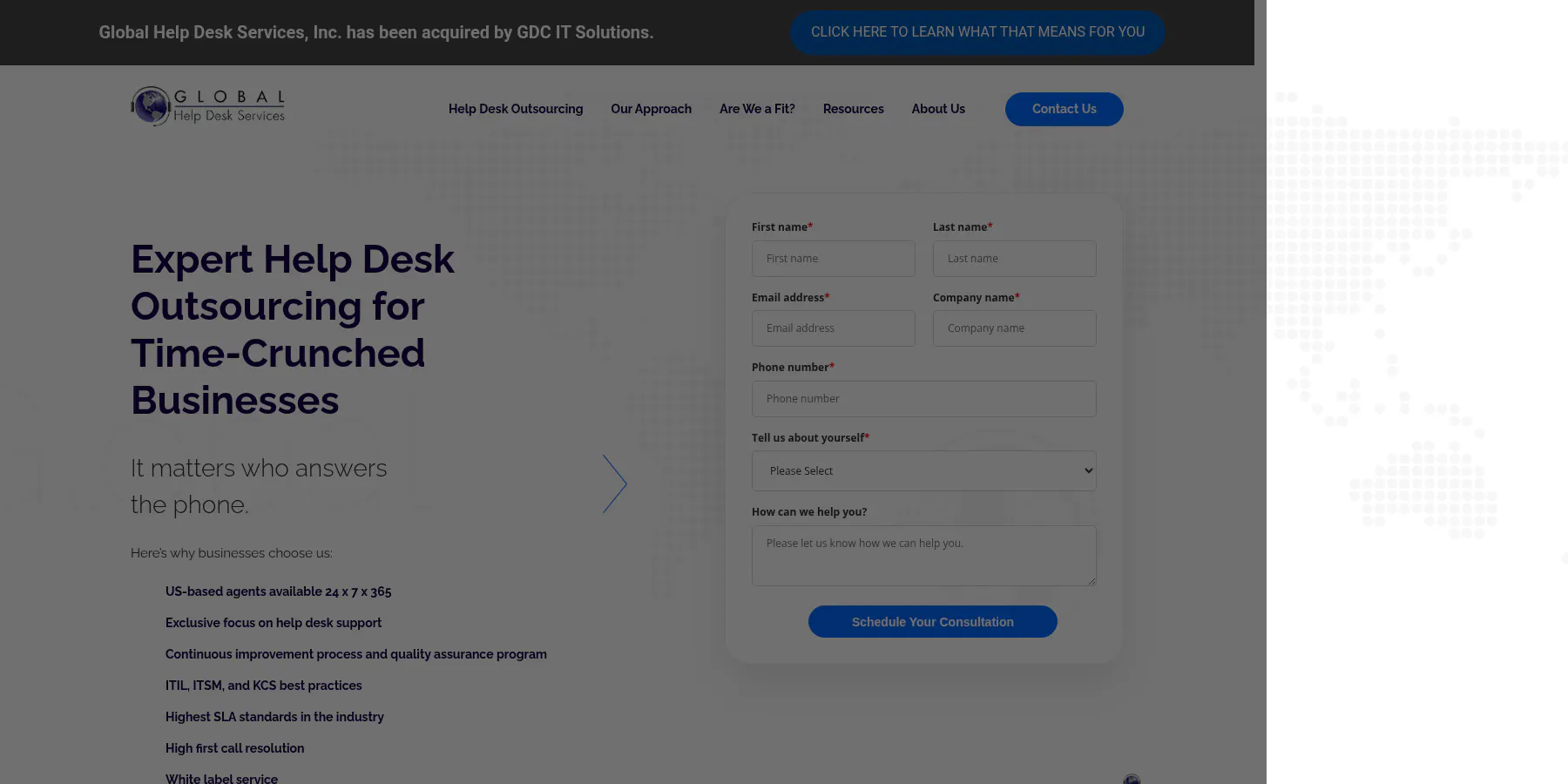
Help desk is not a service line at GHDSi. It's the entire company. As of April 2026, it's also no longer an independent one.
Score: 5.60/10
Start with what's genuinely strong. 100% US-based full-time agents, stated flatly, which is the clearest onshore commitment of any provider here. And GHDSi is the only firm on this list publishing real performance numbers: a documented client engagement moved average speed to answer from 120 seconds to 28, and call abandon rate from 20% to 2.9%. Actual metrics, on the site, where anyone can read them. The others publish coverage hours and adjectives.
On April 2, 2026, GDC IT Solutions announced an asset acquisition of GHDSi. A banner on the GHDSi homepage tells visitors their service will continue without interruption. Maybe it will. But an integration that began four months ago is the live version of the risk the ownership factor exists to measure, and a buyer signing a three-year contract in the middle of one is taking on something a buyer signing with an independent firm isn't.
The other catch predates the acquisition. GHDSi targets enterprise organizations and cites Fortune 100 clients, at 68 employees and roughly $13.2M in revenue. That's a focused shop serving large accounts, close to the opposite of this article's reader.
And being pure-play cuts both ways. Nobody here is more focused on running a desk well. But when a ticket turns out to be a firewall misconfiguration, GHDSi hands it back to your IT team. There's no tier 3 to escalate into, because tier 3 isn't the business.
Best for: Large organizations with an internal IT team that need level 1 volume absorbed by US-based agents, and that are comfortable with a provider mid-integration.
Not ideal for: Any company without in-house engineering to catch escalations, or one that specifically wants ownership stability.
Why it ranks eighth: The most operationally transparent firm on this list, aimed at a company ten times the size of this article's reader, and four months into an ownership change. It ties Electric at 5.60 and loses the review-score tiebreak.
Who didn't make the list, and why
Three groups were excluded deliberately, which matters more than usual here, because they dominate the competing rankings.
Enterprise BPOs. Accenture, TCS, Infosys, Wipro, IBM, NTT Data, HCLTech, Capgemini, Stefanini, Pomeroy. All real, all excellent at what they do, none of which is serving a 200-user company. These firms build service desks as components of multi-year transformation programs measured in thousands of seats. They appear on nearly every competing list. They will not quote a 60-person engagement.
White-label desks for MSPs. 31West, Infrassist, ExterNetworks, Worksent. Their buyer is an IT provider, not a business. Hiring one directly means becoming the integration layer between your employees and a wholesale support vendor, which is the job you were trying to outsource.
Vendors ranking themselves without disclosure. ScienceSoft places itself first on its own ranking page with no methodology and no disclosure. That's not a comment on its capability, which is real. It's a comment on the ranking, which isn't one.
TechMD was considered and cut. Strong regional provider, but its help desk offering is scoped to Southern California and this list is national.
Matching a provider to your situation
Pick on delivery model and escalation depth, not on brand recognition. Coverage hours, where agents sit, and whether the provider owns tier 3 will predict your experience better than any award.
Five questions worth answering before a demo.
How many users, honestly? Under 20, an outsourced desk is heavier than you need. A break-fix arrangement or managed IT for small businesses fits better. Between 20 and 500, most of the top five is in range, though Dataprise's plans start at 50 users. Above 500, GHDSi and All Covered become more viable and the enterprise BPOs enter the picture.
Do you already have internal IT? Changes the answer completely. A company with two internal technicians drowning in password resets wants overflow capacity, which is a co-managed IT arrangement rather than a full outsource. A company with nobody wants a provider that owns the whole stack.
Onshore or offshore, and are you willing to pay for it? Offshore desks run roughly $15 to $35 per user per month. US-based managed support runs $100 to $250 per user monthly. That's a real spread. Some companies genuinely don't need onshore support. The ones that do usually discover it during an outage, which is a bad time to find out. If it matters, get it in the contract, since Buchanan is the case study in why a marketing page saying "global reach" tells you nothing.
What happens when a ticket isn't a level 1 ticket? The question that separates these providers most and gets asked least. Roughly a quarter of tickets don't resolve on first contact even at well-run desks, where first contact resolution averages 70% to 75%. Ask specifically who handles the other quarter. If the answer is "we escalate to your team," you've bought a filter, not a help desk.
Are you buying tickets or buying fewer tickets? Cost per ticket averages about $22.50 for a resolved incident, with agent-handled contacts near $45 against $15 for self-service. A desk paid per ticket has no reason to reduce ticket volume. Flat per-user pricing plus a provider that reviews recurring issues at a strategic level does. Consilien's vCIO loop and Integris's account-assigned engineers both address this. A pure ticket-volume vendor structurally can't.
Can you see a price at all before the sales call? Six of these eight answer that with a form. Electric publishes real per-user rates, $0, $10, and $25 a month across three tiers, and Dataprise publishes named managed IT plans on a public pricing page. Those two aren't comparable to each other, since Electric is selling a lighter product, but both tell you something about how the sales process will go. A provider that won't publish a range usually won't quote one on the first call either.
One more thing that costs nothing. Ask for three references at your size, in your industry, on the same service. Not logos. Phone numbers. Providers who genuinely serve your profile produce those inside a day, because they already know which three clients will take the call and say something useful, while the ones who mostly serve someone else will need a week and come back with two.
Consilien takes first place on this list for a specific and narrow reason: it's the only provider that documents a path from repeat tickets to a security and strategy review, and it's independently owned in a market where most acquisitions now involve private equity. For a 20 to 500 user company that wants support and a plan for why support keeps getting called, that combination is the differentiator. The review sample is small, and the model that produces this ranking weights reviews lower than most buyers would.
Integris is the better choice for anyone who wants the deepest public track record, and it wins under conventional weighting. Buchanan makes more sense if formal desk certification outranks everything else. Companies with a strong internal IT team should look at Global Help Desk Services or a co-managed arrangement instead of a full outsource.
Speak to an IT expert about which model fits your environment.
What does an outsourced help desk actually cost per month?
$100 to $250 per user per month for US-based managed support, with most mid-market contracts landing near $150. Offshore runs $15 to $35. Per-ticket pricing exists too, generally $6 to $40 a ticket, though it aligns the provider's incentives against yours, since fewer tickets means less revenue for them.
Switching over slow response times: worth the disruption?
Depends what "slow" means and whether it's fixable. Response time problems usually trace to one of three things: understaffing at the provider, no defined escalation path, or a contract that never specified targets. The third is worth a conversation before a migration, since it's the cheapest to fix. If you've already had that conversation twice, the answer is different.
Will the help desk actually learn the environment, or just read a script?
This is the question to press hardest in a demo. Ask whether you get a named team or a general queue. Ntiva's pod model and Integris's account-assigned engineers are both structural answers. "Our technicians are highly trained" is not. Also ask who writes and maintains your documentation, because a desk working from stale runbooks behaves exactly like a desk that doesn't know you.
Offshore support: how bad is it really?
Not automatically bad. Plenty of offshore desks run well, and the cost difference is significant enough that dismissing them outright is expensive. Where it goes wrong is timezone-dependent escalation and accent-related friction on complex calls, both of which hit hardest in manufacturing and field-service environments where the person calling is standing next to a machine that stopped. Know which failure mode would hurt your business, then decide.
How long does a help desk transition take?
Four to eight weeks for a clean cutover at mid-market scale, assuming documentation exists. It rarely does. Discovery and documentation are where transitions actually run long, which is why the providers who front-load an environment assessment tend to hit their dates while the ones who promise a two-week cutover are usually quoting the part of the work they can see rather than the part that will eat the schedule. Ask what happens in week one before asking when go-live is.
Is compliance included?
No, and be suspicious of any provider who says otherwise. Frameworks like NIST, CMMC, PCI, and SOC 2 require gap assessments, remediation planning, and ongoing governance. That's a separate engagement with separate scope. Consilien offers compliance readiness as its own service rather than bundling it into managed IT, and no provider on this list can certify you regardless of what a service page implies. Certification comes from an external assessor.