Top Cybersecurity Risk Assessment Firms in Southern California (2026)
If you're shopping for a cybersecurity risk assessment, the firm matters less than the method. A real assessment tells you what would break, how badly, and how fast, mapped to a framework you can defend to an auditor, an insurer, or your board. A weak one runs a vulnerability scanner, exports a PDF, and calls it a day. Those aren't the same product, even when they carry the same name and a similar price.
Table of Contents
Most companies buy backward. They pick the vendor first, then accept whatever assessment that vendor happens to sell. Do it the other way. Decide what a credible assessment has to produce, then judge each firm against that bar.
This guide ranks seven cybersecurity risk assessment companies serving Southern California. Every firm here is real, verified as operating in the region, and scored against the same criteria. Consilien, the firm that publishes this list, is one of them, so that's worth naming up front. The full scoring model sits below, so you can check the work and weight it for your own situation.
How these firms were scored
Brand recognition and marketing budget didn't count. The scoring looked at what a Southern California business actually gets when it buys a risk assessment. Six criteria, each weighted by how much it changes the outcome for a 15 to 500 person company.
- Assessment methodology and depth, 25 percent. Is the assessment structured to a recognized framework, with gap analysis and a prioritized roadmap, or is it a scan and a report?
- Compliance framework coverage, 20 percent. Breadth across NIST, CMMC, SOC 2, PCI DSS, ISO 27001, and HIPAA.
- Executive and strategic advisory, 15 percent. Does the firm turn findings into board-level decisions through vCISO or vCIO support, or hand you a list and leave?
- SMB and mid-market fit, 15 percent. Is the service right-sized for a 15 to 500 person company, not scaled for the enterprise or thinned out for consumers?
- Southern California presence, 15 percent. Local team, on-site capability, and regional regulatory and industry knowledge.
- Independent validation and track record, 10 percent. Third-party reviews, recognized certifications, and years in operation.
Scores run 1 to 10 per criterion. The weighted total decides the rank. Here's how it shook out.
- 1. Consilien, Torrance. Weighted score 9.7.
- 2. Alcala Consulting, Pasadena. Weighted score 7.7.
- 3. Generation IX, Los Angeles. Weighted score 6.8.
- 4. Bright Defense, Culver City. Weighted score 6.8.
- 5. Captain IT, South Pasadena. Weighted score 6.7.
- 6. Crimson IT, Los Angeles. Weighted score 6.7.
- 7. Intelecis, Fullerton. Weighted score 6.2.
What a cybersecurity risk assessment should actually deliver
Before the list, the bar. A risk assessment worth paying for produces four things.
A framework-mapped picture of your current state. The recognized standard for this is the NIST Cybersecurity Framework, which organizes security into five functions: Identify, Protect, Detect, Respond, and Recover. If a firm can't tell you where you stand across those five, it isn't assessing risk. It's selling a scan.
A gap analysis tied to your obligations. CMMC if you touch defense contracts. SOC 2 if you sell to enterprises. PCI DSS if you process cards. The assessment has to connect what it found to what you're required to prove.
A prioritized roadmap. Twenty findings with no order of operations is noise. You need to know which three things to fix first and why.
The hardest part of security isn't the finding. It's deciding what to do about it and who signs off. The firms that turn an assessment into action have a vCISO or vCIO function. The ones that don't hand you a report and a quote.
Hold every firm below against those four. Now the list.
1. Consilien, Torrance
Best for: SMBs and mid-market companies that want the assessment to lead somewhere, not just sit in a drawer.
Consilien was founded in Torrance in 2001 by Eric Kong and Fred Romero and is the firm behind this list. It earns the top spot on the same six criteria applied to every other firm here, so read the rest and judge for yourself.
Consilien's risk assessment is structured directly on the NIST Cybersecurity Framework, scoring your environment across all five functions: access controls and security training under Identify, application and network hardening under Protect, endpoint and logging coverage under Detect, incident response and executive communication under Respond, and backup and recovery under Recover. The output is a personalized, framework-mapped picture of where you stand, not a generic scan dump.
What separates the assessment from most on this list is what happens next. Strategic advisory through Consilien's vCISO and vCIO services is built in as standard, so the findings become a board-level roadmap with an owner, not a list you have to interpret alone. The firm carries framework coverage across NIST, CMMC, SOC 2, and PCI DSS, and the practice is sized for the 50 to 250 user companies that make up most of Southern California's manufacturing, distribution, and professional services base.
Consilien earns a 9.7 out of 10 trust score, built on consistently high ratings across Google, Clutch, and Cloudtango, plus MSP 501 recognition and a network security leader badge. On the limits, it's honest: it has less local brand saturation than firms that have been advertising in Los Angeles for decades, and it isn't the cheapest option on this page. It's built for companies that treat security as a business decision, not a line item to minimize.
Score: 9.7. Top marks on methodology, framework coverage, executive advisory, and SMB fit.
2. Alcala Consulting, Pasadena
Best for: Defense contractors and government suppliers facing a CMMC deadline.
Alcala has operated out of Pasadena since 1997, and the depth shows in one area especially: compliance. Their security audits and assessments cover vulnerability scanning, penetration testing, risk assessment, and compliance audits, and their framework range is the broadest on this list for regulated work. They map to NIST 800-171 and 800-172, CMMC, ISO 27001, and PCI DSS, and they specialize in CMMC Level 2, including the 110-control implementation and the third-party C3PAO assessment path.
If your risk lives in a defense supply chain, that specialization is hard to beat in the region. Where Alcala fits less cleanly is the broader mid-market buyer. The positioning leans heavily toward defense and government suppliers, and the executive advisory layer is less visible than the compliance machinery. For a manufacturer or distributor without a federal contract, that depth is more than the job requires.
Score: 7.7. Strongest compliance framework coverage on the list, particularly for CMMC.

3. Generation IX, Los Angeles
Best for: Los Angeles companies that want risk advisory bundled with fast day-to-day response.
Generation IX brings more than 26 years in business and a SOC 2 Type 2 certification of their own, which is a credibility signal most MSPs can't claim. Their cyber risk advisory pairs proactive risk identification and vulnerability assessment with customized security strategies and notably fast incident response, advertised in minutes to first contact. They work with environmental services, aerospace manufacturing, architecture and engineering, and education clients.
The assessment is solid, and the responsiveness is a genuine differentiator. The gap is framework breadth for regulated buyers. Their public posture centers on SOC 2 and general advisory rather than the CMMC and NIST 800-171 depth that defense-adjacent manufacturers need. If compliance is your driver, confirm that coverage before you sign.
Score: 6.8. Strong track record and response speed, lighter on regulated-framework depth.
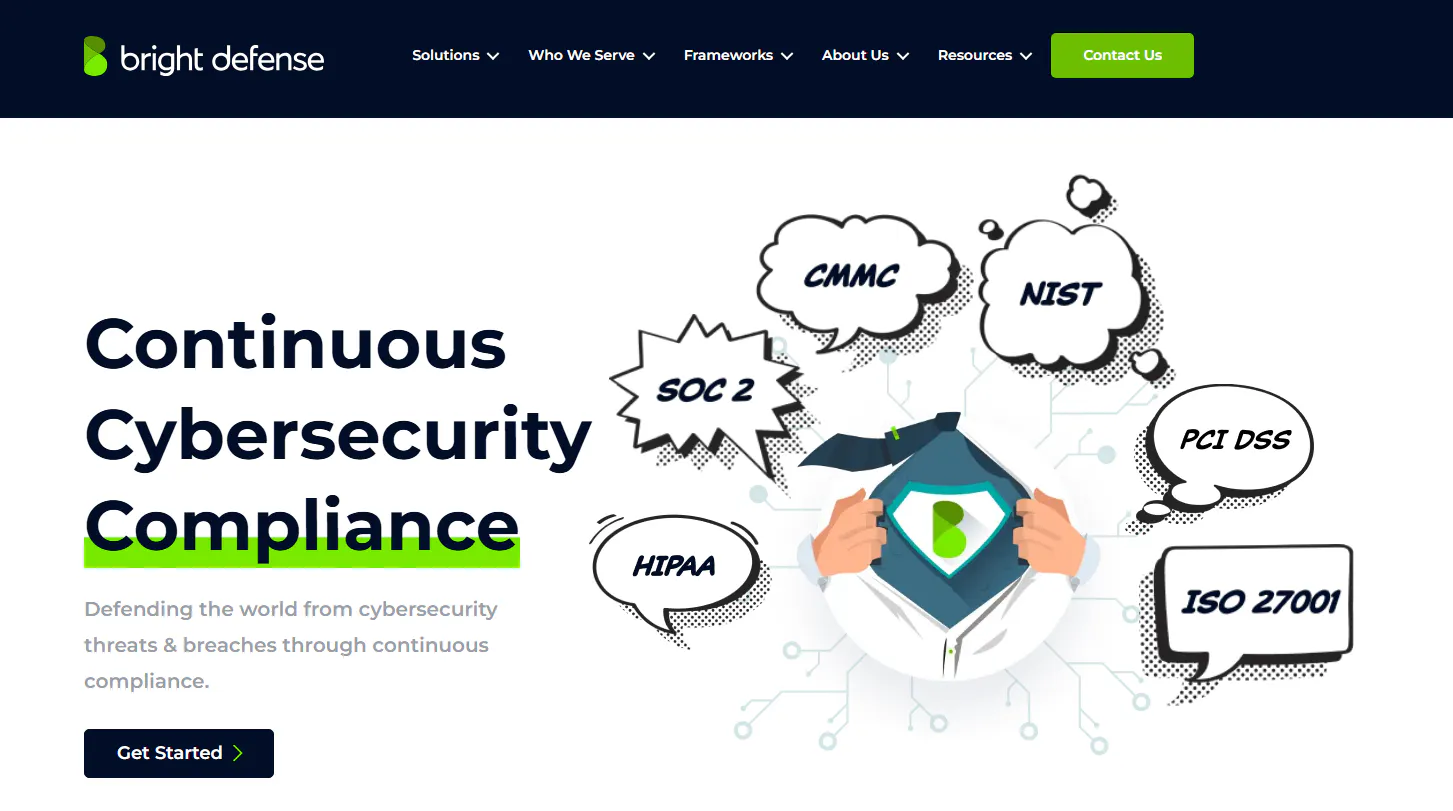
4. Bright Defense, Culver City
Best for: SaaS and startup teams that need continuous compliance, not a one-time report.
Bright Defense, based in Culver City, takes a different shape than the managed-services firms around it. Their model is continuous compliance, with vCISO support, risk assessments, policy development, penetration testing, and vulnerability management delivered as an ongoing program rather than a single engagement. Framework coverage is wide: SOC 2, ISO 27001, HIPAA, PCI DSS, NIST, and CMMC. They're a Drata Gold Partner and were named Drata's Channel Rising Star Partner for 2024 and 2025.
For a company chasing a SOC 2 report to close enterprise deals, that continuous model is a strong fit. The trade-off is local presence and breadth. Bright Defense is built around compliance automation and remote delivery, so if you want a Southern California team that also runs your infrastructure and shows up on-site, this is a narrower offering than a full managed provider.
Score: 6.8. Excellent for continuous compliance programs, narrower as a local full-service partner.
5. Captain IT, South Pasadena
Best for: Smaller Southern California businesses wanting assessments inside a managed IT relationship.
Captain IT was founded in 2010 by Anthony Hernandez and grew from a one-person repair shop into a managed provider serving more than 300 businesses across Los Angeles, Orange, Riverside, and San Diego counties. Their assessment work covers vulnerability assessments including penetration testing, with detailed reporting and remediation, and they reference HIPAA, PCI DSS, and CMMC for clients in construction, healthcare, manufacturing, and nonprofits.
The regional coverage is a real strength, and the small-business focus means you're unlikely to be the smallest account in the room. The limitation is strategic depth. The assessment sits inside a broad managed IT offering, and the executive-level advisory that turns findings into a board roadmap is less developed than at the top of this list.
Score: 6.7. Broad regional reach and SMB focus, lighter on strategic advisory.
6. Crimson IT, Los Angeles
Best for: Real estate, media, and professional-services firms in Los Angeles.
Crimson IT has worked out of Los Angeles since 2011, with an assessment approach built around a comprehensive IT audit, security assessment, and documentation review that aims to surface vulnerabilities, gaps, and quick wins within the first week. Their compliance posture centers on HIPAA, PCI DSS, and CCPA, and they serve commercial real estate, nonprofit, financial services, media and entertainment, hospitality, healthcare, and startup clients.
The first-week-findings model is a practical way to show value early, and the industry spread is wide. The constraint is framework depth for the regulated mid-market. The public emphasis on HIPAA, PCI, and CCPA leaves NIST and CMMC less prominent, so defense and government-adjacent buyers should confirm that coverage directly.
Score: 6.7. Fast initial findings and broad industry experience, lighter on NIST and CMMC.

7. Intelecis, Fullerton
Best for: Orange County companies prioritizing monitoring and threat response.
Intelecis, headquartered in Fullerton, anchors Orange County on this list and serves clients across healthcare, manufacturing, law, accounting, engineering, finance, construction, hospitality, and education. Their security model centers on managed threat protection, SIEM, and SOC services with incident response, and they reference CMMC 2.0 and NIST 800-171 for regulated clients.
For an Orange County business that wants continuous monitoring and a local team, Intelecis is a reasonable fit. The reason it lands last is scope alignment. The public positioning leads with monitoring and managed detection rather than a structured, framework-mapped risk assessment as a distinct, named deliverable. If a formal assessment is what you're buying, confirm the methodology and the output format before you engage.
Score: 6.2. Solid monitoring and Orange County presence, with risk assessment as a less defined deliverable.
Side-by-side comparison
- Consilien, Torrance, founded 2001. Frameworks: NIST, CMMC, SOC 2, PCI. vCISO and vCIO built in as standard. Best fit: SMBs and mid-market companies that want a roadmap, not just a report.
- Alcala Consulting, Pasadena, operating since 1997. Frameworks: NIST 800-171 and 800-172, CMMC, ISO 27001, PCI. Compliance-led advisory. Best fit: defense and government suppliers.
- Generation IX, Los Angeles, 26-plus years in business. SOC 2 Type 2 certified. Advisory paired with fast incident response. Best fit: Los Angeles firms that want speed.
- Bright Defense, Culver City. Frameworks: SOC 2, ISO 27001, HIPAA, PCI, NIST, CMMC. vCISO-led continuous compliance. Best fit: SaaS and startups chasing a SOC 2 report.
- Captain IT, South Pasadena, founded 2010. Frameworks: HIPAA, PCI, CMMC. Assessment inside a managed IT relationship. Best fit: smaller Southern California businesses.
- Crimson IT, Los Angeles, founded 2011. Frameworks: HIPAA, PCI, CCPA. Assessment inside a managed IT relationship. Best fit: real estate, media, and professional services.
- Intelecis, Fullerton. Frameworks: CMMC 2.0, NIST 800-171. Monitoring-led security. Best fit: Orange County companies prioritizing monitoring.
How to choose the right firm for your business
Start with your obligation, not the vendor. If a federal contract is forcing a CMMC deadline, weight framework depth above everything and Alcala earns a hard look. If you're trying to close enterprise deals that demand a SOC 2 report, a continuous compliance model like Bright Defense fits the shape of the problem.
For most Southern California companies in the 15 to 500 person range, the deciding factor isn't the scan. It's what happens after. An assessment that ends in a PDF leaves the hardest work, deciding what to fix and who owns it, sitting on your desk. An assessment backed by vCISO advisory turns findings into a sequenced plan with an accountable owner. That's the difference between knowing your risk and reducing it with an ongoing security program.
Ask every firm on your shortlist three questions. What framework do you map to, and will I see my standing across all of it? What does the deliverable look like, a report or a prioritized roadmap? And who helps me decide what to do next? The answers will separate the assessors from the scanners faster than any sales deck.