Top Compliance Risks Manufacturing Companies Overlook in California
Manufacturing companies in California often overlook major compliance risks, not because they ignore regulations, but because execution gaps go unnoticed. The most neglected risk factors are the failure to properly comprehend the exposure limits set under Proposition 65, failure to properly comply with regulations at various facilities, lack of proper environmental monitoring, failure to properly align their cybersecurity with National Institute of Standards and Technology (NIST) frameworks, and too much reliance on suppliers to ensure compliance.
Table of Contents
What Are Manufacturing Compliance Risks?
Manufacturing compliance risks are operational, environmental, safety, and cybersecurity exposures that arise when a company fails to meet regulatory requirements, such as workplace safety regulations, environmental regulations, product regulations, and data protection regulations.
California’s Manufacturing Compliance Risks
Manufacturing companies in California are exposed to compliance risks from the following regulatory bodies:
- California Office of Environmental Health Hazard Assessment
Chemical exposure and Prop 65 - California Division of Occupational Safety and Health
Workplace Safety and Reporting - U.S. Environmental Protection Agency
Federal regulations - California Air Resources Board
Air Quality and Emissions - State Water Resources Control Board
Water regulations - National Institute of Standards and Technology
Cybersecurity regulations, especially for defense and the supply chain
Key reality: These frameworks don’t operate in isolation. Most compliance failures happen in the gaps between them.
The Most Overlooked Manufacturing Compliance Risks in California
Key Compliance Risks
- Misinterpreting Prop 65 thresholds
- Lack of continuous compliance
- Multi-site inconsistencies
- Environmental monitoring gaps
- Cybersecurity blind spots (NIST/CMMC)
- Supplier compliance assumptions
- Misaligned documentation
1. Misinterpreting Prop 65 Exposure Thresholds
Many manufacturers assume that if a chemical is present, a warning is required; in some cases, no warning is needed without validation.
Reality:
- Safe harbor levels are highly specific
- Enforcement often comes via private lawsuits, not regulators (OEHHA)
- Misinterpretation leads to over-labeling or legal exposure
2. “Audit Passed” But Not Continuously Compliant
Audit readiness ≠ operational compliance.
Common gap:
- Policies exist
- Controls documented
- But execution drifts over time
According to the U.S. Environmental Protection Agency, many violations stem from monitoring and reporting failures, not intentional misconduct.
3. Multi-Site Inconsistency Across Facilities
What leadership sees:
- Standardized compliance program
What actually exists:
- Different processes at each plant
- Local workarounds
- Inconsistent documentation
This is one of the highest-risk blind spots in California manufacturing.
4. Environmental Monitoring Gaps (Air, Water, Waste)
Regulatory compliance is often compromised when the following monitoring aspects are overlooked:
- Manual processes
- Sporadic processes
- Lack of integration between different processes
Cases of regulatory non-compliance with agencies such as the California Air Resources Board and the State Water Resources Control Board mostly revolve around continuous compliance rather than single-point-in-time reporting.
5. Cybersecurity Compliance Blind Spots (NIST, CMMC)
New cybersecurity requirements are increasing pressure on manufacturers to comply:
- Defense contractors
- NIST SP 800-171 / CMMC
- Supply chain partners security requirements
Recently, the Cybersecurity and Infrastructure Security Agency has named manufacturing as one of the prime sectors under threat of ransomware.
Common issue:
- IT handles security
- The compliance team handles audits
- No integration between the two
6. Supplier and Third-Party Compliance Assumptions
Manufacturers often assume:
- Suppliers are compliant
- Certifications are current
- Documentation is accurate
In reality:
- Supplier risk is rarely validated
- Liability still flows upstream
7. Documentation That Doesn’t Reflect Reality
This is one of the most common enforcement triggers:
- Procedures exist
- Records are complete
- But actual practices differ
Regulators and litigators look for this gap.
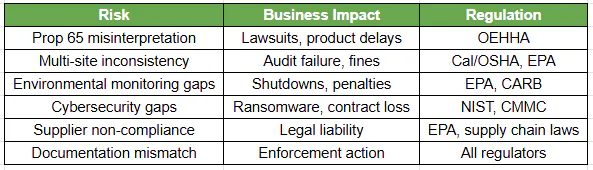
Table – Compliance Risk vs Business Impact vs Regulation
Why Most Manufacturers Miss These Risks
The root causes are operational:
- Siloed teams (EHS, IT, compliance don’t align)
- Internal IT teams are overloaded
- Compliance is treated as a checklist, not a system
- Lack of real-time visibility
The Compliance vs Reality Gap
Most manufacturers operate in two states:
- On paper: compliant
- In practice: exposed
This gap is where:
- Fines happen
- Lawsuits start
- Contracts are lost
How to Reduce Compliance Risk (Operator-Level Guidance)
- Execution, not documentation
- Centralize all site compliance
- Move from periodic audits → continuous monitoring
- Align IT, Security, and Compliance
- Validate supplier compliance
- Prepare for enforcement, not audits
How Consilien Helps Manufacturers Stay Audit Ready
Consilien solves the underlying issue: integration of IT, Security, and Compliance.
What this looks like in practice:
- Co-managed IT model
Supports internal teams without replacing them - vCIO leadership
Aligns compliance with business operations - vCISO oversight
Integrates cybersecurity into compliance posture - Compliance readiness
Focused on audit survival and risk reduction—not checkbox certification - Predictable cost structure
No surprise remediation cycles