Building a Technology Roadmap: What Businesses Get Wrong
Seven technology roadmap mistakes do most of the damage: starting from a tool list, treating the budget as the roadmap, missing hard dates, ignoring tech debt, adding tools without retiring old ones, running AI pilots with no exit rule, and never reviewing it.
Table of Contents
A technology roadmap is the dated order in which you'll replace, add, retire, and pay for technology, tied to where the business is going over the next 2-3 years. Plenty of businesses have one. Far fewer have one that survived its first year. When I start virtual CIO (vCIO) work with a new leadership team, the old roadmap usually turns up in a shared drive, untouched since the meeting where it was presented.
It rarely failed because somebody picked the wrong firewall. It failed because it answered the wrong question.
Gartner's 2025 CIO survey of 3,186 CIOs and technology executives found that only 48% of digital initiatives meet or exceed their business outcome targets. Coin-flip odds. And those are organizations with full-time CIOs.
1. Why does starting with a technology list sink the roadmap?
A roadmap built from a list of technology wants has nothing to defend it when money gets tight. Start with the business plan, the hires, sites, customers, and contracts coming in the next 24 months, then work backward to the technology that has to be ready.
The list version is easy to spot. "Upgrade to Wi-Fi 7. Move file shares to SharePoint. New firewall in Q3." Every item might be reasonable. None of them says why.
Compare that with a roadmap that opens with "second warehouse in Dallas, live by June." Now the network, the phones, the badge readers, and the shipping software all have a date, and the CFO can see exactly what slips if the budget gets cut. A technology list gets negotiated down line by line. A business plan gets funded, because everyone in the room already agreed to the plan.
The quickest test? Ask whoever owns each line item which business goal it serves. A pause is your answer.
2. Isn't the IT budget basically the roadmap?
No. The budget says how much you'll spend this year. The roadmap says what has to happen, in what order, over several years, and why. A budget built from last year's actuals plus 5% is a forecast of habits, not a plan.
Here's how they differ in practice:
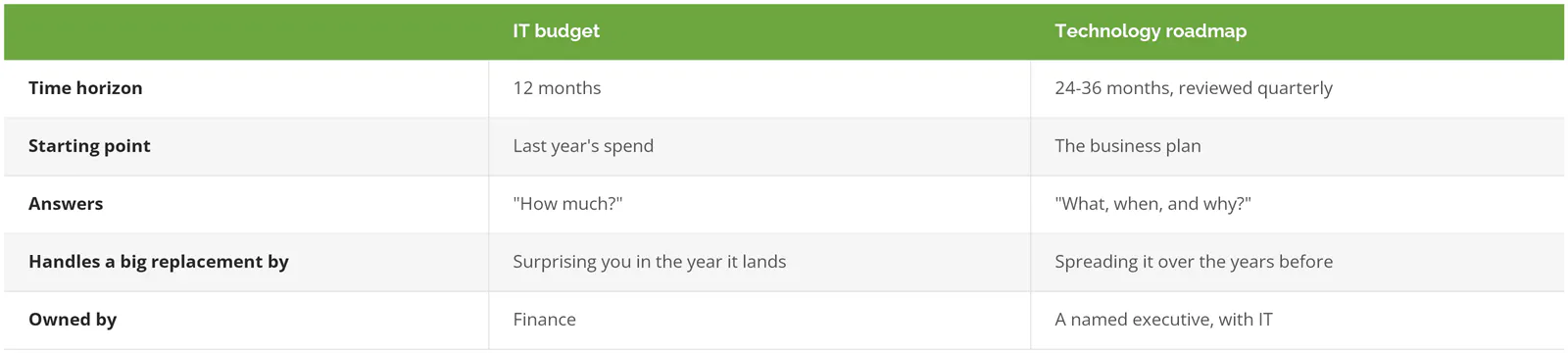
The budget should come out of the roadmap. When it's the other way around, the big items always show up as emergencies. A server that's 7 years old doesn't fail on a schedule, and nobody budgets $60k for something that isn't on a list.
3. Leaving hard dates off until they force themselves on
Some dates aren't yours to choose. Vendor end-of-support, cyber insurance renewals, lease expirations, and contract or audit deadlines all land whether you planned for them or not.
Windows 10 is the recent example everyone lived through. Microsoft ended support on October 14, 2025, announced years ahead. Businesses with a roadmap had replaced or upgraded those PCs in waves, a few departments a quarter. A 40-person office without one was shopping for 40 laptops in September, at whatever price and lead time the market offered, or paying Microsoft for extended security updates to buy a year.
Security belongs on this calendar too, and it's where the cost of missing a date gets ugly. IBM's 2026 report puts the global average cost of a data breach at $4.99M. A system past end-of-support stops getting security patches, which makes it one of the easier doors to leave open.
Your insurance renewal questionnaire is a roadmap input. So is any compliance framework a customer contract requires, whether that's CMMC, PCI, or SOC 2. Those are separate projects with their own owners and budgets, but the deadlines belong on the same calendar as everything else, or they collide with it.
4. Funding new projects while the old debt keeps growing
Tech debt is the backlog of shortcuts, aging systems, and "we'll fix it later" decisions that make every new project cost more. A roadmap that only funds new work quietly hands part of each new budget to old problems.
Two surveys put a number on it. In a 2020 McKinsey survey of CIOs, respondents estimated that 10-20% of the technology budget meant for new products gets diverted to resolving tech debt. That sample was large financial-services and tech companies, and it only counts money meant for new work. Smaller companies aren't immune, though. A 2021 OutSystems survey of 500 IT leaders found small businesses spend about 27% of their IT budget on it.
What does that look like on the ground? Picture an ERP upgrade (the system that runs orders, inventory, and accounting) quoted at 4 months that ends up taking 9, because the custom reports nobody documented have to be rebuilt by hand.
The fix isn't glamorous. Put a debt line on the roadmap every year, with named items: the server that's out of warranty, the database nobody understands, the one-off integration a contractor wrote in 2019. Then pay it down on purpose.
5. Adding tools without retiring any

Every tool on a roadmap should come with a retire-by date for whatever it replaces. Without one, you pay for both, your team supports both, and your attack surface (the number of places an attacker can get in) grows with every login.
Zylo's 2026 SaaS Management Index found that only 54% of SaaS licenses (paid seats in cloud software subscriptions) get used in the average enterprise, and that organizations carry about 305 apps. Those are mostly large companies. The pattern scales down fine, though. A 60-person firm paying for Zoom, Teams, and a GoTo phone system at the same time is a smaller version of the same problem.
More tools don't lower risk. Clarity does. Each app is another vendor holding your data, another password to manage, another account someone forgets to shut off when an employee leaves.
6. Running AI pilots with no rule for stopping them
The newest roadmap mistake is a line that just says "AI." Gartner's survey of 2,002 CIOs, released October 19, 2026, found only 13% say their enterprise has gotten significant value from AI so far. The likelihood of any single use case succeeding is about one in five.
The useful part of that research is what separated the winners. Organizations with written guidelines for when a pilot should not move to production were 2.3 times more likely to be in the top-performing group, and those with rules for shutting down low-value AI already in production were 2.6 times more likely. Only 31% and 17% of CIOs, respectively, have those rules.
So before an AI project goes on the roadmap, write down 3 things. What number has to move, by how much, and by what date. If it doesn't move, the pilot ends and the budget goes back in the pool.
7. Writing it once and filing it
A roadmap without an owner and a review date is just a file. It needs one executive who answers for it, a quarterly review against what actually happened, and a full rebuild once a year alongside the budget.
The quarterly review is short. An hour, maybe 90 minutes. What shipped, what slipped, what changed in the business, and what moves as a result. A new customer contract, an acquisition, a key person leaving, a vendor raising prices 30% at renewal. Any of those can reorder the next 2 quarters.
And the owner can't be IT alone. IT knows what's breaking. Leadership knows where the business is going. The roadmap is where technology strategy and the business plan have to meet, and if nobody on the leadership team is accountable for it, it drifts back into being a tech list. See mistake #1.
How do you check your own technology roadmap?
Answer these 7 questions with a plain yes or no. Three or more "no" answers means you have a list with dates on it.
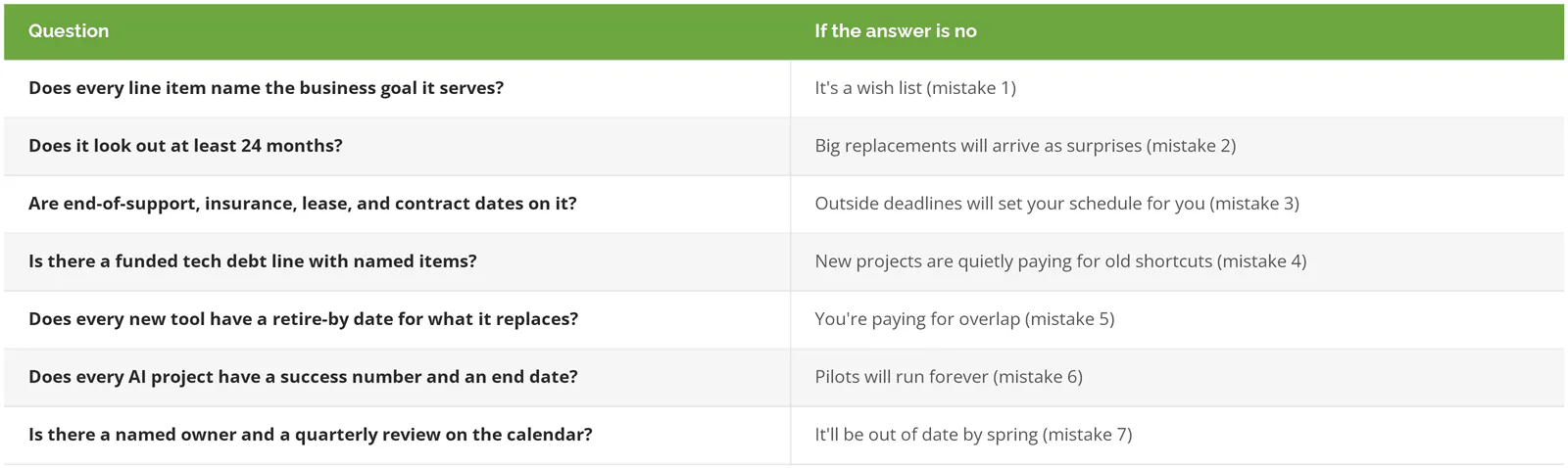
If you're a company with a full-time CIO who already runs this review every quarter, you probably don't need outside help. Use the table as a gut check and move on. If the roadmap lives in one IT person's head, or in a deck nobody has opened since it was presented, that's the gap a fractional CIO fills. Consilien is a managed IT and cybersecurity firm, and its vCIO service builds and maintains technology roadmaps for businesses nationwide, sitting in on the quarterly reviews so the plan keeps up with the business.
If you'd like a second set of eyes on yours, speak to an IT strategy expert and bring the current version, however old it is.