MSP 501 2026: What a Back-to-Back Ranking Actually Tells You
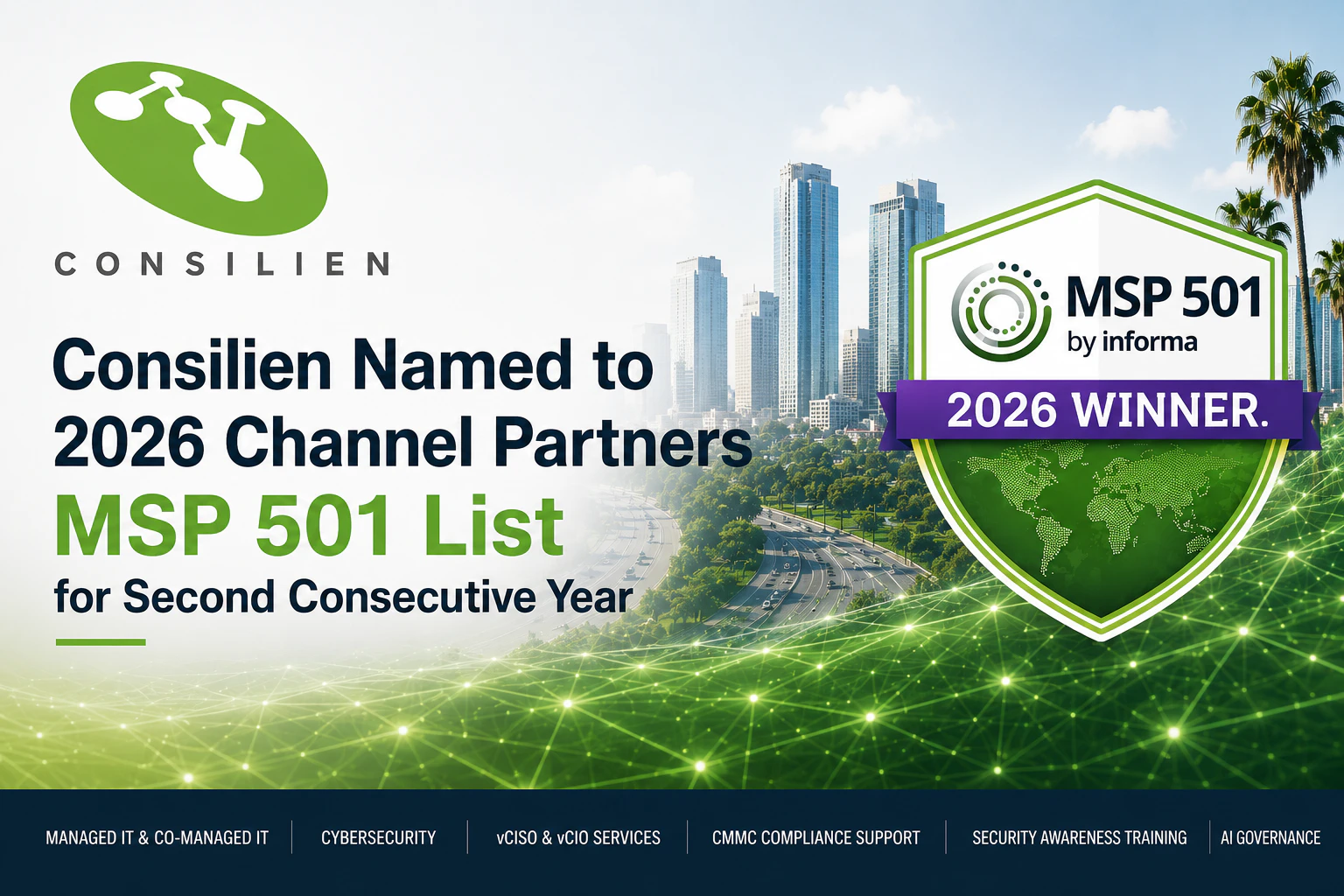
The 2026 Channel Partners MSP 501 ranks the world's top managed service providers by verified revenue, growth, and recurring revenue. Consilien placed for the second year running, at #306 globally. For buyers, that signals financial durability, not automatic fit.
Table of Contents
Consilien made the 2026 MSP 501 for the second consecutive year, ranked #306 worldwide. The list is data-driven, not pay-to-play, so it's a real signal of financial health and recurring-revenue discipline. But a badge doesn't prove a provider fits your business, your security needs, or your response-time expectations. Below is what the ranking proves, what it can't, and how to vet any MSP that waves one at you.
If you're shopping for a managed IT services partner this year, a badge on a website is easy to trust and easy to overrate. We just earned a spot on the 2026 MSP 501 for the second year in a row, and I'd rather use that as a teaching moment than a victory lap. The honest question isn't whether a provider won an award. It's what the award measures, and whether that overlaps with what you actually need.
Most vendor awards you see online are marketing. You pay, you post the logo. The MSP 501 is one of the few that isn't. So it's worth understanding, and it's worth being skeptical about at the same time. We wrote about last year's MSP 501 recognition too, and the story this year is not "we won again." It's that a ranking can tell you something real and still leave out the thing that matters most to you.
What is the Channel Partners MSP 501?
The MSP 501 is an annual global ranking of the top 501 managed service providers, produced by Channel Partners and The MSP Summit. It scores providers on verified business performance, not reputation or marketing spend.
It's now in its 19th year, which makes it the oldest and largest ranking of its kind. Providers submit two years of financials. The MSP Summit content team collects and analyzes the data independently, then an algorithm weighs revenue, growth, profitability, and recurring revenue to build the list. Winners were revealed in June, with the awards gala set for MSP Summit in Orlando this September.
Think of it less like a popularity contest and more like a credit check. It reads the books. It doesn't read the reviews.
What does ranking #306 out of tens of thousands really mean?
It means Consilien cleared a high bar twice. #306 sits in the back half of the 501, and I'm not going to dress that up. But the 501 itself is filtered from tens of thousands of MSPs operating worldwide, and the repeat placement is the part that carries weight.
One year on a list can be a good year. Two years running is a pattern. The global MSP market is enormous and deeply fragmented, with the largest players holding less than 10% of combined share. Getting counted among the top few hundred, back to back, in a field that crowded says the business is built to keep going. Not built to peak once.
The 2026 class averaged around 10% revenue growth, and recurring revenue made up close to 60% of their business. That second number is the one buyers should care about. Recurring revenue means clients renew. Clients renew when the work holds up.
Bias disclosed, because you should expect it from me. We benefit when you hire us. So don't take the ranking as my sales pitch. Take it as one input, weigh it against the ones below, and make the call yourself. Here's the honest split.
Start with what the MSP 501 actually measures.
- Verified revenue and growth
- Recurring-revenue strength and retention
- Profitability and operational efficiency
- Two years of attested financials
- Business durability over time
Now the part it stays silent on.
- Whether the provider fits your industry
- Your real response time when something breaks
- Security maturity and certifications
- How they handle an incident at 2am
- Culture fit with your team
Is the MSP 501 pay-to-play?
No. There's no fee that buys a ranking, and the revenue figures are independently attested rather than self-reported into a vacuum. That's the whole reason it carries weight inside the channel.
This matters more than it sounds. A lot of "Top 10 IT Companies in [Your City]" lists are ad products. You buy the placement, sometimes the trophy, sometimes both. Those lists rank nobody. They rank whoever paid. The MSP 501 runs the other way. Providers hand over 2024 and 2025 financials, and the MSP Summit methodology scores the numbers. So when you see the two side by side, treat them differently.
A ranking you can buy tells you a company has a marketing budget. A ranking you have to earn with attested financials tells you the company can survive a bad quarter. Those are not the same signal.
What a ranking can't tell you before you sign
This is where most buyers get burned. A provider can be financially excellent and still be wrong for you. The 501 grades the MSP's business. It says nothing about the outcome you'll actually get.
I've watched companies pick a provider off a badge and skip the questions that decide everything. Then six months in, a server goes down on a Friday, the ticket sits until Monday, and they learn the SLA never actually promised a response time. The award was real. The fit wasn't.
Financial durability doesn't tell you the engineer-to-user ratio. It doesn't tell you whether the provider carries a SOC 2 Type II attestation on its own operations. It won't tell you if they've ever run an environment like yours, or what happens to your documentation the day you leave. A ranking measures the seller. You're buying an outcome. Mind the gap.
How to vet any MSP, badge or not

Run the same checks whether or not the provider made a list. A strong ranking earns a provider a longer look. It doesn't earn them a shortcut past your diligence. Cyber insurer Beazley publishes a solid list of questions to assess an MSP, and most of it comes down to five things.
- Ask for the SOC 2 Type II report on their own environment. Not a promise they'll secure yours. Proof they secured theirs first.
- Get the response-time commitment in writing, with the penalty if they miss it. "We're responsive" is not an SLA. A number is.
- Three references at your size, in your industry. If they can't produce them, you're the reference they don't have yet.
- What's the engineer-to-user ratio? Somewhere around one engineer per 60 to 100 users is healthy. Push past 120 and your tickets sit while engineers firefight.
- How do you get your data and documentation back when the contract ends? A mature provider answers this without flinching, because they've offboarded before.
Security depth deserves its own conversation. Ask who runs their security operations, whether they enforce MFA on their own privileged accounts, and how they'd handle a breach in your environment. If those answers are vague, keep looking. This is exactly where virtual CISO services and real managed cybersecurity separate the serious providers from the help desks with a nicer logo.
Why durability matters more in 2026
The stakes moved. Roughly 43% of cyberattacks now target small and mid-sized businesses, and the majority of SMBs report a breach in the past year. Small companies used to assume they were too small to bother with. That assumption is gone.
Downtime is the other half. When systems go dark, the meter runs on lost revenue, idle staff, and recovery, and Splunk's research on the hidden costs of downtime puts the total far higher than most owners guess. A provider that folds or gets distracted in a bad year is a provider that isn't there when your server is.
Compliance raised the floor too. The Department of Defense's CMMC final rule took effect November 10, 2025, and certification is now a condition of winning many defense contracts. If you're a manufacturer or a supplier in the defense chain, your IT partner's stability is no longer just an uptime question. It's a can-you-keep-your-contracts question. Worth saying plainly, our compliance readiness and CMMC compliance support are a separate offering, not something bundled into managed IT and hoped for. Compliance done as an afterthought is compliance that fails an assessment.
So durability isn't a nice-to-have on a scorecard. In a year where the threats went up and the rules got stricter, it's the whole point.
What the recognition means for Consilien clients
Consilien is a security-first managed IT and cybersecurity firm, founded in 2001 and headquartered in Torrance, California. We serve small businesses and mid-market companies from 20 to 500 users across manufacturing, distribution, defense supply chain, real estate, and professional services. We deliver managed and co-managed IT, cybersecurity, vCISO and vCIO advisory, CMMC readiness, and AI governance.
What makes us different is that strategy and security aren't upsells here. vCIO and vCISO guidance come standard, and compliance is run as its own discipline rather than a checkbox tucked inside a support plan. The MSP 501 placement is a byproduct of that model working, two years running. It's earned recognition based on performance, not a reputation we bought.
That's the read I'd want you to take. Not "Consilien won, so hire Consilien." More like, "here's a signal that the business is built to last, now go run your checklist."
The Takeaway
The 2026 MSP 501 is a real, data-driven signal that a provider has financial staying power and recurring-revenue discipline. Consilien earning it back to back at #306 says the model holds up over time. But no ranking measures fit, security depth, or how a provider behaves at 2am. Use the list to build your shortlist. Use the vetting checklist to make the actual decision.
If you're weighing IT providers this year and want a straight read on which questions actually separate them, speak to an IT expert at Consilien. And if you're early in the process, our take on local versus national providers is a useful next step.