How Much Does IT Consulting Cost in 2026?
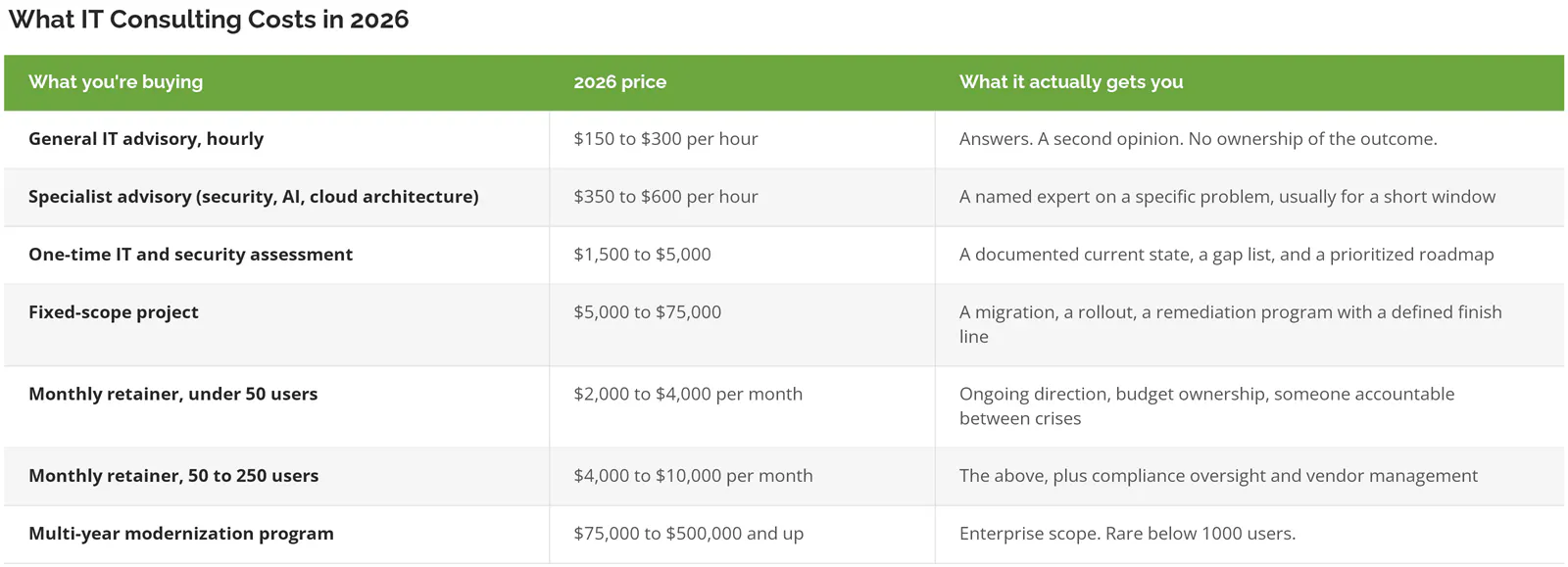
IT consulting costs $150 to $300 per hour in the United States in 2026. Fixed-scope projects run $5,000 to $75,000. Monthly retainers run $2,000 to $10,000 for companies under 250 users.
Table of Contents
Three numbers carry this whole conversation. The hourly rate, the size of the scope, and whether you're buying advice or buying accountability. That last one moves the price more than geography ever will, and it's the part buyers skip when they call around for rates. This guide breaks down what each model costs, when hiring beats consulting, and what IT consulting for a small business actually includes.
PayScale puts the average self-employed IT consultant at roughly $55 an hour. The invoice on your desk says $225. Same person, in some cases. So where does the other $170 go?
Some of it is overhead you'd rather not pay for and can't avoid. Insurance, tooling, certifications, the security stack the consultant runs your assessment on. Some of it is bench, meaning the engineers a firm keeps employed so that when your file server dies at 4pm on a Friday somebody senior picks up instead of a voicemail box. And some of it is margin. Nobody itemizes that one.
Ask which is which. The firms that answer are the ones worth quoting.
What Does IT Consulting Cost in 2026?
Expect $150 to $300 an hour for general technology advisory, $1,500 to $5,000 for a one-time assessment, $5,000 to $75,000 for a fixed-scope project, and $2,000 to $10,000 a month on retainer. Security and AI specialists run higher.
Those bands hold across the US market for companies in the 20 to 1000 user range. Below $150 an hour you're buying a generalist or an offshore team. Usually both. Above $300 you're buying a named specialist in security architecture, cloud design, or AI governance, and the premium is real rather than positioning. Geography matters less than it used to. Delivery is remote now.
Rates moved this year, and not by a small amount. Gartner projects worldwide IT spending at $6.37 trillion in 2026, up 14.2%, with AI spending climbing 47% on its own. Demand at that scale pulls senior people toward AI work and out of everything else. Your firewall replacement is now competing for the same engineer as somebody's model deployment. So when your renewal quote comes back higher than last year, what actually moved? The labor market did, not the sales team.
What Are You Actually Paying For at $250 an Hour?
You're paying for one of two things. Advice, or accountability. Advice is cheaper, arrives as a document, and stops when the meeting ends. Accountability costs more. Someone stays on the hook for whether it worked.
Sounds academic. It stops sounding academic when the invoice arrives. A consultant who produces a 40-page assessment and a roadmap has delivered exactly what you bought. If nothing in that roadmap gets built, that isn't a failure of the engagement. It's a failure of the scope. You bought a document.
Four billing models. Each one draws that line somewhere different, and the difference is where your money goes.
- Hourly. You pay for time. The consultant has no financial interest in how fast the problem gets solved, which is worth saying out loud rather than pretending otherwise. Good for a bounded question. Bad for anything open-ended.
- Fixed-scope project. Price agreed up front against a written statement of work. Risk shifts to the firm. That's why the number looks high right up until you compare it against an hourly engagement that quietly ran 40% over its estimate and nobody flagged it until the third invoice.
- Retainers usually price below the equivalent hourly rate, because you're committing and they're planning capacity around you. Accountability starts appearing in the contract here.
- Value-based pricing exists too, priced as a share of the value created. Rare below the enterprise tier. It's also hard to write cleanly for infrastructure work, where most of the value is an outage that doesn't happen and a lawsuit nobody files, neither of which shows up on a spreadsheet anyone can audit.
A local consulting engagement priced hourly and one priced on retainer can quote within a few thousand dollars of each other for year one. By year two they've diverged completely, because the hourly relationship has no structural reason to get more efficient while the retainer firm is carrying the cost of every hour it takes to fix something twice. Year three isn't close.
What Moves Your Number Up or Down?
Seven things, roughly in order of how hard they hit the quote.
User count. The most honest driver, and the first question any competent firm asks. It scales the work, the licensing, and the number of conversations.
Everything after that is judgment.
How much mess is already there. An environment with documented systems, current patching, and one identity provider quotes low. An environment with three domains, a server nobody will turn off because "something might be running on it," and a former IT vendor who left no documentation at all quotes high, because somebody has to reverse-engineer six years of undocumented decisions before a single recommendation can be written down. Discovery on the second one takes weeks. Firms that quote both the same are guessing.
Compliance load. CMMC, SOC 2, PCI, or alignment to the NIST Cybersecurity Framework adds evidence work, control mapping, and audit coordination that pure IT strategy doesn't carry. It's why compliance readiness work is priced as its own engagement rather than folded into a general consulting retainer. Different deliverables, different clock.
Industry. Manufacturing carries operational technology on the plant floor that a lot of consultants have never touched, and pricing an engagement around a 15-year-old programmable logic controller that runs a production line and can't be patched during business hours is a different exercise entirely. Financial services carries regulatory review. Both cost more than a professional services firm with 60 laptops and Microsoft 365.
Speed. A remediation that has to close before a customer audit in six weeks is priced differently than the same remediation with nine months. Urgency is a real line item. Nobody itemizes it.
Whether execution is included. Advice-only is the cheapest thing on the menu. It's also the least likely to change anything.
Seniority. Bureau of Labor Statistics data puts the median computer systems analyst at $105,850 against $175,140 for an IT manager, both as of May 2025. That's a 65% spread inside the same department, and consulting rates track it. A firm that sends a senior architect to your discovery and a junior to your delivery is arbitraging that gap. Ask who does the work, not who does the pitch.
Is a Consultant Cheaper Than Hiring a Full-Time IT Leader?
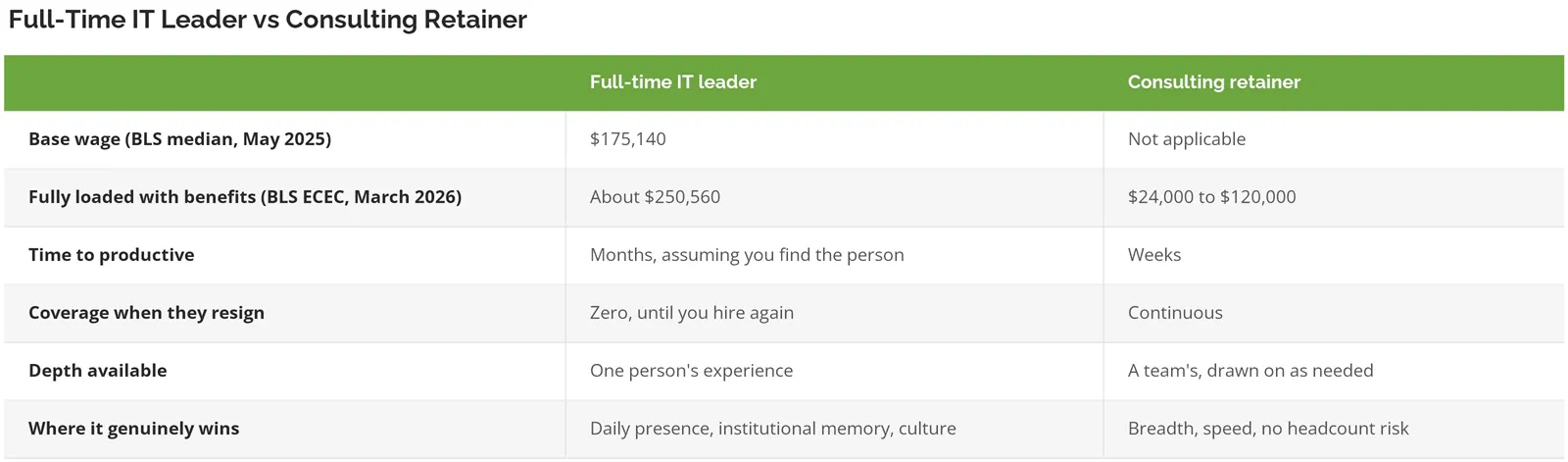
Usually, yes, and by more than the salary comparison suggests. A full-time IT leader costs roughly $250,000 a year fully loaded. A consulting retainer runs $24,000 to $120,000. The gap is wider than most budget conversations assume.
That $250,000 comes from two government datasets nobody bothers to look up. The Bureau of Labor Statistics puts the median wage for computer and information systems managers at $175,140 as of May 2025, with the bottom 10% at $107,550 and the top 10% above $297,510. That's wages only.
Then apply the multiplier nobody applies. BLS Employer Costs for Employee Compensation for March 2026 puts wages at 69.9% of what an employer actually spends per private-sector worker, with benefits making up the other 30.1%. Divide $175,140 by 0.699 and the real cost of that seat is about $250,560. Before recruiting fees. Before the months it sits empty. Before the severance if it doesn't work out. So which line does your CFO actually see, the salary or the number that hits the P&L?
The hiring market isn't helping. BLS projects 16% growth in that occupation through 2035, around 53,500 openings a year. Senior IT leaders aren't sitting around waiting for your posting.
None of which makes hiring wrong. If you need someone in the building every day, who knows why the 2019 acquisition left you running two ERP systems and who can walk down to the plant floor when a line stops, hire. Institutional memory is worth real money. Consultants don't accumulate it the same way. Run the virtual CIO against a full-time hire comparison on your own numbers, not a generic table.
Consultant, vCIO, or MSP. Which One Does Your Problem Need?
A consultant answers a question. A vCIO owns the roadmap and the budget. An MSP, meaning a managed service provider, runs the daily operation. Buying the wrong one is the most expensive mistake in this category. It happens constantly.
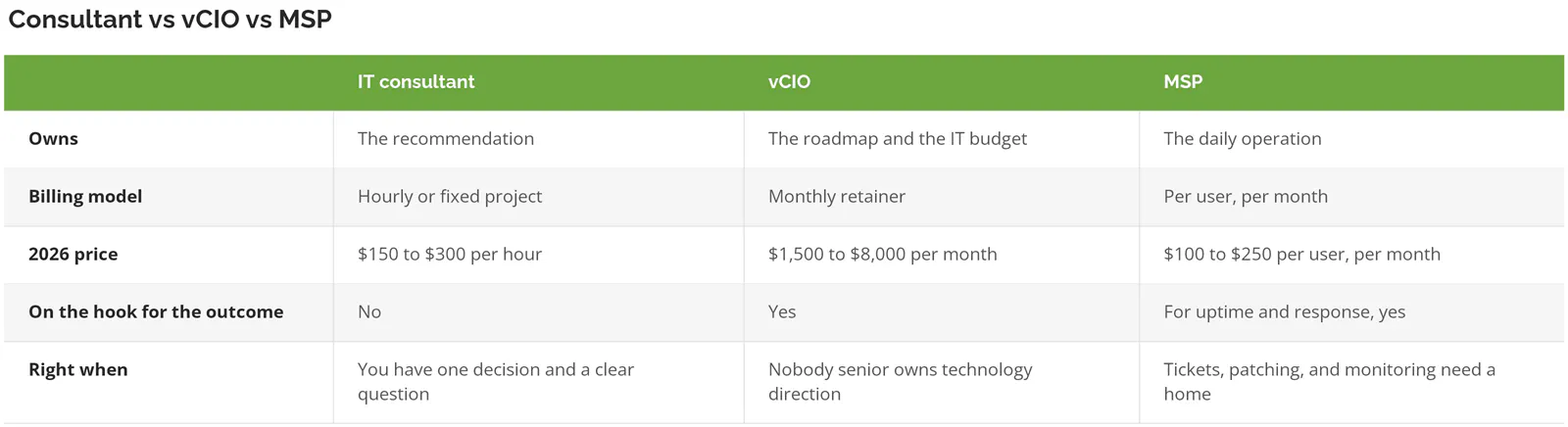
Plenty of companies need two of the three at once. That's normal. It isn't double-paying as long as the boundaries are written down, and the fastest way to find out whether they are is to ask both vendors, separately, who owns the three-year plan and then compare the answers. What doesn't work is expecting roadmap-level strategy from a per-user support contract, or paying vCIO services rates for work a help desk should absorb.
Security leadership is its own line again. If the driver is a customer security questionnaire or an audit, the number you want is what a vCISO runs per month. A vCISO is a part-time security leader, and the rate sits above general IT consulting for good reason.
The Costs That Never Make It Into the Quote
Scope creep is the usual culprit, and it's a governance problem long before it shows up as an invoice. The contract was vague, nobody policed the deliverables, and the overage arrived one small reasonable request at a time.

- Change-order fees when the scope shifts, which it will
- Licensing for whatever the consultant recommends, quoted separately or not at all
- Travel and on-site time, especially for multi-site companies
- Paying for the same assessment twice, once from the consultant and again from the firm that actually does the work, because nobody agreed the first one would transfer
- Compliance rework. Bolting SOC 2 or CMMC controls onto a system that's already live means rebuilding what you just paid to build, and you pay for both passes.
That last one deserves more space than it's getting here. It's the most predictable overrun in the category. And the fix is free. Put the compliance requirement in the original statement of work even if the audit is 18 months out.
Check the assessment methodology while you're at it. A competent assessment maps your environment against a published control set, whether that's the NIST framework or the CISA Cross-Sector Cybersecurity Performance Goals, rather than the consultant's own private checklist. Published standards travel. Private checklists don't. And you want a scoped IT assessment whose findings you own outright and can hand to anyone, including a different firm. If a consultant won't write that into the contract, you're renting their conclusions. Ask before you sign, not after.
What Should You Budget Before You Call Anyone?
Set the total IT budget first, then size consulting inside it. Deloitte's Global Technology Leadership Study put cross-industry technology spend at 5.49% of revenue in its 2022 measurement, up from 4.25% two years earlier. Small companies run higher. Large enterprises run lower.
Consulting is a slice of that number. Not an addition to it. So what did you spend on technology last year, all in? If the answer takes more than a day to assemble, that's the first thing a consultant will tell you to fix. Anyone quoting you without asking what your total IT spend looks like is quoting into a vacuum, and you'll find out which line item got starved to pay for them somewhere around month seven, when the hardware refresh you'd already deferred once gets deferred again.
Run it on a real company. A $40 million manufacturer budgeting 3% of revenue for technology has $1.2 million a year across everything. Licensing, hardware, salaries, security tooling, the whole envelope. A $6,000 monthly consulting retainer is $72,000, or 6% of that IT budget. Defensible in a board meeting. A $30,000 monthly program against the same envelope is not, no matter how good the roadmap looks.

There's a second budget nobody writes down. IBM's 2026 Cost of a Data Breach Report, built on 602 breached organizations, puts the global average at $4.99 million and the United States average at $11.5 million. Nobody budgets for that one. It just arrives.
When You Shouldn't Buy IT Consulting Yet
Three situations where the honest answer is not now.
- You already have mature internal IT leadership and what you're short on is hands. That's staffing, and it's a cheaper conversation with a different kind of firm.
- Under 20 users, a co-managed arrangement or straight managed IT usually costs less and covers more than a consulting retainer will.
- There's one discrete project, with a written spec and a clear finish line. Buy the project. Don't buy an advisory relationship to tell you to buy the project.
Consulting earns its price when the question is which problem to solve first. If you already know, you're buying execution. That's a different quote.
What a Consilien Engagement Costs
Consilien is a security-first managed IT and advisory firm in Torrance, California, working nationwide with companies between 20 and 1000 users in manufacturing, distribution, food processing, real estate management, professional services, and media. The problem it solves is technology run reactively, with no roadmap and no executive visibility into risk or cost. Pricing is set monthly against your size, goals, and risk, and the figure comes out of the technology assessment rather than a published rate card.
What's already public is the time commitment before anyone signs anything. A 20-to-30-minute discovery session, a 45-minute strategy session, a 2-to-4-hour technology assessment, a 75-minute presentation of the recommendation, an hour of questions, and an hour of kickoff. Roughly six and a half hours of senior time, at no cost, before a contract exists. Firms that quote in a single phone call haven't looked at your environment. They've looked at your headcount.
Two other terms worth holding up against whatever else you're evaluating. Agreements run three years with a one-year opt-out at 60 days' notice, which is unusual in a category built on lock-in. Engagements are aligned to CIMS, an internal maturity standard that sets a current state, a target state, and the roadmap between them, so the plan survives a change of personnel on either side of the table. Ask your other finalists for both terms in writing.
Note where compliance sits. It's quoted separately here, and it isn't bundled into managed IT. Any provider telling you otherwise is either discounting the work or planning to do less of it than an auditor expects.
If you're sizing a technology budget for next year and want a real number instead of a range, speak to an IT consulting expert and bring your current spend. The assessment does more work than a rate card ever will.