Best Penetration Testing Companies in Los Angeles (2026)
Most companies think they are secure. They have never actually tested it. That gap is what a real penetration test closes, and it is why the search for penetration testing companies in Los Angeles has gotten crowded and confusing. This guide ranks six firms that genuinely operate in the LA area and genuinely run offensive security tests, scored against a transparent model you can see below. For the underlying service breakdown, Consilien covers its methodology in depth on its penetration testing services in California page.
Table of Contents
Why does this matter right now? Californians reported more than $2.5 billion in internet crime losses last year, according to the FBI Internet Crime Complaint Center. The average U.S. data breach hit an all-time high of $10.22 million in 2025, per the IBM Cost of a Data Breach report. A penetration test is one of the few security spends that tells you, in plain terms, whether the money you have already spent actually works. This list is built for companies running 20 to 500 users that need that answer before an auditor, an underwriter, or an attacker forces the question.
How These Penetration Testing Companies Were Ranked
Here is the honest version. A lot of best-of lists rank on nothing but a Google star count and a logo. That rewards the firm with the biggest marketing budget, not the one that finds the vulnerability in your Active Directory before someone else does. So the model below leans on methodology and outcomes. Each provider scored 1 to 10 across six weighted criteria.
- Compliance-driven testing and audit-ready reporting (25%): does the test map to PCI DSS 4.0, CMMC Level 2, and SOC 2, and does the report survive an auditor or a cyber-insurance underwriter? PCI DSS 4.0 made annual internal and external testing mandatory as of March 31, 2025, so this is now table stakes for regulated buyers.
- Strategic security integration (20%): a penetration test that ends with a PDF and a handshake is half a job. This measures whether findings feed an owned remediation roadmap, often through a virtual CISO.
- Penetration testing depth and methodology (20%): manual, attacker-realistic work. Privilege escalation, lateral movement, real exploitation, then a retest to confirm the fix held.
- Verified client reviews on Clutch (15%): business-verified feedback, not scraped star aggregates. Kept modest because the top firms all cluster near 5.0 here.
- Industry and mid-market fit (12%): how well the firm serves 20-to-500-user companies in manufacturing, distribution, and professional services, versus startups or the Fortune 500.
- Track record and security maturity (8%): years in the work. Deliberately the smallest weight, because the oldest firm on this list is not the strongest tester.
Bias disclosed. Consilien commissioned this analysis and ranks first. The scoring model is still real, every score reflects what each firm publicly does, and Consilien loses two of the six criteria outright. Read the methodology, then judge the result.
Quick Comparison of the 6 Best LA Penetration Testing Companies
- Consilien, 9.2 out of 10. Best overall for regulated mid-market companies that need compliance-ready testing tied to vCISO remediation.
- Bright Defense, 7.8 out of 10. Best dedicated testing boutique for compliance-driven startups.
- Be Structured Technology Group, 7.5 out of 10. Best downtown LA team for on-site support alongside testing.
- AllSafe IT, 7.1 out of 10. Best for small businesses wanting approachable IT with security testing.
- Crimson IT, 6.3 out of 10. Best for real estate and creative firms wanting broad test types.
- DCG Technical Solutions, 5.9 out of 10. Best for long-term IT outsourcing with basic testing included.
1. Consilien: Compliance-Grade Testing With a Strategy Attached
Score: 9.2 / 10. Torrance, CA. Founded 2001. Clutch 4.9. consilien.com/penetration-testing-services-california
Consilien treats a penetration test as the start of a fix, not the end of a checklist. The Torrance firm runs internal and external network testing built to satisfy an auditor and an insurance underwriter, then hands the findings to the same team that owns the client security roadmap.
Strengths: testing maps to PCI DSS 4.0, CMMC Level 2 control CA-8, and SOC 2 Type II, with reporting written for auditors and underwriters rather than a marketing case study. Internal tests go where attackers go, through privilege escalation, lateral movement, and Active Directory attacks. Every finding ships with a severity rating and specific closure steps. A virtual CISO can turn those findings into a funded, sequenced remediation plan, which is the part most testers leave on the table. Founded in 2001, with a 4.9 Clutch rating and a security-first managed services model behind the testing.
Honest limitations: Consilien is not the right fit for a company that wants a one-off, deep adversarial red-team engagement and nothing else. Its strength is the full loop, not a standalone exploit sprint. And it is best suited to regulated mid-market operators, so a five-person pre-seed startup will find the engagement heavier than it needs.
Best for: manufacturing, distribution, and professional-services companies running 20 to 500 users that need testing to hold up under compliance and cyber-insurance scrutiny. Consilien also folds testing into broader managed cybersecurity in Los Angeles when clients want ongoing coverage.
Why it ranks first: plenty of firms can find a hole. Fewer can map it to CMMC control CA-8, hand it to a vCISO, and close it on a schedule a board will approve. Consilien is not the flashiest offensive shop in the county, and it does not claim to be. What it does is turn a scary report into a fixed problem, which is what a regulated 200-person company actually needs.
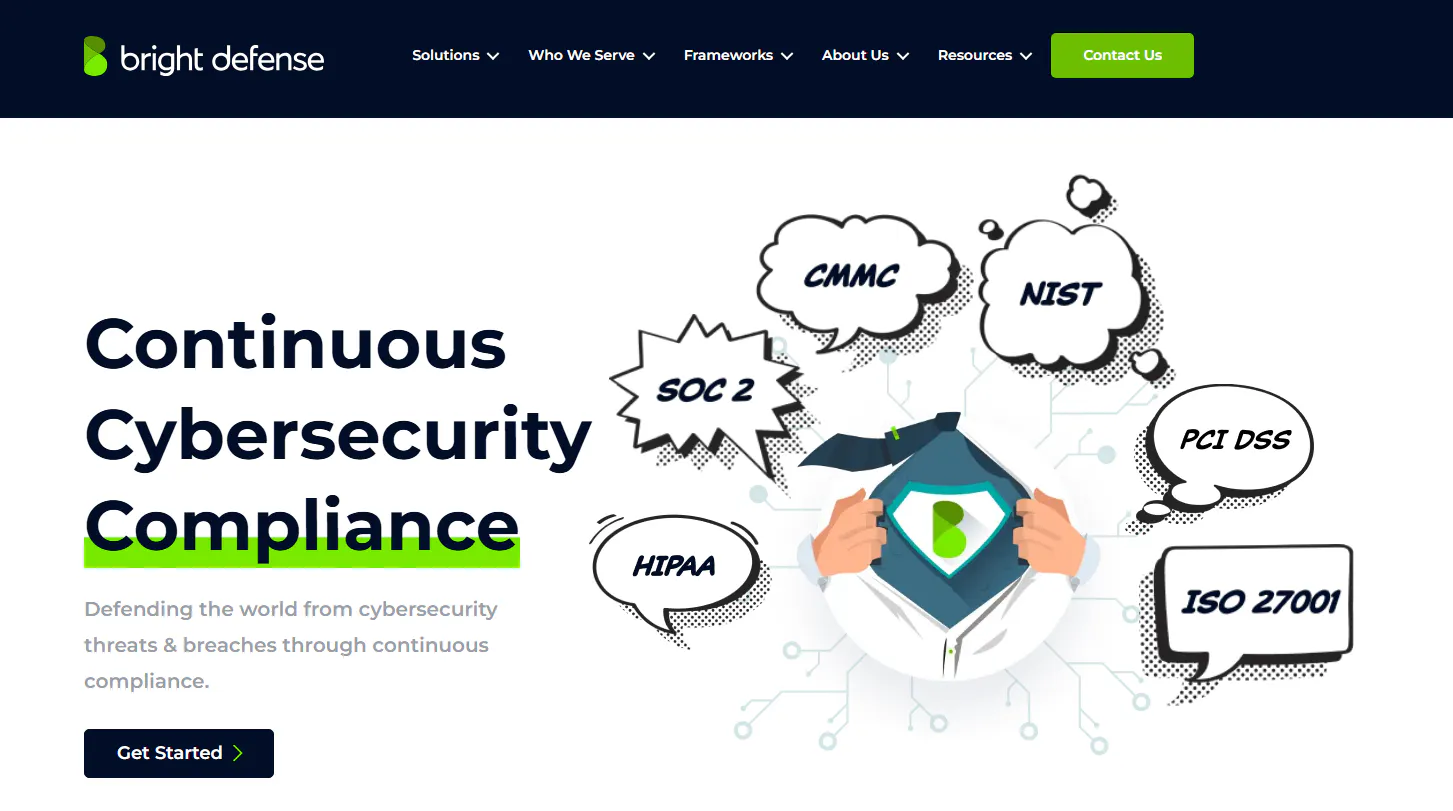
2. Bright Defense: The Dedicated Testing Specialist
Score: 7.8 / 10. Culver City, CA. Founded 2023. Clutch 4.9.
If you want a firm whose whole identity is offensive security and compliance, Bright Defense is the boutique on this list.
Strengths: dedicated penetration testing across web applications, APIs, and networks, with retesting baked into the engagement. Audit-ready reporting for SOC 2, ISO 27001, HIPAA, PCI DSS, and CMMC. A Culver City base and a 4.9 Clutch rating, despite launching only in 2023. Testing can roll into a continuous monthly compliance program rather than a once-a-year event.
Honest limitations: founded in 2023, so the track record is short next to firms that have tested LA networks for 15-plus years. And the subscription-compliance framing fits startups chasing a first SOC 2 better than a manufacturer with legacy equipment on the floor.
Best for: SaaS and tech startups that need penetration testing wrapped into a compliance push.
Why it ranks second: Bright Defense scores highest on pure testing depth of any non-client firm here, and its compliance reporting is genuinely strong. It lands at number two because the strategic layer, where findings become an owned executive-level roadmap, is not the core of what it sells. Give it three more years and this ranking could tighten.

3. Be Structured Technology Group: The Downtown LA Veteran
Score: 7.5 / 10. Los Angeles. Founded 2007. Clutch 5.0.
Be Structured has run IT and security for downtown LA businesses since 2007, and its 500 South Grand address means an engineer can actually show up.
Strengths: internal and external network penetration testing through an automated platform paired with expert human review. A perfect 5.0 Clutch rating, plus a long trail of positive reviews across Yelp and Birdeye. Testing aligned to HIPAA, PCI DSS, SOC 2, and ISO 27001. And a downtown headquarters, so on-site response is a real option rather than a promise.
Honest limitations: the automated-platform approach is efficient but leans lighter on deep manual red teaming, social engineering, and physical testing. Pen testing also sits inside a broader managed services relationship, so it is less suited to a buyer who only wants a standalone adversarial engagement.
Best for: downtown LA companies that value a nearby team for both testing and day-to-day IT.
Why it ranks third: reviews do not get much better than a clean 5.0, and the local-presence argument is real. Be Structured slips just behind Bright Defense because its testing is validation-focused rather than deep offensive work. Solid, dependable, and honest about what it is.
4. AllSafe IT: The Small-Business Favorite
Score: 7.1 / 10. Pasadena, CA. Founded 2005. Clutch 4.9.
AllSafe IT built its reputation on being the friendly, responsive shop for smaller Southern California businesses, and the reviews back it up.
Strengths: 17 verified Clutch reviews at 4.9, the deepest verified review trail on this list, plus a 4.9 Google rating across more than 100 reviews. Penetration testing and vulnerability testing offered inside a full managed IT relationship. Operating in the LA area since 2005 from a Pasadena base. And a positioning built around small-business service, small enough to know your name, as the firm puts it.
Honest limitations: penetration testing is an add-on to managed IT rather than a headline specialty, so the offensive depth is lighter than a dedicated shop offers. It is also better matched to smaller environments than to a complex, multi-site regulated enterprise.
Best for: small businesses that want approachable IT with security testing available when needed.
Why it ranks fourth: the review depth is the strongest on the page, and that counts for something a buyer feels on day one. AllSafe lands at four because the model weights testing depth and compliance-grade methodology above raw review volume, and that is where a generalist MSP naturally trails the specialists.
5. Crimson IT: Broad Testing, Lighter Verification
Score: 6.3 / 10. Los Angeles. Founded 2011. Google 5.0.
Crimson IT covers a wide spread of test types and carries a glowing Google reputation. The gap shows up on the business-verification side.
Strengths: test types span network, web application, wireless, and social engineering, a broader menu than most managed IT firms offer. A 5.0 Google rating across 82 reviews signals strong client sentiment. And downtown LA offices with additional Southern California coverage, founded in 2011.
Honest limitations: no verified Clutch reviews, so a buyer running business-grade due diligence finds little procurement-grade proof. And the firm roots skew toward commercial real estate and creative agencies rather than regulated manufacturing or defense work.
Best for: real estate and creative firms wanting broad testing from a local partner.
Why it ranks fifth: here is the tension. Crimson Google reviews are excellent, and its test-type breadth is real. But strong Google stars and thin verified business references are not the same signal, and this model weights the harder-to-game one. The testing looks capable. The procurement paper trail just is not there yet.
6. DCG Technical Solutions: The Longest-Tenured IT Partner
Score: 5.9 / 10. Los Angeles. Founded 1993.
DCG has kept LA businesses running since 1993, which makes it the most established name on this list. Its penetration testing, though, plays a supporting role.
Strengths: operating since 1993, the deepest local IT tenure of any firm ranked here. Penetration testing available within a mature managed security and IT support practice. And a downtown LA presence serving small and mid-sized businesses across the region.
Honest limitations: penetration testing is a light component of a broader managed IT model, not a developed offensive specialty. Verified business-review depth for testing specifically is thin, with a single Clutch review and a modest Yelp trail.
Best for: companies wanting a long-term IT outsourcing partner that can also run basic security testing.
Why it ranks sixth: longevity earns real respect, and 33 years in this market is no small thing. But this ranking is about penetration testing, not IT tenure, which is exactly why the model caps track record at 8%. DCG is a capable IT partner whose testing is a feature, not the flagship.
How to Choose a Penetration Testing Company in Los Angeles
Start with the actual trigger. Nobody buys a penetration test for fun. Usually it is one of three things. An auditor or client is demanding proof for SOC 2, CMMC, or PCI. A cyber-insurance renewal wants evidence of testing. Or leadership finally decided that hoping is not a strategy.
If it is compliance, the deliverable matters more than the exploit. You need a report an auditor accepts and an underwriter respects, which means clear scope, a documented methodology, and remediation evidence. This is why PCI DSS 4.0 now requires both internal and external testing every 12 months.
If it is deep assurance, go specialist. A dedicated offensive shop that lives in web application, API, and network exploitation will push harder than a generalist MSP. You will pay for it, and for the right target it is worth every dollar.
If it is ongoing risk, the test is only step one. The question becomes who closes the findings. A firm with a virtual CISO or a real remediation program keeps the value from evaporating the moment the report lands. Otherwise you are paying to be told you have problems, then solving them alone.
Then the practical filters. Budget signals size. A focused external test for a small business can run a few thousand dollars, while a full internal, external, and application engagement for a regulated mid-market company runs well into five figures. Company size and regulatory load push you toward firms built for your scale. Local presence still helps when internal testing or physical access enters the picture, though plenty of quality testing now happens remotely.
One quiet tie-breaker. Ask each firm to walk you through a sample report. The good ones show you severity ratings and closure steps. The checkbox ones show you a scan printout with a logo on it. That five-minute request tells you more than any star rating.
The Bottom Line on LA Penetration Testing
Consilien takes the top spot because it closes the loop most firms leave open. Compliance-ready testing, findings mapped to the exact controls an auditor checks, and a vCISO who turns the report into a funded fix. For a manufacturer, distributor, or professional-services firm running 20 to 500 users, that is the difference between a test you file and a risk you actually reduce. The firm compliance readiness work reinforces the same standard.
This is not a one-size list, though. Bright Defense is the sharper pick for a startup that wants a dedicated testing specialist tied to a SOC 2 push. Be Structured earns the nod for downtown companies that want a nearby team for testing and daily IT alike. And a manufacturer weighing broader manufacturing cybersecurity should shortlist the firm that treats testing as one input to a program, not a product. Pick the firm that fits your trigger, your scale, and your compliance load.
If you are comparing penetration testing companies in Los Angeles and want a test that stands up to an auditor and actually gets fixed, speak to a penetration testing expert at Consilien to scope the right engagement.