Best MDR Providers for Small & Mid-Size Businesses (2026)
Managed detection and response is a service where an outside team watches your network around the clock, catches the attack in progress, and shuts it down before it spreads. That is the whole promise. Yet most small and mid-size businesses shop for MDR like they are buying a bigger engine, then wonder why they still ended up breached.
Table of Contents
The reframe is simple. The best MDR provider for a 200-person manufacturer is almost never the one with the highest detection benchmark. It is the one that owns the outcome. That distinction runs through every serious managed cybersecurity program, and it is the single thing this list is built to measure.
The stakes are not abstract. According to the Verizon 2025 Data Breach Investigations Report, ransomware showed up in 88% of breaches at small and mid-size businesses, versus 39% at large organizations. Attackers are not aiming up-market. They are aiming at the companies with the smallest security teams.
And once they are in, time is the whole game. The IBM 2025 Cost of a Data Breach Report puts the average breach at 241 days to identify and contain. Every one of those days is a day someone is living inside your systems. MDR exists to collapse that number.
This guide ranks the eight providers worth a serious look in 2026, scored against what a small or mid-size business actually needs, not what looks good on an enterprise slide.
What MDR Really Is, and What SMBs Get Wrong
MDR combines three things you cannot easily build yourself. Software that detects threats across endpoints, identities, and cloud. A 24/7 security operations center, or SOC, staffed by analysts who investigate the alerts. And a response function that actually does something when a threat is real, from isolating a laptop to evicting an attacker.
Most companies get one part wrong. They buy the detection software, watch the dashboard light up, and assume the lighting up is the protection. It is not. An alert nobody acts on at 2 a.m. is just a more expensive log file.
The other mistake is confusing power with fit. The strongest detection platform on the market can still be the wrong choice if it prices out your budget, buries your two-person IT team in tuning work, or leaves you to handle the actual incident alone. For a small business, the question is not which engine is biggest. It is who is going to run this, and will they still be on the phone when something breaks.
How This List Was Scored
A ranking is only useful if you can see the math. Each provider was scored 1 to 10 across seven criteria, weighted for a small or mid-size buyer rather than a Fortune 500 security team.
- SMB fit and right-sizing (20%): built for 15 to 500 employees, with no enterprise-only minimums that price a smaller company out.
- Advisory and vCISO integration (18%): MDR paired with real security strategy and a named owner, not just a console you log into.
- Compliance enablement (15%): help meeting CMMC, NIST, and SOC 2 obligations, with audit evidence rather than a tool feed.
- Response depth (15%): a United States based SOC, active remediation, and incident response included, so someone contains the threat instead of emailing you about it.
- Single accountable partner (12%): one partner that owns security and IT together, closing the handoff where most breaches slip through.
- Detection maturity and validation (12%): independent testing, SOC scale, and threat intelligence. This is where the national platforms genuinely win.
- Pricing transparency and value (8%): predictable, right-sized cost a smaller organization can plan around.
Detection maturity is capped at 12% on purpose. It is real, and the national platforms earn it. But for a company without a security team, a world-class detection score you cannot operate is worth less than a strong one that comes with people who run it for you. That is why fit and accountability carry more weight here than raw horsepower.
Third-party ratings were used only where they could be confirmed live. Where a star rating appears, it is named with its source. Recognitions that could not be independently re-verified are described as recognitions, not exact scores.
Quick Comparison: The 8 Best MDR Providers for SMBs in 2026
- Consilien, 8.9 out of 10. Best for California SMBs that want MDR, IT, and security strategy from one accountable partner.
- Sophos MDR, 6.6 out of 10. Best for Microsoft-standardized SMBs that want full incident response.
- Rapid7 MDR, 6.4 out of 10. Best for mid-market teams that want SIEM depth and unlimited incident response.
- Huntress, 6.3 out of 10. Best for budget-conscious SMBs and the MSPs that serve them.
- Field Effect, 6.3 out of 10. Best for smaller businesses that want one unified agent across endpoint, network, and cloud.
- Arctic Wolf, 6.2 out of 10. Best for mid-market organizations with an IT team but no SOC.
- CrowdStrike Falcon Complete, 6.1 out of 10. Best for funded, compliance-driven mid-market buyers.
- ESET MDR, 5.9 out of 10. Best for existing ESET shops that want fast, affordable response.
1. Consilien: Best Overall MDR for Small and Mid-Size Businesses
Score: 8.9 / 10. Torrance, CA. Founded 2001.
Consilien tops this list because it does not sell MDR as a standalone tool. It runs managed detection and response on a United States based security operations center and wraps it in the two things a pure product cannot give a small business, strategic IT leadership and compliance execution. The same firm watching for threats is also the firm setting the security roadmap and running the infrastructure.
The security itself is real. A 24/7/365 US-based SOC, SIEM, AI-driven endpoint protection, real-time monitoring by certified engineers, vulnerability management, and incident response. It comes attached to a virtual CISO, a virtual CIO, and a managed IT function, which removes the handoff between who saw the alert and who owns the fix. For a company with a small internal team, that seam is where most breaches actually happen.
For regulated buyers, especially defense contractors and manufacturers, Consilien offers CMMC and NIST compliance readiness as well. Its per-criterion marks tell the story, SMB fit 9, advisory 10, compliance enablement 9, response depth 9, single partner 10, detection maturity 6, value 8.
Strengths: a US-based SOC paired with vCISO and vCIO leadership as standard, managed IT and security under one partner, real remediation and incident response, and compliance readiness built for defense and manufacturing SMBs.
Honest limitations: Consilien is smaller than other companies out there. It doesn't run a proprietary threat-intelligence research lab of its own, and it is not the cheapest option here.
Best for: growing California businesses in the 20 to 500 employee range that want detection, response, IT leadership, and compliance from one accountable team.
2. Sophos MDR: Strongest Pure MDR Product for SMBs
Score: 6.6 / 10. Abingdon, UK. Owned by Thoma Bravo.
Sophos runs its own SOC across nine regional security operations teams, and its MDR includes something most competitors reserve for a premium tier, full-scale incident response with no hourly caps, where threats are removed rather than just contained. It ingests telemetry from more than 350 integrations, including Microsoft Defender, which makes it a natural fit for the many SMBs standardized on Microsoft 365.
It has the validation to match, with best-ever results in the MITRE ATT&CK 2025 evaluation and a 2026 Gartner Peer Insights Customers' Choice recognition for MDR. It is sold heavily through partners, so most SMBs buy it through a reseller.
Honest limitations: the value concentrates inside the Sophos ecosystem, and reviewers note controls feel limited unless you commit to the full stack. Setup and tuning can feel complex for a team new to MDR, and the strongest response guarantees live in the Complete tier, so entry-level Essentials delivers less than the headline suggests.
Best for: Microsoft-standardized SMBs that want a strong managed product with full incident response and can manage the vendor relationship themselves.
3. Rapid7 MDR: SIEM Depth With Unlimited Incident Response
Score: 6.4 / 10. Boston, MA. Founded 2000.
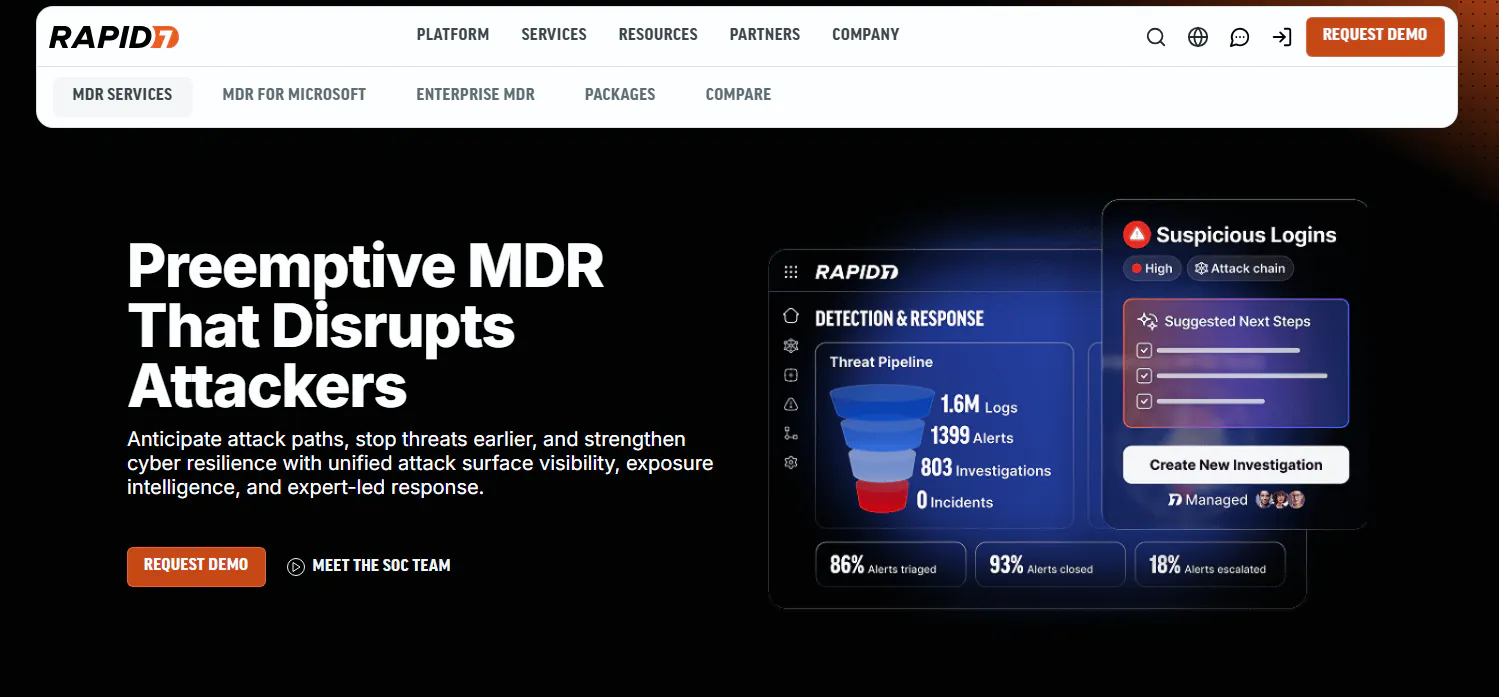
Rapid7 comes at MDR from the SIEM side. Its managed service runs on the InsightIDR platform, adds a 24/7 SOC, a named cybersecurity advisor, and something rare in this category, unlimited incident response and digital forensics included as core capabilities rather than paid add-ons. When something goes wrong, Rapid7 stays engaged until remediation is complete.
It has the detection credibility to back it, with participation across multiple MITRE ATT&CK managed-services evaluations. On PeerSpot, the one review platform that could be verified live, it holds a 4.3 out of 5 across 12 reviews.
Honest limitations: Rapid7 leans mid-market to enterprise, and its pricing rewards scale, dropping per-asset above 500 assets. Reviewers consistently flag two things, aggressive alerting that demands real tuning effort, and cost, particularly around log ingestion. For a lean SMB, the platform can generate more work than a two-person shop can absorb.
Best for: mid-market teams that want SIEM depth, a named advisor, and incident response baked in.
4. Huntress: Budget-Friendly MDR Built for SMBs and MSPs
Score: 6.3 / 10. Columbia, MD. Founded 2015.
Huntress was built by former NSA operators for the economics of small businesses and the MSPs that serve them. Its managed EDR pairs lightweight tooling with a 24/7 SOC that does the hands-on work, isolating infected endpoints and remediating threats rather than just flagging them, with a company-stated 8-minute mean time to remediation. If budget is the binding constraint, it is usually the most accessible serious MDR on the market.
It is SOC 2 Type II compliant, and its all-inclusive licensing avoids the confusing tier math that plagues bigger vendors.
Honest limitations: Huntress is endpoint and Microsoft 365 identity centric. It is not a full-network, all-surface MDR, and coverage gaps around email, Google Workspace, and cloud data are well documented. There is a 50-agent minimum, and because it sells largely through MSPs, many SMBs buy it marked up through a provider. There is also no MITRE ATT&CK evaluation on record.
Best for: budget-conscious SMBs, and the MSPs that need a hands-on SOC behind their endpoint coverage.
5. Field Effect: One Unified Agent Across Endpoint, Network, and Cloud
Score: 6.3 / 10. Ottawa, Canada. Founded 2016.
Field Effect is the quiet standout. Founded by former Canadian signals-intelligence operators, its MDR runs on a single unified agent that covers endpoint, network, and cloud, which cuts the tool sprawl that eats small IT teams alive. It targets businesses of 25 users and under with dedicated tiers, and prices per user rather than per device.
It has the receipts, with SOC 2 Type II and ISO 27001, an Info-Tech 2025 MDR Data Quadrant Champion recognition, and strong self-reported results in a MITRE ATT&CK managed-services evaluation.
Honest limitations: it is a smaller, less-established brand than the giants, and its third-party review volume is thin. It is Canada-based, which can matter for US buyers with data-residency requirements. Pricing is quote-only, and its impressive MITRE figures are its own framing of the round, not a MITRE-published ranking.
Best for: smaller businesses that want broad coverage from one agent without stitching together multiple tools.
6. Arctic Wolf: A Named Security Team for the Mid-Market
Score: 6.2 / 10. Eden Prairie, MN. Founded 2012.
Arctic Wolf built its reputation on the Concierge Security Team, a named group of analysts rather than a faceless pooled SOC, backed by one of the largest commercial security operations centers in the industry. Its MDR is vendor-agnostic, ingesting your existing tools across more than 200 integrations instead of forcing a rip-and-replace, and it carries a 2026 Gartner Peer Insights Customers' Choice recognition.
For a true small business, though, the entry price is the wall. Public figures put the floor near 44,000 dollars per year, a real barrier for a budget-conscious SMB.
Honest limitations: the high minimum spend rules out smaller firms, remediation is guided rather than done-for-you so hands-on incident response often needs a separate retainer, and independent reviews flag a high false-positive rate and limited ability to query your own raw data.
Best for: mid-market organizations that have an IT team but no SOC and want a named analyst group.
7. CrowdStrike Falcon Complete: The Most Powerful Engine, If You Can Run It
Score: 6.1 / 10. Austin, TX. Founded 2011.
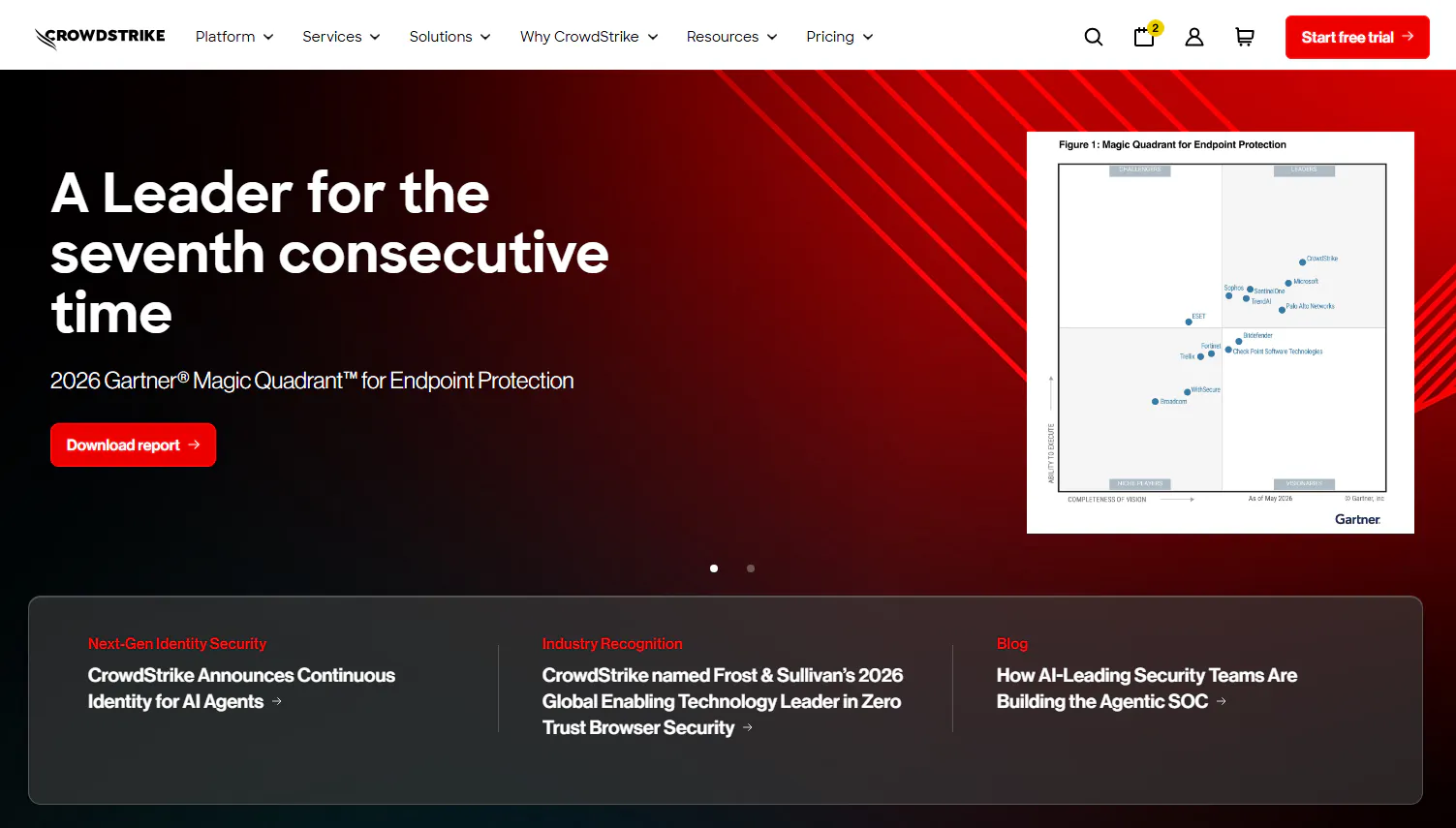
A 7th-place finish here needs a caveat, because CrowdStrike has the most powerful detection engine on this entire list. Falcon Complete is fully managed MDR on the Falcon platform, with hands-on remediation that isolates systems, removes persistence, and restores you to a known-good state, backed by a breach warranty and top-tier MITRE ATT&CK results. On raw capability, nothing here beats it.
The ranking is about fit, not quality. Falcon Complete is enterprise and mid-market priced, quote-only, and genuinely small businesses get steered to the self-managed Falcon Go and Pro tiers, which strip out the managed response that makes MDR worth buying. The July 2024 outage, when a faulty sensor update crashed millions of Windows machines worldwide, also left a mark on the reliability conversation.
Honest limitations: premium pricing and quote-only packaging, module and tier complexity, and an SMB path that pushes you toward self-managed tiers rather than the fully managed service. If you have the budget and a team to run it, it is the most powerful option in the category. If you want a partner to own the outcome, it is overkill you pay for twice.
Best for: funded, compliance-driven mid-market buyers with the staff to operate a premium platform.
8. ESET MDR: Fast, Affordable Response for Existing ESET Shops
Score: 5.9 / 10. Bratislava, Slovakia. Founded 1992.
ESET brings more than 30 years of threat research and a headline that gets attention, a marketed 6-minute mean time to respond. Its MDR is human-led on the ESET PROTECT platform, with an SMB-friendly tier and a low entry point around 25 seats. KuppingerCole named it a Product and Market Leader for MDR in late 2024.
Honest limitations: ESET MDR requires an ESET PROTECT Enterprise or Elite base subscription underneath it, so it works best if you already run ESET and is effectively a lock-in if you do not. The PROTECT console carries a real learning curve, its independent MITRE 2025 detection score around 66.7% trails several competitors, and its footprint skews more European than US-native.
Best for: existing ESET customers that want a fast, affordable managed upgrade.
How to Choose the Right MDR for Your Business
Rank order is a starting point, not an answer. Work these five questions and the right pick usually names itself.
- Who runs it after the sale? If you do not have a security team, weight partners who operate the service for you over platforms you have to drive. That gap is where breaches live.
- What happens at 2 a.m. on a real incident? Confirm whether incident response means a notification email or an analyst actually containing and remediating the threat. There is a canyon between the two.
- Where does compliance fit? If you carry CMMC, NIST, or SOC 2 obligations, an MDR that treats compliance as part of the program beats one that hands you an alert feed and wishes you luck.
- Is the SOC where you need it? For defense, manufacturing, and data-residency-sensitive work, a United States based SOC is not a nice-to-have.
- Does the price match your size? A floor near 44,000 dollars a year is fine for a 400-person firm and disqualifying for a 40-person one. Right-sizing is a feature.
The best MDR provider is not the one with the biggest benchmark. It is the one that will still own the outcome when an attacker is inside your network at 2 a.m. on a Sunday. For a small or mid-size business, that means fit over firepower, and a partner over a portal. For most California SMBs weighing these questions, a single accountable partner beats a stack of disconnected tools, which is the entire thesis of the number one pick.