Best Email Security Solutions for Small Businesses (2026)
IRONSCALES ranks first for small businesses in 2026 because it pairs AI phishing detection with transparent per-user pricing and a three-click Microsoft 365 setup. Abnormal Security leads on business email compromise, Microsoft Defender wins on built-in value, and Guardz packs the most into a single pane. Every product here was scored on detection, small-business fit, and ease of deployment.
Table of Contents
Quick picks: Best overall is IRONSCALES. Best for stopping BEC and vendor fraud is Abnormal Security. Best built-in value is Microsoft Defender for Office 365. Best all-in-one for small teams is Guardz.
Email is still where most attacks start. In 2025, business email compromise alone drove more than $3 billion in reported losses, with the average complaint topping $122,000, according to the FBI's Internet Crime Complaint Center. Phishing losses grew 208 percent in a single year even as the number of complaints held flat. Read that again. Fewer attacks, far more damage per hit.
Small businesses feel this hardest. A 40-person company rarely has a security analyst on staff, yet it sits on the same wire transfers and vendor relationships an attacker wants. This guide ranks the eight email security tools best suited to that reality: strong enough to stop modern attacks, simple enough to run without a security team, and priced for a business that counts users in the dozens, not the thousands. For companies that would rather hand the whole function to a specialist, managed email security is the alternative to running one of these tools in-house.
How These Solutions Were Scored
Here is the short version. Eight products, six criteria, one 1-to-10 scale, weighted toward what a small business actually needs rather than what looks good in an enterprise RFP.
- Threat detection (25%): real-world stopping power on modern attacks, from AI phishing to BEC, vendor fraud, and account takeover.
- Small-business fit and value (20%): right-sized for 10 to 500 users, with pricing transparency and no enterprise bloat.
- Deployment and ease of use (20%): API versus MX-record change, time to go live, and day-to-day admin simplicity.
- Coverage breadth (15%): phishing, malware, BEC, account takeover, data loss prevention, and user training in one platform.
- Management overhead (10%): how much the tool runs itself, and how cleanly a managed provider can co-run it.
- Trust rating (10%): the one consistent third-party signal, pulled from Gartner Peer Insights and applied to all.
Detection carries the most weight because stopping the attack is the entire point. Fit and ease sit close behind, because a tool a 30-person company cannot afford, deploy, or run is worthless no matter how clever its engine. Trust rating is capped at 10 percent on purpose. A vendor with 1,400 enterprise reviews should not outrank a leaner tool just because more Fortune 500 admins wrote it up.
Bias disclosed, plainly. Consilien is a managed security provider, not an email security vendor, and it produced this ranking. Consilien does not appear on the list. The scoring model was applied the same way to all eight products, the criteria were set before any scores ran, and where a product's third-party rating is not yet established, that gap is noted rather than papered over.
Email Security Solutions Compared at a Glance
- IRONSCALES (9.1/10). Best for SMBs that want AI protection plus built-in training. Transparent per-user pricing and a three-click Microsoft 365 setup. Lighter archiving is the tradeoff.
- Abnormal Security (8.6/10). Best for companies bleeding on invoice fraud and CEO spoofing. Best-in-class behavioral AI, deployed by API. Premium, quote-only pricing.
- Check Point Harmony Email (8.5/10). Best for M365 or Workspace shops that want inline, pre-delivery blocking. Backed by Check Point intelligence. The console runs busy.
- Barracuda Email Protection (8.4/10). Best for value-focused SMBs that want broad coverage from one vendor. Detection trails the AI-native tools.
- Guardz (8.3/10). Best for very small teams and MSP-managed shops. Email, identity, endpoint, and MDR in one pane. No established Gartner rating yet.
- Microsoft Defender for Office 365 (7.8/10). Best baseline for any business already on Microsoft 365. Built in, no extra vendor. Documented gaps on targeted BEC.
- Proofpoint (7.6/10). Best for firms growing into enterprise needs. Gold-standard threat intelligence in a heavier gateway package.
- Mimecast (7.5/10). Best for compliance-heavy, archiving-first buyers. Email continuity and long retention, with more setup complexity.
The 8 Best Email Security Solutions for Small Businesses
1. IRONSCALES (Score: 9.1)
Most tools on this list ask a small business to compromise on something: price, simplicity, or detection depth. IRONSCALES mostly refuses to.
Score: 9.1 out of 10.
Where it is strong:
- It publishes its prices. Tiers run $3.89 to $7.29 per user per month, a rarity in a category where nearly everyone hides behind a quote form.
- Deployment is genuinely a three-click Microsoft 365 connection. No MX-record surgery, no mail rerouting, live in minutes.
- Detection blends AI with a human-in-the-loop model that learns from analyst decisions across its customer base, so a phish caught at one company sharpens protection at the next.
- Phishing simulation and awareness training are built in, not a separate purchase. For a business without a security team, that consolidation matters.
Honest limitations:
- Archiving and email continuity are lighter than a dedicated gateway offers. A compliance-driven buyer may want more.
- Its Gartner Peer Insights score is a strong 4.7 stars, but on a smaller review base than the enterprise incumbents.
Best for: small and midsize businesses on Microsoft 365 or Google Workspace that want serious detection plus training without an enterprise contract. Not ideal for: organizations with heavy archiving or long-term retention mandates.
Why it ranks #1: IRONSCALES wins because it is the rare product that scores well on every axis a small business cares about instead of spiking on one. It detects like a modern AI-native tool, deploys faster than most, tells you what it costs, and folds in the training that stops the human side of phishing. That balance, not any single headline feature, is what earns the top spot.
2. Abnormal Security (Score: 8.6)
If the attack keeping an owner up at night is the fake-CEO wire request, this is the tool built for that exact fear.
Score: 8.6 out of 10.
Where it is strong:
- Behavioral AI is the whole thesis. Abnormal reads historical email to build a baseline for every user and vendor relationship, then flags the message that does not fit the pattern.
- It catches what gateways miss: text-only fraud, no malicious link, no attachment, just a plausible request to change bank details.
- Deployment is API-based, so there is nothing in the mail flow to break, and it earns the highest third-party score here at 4.8 stars on Gartner Peer Insights.
Honest limitations:
- Pricing is quote-only and lands at a premium. The smallest shops sometimes find it aimed a size class above them.
- Gateway functions and archiving are not the focus, so it usually layers on top of another control rather than replacing everything.
Best for: businesses with real exposure to invoice fraud, vendor impersonation, or executive spoofing. Not ideal for: cost-sensitive micro-businesses that need one affordable tool to do everything.
Why it ranks #2: no product on this list reads intent better. Abnormal loses ground only on price and small-business fit, and if BEC is the primary threat, it is arguably the sharpest instrument here.

3. Check Point Harmony Email and Collaboration (Score: 8.5)
Formerly Avanan, now folded into Check Point, Harmony sits inside the tenant and blocks threats before they ever hit the inbox.
Score: 8.5 out of 10.
Where it is strong:
- Inline, pre-delivery blocking through an API connection to Microsoft 365 or Google Workspace. Malicious mail is stopped, not just clawed back after delivery.
- Coverage extends past email into Teams, Slack, and file-sharing apps, which is where a lot of small-team collaboration actually lives now.
- Backed by Check Point threat intelligence and a large, mature review base at 4.7 stars on Gartner Peer Insights.
Honest limitations:
- The management console carries the weight of a big security portfolio. Some admins find it busier than a purpose-built SMB tool.
- Pricing is quote-only, and the product leans slightly upmarket of the smallest businesses.
Best for: Microsoft 365 or Google Workspace shops that want threats blocked before delivery and protection across collaboration apps. Not ideal for: teams that want the leanest possible interface and published pricing.
Why it ranks #3: strong detection and true inline blocking put it a hair behind Abnormal. The console complexity is the main thing keeping it out of the top two for a small business without dedicated IT.
4. Barracuda Email Protection (Score: 8.4)
Barracuda has been the pragmatic SMB pick for two decades, and the reason is simple. It does a lot, for a price small businesses can stomach.
Score: 8.4 out of 10.
Where it is strong:
- The breadth is the story. Gateway filtering, impersonation protection, account takeover defense, data loss prevention, encryption, backup, and awareness training under one roof.
- Affordable and widely deployed, with a reputation for being easy to live with day to day.
- A deep, consistent track record, reflected in 4.6 stars across nearly 500 Gartner Peer Insights reviews.
Honest limitations:
- Raw detection trails the AI-native newcomers on the most sophisticated, socially engineered attacks.
- The all-in-one breadth means some individual modules are good rather than best-in-class.
Best for: value-focused small businesses that want one vendor covering most of the email security checklist. Not ideal for: companies whose top risk is advanced BEC that a behavioral engine catches better.
Why it ranks #4: Barracuda is the safe, sensible, cover-the-bases choice. It gives up a little on frontier detection, but for a business that wants broad protection without a science project, it is hard to fault.
5. Guardz (Score: 8.3)
Guardz answers a question most email tools ignore. What about the business that cannot manage five separate security products?
Score: 8.3 out of 10.
Where it is strong:
- Email security sits next to identity, endpoint, and managed detection and response in a single multi-tenant console. One contract, one onboarding, one place to work an incident.
- Purpose-built for small businesses and the MSPs that serve them, with per-seat pricing designed for that scale.
- When a malicious email, a risky sign-in, and an endpoint alert turn out to be the same attack, they surface in the same place instead of three disconnected dashboards.
Honest limitations:
- Founded in 2022, Guardz does not yet carry an established Gartner Peer Insights rating, so its third-party trust signal is unproven at scale. That is a real gap, and it is why the scoring model penalized it here.
- Its email detection engine leans on partnered technology rather than a decade of in-house research.
Best for: very small businesses or MSP-managed environments that want broad security consolidated into one platform. Not ideal for: buyers who weight a long, verifiable third-party track record heavily.
Why it ranks #5: for consolidation and small-team fit, nothing here beats it. The unproven rating is the anchor on its score, not the product's ambition, which is genuinely well-aimed at this market.
6. Microsoft Defender for Office 365 (Score: 7.8)
Start here. Most small businesses on Microsoft 365 already have some version of this and have not turned it all on.
Score: 7.8 out of 10.
Where it is strong:
- It is built in. Safe Links and Safe Attachments, anti-phishing policies, and automated investigation ship inside Microsoft 365, with Plan 2 bundled into the E5 license.
- No new vendor, no separate contract, no extra console to learn from scratch.
- For the price of configuration time, a business closes a surprising amount of its exposure.
Honest limitations:
- Defaults leave gaps. Years of documented BEC bypasses show native filters miss the advanced impersonation and text-only fraud that third-party layers exist to catch.
- Its Gartner Peer Insights rating, 4.4 stars, is the lowest here, and getting the most from it takes ongoing policy tuning most small teams never get to.
Best for: any Microsoft 365 business as a foundation, especially one not ready to add a dedicated tool. Not ideal for: companies relying on it alone against targeted BEC. The defaults are not enough.
Why it ranks #6: this is not a knock on Microsoft. It is a ranking built for dedicated protection, and Defender is a baseline rather than a specialist. Tuned well and layered with a tool higher on this list, it does its job. Left on defaults, it is the gap attackers count on.
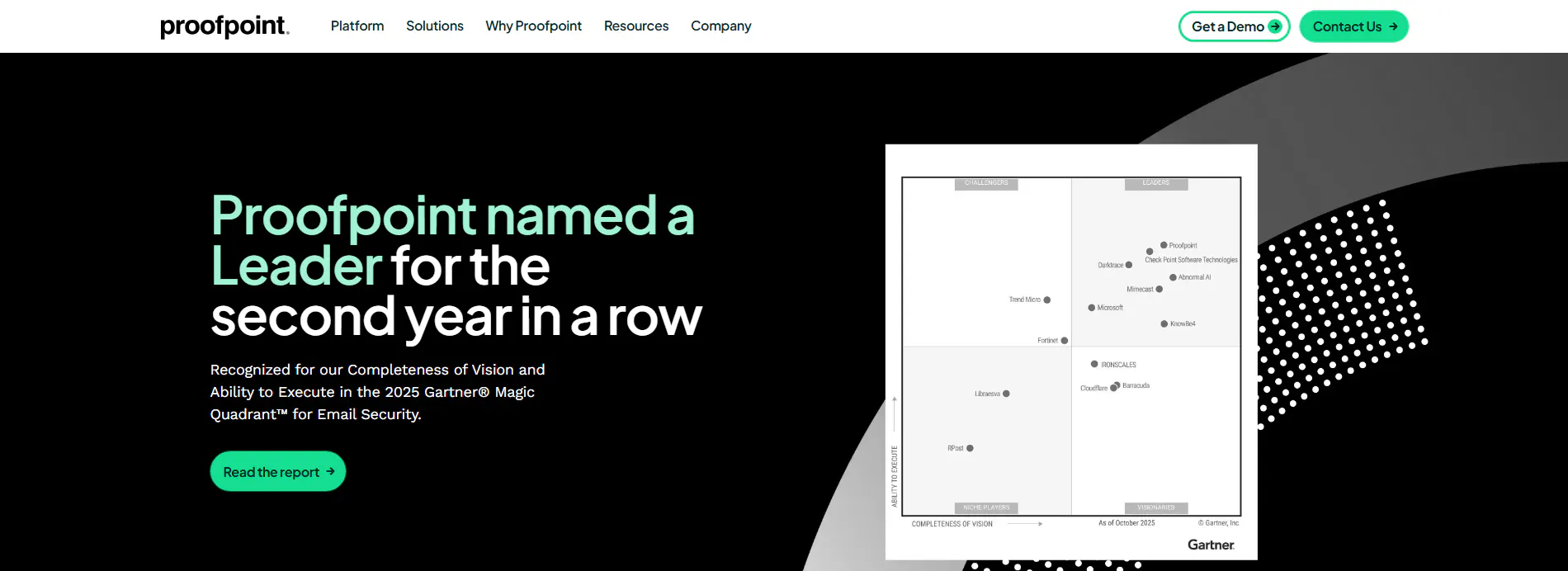
7. Proofpoint (Score: 7.6)
Proofpoint is the name security veterans trust, and for good reason. It also brings baggage a 30-person company does not need.
Score: 7.6 out of 10.
Where it is strong:
- Its threat intelligence is genuinely elite. Proofpoint analyzes an enormous volume of data daily, and its Targeted Attack Protection remains a benchmark others measure against.
- The feature depth is vast, spanning threat protection, data loss prevention, encryption, archiving, and awareness training.
- A massive, high-scoring review base, 4.7 stars across more than 1,400 Gartner Peer Insights reviews.
Honest limitations:
- It is a secure email gateway, which means MX-record changes and heavier administration.
- Pricing and complexity are built for larger organizations. For most small businesses, it is more platform than the team can staff.
Best for: growing companies that expect enterprise-grade compliance and threat needs soon. Not ideal for: small teams wanting fast setup and light management.
Why it ranks #7: the detection is arguably the best on this list. The fit for a small business is the worst of the top tier. That tradeoff, not any weakness in the engine, is what drops it here.
8. Mimecast (Score: 7.5)
Mimecast's pitch has always leaned on what happens around the email, not just the threat in it.
Score: 7.5 out of 10.
Where it is strong:
- Email continuity is the standout. If the primary mail environment goes down, Mimecast's cloud archive keeps people sending and receiving.
- That archive supports long retention, a draw for organizations with strict compliance obligations.
- Broad protection plus data loss prevention and awareness training in one suite.
Honest limitations:
- Recent reviews are mixed. Some longtime users report more missed attacks and a complex setup, and its 4.5-star Gartner rating trails the AI-native tools.
- Like other gateways, it asks more of a small admin team than an API-based tool does.
Best for: compliance-driven or archiving-first businesses that value email continuity above all. Not ideal for: small teams whose priority is cutting-edge detection with minimal overhead.
Why it ranks #8: Mimecast still does continuity and archiving as well as anyone. But this list is ranked on protecting a small business from modern attacks with minimal lift, and on that specific test, it finishes behind the field.
How to Choose Email Security Software for a Small Business
Match the tool to the threat and the team, not to the longest feature list. A business drowning in invoice fraud needs behavioral AI. A business that already owns Microsoft 365 should max out what it has before buying anything.
Budget signals first. If pricing transparency matters and the budget is fixed, IRONSCALES and the built-in Microsoft Defender tiers are the clearest starting points. Quote-only tools like Abnormal, Proofpoint, and Harmony can be worth it, but plan for a sales conversation and a higher number.
Then team size and skill. No security staff? Favor API-based tools that deploy in minutes and remediate on their own, and lean toward platforms that fold in user training. That points to IRONSCALES, Abnormal, or the consolidated Guardz approach. A gateway like Proofpoint or Mimecast rewards a team that can tune it and punishes one that cannot.
Threat profile decides the rest. Heavy vendor and wire-transfer exposure points to Abnormal. Broad, general coverage on a budget points to Barracuda. A need for archiving and continuity points to Mimecast. And a business that wants email security bundled with endpoint and identity in one bill points to Guardz.
One more thing worth saying out loud. Buying the software is the easy part. Configuring it correctly, tuning it as attacks evolve, and responding when something slips through is the ongoing work, and it is where most small businesses quietly fall behind. That gap is where a managed provider fits. Consilien deploys and continuously tunes tools like these as part of a broader managed cybersecurity program, so the protection keeps working after the install-day glow wears off.
The Bottom Line
For most small businesses in 2026, IRONSCALES is the strongest single choice, because it does the whole job, detection, deployment, pricing, and training, without demanding a security team or an enterprise budget. If business email compromise is the specific fear, Abnormal Security is the sharper tool. If the budget is zero and Microsoft 365 is already in place, the honest first move is to fully configure Defender before spending a dollar elsewhere.
The tool matters less than what happens after it is installed. Email attacks are getting more expensive per hit, not less, and default settings are exactly what attackers plan around. Technology stops most of what reaches the inbox, but people are still the last line, which is why security awareness training belongs in the same plan. Whichever solution fits, the businesses that stay safe are the ones that keep it tuned.