AI Acceptable Use Policy: Workplace Guidelines and Policy Template
02/04/2026
News
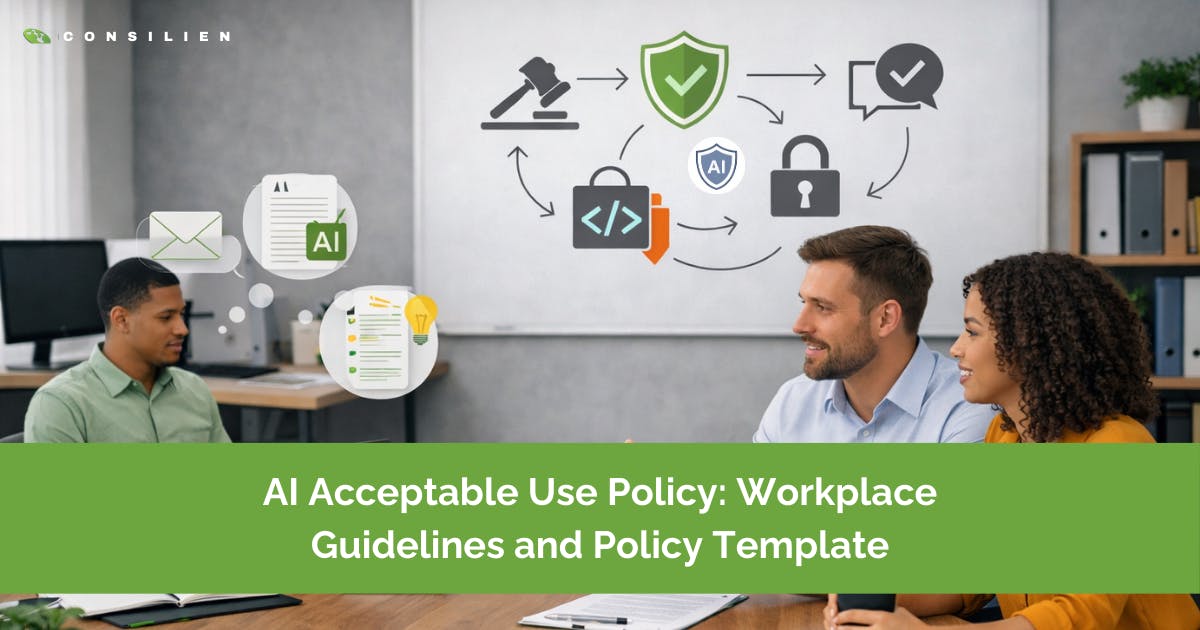
AI is already in your workplace.
Employees are using it to write emails, summarize documents, brainstorm ideas, and move faster. Some of that use is helpful. Some of it is risky. Most of it is happening without clear rules.
That’s the problem an AI acceptable use policy is meant to solve.
Not by banning AI.
Not by slowing people down.
But by setting clear expectations so AI helps the business instead of creating risk.
What Is an AI Acceptable Use Policy?
An AI acceptable use policy explains how employees are allowed to use AI tools at work and where the lines are.
It answers questions like:
- Which AI tools are approved
- What data can and cannot be shared
- When human review is required
- What uses are off-limits
At its core, this policy is about risk control, not control over people.
Why Every Business Needs One Now
Industry research from McKinsey and Microsoft shows that AI adoption in the workplace is accelerating faster than governance and policy development. Employees are using AI tools before many organizations have clear rules, training, or oversight in place.
That gap is where most AI-related risk comes from.
AI tools are easy to access and easy to misuse. Most employees don’t see themselves as taking risks. They’re just trying to be efficient. But without guidance, small choices can turn into big problems.
Here’s what leaders end up owning when there’s no policy.
Data exposure
Employees paste information into public AI tools without realizing:
- That data may be stored
- It may be reviewed
- It may be used to train models
If you wouldn’t post it on a public website, it doesn’t belong in a public AI tool.
Confident but wrong answers
AI can sound polished and authoritative while being completely wrong:
- Outdated information
- Made-up citations
- Incorrect assumptions
Without human review, errors spread fast.
Legal and compliance risk
AI can affect:
- Privacy obligations
- Employment decisions
- Intellectual property rights
These issues rarely show up immediately. They show up later, when the damage is harder to undo.
Reputational harm
Customers don’t care whether a mistake came from a person or a tool. They only see the result.
AI Use Policy vs AI Acceptable Use Policy
You’ll see both terms used online. They’re closely related.
In practice:
- An AI use policy explains how AI is used in the business
- An AI acceptable use policy focuses on what is allowed and what is not
Many organizations use the terms interchangeably. What matters is clarity, not the label.
The One Rule Employees Should Remember
If your policy only sticks one thing in people’s heads, make it this:
- If you wouldn’t paste it into a public website, don’t paste it into a public AI tool.
- If you wouldn’t send it to a customer without review, don’t use it just because AI wrote it.
That single rule prevents most AI-related problems.
What Employees Can and Cannot Do With AI
Clear examples matter more than long explanations.
Allowed uses
Employees may use approved AI tools for:
- Drafting internal emails with no sensitive data
- Summarizing non-confidential notes or documents
- Brainstorming ideas, outlines, or options
- Rewriting or polishing public-facing content before review
Not allowed without approval
These uses require explicit approval:
- Legal or financial advice
- Integrations with internal systems
- Automated decision-making
- Use with sensitive or regulated data
Never allowed
These uses should be prohibited outright:
- Using AI to make or influence employment decisions
(hiring, promotion, discipline, termination) - Uploading confidential or proprietary information into public tools
- Uploading personal data about employees, customers, or partners
- Circumventing security controls with AI tools
Many organizations restrict AI use in employment decisions due to legal and bias risks, as reflected in guidance from employment law firms.
Data Rules That People Can Actually Follow
Vague language creates confusion. Clear rules reduce mistakes.
Universities and large organizations, including Harvard and the University of Texas at Austin, use similar data classification approaches to limit what information can be entered into public AI tools.
Simple data categories
Most businesses can keep this simple:
- Public data – already public or approved for public release
- Internal data – business information not meant for the public
- Confidential or regulated data – personal data, financials, IP, contracts
What must never go into public AI tools
- Passwords or credentials
- Customer or employee personal data
- Financial data not publicly released
- Contracts or legal documents
- Trade secrets or proprietary material
When sensitive data may be allowed
Only if all of these are true:
- The AI tool is company-managed
- A contract protects your data
- Data is not used for training
- Access is restricted
- Usage is logged and monitored
Accuracy and Human Oversight
AI is a tool, not a source of truth.
Employees are responsible for:
- Reviewing AI output
- Verifying facts
- Correcting errors
High-risk outputs should always get a second set of eyes, especially when they affect:
- Customers
- Money
- Access
- Policy
- Compliance
Ethics and Fairness Without the Corporate Theater
This doesn’t need to be philosophical.
Bias and discrimination
AI should not be used to:
- Screen candidates
- Score employees
- Recommend disciplinary actions
Unless it has been formally reviewed and approved, keep AI out of employment decisions.
Transparency
Employees should know:
- When AI assistance is acceptable
- When disclosure is required
- When human authorship is expected
Clear expectations around transparency and responsible use mirror guidance published by AI developers focused on responsible AI adoption.
Tool Approval and Procurement
Most problems start with “someone just signed up for it.”
Approved tools list
Maintain a simple list:
- Approved AI tools
- Prohibited tools
- Who can approve exceptions
Minimum requirements for approval
Approved AI tools should support:
- Clear data usage terms
- No training on your data without consent
- Admin controls
- Access management
- Audit logs
- Reasonable data retention settings
Audits and Monitoring
You don’t need to spy on people. You do need visibility.
Focus on:
- Which tools are being used
- What types of data are being entered
- High-risk use cases
- Vendor settings and changes
Review cadence:
- High-risk tools: quarterly
- All others: annually
- Anytime a tool or vendor changes
HR and compliance guidance increasingly includes AI audits and monitoring as a core policy requirement.
Policy Ownership, Training, and Rollout
Policies fail when no one owns them.
Ownership
- IT or Security manages tools and controls
- HR manages conduct and discipline
- Legal supports regulated areas
- Leaders enforce expectations
Training that works
Keep it practical:
- Short training sessions
- Real examples
- Clear do’s and don’ts
- Annual refreshers
- New-hire onboarding
Violations and Enforcement
Spell this out. Ambiguity causes problems.
Include:
- How issues are reported
- What happens on first violation
- When issues escalate
- Who investigates
Consistency matters more than severity.
AI Acceptable Use Policy Template
Use this as a starting point. Keep the language plain.
Sections to include:
- Purpose
- Scope
- Definitions
- Approved and prohibited tools
- Allowed uses
- Prohibited uses
- Data handling rules
- Accuracy and review requirements
- Employment-related restrictions
- Transparency expectations
- Tool approval process
- Monitoring and audits
- Training
- Enforcement
- Acknowledgment
This should be easy to adapt, not something that requires a lawyer to translate.
AI Acceptable Use Policy Checklist
Use this to validate what you already have.
- Policy applies to employees and contractors
- Approved tools list exists
- Data rules are specific
- Confidential data rules are explicit
- Human review is required
- Employment decisions are restricted
- Tool approval process exists
- Vendor requirements are defined
- Audit cadence is defined
- Training is required
- Enforcement is documented
If you can check every box, you’re in good shape.
Final Thoughts
AI is becoming part of everyday work. Ignoring that reality doesn’t reduce risk. It increases it.
A clear AI acceptable use policy:
- Protects your data
- Sets expectations
- Reduces legal and security exposure
- Helps employees use AI responsibly
Done right, it doesn’t block innovation.
It makes innovation safer.
Legal Disclaimer
This article and the included AI acceptable use policy template are provided for general informational purposes only. They do not constitute legal advice. Every organization’s legal, regulatory, and contractual obligations are different. You should consult qualified legal counsel before adopting or enforcing any workplace policy.
What is an AI acceptable use policy?
An AI acceptable use policy defines how employees are allowed to use AI tools at work and where the boundaries are. It covers approved tools, data restrictions, required human review, and prohibited uses. The goal is to reduce risk while still allowing employees to benefit from AI.